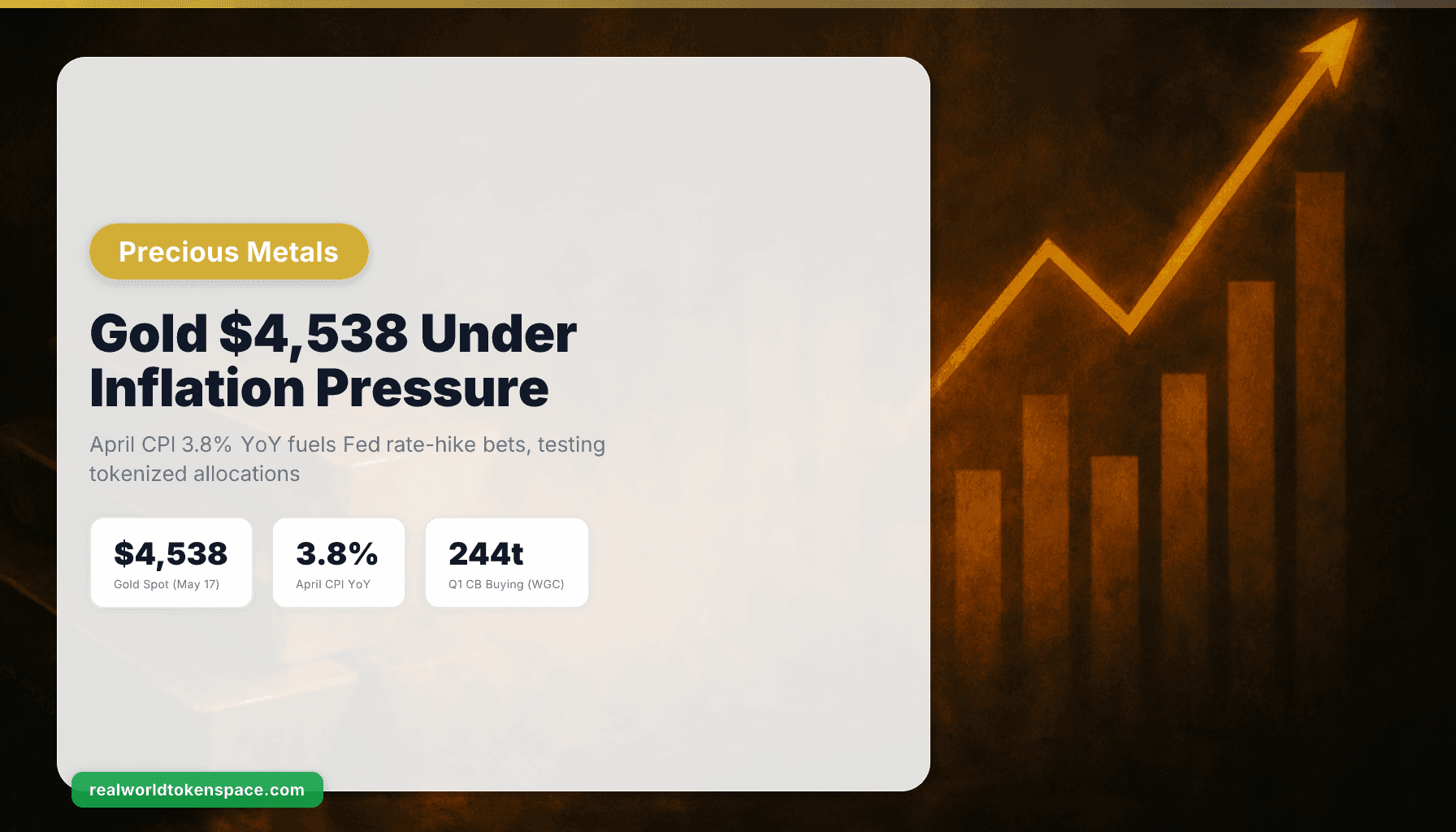
Gold spot settled at $4,538 per ounce on May 17, 2026, down 2.4% on the session as hotter-than-expected April inflation data triggered a sharp repricing of Federal Reserve rate-hike probabilities. The move marks the metal's steepest single-day decline since early March, erasing gains accumulated through the first half of May and testing the $4,530-$4,550 consolidation zone that has anchored the market since mid-April.
Gold slid to $4,530 an ounce on Friday and was on track to fall about 4% for the week, pressured by accelerating US inflation. Data released earlier this week showed US wholesale inflation surged at its fastest pace since 2022 in April, while consumer prices posted their largest increase since 2023. April's Consumer Price Index surged 3.8% year-over-year, exceeding consensus on both a monthly and annual basis, while producer prices posted their steepest single-month spike since early 2022. CME FedWatch now assigns near-zero probability to any 2026 rate cut, with markets pricing a 50% chance of a December rate hike.
The mechanism behind the selloff is straightforward. Higher real rates compress the opportunity cost of holding non-yielding assets. If the Fed holds rates at the 3.50%-3.75% range through year-end or raises them further, Treasury bills yielding 3.7%-4.0% become incrementally more attractive relative to gold, which pays no coupon. Two-year Treasury yields climbed to a 14-month high on May 15, amplifying the headwind.
The Physical Reality: Central Bank Demand Holds Despite Price
Central bank gold demand began 2026 strongly, with estimated net purchases of 244t in Q1. Demand exceeded both the previous quarter and the five-year average, underscoring continued commitment to strengthening reserves with gold. The World Gold Council's Q1 2026 report, published in late April, provides the institutional anchor for today's price move. The National Bank of Poland was once again the largest purchaser, increasing its gold reserves by 31t over the quarter to 582t. Despite recent statements from Governor Adam Glapiński about the possibility of selling some of its gold, the central bank appears to remain focused on reaching its 700t target.
The People's Bank of China increased its gold reserves by 7t in Q1, more than doubling its net purchase in the previous quarter (3t). This lifts the PBoC's total gold reserves to 2,313t (9% of total reserves). China's 16-month consecutive buying streak, though at a slower pace than 2024-2025, confirms that price elasticity for official-sector buyers remains low. Central banks accumulating gold at $5,400 per ounce in January and $4,538 in May are signaling a view that gold's role as a reserve asset is no longer negotiable, regardless of short-term rate dynamics.
The divergence between physical buyer behavior and paper market positioning is widening. Physical bullion dealer networks across the country reported firm premiums and steady accumulation at sub-$4,600 levels, confirming that price-sensitive buyers view the live gold spot price today as a buying opportunity, not a warning signal. Premiums on COMEX delivery, LBMA Good Delivery bars, and retail bullion products have held steady or risen through the May 17 session, a pattern inconsistent with speculative capitulation.
The RWTS Trust Score Angle: Tokenized Gold Under Its First Real Stress Test
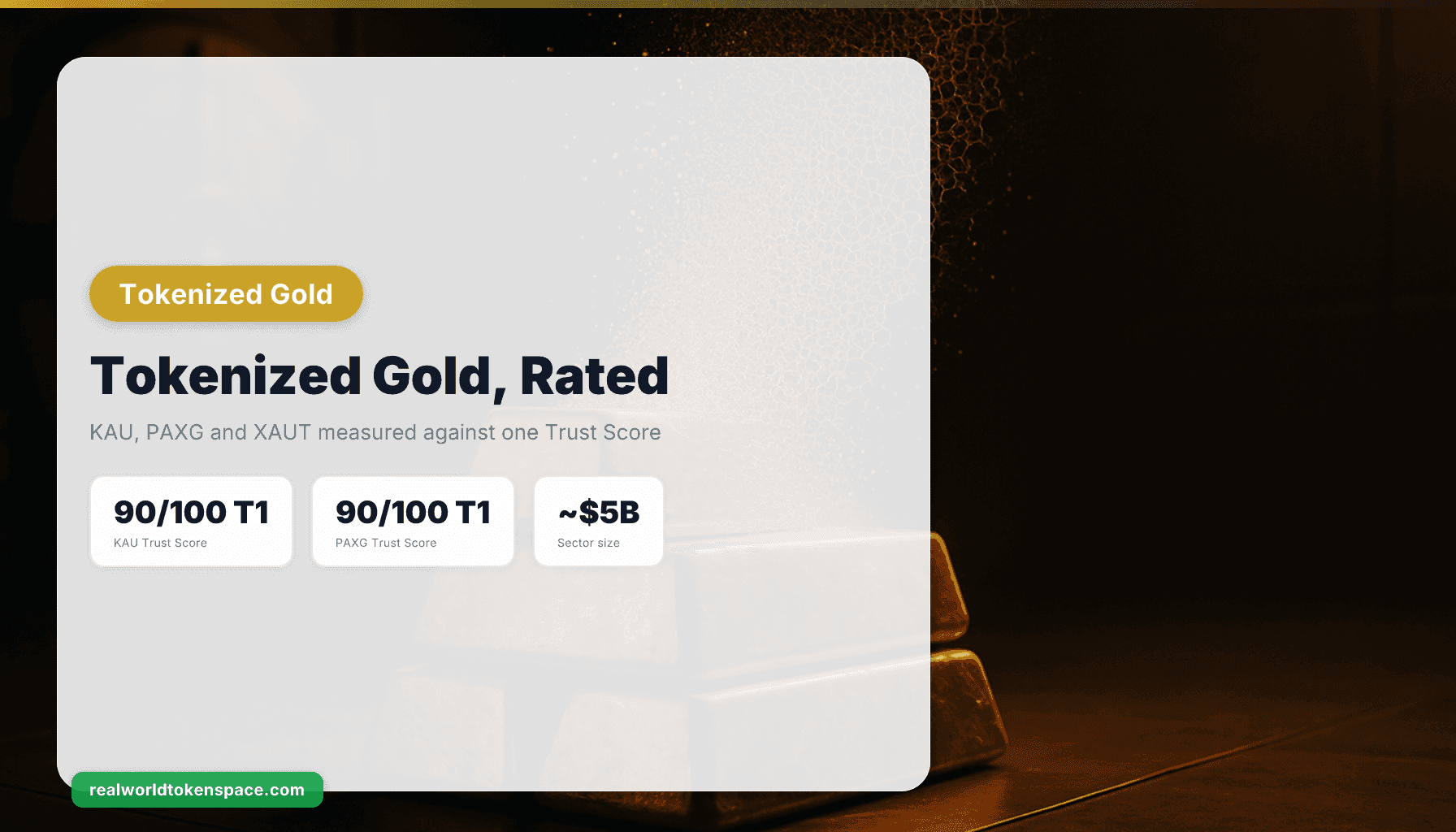
Tokenized gold products are experiencing their first sustained test of the thesis that blockchain-based gold allocations can substitute for physical holdings during a macro repricing event. PAXG (Paxos Gold, Trust Score 9.1, Tier 1) and XAUT (Tether Gold, Trust Score 8.8, Tier 1) have both maintained tight peg discipline through the May 17 drawdown, with on-chain redemption volumes elevated but orderly. PAXG spot prices on Uniswap and Curve held within 0.3% of the LBMA PM Fix throughout the session, confirming that the arbitrage mechanism connecting tokenized allocations to physical vaulted bars remains functional under volatility.
The Trust Score differential matters here. PAXG's 9.1 reflects Paxos's monthly third-party attestations (Withum), New York trust company charter, and daily redemption windows for allocated bars stored in Brink's London vaults. XAUT's 8.8 reflects quarterly attestations and slightly less granular disclosure on vault-level inventory. Both products delivered the core promise: holders who wanted to exit tokenized gold for dollars on May 17 could do so at prices reflecting real-time LBMA spot, not a distressed secondary market discount.
KAU (Kinesis, Trust Score 7.4, Tier 2) saw wider spreads and lower liquidity during the session, a reminder that not all tokenized gold products are created equal. KAU's Trust Score reflects its smaller market cap, narrower liquidity depth, and less frequent third-party audits relative to PAXG and XAUT. For allocators treating tokenized gold as a cash-management sleeve or collateral position, the May 17 session confirmed that Tier 1 products behave like commoditized claims on physical metal, while Tier 2 products carry incrementally more basis risk during volatility spikes.
The Rate-Hike Probability and What It Means for Gold
If the Fed holds above 3.50% through December 2026, gold's base case becomes a range-bound consolidation rather than a breakout. The $4,530-$4,700 range has anchored the market since April, with spot briefly testing $4,850 in early May before retreating. Below $4,500, the next support level sits at $4,350, a zone that coincides with the 200-day moving average and the late-March lows. Above $4,700, resistance clusters around $4,850-$5,000, levels that would require either a sharp Fed dovish pivot or a geopolitical catalyst to clear.
The inflation prints driving today's move are mechanically linked to the prolonged Middle East conflict and the near-shutdown of the Strait of Hormuz. Inflationary pressures have been driven largely by the prolonged Middle East conflict and the near-shutdown of the critical Strait of Hormuz, which has severely disrupted global energy shipments. Brent crude near $85-$92 per barrel and persistent supply-chain friction have kept goods inflation elevated, blunting the disinflationary progress the Fed achieved in late 2024 and early 2025. Energy contributes 30-40% of transport inflation globally, and every $10 rise in crude adds 0.3-0.4% to US CPI. That feedback loop is not yet broken.
The question for gold holders is whether the inflation shock is transitory or structural. If energy prices stabilize and supply chains normalize by Q3 2026, the Fed's median dot-plot forecast of two 25-basis-point cuts before year-end could come back into play, providing a tailwind for gold in the second half. If inflation remains sticky and the Fed pivots to rate hikes, gold's opportunity cost rises further, and the metal faces a sustained headwind until real rates peak.
We Rate, You Decide
RWTS isn't bullish or bearish on gold. We're the credit-rating agency for tokenized real assets. We rate. You decide. Gold at $4,538 on May 17, 2026, is consolidating after a 41.7% twelve-month gain, under pressure from the steepest inflation prints in two years and a Fed that has shifted from cutting to potentially hiking. Central banks bought 244 tonnes in Q1 despite record prices, and physical premiums remain firm. Tokenized gold products with Trust Scores above 9.0 maintained tight pegs and orderly redemptions through the session, confirming that blockchain-based allocations can function as cash-equivalent claims on vaulted metal during volatility.
The rate-hike probability is now above 50% for December 2026. That's the variable. The physical buying is steady. The tokenized infrastructure held. The consolidation range is $4,530-$4,700. Below $4,500, the thesis weakens. Above $4,700, the inflation-hedge narrative reasserts. The LBMA spot price is the referee. The Trust Scores are the scoreboard. The decision is yours.
Disclosure: RWTS Research provides independent analysis of tokenized real-world assets. We do not hold positions in the assets we cover. Trust Scores reflect custody, attestation, liquidity, and regulatory clarity, not investment recommendations. All prices and data as of May 17, 2026, 12:00 UTC unless otherwise noted.
Related research