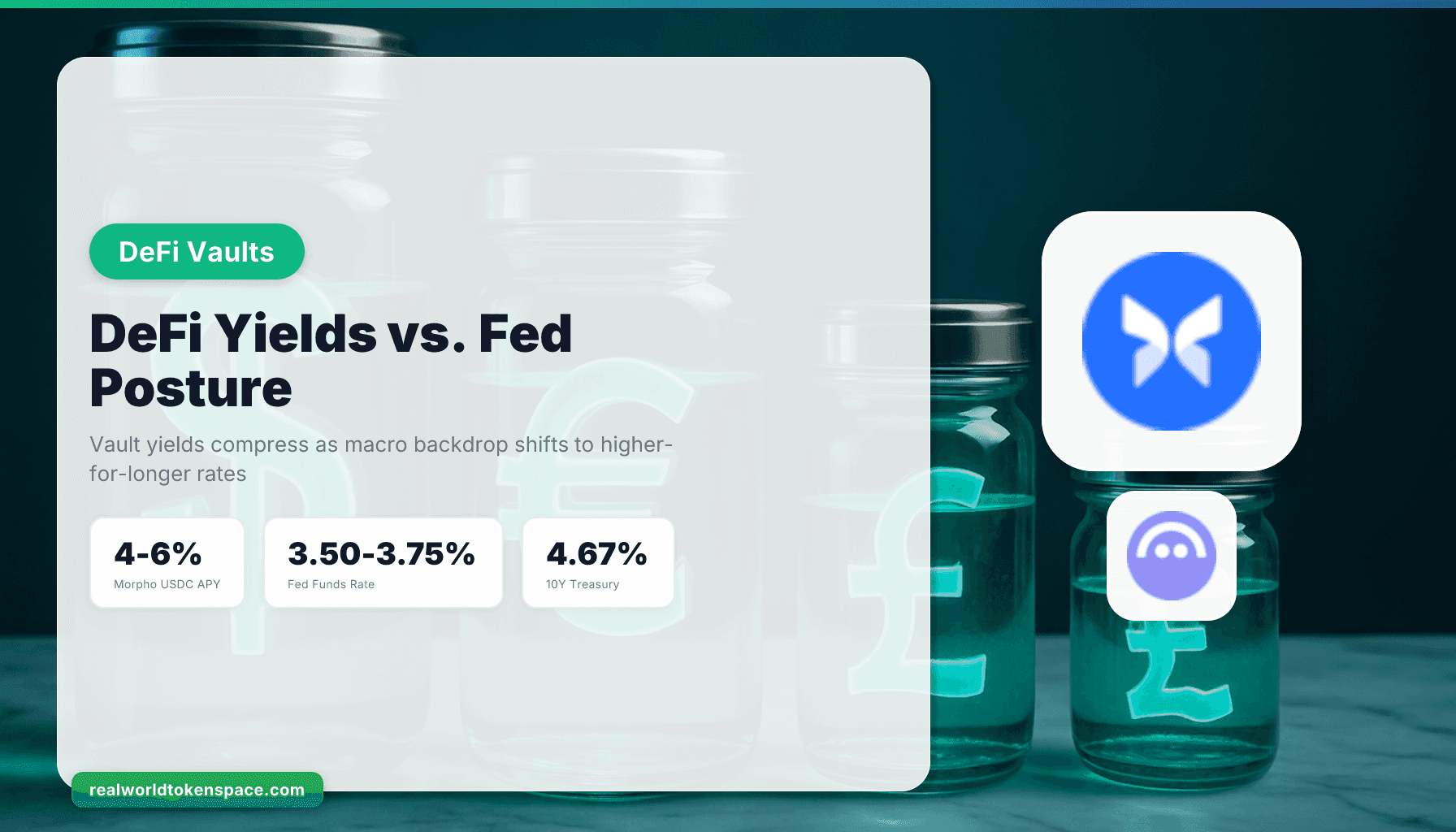
Inflation is elevated, in part reflecting the recent increase in global energy prices. Developments in the Middle East are contributing to a high level of uncertainty about the economic outlook, the Federal Reserve stated in its April 29 policy release. The committee decided to maintain the target range for the federal funds rate at 3.5 to 3.75 percent, marking the third consecutive hold after three consecutive cuts in late 2025.
The macro yield landscape has shifted. The yield on the 10-year note finished May 15, 2026 at 4.59% while the 2-year note ended at 4.09%. That is the highest level for each since February 2025. The curve has steepened, but not because rate-cut expectations rose. It steepened because inflation expectations rose faster.
For allocators parking capital in DeFi vaults, the implication is straightforward: the opportunity cost of on-chain yield has risen. When 10-year Treasuries yield 4.59% with no smart-contract risk, a Morpho USDC vault yielding 5.2% no longer offers the same risk-adjusted spread it did when Treasuries yielded 3.8%.
The DeFi Vault Positioning
Morpho USD Lending vaults currently offer 4-6% APY on USDC, according to May 13 data from vaults.fyi. As of early 2026, Morpho Blue typically offers the highest supply rates for stablecoins (4-8% on USDC) because its peer-to-peer matching and modular vault architecture reduce the spread between supply and borrow rates. Aave V3 generally offers 3-6% on USDC, while Compound III ranges from 3-5%. However, rates fluctuate with utilization, so the highest-yielding protocol can change daily.
The mechanism is simple: DeFi lending yields compress when borrowing demand falls. Morpho sits on top of protocols like Aave and Compound, automatically matching lenders and borrowers peer-to-peer when possible. This reduces spreads and often improves rates for both sides. When Aave has a 3% lending rate and 5% borrowing rate, that 2% spread goes to the protocol. Morpho matches users directly at better rates while falling back to the underlying protocol when no match exists.
The borrowing demand side is where the macro backdrop matters. If the Fed is holding rates higher for longer and inflation remains elevated, leveraged DeFi strategies become more expensive to maintain. Borrowers rotate out. Supply-side yields compress. The marginal borrower disappears.
The Institutional Vault Adoption
Crypto exchange Kraken is rolling out a new DeFi Earn product in Canada, the European Economic Area, and most U.S. states. The product will provide onchain earning opportunities, including APYs of up to 8%. Kraken's DeFi Earn will tap vault infrastructure provider Veda to power the new product. Risk managers Chaos Labs and Sentora will also operate the first three USDC vaults, allocating funds to well-known onchain protocols like Aave, Morpho, Sky, and Tydro.
The Kraken rollout is the institutional validation that vault infrastructure has crossed the chasm. The product wraps curated vault strategies inside a centralized exchange interface, removing wallet friction and gas costs. The underlying mechanics remain the same: capital flows into Morpho or Aave, earns the protocol's native yield, and gets auto-compounded by the vault curator.
Morpho has emerged as a leading platform for institutional vault adoption, positioning itself as a neutral infrastructure layer for permissionless, isolated lending markets managed by curators. As of January 2026, Morpho vaults are attracting the majority of net new deposits in the vault sector. Morpho's architecture allows curators to define specific lending markets with precise risk parameters, creating isolated exposure that prevents contagion between different strategies.
The isolation matters. When a single collateral type crashes in a pooled lending market, bad debt can contaminate all lenders in the pool. Morpho Blue's 650 lines of immutable Solidity eliminates that contagion risk by separating each market: one loan asset, one collateral asset, one oracle, one LTV. If a market blows up, it blows up alone.
The Yield Competition
The allocator decision now sits at the intersection of three products: DeFi vaults (4-6% on Morpho), tokenized Treasuries (4.8% on USYC), and traditional money market funds (sub-4% depending on structure). All three offer dollar-denominated yield. The difference is custody, redemption speed, and regulatory wrapper.
Conservative RWA-backed vaults may offer 5-15% APY from real-world yields. Aggressive leveraged strategies might achieve 20-40% APY but with substantially higher risk. The conservative end of that range now overlaps with tokenized Treasury yields. The aggressive end requires accepting leverage, liquidation risk, and smart-contract exposure that most institutional allocators cannot stomach.
Morpho's curated vault system holds roughly $5.8 billion in total value locked. Kamino manages $2.36 billion on Solana. Pendle's yield tokenization protocol sits at $3.5 billion across 11 chains. The classic yield aggregator category (Yearn, Beefy, and others) totals around $1.6 billion combined. Capital has spoken. The curated vault model won.
The Fed Posture and Yield Compression
An unusually divided Federal Reserve on Wednesday held its key interest rate steady as policymakers grappled with the policy impact of persistent inflation. The meeting saw a dramatic turn amid a groundswell of officials who opposed messaging that further rate cuts could be ahead. The FOMC was split along 8-4 lines, with officials expressing different reasons for their vote.
The 8-4 split is the clearest signal yet that the committee is not unified on the path forward. At issue for the trio was this sentence: "In considering the extent and timing of additional adjustments to the target range for the federal funds rate, the Committee will carefully assess incoming data, the evolving outlook, and the balance of risks." The phrasing indicates the likelihood that the next move would be lower, implied by using the word "additional," which reflects that the most recent rate actions have been to cut. Hammack, Kashkari and Logan, along with several other Fed officials, have warned about the dangers of persistent inflation.
If the next move is a hike rather than a cut, DeFi vault yields will compress further. The mechanism: higher policy rates raise the cost of leverage, reducing borrowing demand. Lower borrowing demand reduces the rates protocols can pay to lenders. The vault curator cannot manufacture yield when the underlying protocol's utilization falls.
Where RWTS Stands
RWTS is not bullish or bearish on DeFi vault yields. We rate the underlying protocol's security posture, the curator's track record, and the transparency of the vault's strategy. Morpho Blue earns a Trust Score of 8.9 (Tier 1) for its minimalist architecture and isolated market design. Aave V3 earns 9.1 (Tier 1) for its multi-year operational history and institutional TVL. Both protocols belong in an institutional DeFi allocation framework.
The yield compression story is mechanical, not narrative. When the Fed holds rates higher for longer, on-chain yields compress because borrowing demand falls. When Treasury yields rise, the opportunity cost of vault exposure increases. The allocator's job is to decide whether the incremental 1-2% yield premium justifies the smart-contract and custody risk.
The answer depends on portfolio construction, not market timing. A treasury team parking $50 million for 90 days may conclude that the vault premium does not justify the operational lift. A DeFi-native fund with in-house custody infrastructure may conclude the opposite. RWTS provides the data. You decide the allocation.
Trust Score Reference:
Morpho Blue: 8.9 / Tier 1 — Immutable architecture, isolated markets, institutional curator adoption
Aave V3: 9.1 / Tier 1 — Multi-year track record, $27.8B TVL, extensive audits
USYC (for comparison): 9.2 / Tier 1 — Tokenized Treasury product, regulated issuer
All scores current as of May 2026. For full methodology, visit https://www.realworldtokenspace.com/trust-scores.
Related research