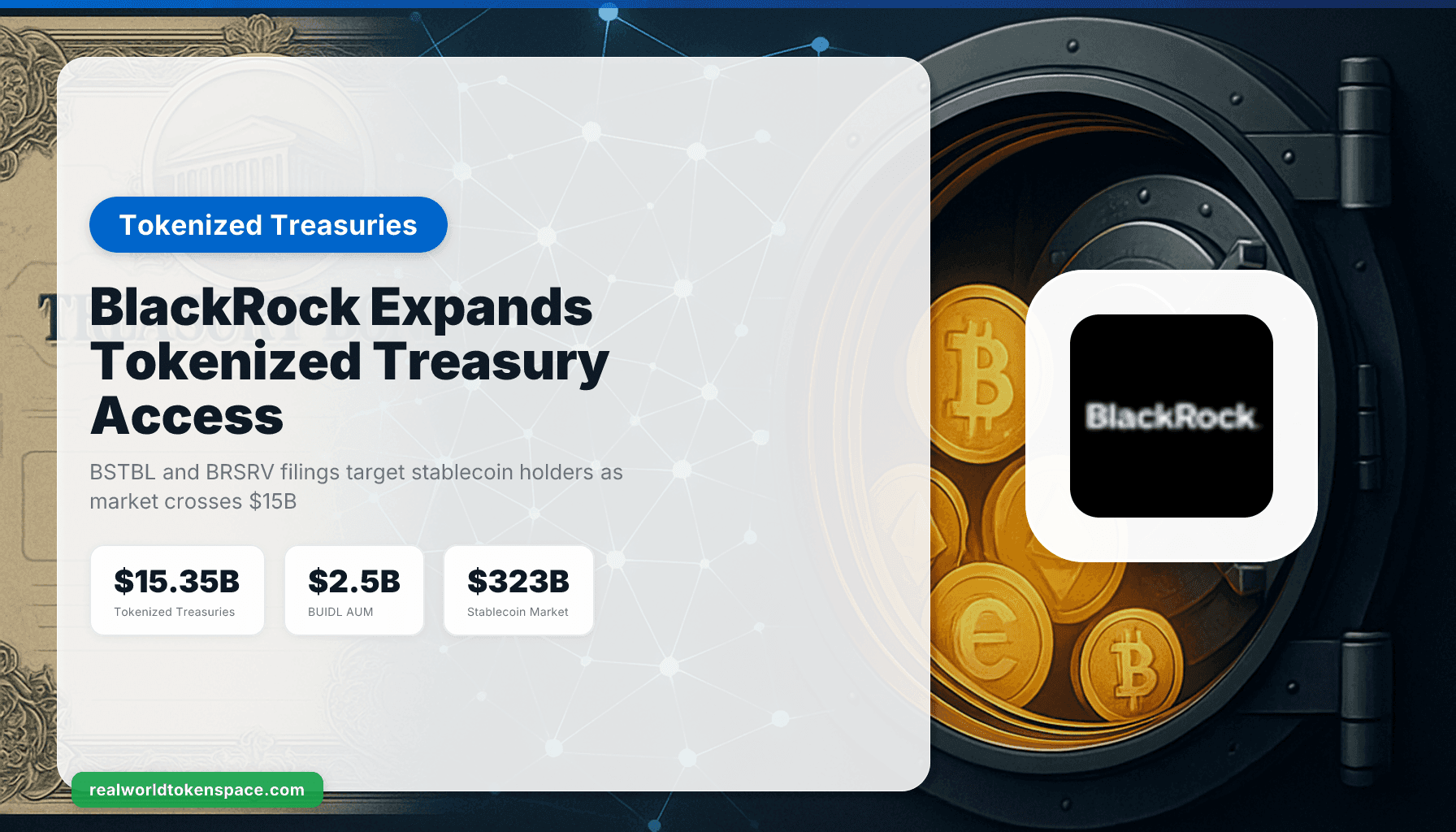
BlackRock filed paperwork with the U.S. Securities and Exchange Commission on May 8, 2026, to launch two tokenized money market funds designed to give stablecoin holders a regulated path to earning Treasury yield without leaving the blockchain. The filings arrive as the tokenized Treasury market crossed $15.35 billion on May 13, up from $15.10 billion in mid-April, and as the GENIUS Act's stablecoin yield ban creates a structural bid for on-chain yield products that comply with securities law.
BlackRock filed with the SEC on May 8, 2026, to launch two tokenized money-market funds: BSTBL on Ethereum and BRSRV across multiple blockchains. Both funds invest in cash and short-term U.S. Treasuries, and they're designed to give stablecoin holders a regulated way to earn yield that idle USDC and USDT can't legally pay them. The move builds on the success of BUIDL, BlackRock's existing tokenized institutional digital liquidity fund, which has grown to approximately $2.5 billion in assets under management since its March 2024 launch and now represents roughly 40% of the total tokenized Treasury market.
The filing strategy is clear. BSTBL will run on Ethereum, targeting institutional allocators and DeFi protocols that need dollar-denominated yield for collateral, treasury management, or stablecoin reserve backing. BRSRV will launch across multiple blockchains, extending reach to retail and crypto-native users who hold stablecoins but lack access to traditional money market funds. The move builds on BlackRock's existing BUIDL fund, now at roughly $2.5 billion in assets, and signals that tokenized real-world assets have crossed $30 billion in 2026.
The GENIUS Act Context: Stablecoin Yield Ban Drives Institutional Rotation
The timing of BlackRock's filings is not coincidental. The GENIUS Act, signed into U.S. law in 2025 and scheduled for full implementation in mid-2026, prohibits stablecoin issuers from paying yield directly on reserves. The CLARITY Act stablecoin yield compromise reached in May 2026 draws a clear line between passive bank-like yield (restricted) and activity-based rewards (permitted), which tokenized Treasury funds navigate cleanly. That regulatory structure creates a bifurcated market: stablecoins like USDC and USDT cannot pay interest, but tokenized Treasury funds like BUIDL, USYC, and the newly proposed BSTBL and BRSRV can.
The result is a structural rotation. Allocators holding idle USDC in exchange wallets, DAO treasuries, or institutional custody accounts now face a choice: earn zero by holding the stablecoin, or rotate into a tokenized Treasury fund that pays 3.7%-5.0% APY while maintaining the liquidity and settlement speed of an on-chain token. The total value locked in tokenized Treasuries has surged to $15.35 billion, topping the mid-April peak of around $15.10 billion, according to rwa.xyz data. This comes as markets price in a higher probability of a Federal Reserve interest-rate hike, a stark shift from expectations for rapid rate cuts baked in earlier this year.
The institutional adoption signal is unambiguous. BlackRock CEO Larry Fink has repeatedly backed tokenization as a way to modernize financial infrastructure. The fund has since grown to roughly $2.5 billion in assets and is increasingly used across crypto markets as collateral for borrowing and leveraged trading. BUIDL is now accepted as collateral on Binance for institutional traders, deployed across eight blockchains, and integrated into DeFi protocols for margin, lending, and perpetual futures positions. The May 8 filings extend that model in two directions: deeper into traditional fund structures with BSTBL, and outward to the crypto-native retail audience with BRSRV.
The $15.35 Billion Milestone and What It Signals
The market capitalization of tokenized US Treasuries on Ethereum has reached approximately $8 billion, a fresh all-time high, according to a Cointelegraph update posted on May 6, 2026. The milestone arrived on a quiet trading session for ETH, which sat at $2,369 and was down 0.16% on the day at the time of the report. The $15.35 billion total across all chains represents incremental growth rather than a speculative surge, but the trend is the part worth marking. Tokenized Treasuries on Ethereum have grown into a multi-billion-dollar collateral layer that now competes with stablecoin reserves, money market funds, and short-duration ETFs as the parking lot for idle on-chain dollars.
Public dashboards have placed the bulk of Ethereum-based tokenized Treasury supply across BlackRock's BUIDL, Ondo's USDY and OUSG, Franklin Templeton's BENJI, and Superstate's USTB, with smaller share for newer entrants. Concentration in BUIDL has been a recurring talking point, since one issuer holding a large share of the category creates a single point of redemption stress if rates or rules shift sharply. The mix matters because each product has different redemption mechanics, transfer restrictions, and counterparty profiles.
The composition of demand reveals the institutional use case. Stablecoin issuers are using tokenized Treasuries to generate yield on the reserves backing USDC and USDT. DeFi protocols are using them as collateral and liquidity backstops. Corporate treasuries from both crypto-native companies and traditional enterprises are allocating capital to these instruments as part of cash management strategies. Stablecoin issuers represent a significant portion of inflows, as they seek to generate yield on the massive reserves backing their tokens. DeFi protocols have also become major participants, using tokenized Treasuries as collateral and liquidity backstops for their smart contract systems. Corporate treasuries from both crypto-native companies and traditional enterprises are increasingly allocating capital to these instruments as part of cash management strategies.
The demand is structural, not speculative. Tokenized Treasuries do not trade on volatility. They track short-dated U.S. government paper, and the on-chain wrapper is mostly a settlement and accounting layer. The yield comes from Treasury bills, and the growth curve tracks demand for dollar-denominated yield from on-chain treasuries, DAOs, market-makers, and stablecoin issuers, rather than retail risk appetite. That decoupling from crypto price action is the key insight. ETH was flat on May 6 when tokenized Treasuries hit $8 billion on Ethereum. Bitcoin stalled near $80,000 on May 13 when the total market crossed $15.35 billion. The RWA sector is growing whether crypto rallies or consolidates.
BSTBL, BRSRV, and the Path to $50 Billion
BlackRock filed for a new tokenized Treasury reserve fund with Securitize. The asset manager also proposed to create onchain shares for a $7 billion money-market fund. The moves add to BlackRock's growing bet on tokenized finance as the sector surpasses $30 billion, tripling in a year. The $7 billion reference is BlackRock's Select Treasury Based Liquidity Fund, a traditional money market fund with nearly $7 billion in AUM. The May 8 filing outlined how BNY Mellon Investment Servicing would maintain official ownership records on Ethereum using ERC-20 token standards, with blockchain records combined with off-chain identity systems serving as the official shareholder registry.
The scale matters. If BlackRock successfully migrates even a fraction of its existing money market fund AUM onto blockchain rails, the tokenized Treasury market could cross $50 billion within 12 months. That would position tokenized Treasuries as a peer to the $320 billion stablecoin market in terms of institutional infrastructure relevance, even if total market cap remains an order of magnitude smaller. The functional use case is identical: both are dollar-denominated, blockchain-native, 24/7 settlement instruments. The regulatory treatment is different: stablecoins cannot pay yield, tokenized Treasuries can.
Tokenized Treasury funds have crossed from crypto experiment to institutional infrastructure in 2026, with more than $7 billion in assets proving that blockchain-based government debt products deliver real economic value to both institutional and retail investors. BlackRock BUIDL leads by AUM and DeFi integration depth, Franklin Templeton BENJI wins on fee efficiency and regulatory clarity, and Ondo USDY tops the yield leaderboard for non-U.S. retail investors seeking maximum return with tax-efficient structure. The competition among issuers is intensifying. BUIDL charges 0.2%-0.5% management fees and targets qualified purchasers. BENJI charges zero fees and targets retail investors. USDY offers the highest yield (5.5%-6.0% gross) but only for non-U.S. investors. BSTBL and BRSRV will slot into this spectrum, with BSTBL targeting institutional depth and BRSRV targeting retail accessibility.
We Rate, You Decide
RWTS isn't bullish or bearish on tokenized Treasuries, BlackRock, or stablecoins. We're the credit-rating agency for tokenized real assets. We rate. You decide. BlackRock filed for BSTBL and BRSRV on May 8, 2026, extending its tokenized Treasury franchise beyond BUIDL and into products designed for the $323 billion stablecoin market. The tokenized Treasury sector crossed $15.35 billion on May 13, growing through a period when Bitcoin stalled and ETH traded flat, confirming that the demand is structural rather than speculative. The GENIUS Act's stablecoin yield ban creates a regulatory moat for tokenized Treasury products, and BlackRock's $2.5 billion BUIDL AUM proves the institutional demand is real.
The filing does not guarantee success. BSTBL and BRSRV will compete with USYC, BENJI, USDY, OUSG, and a dozen other products for allocator attention. The concentration risk in BUIDL (40% of the tokenized Treasury market) creates a single point of failure if redemption stress or regulatory changes hit BlackRock specifically. The stablecoin market is 20x larger than the tokenized Treasury market, and most stablecoin holders are not rotating into yield products yet. But the direction of travel is clear. The infrastructure is scaling. The regulatory clarity is improving. The institutional adoption is accelerating. The BSTBL and BRSRV filings are the next chapter, not the final one.
Disclosure: RWTS Research provides independent analysis of tokenized real-world assets. We do not hold positions in the assets we cover. Trust Scores for BUIDL, USYC, and BENJI reflect custody, attestation, liquidity, and regulatory clarity, not investment recommendations. All data as of May 17, 2026, 12:00 UTC unless otherwise noted.
Related research