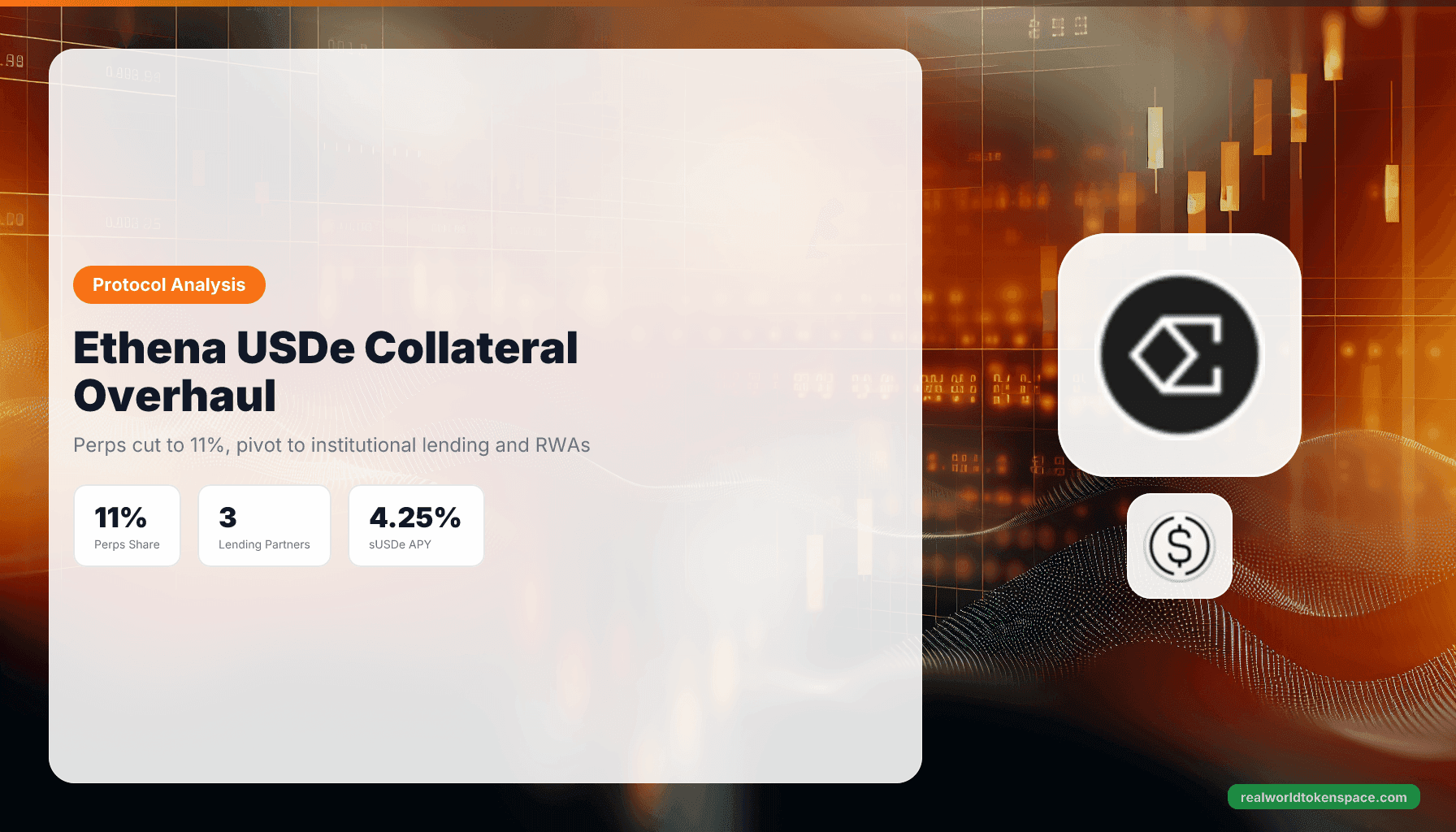
On April 7, Ethena Labs announced the largest reserve-composition change in USDe's history. Perpetual futures positions, once the dominant engine behind the synthetic dollar's yield and stability, now account for just 11% of the collateral backing. The remainder sits in stablecoin reserves and DeFi lending positions, with new institutional lending lines and expanded real-world asset exposure on the way. According to Unchained's reporting, the shift is the most significant reserve strategy revision since USDe's 2024 launch.
The risk to flag upfront is that Ethena is trading one set of dependencies for another. The basis-trade model exposed sUSDe yield to perpetual funding rates: when funding flipped negative for extended periods, the protocol leaned on its reserve fund to smooth distributions. The new model replaces that funding exposure with counterparty and credit exposure to Anchorage Digital, Maple Institutional, Coinbase Asset Management, and a widening basket of private credit and corporate bond holdings. The headline yield may become more stable. The underlying risks become more bank-like, and they require different diligence than the original perps basis trade did.
What Actually Changed in the Reserve Stack
The composition shift is the numerical story. Perps exposure dropped from majority backing to 11%, according to The Defiant. Stablecoin reserves and DeFi lending positions now carry most of the collateral weight, with on-chain lending into Aave and Morpho generating a base yield that is uncorrelated with perpetual funding dynamics. The protocol is also finalizing direct overcollateralized lending agreements with three regulated counterparties:
Anchorage Digital, a federally chartered crypto bank, will originate loans to institutional borrowers against BTC and ETH collateral held in secured triparty custody. Maple Institutional, the regulated arm of Maple Finance, will do the same through its existing credit stack. Coinbase Asset Management rounds out the trio. Per Crypto Economy's coverage, each loan operates within parameters set by Ethena's Risk Committee: minimum overcollateralization ratios, concentration limits, automatic liquidation thresholds, and tenors designed to absorb large USDe redemption events without forced sales.
The RWA expansion is the second leg. Ethena is adding exposure beyond tokenized T-bills to include collateralized loan obligations, investment-grade corporate bond funds, short-duration credit, and structured credit products. BingX's summary frames this as a direct response to the yield compression risk created by a decelerating Fed tightening cycle: if Treasury yields decline and perp funding normalizes, a synthetic dollar needs a third and fourth yield source to defend its headline APY.
Why Ethena Was Forced to Diversify
The macro backdrop matters. Through 2024 and most of 2025, USDe's basis-trade model printed money because perpetual funding on the major crypto pairs ran positive at double-digit annualized rates for sustained stretches. The protocol captured the delta, paid stakers through sUSDe, and scaled USDe supply aggressively. That world is gone. Funding has normalized. Competition for basis yield intensified as more protocols piled into the same trade. sUSDe APY, which once clipped 20%+ during favorable windows, has traded closer to single digits through most of Q1 2026.
Meanwhile, the comparison set shifted. Tokenized Treasury products like BUIDL, USYC, and USDY have paid yields in the 4.3% to 5.2% range with substantially simpler risk profiles. For a detailed comparison of how those products structure their yield and risk, our tokenized Treasury market breakdown remains the cleanest side-by-side. Institutional allocators underwriting synthetic dollars had started asking why they should accept perpetual funding risk for a yield premium that had compressed. Ethena's answer, delivered on April 7, is that the product is no longer a single-source basis trade; it is a diversified stablecoin backed by four distinct yield engines.
For a deeper view of how sUSDe yield compression and the earlier USDtb reserve fund launch positioned the protocol for this pivot, see our February analysis of Ethena's yield mechanics and reserve fund.
What This Means for sUSDe Holders
The practical impact on sUSDe yield depends on how quickly the new collateral mix is deployed and how it performs. In the near term, holders should expect:
Yield stability increases. Perps funding volatility no longer dominates the distribution math. Base yield from Aave and Morpho lending plus tokenized Treasury exposure creates a floor that did not exist before.
Peak yield decreases. When funding spikes during bullish derivative regimes, the reserve fund will still benefit, but the perps engine is now one contributor among four rather than the dominant one. Allocators who bought sUSDe to harvest 15%+ APY during funding windows need to reset that expectation.
Risk vector changes character. The new counterparties, Anchorage, Maple Institutional, and Coinbase Asset Management, are high-quality credit counterparties, but they are credit counterparties. If any of them faces a lending-book problem, Ethena's reserve experiences it. This is materially different from the pure market-neutral basis trade the protocol started with. For investors who previously modeled sUSDe as a market-risk product, the new profile is closer to a diversified yield fund that happens to tokenize its share class.
The ENA Fee Switch and What Comes Next
Running alongside the reserve overhaul is the fee switch. Per Ethena's governance forum, the Risk Committee has signed off on parameters that would route a portion of protocol revenue to sENA stakers. Implementation is awaiting a final ENA governance vote. If activated with the current collateral mix, the fee switch would distribute revenue derived from four structurally different sources, a meaningfully more durable cash-flow profile than the original single-engine model could have supported.
The competitive read here is that Ethena is repositioning from a crypto-native basis-trade product toward something that looks more like an onchain money-market fund with a synthetic dollar wrapper. That is the same product space Ondo, Circle, and Franklin Templeton are contesting with tokenized Treasury vehicles. Ethena's differentiation is the ability to include yield sources those issuers cannot touch, such as DeFi lending yield and basis-trade residuals, while still offering the regulated lending-book exposure institutional allocators want. Whether the market rewards this hybrid or treats it as too complex relative to pure tokenized Treasuries is the question the next two quarters will answer.
For risk-tiered alternatives to sUSDe across the yield stack, the RWTS asset directory catalogs options from tokenized Treasuries through tokenized credit.
Conclusion
The April 7 overhaul is the clearest signal yet that the synthetic dollar category is consolidating around diversified, institutional-grade reserves rather than single-strategy yield engines. Ethena's pivot to Anchorage, Maple, Coinbase, and an expanded RWA book acknowledges that basis-trade economics alone cannot defend the product against tokenized Treasury competition in a normalizing funding environment. Holders of sUSDe should recalibrate their models accordingly: expect steadier yield, lower peaks, and a risk profile that rewards credit diligence more than perps-market intuition.
Subscribe to The Yield Report for weekly yield intelligence.
This is not financial advice. Always do your own research before making investment decisions.
Stay Ahead of the Yield Curve
Subscribe to The Yield Report for weekly yield intelligence.
Subscribe Now