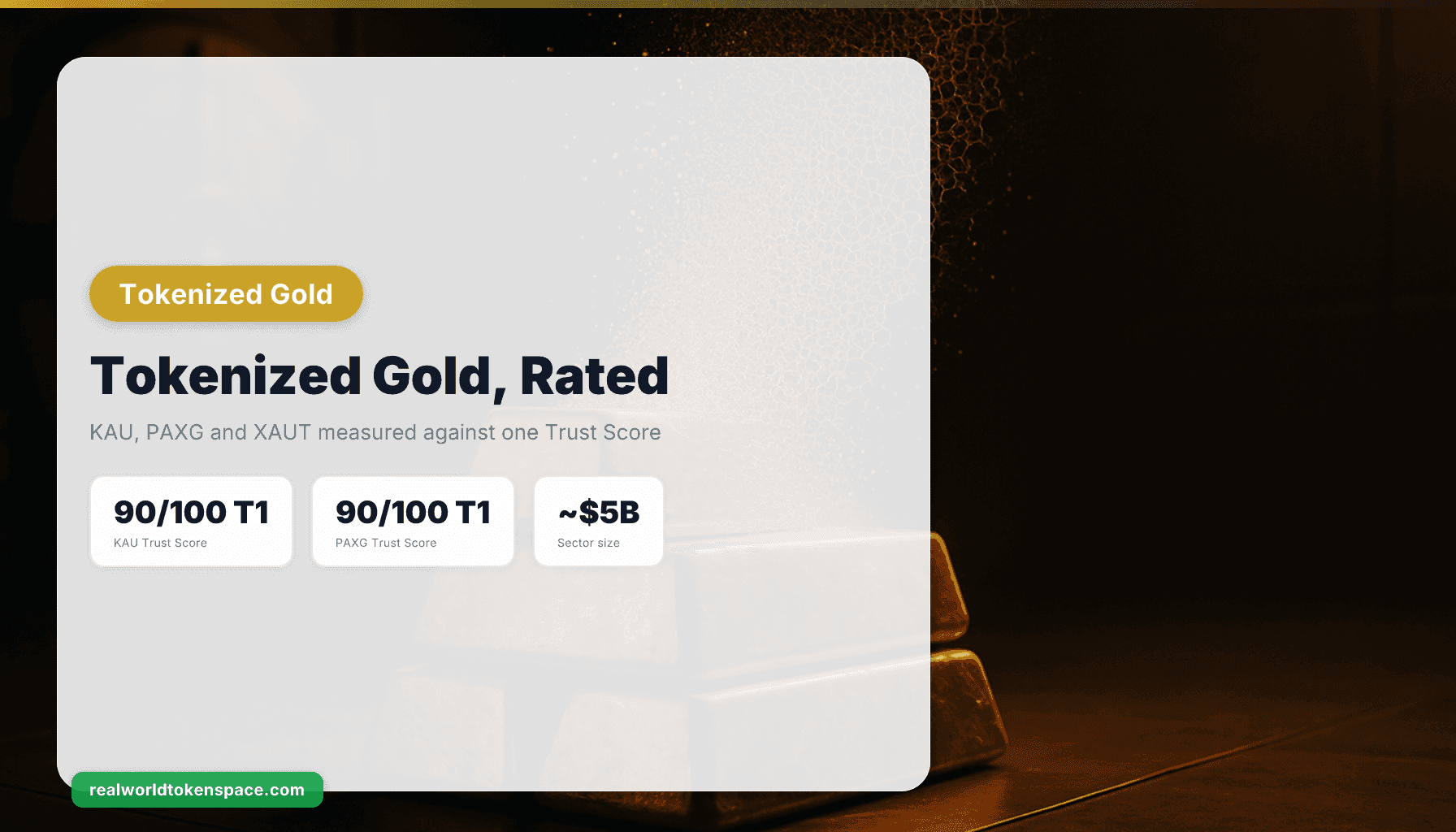
Tokenized gold crossed a line last week that it had circled for more than a year. The segment's combined market capitalization now sits above $6 billion, with Tether Gold (XAUT) and PAX Gold (PAXG) holding roughly 95% of on-chain supply, according to BingX's February recap. Since then, two distribution events have reshaped the competitive picture for the rest of 2026: Kinesis listed KAU and KAG on Mercado Bitcoin on April 16, opening a BRL on-ramp into Latin America's largest exchange by volume, and Aave governance is now on track for a May vote that would make PAXG a first-class collateral type on the largest DeFi lending venue.
The risk to state upfront is that tokenized gold is now carrying two very different narratives at the same time. One is a safe-haven narrative driven by gold's run to $5,300 per ounce and the geopolitical shocks that have punctuated Q1 2026. The other is a DeFi integration narrative, where gold becomes a yield-eligible collateral asset inside lending books built primarily around Treasuries, stablecoins, and ETH. These two stories pull capital toward the same tokens, but the users behind each flow are very different, and the product risk they are underwriting is not the same.
The Numbers Behind the $6B Milestone
Gold itself is the primary driver. Spot prices pushed above $5,300 per ounce in mid-April after U.S. and Israeli strikes on Iran triggered a broader flight to safety, as covered in BlockHead's tokenization recap. Tokenized wrappers captured a meaningful share of that move in percentage terms because they carry weekend and overnight pricing that London and New York pits do not. Per KuCoin's risk-off analysis, PAXG and XAUT decoupled from the broader crypto sell-off on January 21 and have tended to decouple again each time fiat-market catalysts have hit outside trading hours.
Supply followed price. PAX Gold took in roughly $248 million of net inflows in January alone, pushing market cap above $2.2 billion and outstanding supply past 500,000 tokens, which corresponds to more than 15 metric tons of physical gold held in custody. Tether Gold scaled faster on the supply side. Tether has accumulated an estimated 140 metric tons of bullion backing USDT and XAUT, a position that effectively makes the issuer a sovereign-scale buyer of physical gold. CoinGecko's tokenized gold primer frames the weekend price-discovery role these tokens now play: when fiat markets are closed, tokenized gold becomes the only continuously priced reference for physical bullion.
Volume has followed the same trajectory. CoinMarketCap's review of on-chain metals trading places 2025 tokenized gold volume at roughly $178 billion, with the large majority concentrated in the two incumbent tokens. The segment is not a marketing exercise at this point. It is a meaningful slice of the total spot gold market that now clears on-chain and benefits from 24/7 liquidity.
Kinesis Takes a Different Shape Into Latin America
The Kinesis listing on Mercado Bitcoin is a different kind of milestone. Per Kinesis's announcement, KAU and KAG now trade with direct BRL pairs against Brazil's largest digital asset platform, removing the USD bridge that had previously cost Latin American users conversion spreads on every entry and exit. The listing is paired with a forthcoming Kinesis Virtual Card rollout across the region, which is the piece of the product that separates Kinesis from the PAXG and XAUT model.
PAXG and XAUT are primarily investment wrappers. Users hold them to get gold exposure in a crypto-native form and to collateralize positions in DeFi. Kinesis is building a monetary system: KAU is denominated per gram rather than per ounce, holders earn a yield sourced from 15% of platform transaction fees paid in metal, and the card turns holdings into a spendable balance. That changes the user persona materially. For a saver in a country where the local currency has lost meaningful purchasing power, a gold-denominated balance that settles point-of-sale transactions at retail is a different product than a PAXG position held in a MetaMask wallet for eventual redemption.
The competitive read is that the tokenized gold segment is bifurcating. XAUT and PAXG are winning the treasury and DeFi collateral market. Kinesis is positioning for consumer and diaspora flows in emerging markets, where the value proposition is inflation protection plus spendability rather than on-chain programmability. Both can grow simultaneously because they are not the same product, and the Mercado Bitcoin listing is the clearest signal yet that Kinesis is choosing that latter market as its primary battlefield for the rest of 2026.
The Aave PAXG Vote Is the DeFi Integration Story
On the DeFi side, the catalyst to watch is Aave. Per governance threads dating back to 2022 and reactivated in early 2026, the DAO has been weighing PAXG as a collateral type for years. What changed in Q1 2026 is that the temperature check cleared and a full risk-parameter proposal is now in the pipeline for a May vote. If it passes with meaningful supply and borrow caps, PAXG becomes the first tokenized commodity on Aave V3 with full collateral support.
The mechanical effect is that holders of tokenized gold can borrow stablecoins against it without selling. For long-term gold allocators, that converts a historically idle position into a source of dollar liquidity that preserves metal exposure. For borrowers, it adds a new collateral type that is structurally uncorrelated with crypto beta, which is precisely the profile that Aave's risk committee has been trying to add to the book since last year's cycle of ETH-collateralized looping concentration. For a view of how Aave's collateral mix has been stress-tested recently, see our coverage of the KelpDAO rsETH exploit and the structural risk it exposed in liquid restaking collateral.
Compound and several mid-tier lending venues already accept PAXG. The Aave listing matters because it is the marginal liquidity venue: if PAXG can be pledged on Aave at competitive LTVs, the on-chain cost of carrying gold falls meaningfully for anyone who also wants to run dollar-denominated strategies. That is the single largest mechanical boost to tokenized gold utility the segment has seen since launch.
What This Means for Allocators
Three takeaways for yield-focused allocators.
The first is that tokenized gold is no longer a niche. A $6B segment with more than $178B of annualized volume, two incumbents splitting 95% share, and pending first-class lending-venue support puts the category on the same footing as tokenized Treasuries in terms of plausible addressable market, even if yields differ substantially.
The second is that the yield profile matters. PAXG and XAUT do not pay a holder yield. They track spot gold net of small storage and transaction fees. Kinesis pays a fee-share yield to holders and stackers. Tokenized Treasury products pay Treasury yield net of issuer spread. An allocator choosing among these is not picking between gold and Treasuries, they are picking among three different yield engines layered on top of three different underlying claims. Our tokenized Treasury market breakdown lays out the Treasury side of that comparison.
The third is that the DeFi integration thesis has a timeline. The Aave PAXG vote is the single cleanest catalyst to watch in May. If it passes, the cost of capital for gold-collateralized dollar loans compresses meaningfully on-chain, and the reference product for that trade is PAXG. XAUT retains the size advantage, but liquidity venue support has historically been the swing factor that decides which tokenized asset accumulates DeFi TVL. For a broader risk-tiered view of the yield stack, the RWTS asset directory remains the cleanest starting point.
Conclusion
Tokenized gold crossed $6B because physical gold ran to $5,300 and because two new distribution channels lined up in April: a Brazilian on-ramp for the Kinesis monetary product, and a DeFi lending venue pushing toward collateral integration of PAXG. The segment is no longer one story. It is a consumer payments story in emerging markets through Kinesis, a safe-haven treasury story through XAUT, and a DeFi collateral story through PAXG, all running on top of the same underlying metal. Allocators should treat those as three separate decisions, not one.
Subscribe to The Yield Report for weekly yield intelligence.
This is not financial advice. Always do your own research before making investment decisions.
Stay Ahead of the Yield Curve
Subscribe to The Yield Report for weekly yield intelligence.
Subscribe Now