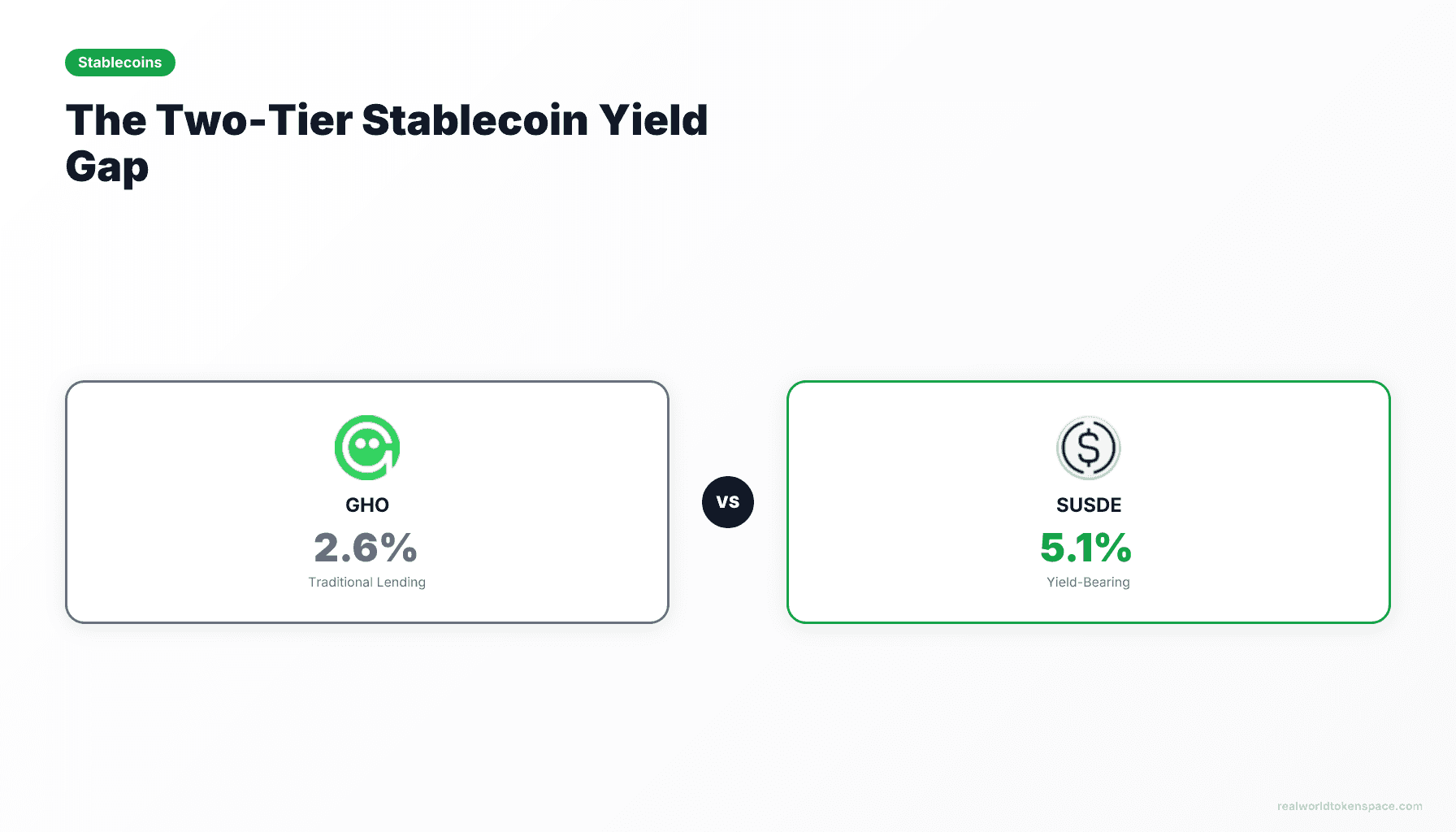
The onchain dollar market has split in two, and the spread is now wide enough that it has become the defining feature of stablecoin yield in April 2026. At one end, plain deposits of USDC and USDT on the largest DeFi lending protocols pay less than a money-market fund. CoinDesk's April 7 piece put the number bluntly: Aave's USDC supply rate is about 2.61%, trailing the 3.14% that Interactive Brokers currently pays on idle customer cash. USDT pools on Aave are lower still, around 1.84%. At the other end, sitting inside the same Aave front end or on Pendle, yield-bearing stablecoins are paying 4 to 6% with TVL still growing into a market that Redstone's 2025 yield report estimated at more than $20 billion in circulation by February 2026.
Both of these rates are correct. They describe two different products with two different risk models, and the gap between them has become structural.
The Low End: Rates Are Just Rates
The reason a plain USDC deposit on Aave pays 2.6% is not complicated. Aave V3 and the V4 Core hub price supply based on utilization, which reflects how much stablecoin is being borrowed against volatile collateral on the protocol. In early 2023, that borrow demand ran hot because crypto prices were running hot and traders wanted leverage. In April 2026, with the Fed holding at 3.50 to 3.75% and the market pricing only two quarter-point cuts later this year per iShares' Fed outlook, it is cheaper and cleaner for most borrowers to run a margin account at a broker than to post ETH and borrow USDC on Aave.
The result is that the marginal borrower on the main V3 pools has disappeared, utilization has fallen, and supply APY has compressed below the risk-free rate. Any deposit sitting on Aave at 2.61% is, arithmetically, worse than T-Bills plus a wrapper fee. That is the signal the market is sending. It is also the signal the protocol is responding to, through Horizon and the V4 Prime hub, by trying to route deposits to institutional RWA borrowers whose demand does not depend on crypto volatility.
The High End: Why Yield-Bearing Stablecoins Pay More
The 4 to 6% band on yield-bearing stablecoins, specifically sGHO, USDG, sUSDe, sUSDS, and USDTB, is not coming from lending demand. Each of these tokens embeds a yield source other than on-protocol borrow interest, which means the rate on the wrapper can sit above the plain-vanilla pool rate without arbitrage closing the gap.
sGHO, Aave's own savings wrapper for GHO, pays about 5.13% per the Aavescan dashboard. The yield comes from GHO borrow interest flowing to the savings module, with the rate set by Aave governance rather than by raw pool utilization. USDG, Paxos's yield-bearing dollar, pays 5.9%. Its yield comes from the reserve composition, which is weighted toward short-duration Treasuries, with a portion of the interest flowing through to holders. Per Stablecoin Insider's 2026 tracker, USDG's market cap grew 169% in the six months to March 2026 as institutional treasuries picked it up as a cash equivalent with a yield pickup versus USDC.
sUSDe, Ethena's staked version of USDe, is paying roughly 3.5 to 4.3% right now after a sharp compression from the 15%+ levels of early 2025 (see our sUSDe yield compression deep dive for the structural read). The yield source is delta-neutral ETH and BTC perpetual funding plus staking rewards on the underlying ETH collateral. When funding rates are high, sUSDe prints more than sGHO. When funding is crushed, as it has been for most of Q1 2026, sUSDe converges toward the risk-free rate. This is not a hidden risk. It is the protocol's disclosed yield driver, and it is why Ethena's TVL has fallen from $11 billion to $3.6 billion over the past six months as capital rotated toward yields less exposed to funding dynamics.
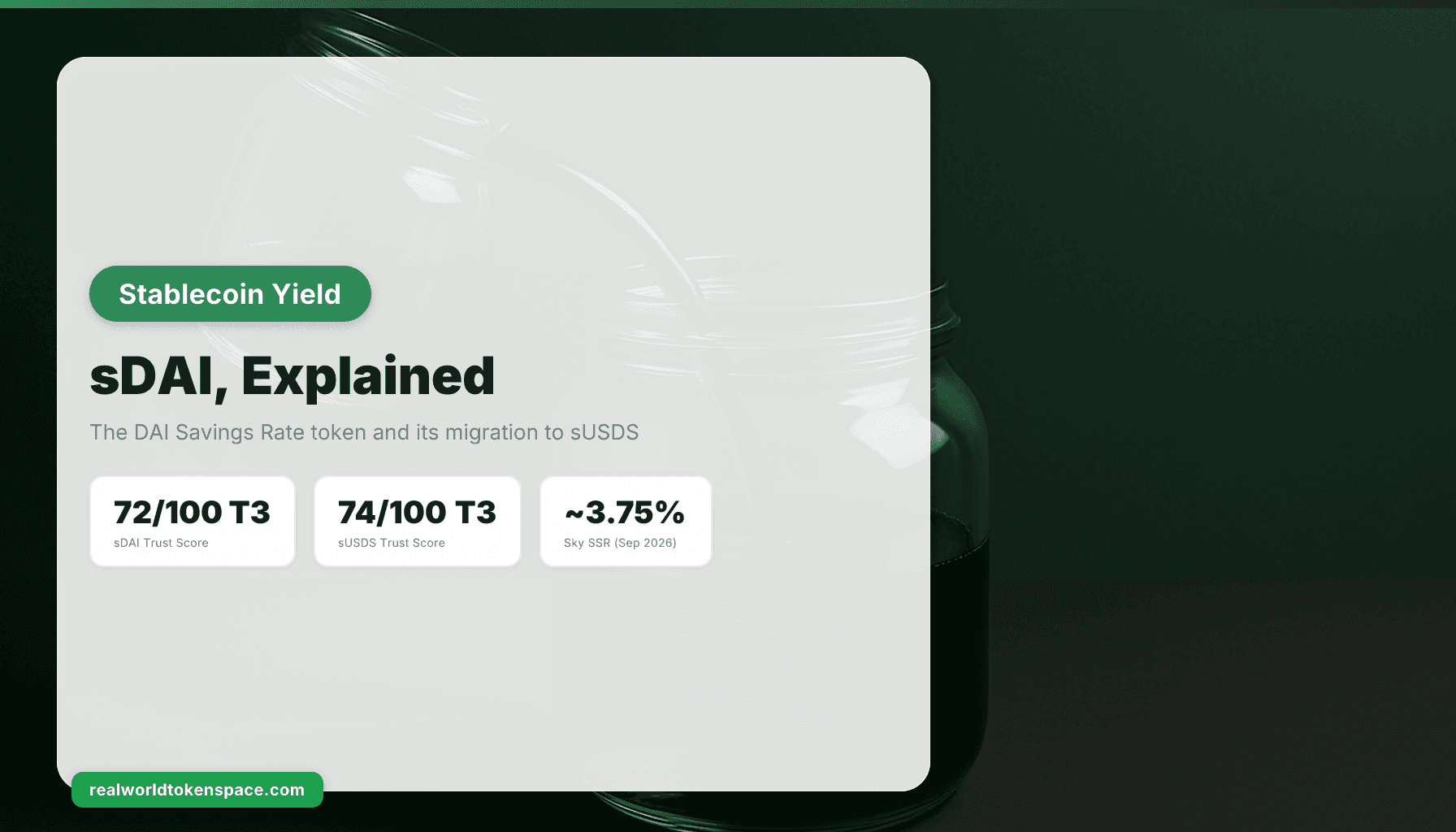
sUSDS, Sky Protocol's savings token, sits at a $4.58 billion market cap and pays roughly 4.25 to 4.5% via the Sky Savings Rate. USDTB pays around 4.0% on Aave directly. RLUSD on Aave is at 4.4%. The common feature across this group is that yield is underwritten by short-duration Treasuries or regulated collateral, not by the borrow curve of a leveraged DeFi protocol.
How the Gap Actually Stays Open
In a frictionless market, a 2.5-point spread between plain USDC and sGHO on the same protocol should close through arbitrage. Three frictions keep it open. First, yield-bearing stablecoins generally cannot be borrowed against inside the same protocol at favorable LTVs, or they carry reserve-factor haircuts that eat most of the spread. Second, the underlying yield is paid in tokens that carry additional risk: custody risk on USDG, depeg and funding-rate risk on sUSDe, smart-contract risk on sGHO and sUSDS. A plain USDC deposit carries essentially none of those beyond Aave's own contract risk. Third, a U.S. retail user cannot always hold sGHO or sUSDe without jurisdictional frictions, so demand for the higher-yielding wrapper is capped by the on-ramp footprint.
The practical consequence is that the two markets clear at different rates. The 2.6% market is for dollars that need to be convertible back into USDC in a single transaction. The 5% market is for dollars that are willing to hold a different token in exchange for an additional 200 to 300 basis points.
Where the Capital Is Moving
BlockEden's March 2026 framing called yield-bearing stablecoins the "core collateral type" of 2026 DeFi, and the on-chain data supports the call. Pendle now holds more than $3 billion of yield-bearing stablecoin TVL, roughly 30% of the segment, per its public dashboards. Aave accepts sUSDe, USDe, sUSDS, and Maple's syrupUSDC as collateral on its main markets. Morpho curators have built vaults that use yield-bearing stablecoins as the underlying deposit asset, layering incentive-driven yield on top of the base carry.
The net effect is a tier structure where sophisticated capital holds yield-bearing stablecoins, possibly wrapped further via Pendle into fixed-yield PT tokens, and uses plain USDC only for transaction layer or rebalance flow. Retail capital still sits disproportionately in plain USDC on Aave at 2.6%, and that gap represents the single largest yield pickup available in the onchain dollar market that does not require leaving the top three lending protocols.
What To Watch Over the Next Quarter
Three variables will determine whether the two-tier market persists or compresses. The first is Fed policy. If the October and December rate cuts priced into CME FedWatch materialize, the Treasury-backed leg of yield-bearing stablecoins, meaning USDG, USDS, and Treasury-backed Horizon collateral, will compress toward 3.5 to 4%. The second is ETH and BTC perpetual funding. If funding recovers to its 2024 levels, sUSDe could print above sGHO again and pull TVL back toward Ethena. The third is Aave Horizon growth. If stablecoin supply into the Prime hub scales as RWA collateral is added, the retail Aave USDC supply rate could catch a bid from institutional borrowers and close part of the gap from below.
For an onchain dollar holder today, the question is simpler than the macro. Leaving capital in plain USDC on Aave at 2.61%, while sGHO pays 5.13% and sUSDe averages around 4.3%, is a choice that has to be justified by liquidity or risk aversion, not by convenience. The two-tier market is real, it is disclosed, and the math on the spread is done in basis points.
This is RWTS research, not financial advice. Stablecoin yields and underlying protocol mechanics change continuously. Check issuer documentation and current on-chain rates before allocating capital. For Trust Score breakdowns of every yield-bearing stablecoin in this article, see the RWTS rating methodology and the live asset directory. Subscribe to The Yield Report for weekly yield intelligence.
Sources
Stay Ahead of the Yield Curve
Subscribe to The Yield Report for weekly yield intelligence.
Subscribe Now