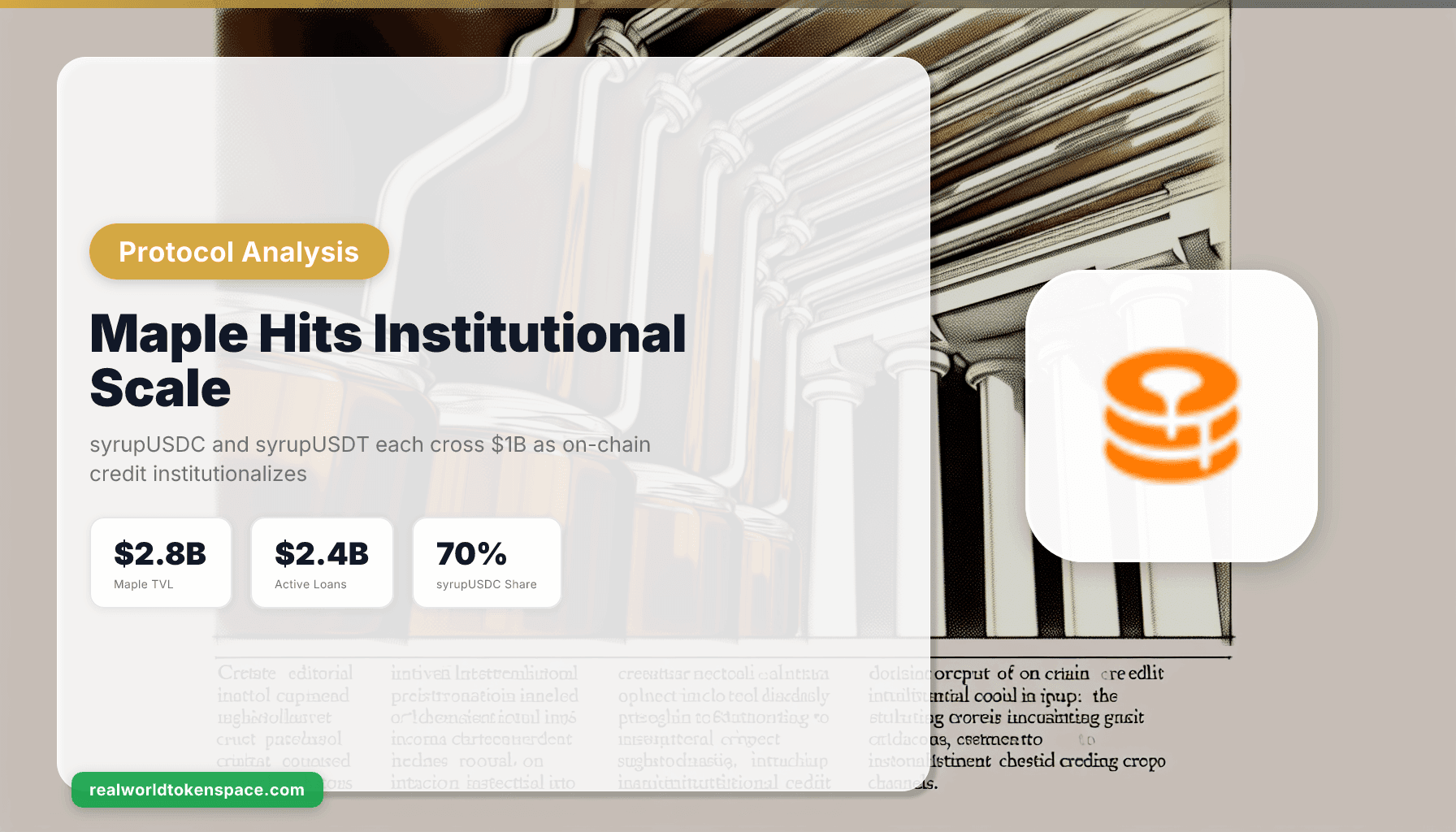
Maple Finance's two flagship yield-bearing stablecoins, syrupUSDC and syrupUSDT, each surpassed $1 billion in deposits in 2026, marking a milestone in the institutionalization of on-chain credit. Per Maple's product update, the pools issued $350 million in loans in a single day around the milestone, a throughput that rivals mid-tier traditional credit funds. Aggregate Maple TVL sits near $2.8B as of January 2026, up roughly 10x from under $300M one year prior, per CoinMarketCap research, with active loans of $2.4B of which approximately 70% are sourced from syrupUSDC.
This piece looks at what Maple has actually built, how the yields stack up against the rest of the on-chain stablecoin yield ladder, what the credit risk picture looks like, and where syrupUSDC and syrupUSDT fit in a 2026 RWA portfolio. None of this is financial advice. Yields and pool parameters change frequently and should be verified on the Maple dashboard before allocating capital.
The Quick Answer
syrupUSDC and syrupUSDT are yield-bearing stablecoin LP tokens that represent a depositor's pro-rata share of an over-collateralized institutional lending pool. Borrowers are vetted institutional counterparties such as market makers, prop trading firms, and basis-trade desks, posting digital-asset collateral against USDC or USDT loans. The yield to a syrup holder comes from the net interest margin Maple captures across active loans, after pool fees and Maple's protocol cut. Posted yields in early 2026 have generally run in the high single digits, materially above tokenized treasuries (4.0%-4.5%) and conservative Morpho vaults (4%-5%) but below leveraged-and-looped strategies. The trade is credit risk for yield premium, with Maple's curation and historical zero-default record on its flagship pools doing the heavy lifting.
What Maple Actually Does
Maple has been on-chain since 2021 and has gone through more than one model iteration. The current product, organized around syrupUSDC and syrupUSDT, is best understood as on-chain institutional private credit with daily-liquid stablecoin entry. A depositor sends USDC into the syrupUSDC pool and receives syrupUSDC back. The token accrues yield in a rebasing or exchange-rate fashion (the price of syrupUSDC against USDC drifts upward as yield accrues) and can be redeemed back to USDC subject to pool liquidity windows.
On the borrower side, every loan is over-collateralized, meaning the institutional borrower posts more than $1 of digital-asset collateral for every $1 of stablecoin debt. Maple's underwriting process screens the counterparty, sets the collateral mix and ratios, and monitors positions through the loan term. The protocol's track record on its institutional pools, with zero realized defaults across the syrup product line as of April 2026, is what justifies the credit-risk premium versus a treasury-backed yield. RWTS Trust Score components for Maple weigh that record alongside the protocol's transparency on borrower disclosures, custody arrangements, and audit cadence.
The composition of borrowers matters more than the headline TVL number. Per OAK Research, Maple's borrower set has consolidated around larger, better-known counterparties through 2024 and 2025. The protocol has moved away from undercollateralized loans (which had been a feature in its earlier model and the source of its 2022 stress) to a current posture where over-collateralization is the standard. That shift is the precondition for the institutional capital that has driven the recent TVL run.
Yield Comparison: Where syrup Sits in the Ladder
For a 2026 stablecoin yield seeker, the practical comparison looks roughly like this on a recent snapshot, all subject to live verification:
Coinbase One USDC rewards, 3.50% APY, low operational risk, custody risk concentrated at Coinbase. Tokenized treasuries (USYC, BUIDL, USDY), 4.00% to 4.50% net, sovereign credit, on-chain settlement. Sky sUSDS at the SSR, around 4.5%, governance-set rate against MakerDAO collateral. sDAI, around 3.75%, anchored to the DSR. sUSDe, variable in the 4% to 8% range depending on funding-rate environment, synthetic dollar exposure. Conservative Morpho USDC vaults, 4% to 5%, on-chain blue-chip collateral. Aggressive Morpho USDC vaults, 6% to 8%, longer-tail collateral and higher utilization. syrupUSDC and syrupUSDT, generally in the high single digits, institutional credit risk against over-collateralized loans.
Maple's product sits in a defensible spot on that ladder. It is meaningfully above the treasury and savings-rate cohort, comparable to or slightly above the most aggressive Morpho vault tier, and well below leveraged or looped strategies that depend on continued funding-rate compensation. The headline number is not what makes the product interesting; what makes it interesting is the source of yield, which is real institutional borrowing demand for stablecoin liquidity, not a token incentive or an internal recursive loop.
Credit Risk: What Could Actually Go Wrong
For an honest read on syrupUSDC and syrupUSDT, the credit-risk picture has to be the centerpiece. Three failure modes deserve attention.
The first is borrower default. Despite over-collateralization, a sufficiently violent collateral price move combined with insufficient liquidation infrastructure could leave a pool with bad debt. Maple's mitigants are conservative collateral ratios on volatile assets, real-time position monitoring, and a track record of healthy liquidations through 2024-2025 stress events. The risk is not zero, but the protocol's history of zero realized defaults on the syrup product line is a meaningful signal.
The second is liquidity mismatch. syrupUSDC and syrupUSDT are daily-liquid (or close to it) on the depositor side, but the underlying loans have term durations measured in weeks or months. A simultaneous redemption surge could test pool liquidity and force discounted secondary-market exits or temporary withdrawal queues. Maple has built buffer mechanisms and withdrawal windows to manage this, but in a stressed market, syrup tokens could trade at a discount to NAV in the secondary market.
The third is governance and concentration risk. As Maple grows, a small number of large institutional borrowers necessarily account for a large share of loans. Concentration in any one borrower, asset class, or strategy creates correlated risk that pool-level diversification cannot fully neutralize. Maple's borrower disclosures, while improved, remain less granular than what an institutional credit fund would publish, and that gap is part of what RWTS Trust Score weighs against the headline yield premium.
The institutional capital that has flowed into Maple in 2025 and 2026 has explicitly been pricing this risk picture. Per Messari, allocators including Bitwise have put institutional dollars into Maple as a deliberate exposure to on-chain credit yield, not as a substitute for treasury-equivalent cash management.
Where syrup Fits in a 2026 Portfolio
For an RWTS reader building a stablecoin yield sleeve in 2026, the honest framing of syrupUSDC and syrupUSDT is as a credit-risk allocation, sized appropriately. A reasonable allocation framework treats tokenized treasuries and high-grade savings-rate stablecoins (USYC, BUIDL, sUSDS, sDAI) as the core holding, with conservative Morpho vaults and Coinbase USDC rewards as the bridge to mid-yield, and syrupUSDC, syrupUSDT, and the most aggressive Morpho vaults as the credit-risk satellite layer.
Sizing is the variable that matters most. A 5% to 15% allocation to syrupUSDC inside a stablecoin sleeve adds 30 to 80 basis points of blended yield against a treasury-only baseline, while keeping correlated tail-risk modest. A 50% allocation puts the sleeve into a fundamentally different risk class, where any institutional credit event in the broader DeFi market would be felt at the portfolio level.
The bull case for Maple over the rest of 2026 rests on the institutional credit thesis playing out: more allocators, more disclosure, larger pools, lower spreads to the risk-free rate as the product matures, and continued zero-default execution. The bear case is concentration: as TVL grows past current levels, finding enough credit-quality borrowers to absorb new capital at current yields becomes harder. Maple has stated a public goal of $100M in annual recurring revenue by year-end 2026, which implies continued aggressive growth and is the right context for understanding the protocol's strategic posture.
For now, syrupUSDC and syrupUSDT crossing the $1B threshold each is exactly the kind of milestone that signals on-chain credit has become a real, sized, institutional product line. Whether it stays there will depend on execution through the rest of the cycle.
Related research
For the broader stablecoin yield landscape syrup competes inside, see the 2026 stablecoin yield comparison and the best USDC yield 2026 ranking. For Maple's earlier Aave-Base integration context, see the original syrupUSDC institutional credit piece. The full RWTS Trust Score methodology is on the RWTS Rating page.
This article is for informational purposes only and does not constitute financial advice. Verify all yield numbers, protocol metrics, and pool parameters on official dashboards before allocating capital.