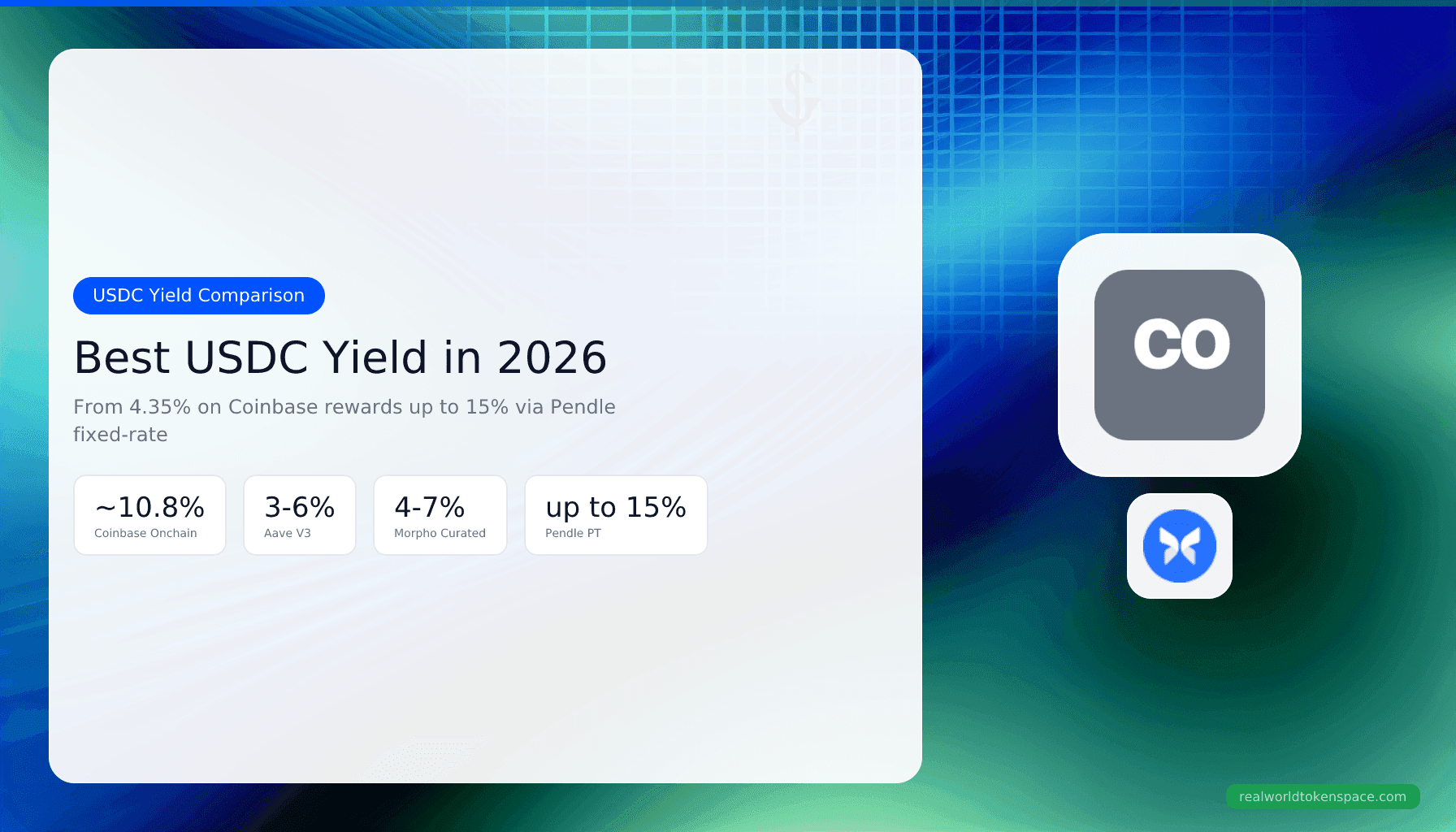
For institutional or sophisticated users, the answer is more nuanced. A Pendle PT position on a USDC-denominated yield asset can lock in 11-15% fixed yield to a near-dated maturity, but requires understanding of yield tokenization mechanics. Splitting USDC across Aave V3, Morpho, and a tokenized Treasury wrapper like USYC (RWTS Trust Score: 81/100, Tier 2) is the standard institutional yield allocation. Each tier sits on a different point of the risk curve, so the right answer depends on what the capital is for.
The full ranking, sorted by net yield as of April 26, 2026, looks like this:
| Rank |
Product |
Venue |
Net APY |
Liquidity |
RWTS Trust Score Context |
| 1 |
Pendle PT (apxUSD) |
DeFi: Pendle |
up to 15.0% |
Locked to maturity |
Underlying scored separately |
| 2 |
Coinbase Onchain (Morpho) |
CeFi/DeFi hybrid |
~10.8% |
Same-day |
Morpho vault: curated |
| 3 |
Coinbase Onchain (organic only) |
CeFi/DeFi hybrid |
~5.8% |
Same-day |
Morpho vault: curated |
| 4 |
Morpho Curated Vaults |
DeFi: Morpho |
4-7% |
Same-day |
Curator-dependent |
| 5 |
Coinbase Wallet USDC |
CeFi (off-platform) |
4.7% |
Instant |
Circle USDC reserves |
| 6 |
Coinbase USDC Rewards |
CeFi: Coinbase |
4.35% |
Instant |
Circle USDC reserves |
| 7 |
Aave V3 USDC supply |
DeFi: Aave |
3-6% |
Same-day |
Aave: blue-chip lending |
| 8 |
sDAI (DAI conversion) |
DeFi: Sky |
~3.75% |
Same-day |
sDAI: 72/100, Tier 3 |
| 9 |
sUSDe (USDe conversion) |
DeFi: Ethena |
~3.5% |
7-day cooldown |
sUSDe: 61/100, Tier 4 |
| 10 |
Tokenized Treasuries (USYC, USDY) |
RWA |
4.4-4.8% |
Same-day to T+1 |
80-81/100, Tier 2 |
Tier 1: Coinbase Onchain Lending (10.8% Headline)
The Coinbase USDC onchain lending product is the most retail-accessible high-yield USDC option in the market in 2026. Per Coinbase's own blog post on the lending feature and Blockworks's coverage of the integration on Base, the product works by routing user deposits into a Steakhouse-curated Morpho vault on the Base network through a Coinbase smart contract wallet that abstracts the entire onchain experience.
The mechanics matter for understanding the yield. The 10.8% headline rate decomposes into two components. Roughly 6% of the rate comes from organic borrower demand on Morpho's USDC market, where institutional and DeFi-native borrowers post overcollateralized loans in WBTC, ETH, wstETH, and other quality collateral. The remaining 5% or so comes from a Morpho-token incentive program that subsidizes the rate to attract supply during a growth period. Per Decrypt's analysis of the rate composition, the incentive boost is explicitly temporary and will compress as the program scales. Users should plan for an organic rate in the 5-8% range once incentives normalize, which is still a meaningful premium over the standard Coinbase USDC rewards rate.
Trust Score context: Morpho is currently the second-largest curated DeFi lending platform with $6.5B in TVL across vaults curated by Steakhouse Financial, Gauntlet, RE7, and others. The Steakhouse-curated USDC vault that Coinbase routes into has been operating since early 2024 with no losses, audited collateral parameters, and conservative liquidation thresholds. The smart contract risk is real but well understood, and the Coinbase wrapper adds an additional layer of operational simplicity for retail users who do not want to interact with onchain protocols directly.
The geographic restriction matters. As of April 2026, the Coinbase onchain lending product is unavailable in New York State and a handful of other jurisdictions. Verify availability against the Coinbase product page before assuming access.
Tier 2: Direct DeFi Lending (3-7%)
Skipping the Coinbase wrapper and going directly to Aave V3 or Morpho gives sophisticated users full control and slightly different yield mechanics.
Aave V3 USDC supply rates currently range from roughly 3% to 6% APY depending on chain and utilization. Ethereum mainnet typically sits at the lower end of the range due to higher liquidity and more conservative borrower-to-supplier ratios. Arbitrum and Base typically run slightly hotter, with rates closer to 5-6% during periods of strong borrowing demand. Aave's recent V4 launch, covered in our writeup of the Aave V4 hub-and-spoke architecture, has not materially changed the USDC supply rate but has added new RWA-collateralized lending markets that have absorbed some of the demand previously concentrated in V3. Aave is the safest blue-chip DeFi lending platform in the market, with $26B in TVL, a multi-year track record without protocol-level losses, and the most-audited smart contract stack in DeFi.
Morpho curated vaults for USDC currently deliver 4-7% APY across the major curators. Gauntlet's curated USDC vault sits at roughly 3.35% APY with $9.58M TVL as of late April 2026, while Steakhouse's vault, the same one Coinbase routes into, runs slightly higher because of broader collateral acceptance. Morpho's architecture, covered in our Morpho vaults deep-dive, gives curators discretion over which collateral types and risk parameters to accept, which means the same nominal "USDC vault" can have very different risk profiles across curators. Sophisticated users should evaluate the curator's track record, the vault's collateral composition, and the historical liquidation behavior before allocating.
Trust Score context: Both Aave and Morpho are in the top tier of DeFi lending venues. The risk profile is overcollateralized lending against quality collateral, which is the most well-understood DeFi yield primitive. Smart contract risk, oracle risk, and liquidation risk all exist but are bounded. Users should not treat these yields as risk-free. They are not. They are the smallest premium over the risk-free rate that DeFi can structurally produce.
Tier 3: Coinbase Standard Rewards (4.35%) and Coinbase Wallet (4.7%)
For users unwilling to take on smart contract risk, the standard Coinbase USDC rewards program pays 4.35% APY on USDC held in a Coinbase exchange account. Per Coinbase's USDC rewards FAQ, the rewards are funded by Circle's reserve interest sharing arrangement and are paid as additional USDC. The program is now structured as a Coinbase One member benefit with a $4.99 monthly subscription, which makes the effective rate slightly lower for small balances and slightly higher for large balances.
Coinbase Wallet USDC pays a separate 4.7% rate, per Coinbase's wallet rewards announcement. The Coinbase Wallet rate is delivered through a different mechanism, with Coinbase routing wallet USDC through an institutional yield strategy and rebating the income to wallet holders. The 4.7% rate is paid in USDC and credits to the wallet directly.
Trust Score context: Both products carry the credit risk of Coinbase as a regulated US-domiciled exchange and broker-dealer. Coinbase has the most regulated structure of any major US crypto exchange, with state-level money transmitter licenses, a public-company reporting regime, and BNY Mellon as a custody partner. This is the safest CeFi yield product in the US market, though it is not as conservative as a tokenized Treasury product like USYC (RWTS Trust Score: 81/100, Tier 2) or BUIDL (84/100, Tier 2) on a strict asset-backing basis.
Tier 4: Synthetic and Algorithmic Yield (sUSDe at 3.5%, sDAI at 3.75%)
USDC can be converted into other yield-bearing stablecoins to access different yield mechanisms. Two are worth covering.
sUSDe is Ethena's staked synthetic dollar. USDe, Ethena's underlying token, is a synthetic dollar collateralized by a delta-neutral position across spot crypto and short perpetual futures. Staking USDe into sUSDe captures the protocol's yield, which historically peaked above 27% during periods of high perpetual funding rates and has compressed to roughly 3.5% as of April 2026. Per our coverage of Ethena's collateral overhaul, Ethena has cut its perpetual futures exposure to 11% of collateral and pivoted toward institutional lending and tokenized Treasury collateral, which is structurally healthier but also caps the upside on the yield. sUSDe carries a 7-day cooldown for unstaking. RWTS Trust Score: 45/100, Tier 4. The Tier 4 classification reflects that sUSDe is a synthetic structured product, not a directly-backed asset.
sDAI is the Sky savings rate token. Holders of DAI can convert into sDAI to capture the Dai Savings Rate, which currently sits at 3.75%. The DSR is funded by Sky's RWA-backed balance sheet, which holds a meaningful allocation to tokenized Treasuries and direct credit. sDAI is fully redeemable into DAI at any time with no cooldown. RWTS Trust Score: 66/100, Tier 3. The Tier 3 classification reflects that sDAI is a secured DeFi exposure with a transparent reserve composition and an active redemption mechanism.
Both products require converting USDC into the underlying stablecoin first, which adds a swap step and modest slippage, and re-converting to exit. For users who want USDC-denominated yield without the conversion step, the lending markets above are simpler.
Tier 5: Pendle Fixed-Rate Yield (up to 15%)
Pendle is the largest yield tokenization protocol in DeFi, with $4.5B in TVL across yield markets on multiple chains. The basic mechanic is that Pendle splits any yield-bearing asset into a Principal Token (PT) and a Yield Token (YT). Holding the PT to maturity locks in a fixed yield equivalent to the discount at which the PT trades versus the underlying.
For USDC-denominated fixed-rate exposure, the most attractive Pendle position in late April 2026 is on apxUSD, where the PT trades at a 15.03% APY to a June 18, 2026 maturity with $12.52M in TVL on the position. Other Pendle USDC positions are available on USDe, sUSDe, and various Morpho vault wrappers, with rates ranging from 8% to 14% depending on maturity and underlying.
The structural caveat is that Pendle PT positions are locked to maturity. Users can sell the PT in the secondary market before maturity, but the price at sale depends on prevailing yield conditions and may be below par. Pendle is appropriate for users who want to lock a known yield for a known duration and who understand that the PT is a fixed-income instrument with duration risk, not a savings account.
Trust Score context: Pendle itself is a well-audited protocol with a multi-year track record. The PT yield rating depends on the underlying asset. A PT on a USDC-collateralized vault inherits that vault's risk. A PT on sUSDe inherits sUSDe's structural risk. The fixed-yield wrapper does not change the credit quality of the underlying.
Tier 6: Convert USDC to Tokenized Treasuries (4.4-4.8%)
For institutional users with the ability to hold tokenized Treasury wrappers, converting USDC into USYC, USDY, JTRSY, or BUIDL gives access to short-duration US Treasury yield in a regulated wrapper. Net yields cluster in the 4.4% to 4.8% range, with each product holding similar underlying exposure but offering different access tiers, redemption mechanics, and onchain composability features. Our tokenized Treasury market overview covers the full landscape.
The trade-off is that tokenized Treasuries are not USDC-equivalent for transaction purposes. They cannot be used as gas, are accepted as collateral in a much narrower set of DeFi protocols, and require either KYC or a non-US jurisdiction for retail access in most cases. They are appropriate for the reserve allocation of a treasury, not for working capital.
How to Choose: A Practical Framework
The right USDC yield product depends on three questions. What is the time horizon? What is the operational complexity tolerance? What is the regulatory wrapper requirement?
For working capital that needs to remain liquid and accessible: Coinbase Wallet USDC at 4.7% or Aave V3 at 3-6% are the right tools. Both offer same-day liquidity, well-understood risk profiles, and minimal operational overhead.
For active yield optimization with sophisticated users: a barbell of Morpho-curated vaults and Pendle PT positions currently delivers 6-12% blended depending on the curator and maturity selection. This requires active management, smart contract literacy, and ongoing monitoring of curator performance.
For retail users who want a single-platform high-yield option with manageable complexity: the Coinbase USDC onchain lending product at 10.8% is currently the best in market, with the caveat that the rate includes temporary incentives and will compress to 5-8% as the program scales.
For treasuries and large institutional balances: a combination of MSNXX (the new Morgan Stanley stablecoin reserves fund), tokenized Treasuries like USYC or BUIDL, and a small allocation to Aave or Morpho for incremental yield is the standard institutional shape. The yield gives up the headline numbers in exchange for regulatory wrapping, audit-quality reporting, and concentration management.
What Could Change the Ranking
Three things could move this ranking materially over the next quarter.
First, the Aave USDC pool freeze earlier in April demonstrated that even blue-chip DeFi lending is not immune to operational stress. If Aave introduces structural changes to its risk parameters, the supply rate could move in either direction. The current 3-6% range assumes normal operating conditions. Stress events compress the rate temporarily and re-rate the risk premium.
Second, Morpho's incentive program for the Coinbase integration is explicitly time-limited. When the boost ends, the headline 10.8% rate compresses to roughly 5-8%, which is still attractive but no longer dramatically above competing options. The exact timing of the incentive cliff has not been published.
Third, the Federal Reserve's rate path has direct effects on every yield in this list. Treasury-backed yields, sDAI's DSR, money market funds, and DeFi lending rates are all anchored to the federal funds rate. A 25-basis-point cut compresses the entire distribution by roughly 25 basis points. A 50-basis-point cut compresses it more.
Frequently Asked Questions
What is the best USDC yield in 2026?
For most retail users, the Coinbase USDC onchain lending product at roughly 10.8% APY is the best USDC yield available with same-day liquidity and manageable complexity. The rate includes temporary Morpho incentives and will compress to 5-8% once those incentives normalize. For institutional users, a Pendle PT position at 11-15% offers the highest fixed-rate option with maturity-locked exposure.
Is the Coinbase 10.8% USDC rate sustainable?
No. The 10.8% rate decomposes into roughly 6% organic yield from Morpho borrowers plus 5% in temporary Morpho-token incentives. The incentive component is explicitly time-limited. Users should plan for an organic rate of 5-8% once the incentives end, which is still a strong rate but not the headline number.
How does USDC yield on Aave compare to Morpho?
Aave V3 USDC supply rates run 3-6% depending on chain and utilization, while Morpho curated vaults deliver 4-7% on USDC across major curators. Morpho's slightly higher rate reflects the additional flexibility in collateral acceptance and the curator's ability to take on incremental risk in exchange for incremental yield. Aave is the more conservative venue with a longer track record. Both are appropriate for sophisticated DeFi users.
Should I use sUSDe or Morpho for USDC yield?
These products are not directly comparable. sUSDe (RWTS Trust Score: 61/100, Tier 4) is a synthetic dollar yield with a 7-day unstaking cooldown and structural exposure to perpetual futures funding rates. Morpho-curated USDC vaults are overcollateralized lending markets with same-day liquidity and a more transparent risk profile. The Morpho rate is currently higher than sUSDe and the risk profile is materially simpler.
Is USDC yield safe?
USDC yield is not risk-free. Every option in this ranking carries some combination of smart contract risk, custody risk, counterparty risk, or liquidity risk. The safest options are Coinbase USDC rewards at 4.35% and tokenized Treasuries like USYC and BUIDL at 4.4-4.8%. Higher yields above 6% reflect higher risk, including smart contract risk, curator discretion risk, and incentive compression risk. Use the RWTS rating methodology to evaluate the structural quality of any specific product.
What is the best place to earn USDC yield as a US resident?
US residents are excluded from many DeFi-native yield options either by geography or by KYC. The best USDC yield options for US users are Coinbase USDC rewards at 4.35%, Coinbase Wallet USDC at 4.7%, the Coinbase onchain lending product at up to 10.8% (excluding NY State), and direct supply to Aave V3 or Morpho for users comfortable interacting with onchain protocols. US-domiciled tokenized Treasuries are accessible to qualified investors through registered issuers but generally not to retail.
The Takeaway
The best USDC yield in 2026 is not a single number. It is a distribution that runs from 4.35% on the safest CeFi-platform exposure up through 10.8% on the Coinbase Morpho integration and 15% on the most aggressive Pendle PT positions. Each tier sits on a different point of the risk curve. The right tool for any specific dollar of USDC depends on what that dollar is supposed to do. Working capital wants liquidity. Reserve capital wants regulatory wrapping. Yield-seeking capital can take on smart contract or maturity risk. Match the product to the purpose, score the product through the RWTS Trust Score framework, and re-evaluate quarterly because the rates move.
Subscribe to The Yield Report for weekly yield intelligence across CeFi, DeFi, vaults, and tokenized RWA.
This article is for informational purposes only and is not financial, legal, or investment advice. RWTS Trust Scores are independent research opinions and should not be the sole basis for any investment decision. Verify all yields, fees, and product terms directly with issuers and protocols before allocating capital.