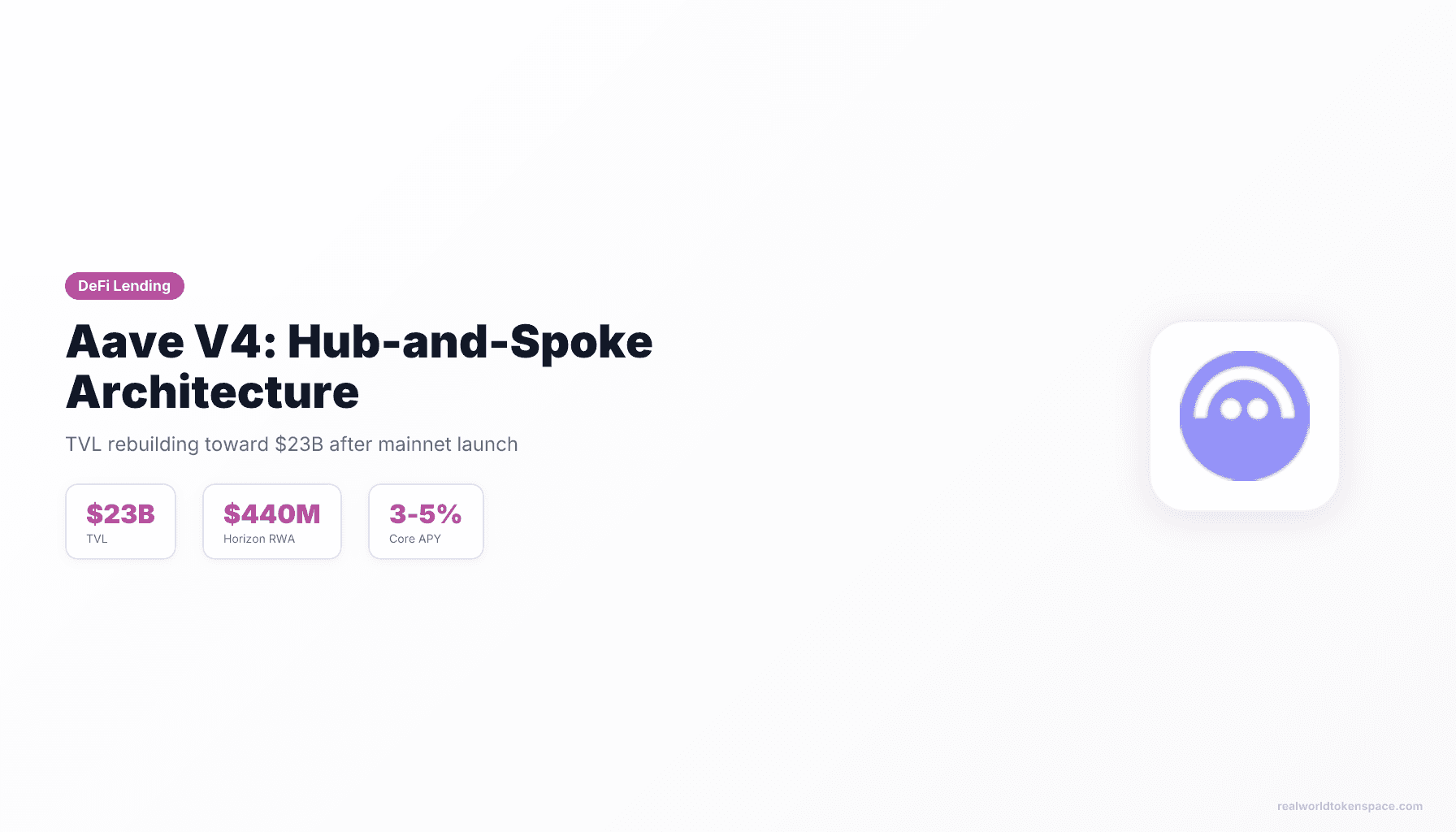
Aave V4 has been live on Ethereum mainnet for almost four weeks. The upgrade, announced at EthCC and shipped on March 30, 2026, is the first structural redesign of the protocol's core lending engine since V3 went out in 2023. It landed in a market that was already absorbing the KelpDAO rsETH exploit and the resulting $6.6 billion drawdown in Aave's total value locked. Four weeks in, the picture is clearer than it was at launch: V4 is back above $23 billion in TVL per DefiLlama's Aave dashboard, Horizon has crossed $440 million in RWA collateral, and the hub-and-spoke design is starting to do what the team said it would, which is separate liquidity from risk.
For lenders and borrowers who are not trying to read Aave governance forums every week, the practical question is simple: what changed on March 30, and what does it mean for the rate you earn or pay on a stablecoin position today? The short answer is that V4 does not immediately rewrite the rate you see on an Aave front end, but it does quietly change the plumbing underneath every market, and it sets up the protocol to take on collateral types that the V3 pool model was never going to absorb cleanly.
What Actually Shipped on March 30
V4 is built around three "liquidity hubs" and eleven "spokes," a pattern that Aave's own documentation calls hub-and-spoke. The three hubs at launch are Core, Plus, and Prime. Core holds the biggest, most liquid assets, meaning WETH, USDC, USDT, and the protocol's native GHO. Plus is the hub built for ETH correlated assets and liquid restaking tokens. Prime is positioned for institutional markets, including assets that graduate from Horizon.
Each hub is a unified liquidity pool. A spoke is a purpose-built borrowing market that plugs into a hub and pulls liquidity from it under its own set of risk parameters. A spoke can list a long-tail asset as collateral, set its own LTV, liquidation threshold, and oracle configuration, and still access the deep liquidity sitting in the hub. If the spoke's risk model blows up, the damage is ring-fenced to that spoke. The hub is insulated. This is the structural fix to what happened in April: a single integration, rsETH via Kelp's bridge, put $292 million of bad debt inside the main V3 pool and pulled the rest of Aave's TVL down with it.
The other material changes are under the hood. V4 moves from rebasing aTokens to ERC-4626-style share accounting, which Aave's architecture post flags as the bigger integration story for downstream DeFi. Share accounting is what yield-bearing stablecoins, Pendle, and most LP tokens already use, and it removes a category of accounting weirdness that has historically complicated tax reporting and composability. V4 also introduces a health-targeted liquidation engine that sells only enough collateral to restore a loan to safety, rather than the full configured close factor. For large positions, that should mean less forced selling at the wrong moment and fewer cascade events.
TVL Picture After the Kelp Drawdown
The V4 launch was supposed to be the story of early April. Instead, it shared the tape with the KelpDAO rsETH exploit. On April 19, per CoinDesk's coverage, attackers used $292 million of stolen rsETH as collateral on Aave V3 and drained borrows against it. AAVE fell 16% on the day. Total DeFi lending TVL contracted sharply, with Morpho down roughly 9.62% in the same window per Portals' weekly recap.
Aave's recovery since then has been driven by two flows. First, V3 markets stabilized once the rsETH listing was frozen and bad debt was absorbed by the safety module. Second, and more important for the V4 story, net liquidity has started to move into the new hubs. Core and Plus have gained steadily through mid-April as curators and integrators redeploy positions. The Prime hub is smaller but carries the highest APR floor because its spokes include Horizon's institutional borrowers.
The total number is the headline, but the composition underneath it matters more. Roughly 78% of Aave's current TVL is still on V3. V4 is not yet dominant, and it should not be. The DAO is expanding supply and borrow caps gradually, and that is the correct posture for a new codebase, even one that passed audits with zero critical findings. What to watch over the next 60 days is the velocity of migration, especially in the Core hub.
Horizon Is Doing the Work That V3 Could Not
Aave Horizon, the permissioned RWA market that went live in August 2025, has become the clearest signal that the V4 architecture thesis is right. Per Aave's Horizon launch post, the market has crossed $440 million in deposits and is now the largest RWA venue onchain by that measure. Collateral at launch included Superstate's USTB and USCC, Centrifuge's JRTSY and JAAA, and Circle's USYC has since been added. Stablecoin lenders supply GHO, RLUSD, and USDC into the book.
The Horizon book is exactly the kind of market that the old monolithic V3 pool could not have hosted. It needs permissioned borrower access, custom oracle wiring, and LTV settings that reflect the settlement risk of a tokenized Treasury rather than an ETH derivative. Under V4, Horizon fits naturally as a set of spokes into the Prime hub. Institutional borrowers post tokenized Treasuries and get GHO or RLUSD against them. Retail and DAO stablecoin holders on the other side earn yield that is sourced from those borrowers rather than from leveraged crypto speculation.
For yield seekers, this is the meaningful change. The stablecoin APY on Horizon is being underwritten by short-duration Treasury collateral plus a regulated borrower, not by a perpetual funding trade. That is a different risk model from sUSDe, and it is closer to what a prime brokerage lending desk would charge on a repo book. Aave has not published a blended Horizon APY, but current supply rates across GHO, RLUSD, and USDC sit in the 4 to 6% range, with sGHO holders picking up the incremental spread from GHO borrow demand.
What Changes for a Retail Lender This Week
For someone who is supplying USDC, USDT, or GHO to Aave today, V4 does not force any action. The V3 markets keep running in parallel and will for at least the rest of 2026 based on the published migration plan. But three things are worth doing now. First, check whether the asset being supplied has a V4 version of its market, since the Core hub rates are already competitive with V3 on WETH and GHO. Second, look at sGHO specifically: per Aavescan it is paying roughly 5.1% against a cost of capital that the protocol itself controls, which makes it a cleaner yield profile than most external stablecoin wrappers. For the broader stablecoin yield context, see our two-tier stablecoin market analysis. Third, for anyone wanting RWA exposure rather than crypto-native risk, the Horizon supply side is live and accepting GHO, RLUSD, and USDC.
The larger question Aave V4 poses is about where DeFi lending goes next. The protocol is no longer chasing the highest APY on ETH. It is building infrastructure that looks more like a tokenized money-market fund on one end and a permissioned RWA repo book on the other. That is the structural bet. Whether it pays off depends on how much RWA collateral actually migrates onchain over the next twelve months. The first four weeks of V4 suggest the plumbing is ready.
This article is RWTS research, not financial advice. Yields and TVL figures cited reflect publicly available data as of April 23, 2026, and move continuously. For protocol-by-protocol Trust Scores, see the RWTS rating methodology and the live asset directory. Subscribe to The Yield Report for weekly yield intelligence.
Sources
Stay Ahead of the Yield Curve
Subscribe to The Yield Report for weekly yield intelligence.
Subscribe Now