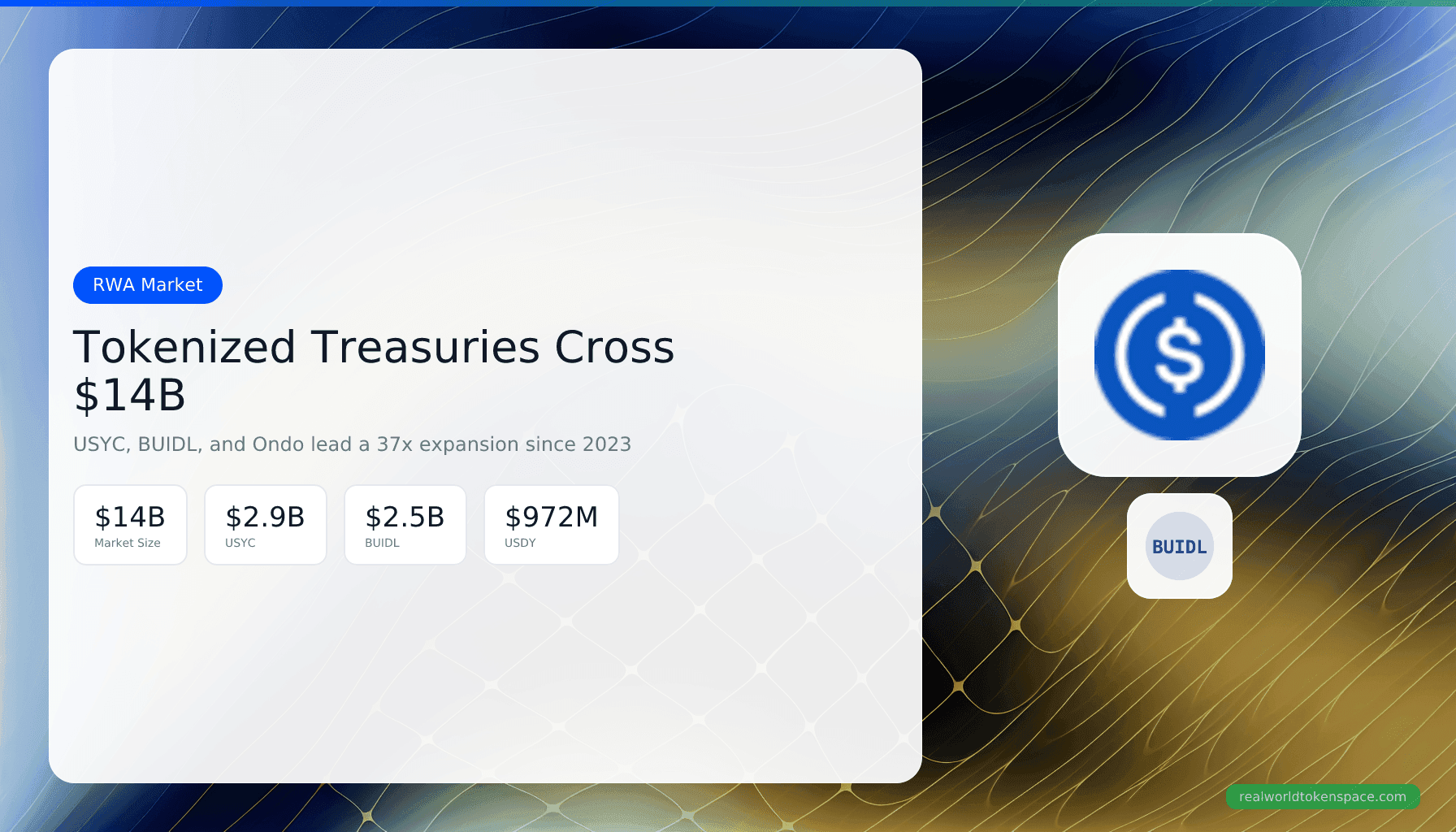
Circle's USYC sits at the top with about $2.9 billion in AUM. USYC is the tokenized form of the Hashnote Short Duration Yield Coin, which Circle acquired in early 2025. It holds a portfolio of US Treasury bills and reverse repurchase agreements, currently distributing roughly 4.7% net yield. USYC is structured for non-US institutional investors and integrates with Circle's broader USDC stack as a yield-bearing reserve product. Per Yahoo Finance's coverage of the leading tokenized Treasury issuers, Circle's pitch is that USYC is the closest thing onchain to a money market fund built specifically for stablecoin issuers and crypto-native treasuries. RWTS Trust Score: 83/100, Tier 2.
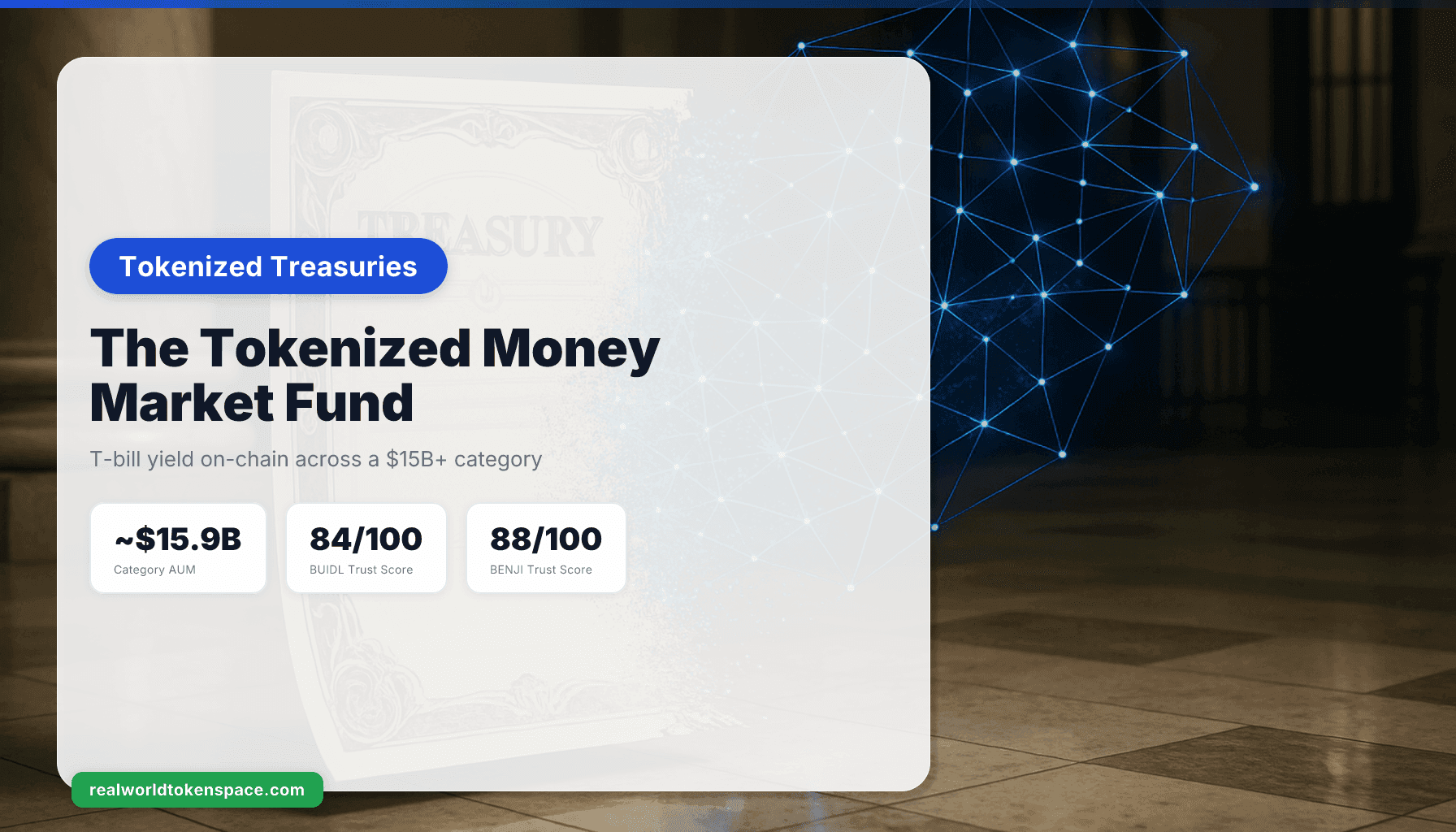
BlackRock's BUIDL, structured and issued through Securitize, has surpassed $2.5 billion. BUIDL is a tokenized share of BlackRock's USD Institutional Digital Liquidity Fund, which holds short-duration US Treasuries and overnight repo. BUIDL distributes roughly 4.5% net yield, with monthly attestations from BNY Mellon as the reserve custodian. The product is restricted to qualified investors with $5 million minimums, which has made it the dominant institutional choice but has also kept it functionally unavailable to retail. BUIDL's growth in 2026 has come almost entirely from stablecoin issuers using it as a reserve asset, from DeFi protocols including Ondo and Frax using BUIDL shares as collateral, and from a handful of crypto-native treasuries diversifying out of bare USDC. RWTS Trust Score: 88/100, Tier 2.
Centrifuge's JTRSY is third at roughly $1.5 billion. JTRSY is a tokenized Treasury fund operated through Centrifuge's onchain real-world asset infrastructure with Anemoy as the asset manager. It holds short-dated US Treasury bills and distributes roughly 4.6% net yield. JTRSY's distinguishing feature is composability. Unlike BUIDL, which requires off-protocol redemption flows, JTRSY plugs directly into Centrifuge's onchain pool architecture and is currently used as collateral in Morpho vaults, Aave's Horizon RWA market, and several smaller credit protocols. RWTS Trust Score: 80/100, Tier 2.
Franklin Templeton's IBENJI rounds out the top four with about $1 billion. IBENJI is the institutional version of Franklin Templeton's OnChain US Government Money Fund, originally tokenized as the FOBXX product. Yields cluster around 4.4% net, distribution is structured through Franklin's institutional channels, and the product is one of the only tokenized Treasury wrappers issued by a registered US mutual fund manager with public reporting obligations. IBENJI's growth has been steady rather than dramatic, but its regulatory status has made it a default choice for US institutions that need a 40-Act compliant onchain vehicle. RWTS Trust Score: 81/100, Tier 2.
Ondo Finance's USDY leads the sub-billion-dollar tier with roughly $972 million in supply. USDY is structurally different from the other four. It is a tokenized note rather than a fund share, backed by a portfolio of US Treasuries and bank deposits, and it is designed to function as a yield-bearing stablecoin alternative. Per CoinReporter's analysis of the $14 billion milestone, USDY currently distributes roughly 4.8% net yield and is the largest tokenized Treasury product available to non-US retail investors with no minimum gating. Ondo's other product, OUSG, holds short-term government bonds in a more traditional fund wrapper, sits at roughly $480 million in AUM, and serves the qualified-investor segment. Combined Ondo AUM is now approximately $1.45 billion. USDY RWTS Trust Score: 81/100, Tier 2. OUSG: 80/100, Tier 2.
The remaining ~$5.5 billion is distributed across smaller issuers including Superstate's USTB ($380M, Trust Score 78), Maple's syrupUSDC pseudo-Treasury wrappers, OpenEden's TBILL ($340M, Trust Score 80), and a long tail of bank-issued and exchange-issued products that each sit under $250M. RWTS publishes the full directory at /rwa-yields.
Yield, Liquidity, and Composability: The Three Levers
The mistake retail investors make most often when evaluating this market is treating tokenized Treasuries as a single product. They are not. The five major issuers differ on three levers that determine which one is right for which use case.
Yield. Net distributable yield ranges from 4.4% to 4.8% across the top five. The differences are small but real. USYC and USDY come in at the top of the range because they hold a slightly longer-duration portfolio and pass through more of the underlying T-bill yield to holders. BUIDL and IBENJI come in slightly lower because they hold more reverse repo and shorter duration paper, which is the more conservative posture but compresses the distributed yield. JTRSY sits in the middle. None of the top five charge meaningful fees relative to traditional money market funds, with management fees clustering at 15 to 25 basis points. The yield gap between the worst and best of the major five is roughly 40 basis points, which is a meaningful number on a $1 million treasury allocation but a rounding error on a $50,000 retail position.
Liquidity. Daily redemption is the standard for all five, but the operational paths are different. BUIDL and IBENJI operate through Securitize and Franklin's institutional rails, which means redemption is a T+1 wire-out process with no onchain secondary liquidity to speak of. JTRSY can be redeemed through Centrifuge's onchain mechanism but also has secondary liquidity through DEX pools on Ethereum and Base. USDY has the deepest secondary onchain liquidity, with active pools on Ethereum, Solana, and Mantle, and a partial 24/7 redemption window. USYC sits between JTRSY and BUIDL on operational liquidity. For institutional treasuries with predictable cash needs, the BUIDL flow is fine. For DeFi protocols that need to use the token as collateral with intra-day liquidation, USDY is structurally better.
Composability. Composability is whether the token can be plugged into other DeFi infrastructure as collateral, as vault-strategy input, or as a reserve asset. BUIDL has the most institutional integrations through Securitize partnerships but the fewest pure onchain integrations. JTRSY is the most composable in the strict DeFi sense, with active integrations in Aave's Horizon market, Morpho vaults, and Pendle's RWA pools. USDY is the most composable in the retail-DeFi sense, with active integrations in Aave on Mantle, Coinbase's onchain product layer, and a growing list of Solana DeFi protocols. USYC's composability is improving as Circle integrates the product into its broader USDC stack, but it still trails JTRSY and USDY for plug-and-play onchain use.
The Trust Score View
The RWTS Trust Score framework rates each of these assets on six dimensions: asset backing, proof of reserves, redeemability, audit and security, regulatory standing, and track record. The methodology is published at /rwts-rating. For tokenized Treasuries specifically, the scores cluster tightly because the underlying collateral is the same asset class. The differences come from the wrapper.
| Product |
RWTS Trust Score |
Tier |
Net APY |
Notes |
| BUIDL (BlackRock) |
84/100 |
Tier 2 |
~4.5% |
Strongest institutional governance, $5M minimum |
| USYC (Circle) |
81/100 |
Tier 2 |
~4.7% |
Strong issuer, non-US institutional focus |
| USDY (Ondo) |
81/100 |
Tier 2 |
~4.8% |
Best retail access, deep onchain liquidity |
| IBENJI (Franklin) |
88/100 |
Tier 2 |
~4.4% |
40-Act compliant, institutional channels |
| OUSG (Ondo) |
77/100 |
Tier 2 |
~4.6% |
Fund wrapper, qualified investor only |
| JTRSY (Centrifuge) |
80/100 |
Tier 2 |
~4.6% |
Best DeFi composability |
| TBILL (OpenEden) |
77/100 |
Tier 2 |
~4.5% |
Smaller AUM, BVI structure |
| USTB (Superstate) |
81/100 |
Tier 2 |
~4.4% |
US-domiciled, Anchorage custody |
Compare those scores against the synthetic alternatives that retail yield-seekers often consider in the same breath. Ethena's sUSDe carries a Trust Score of 61/100 in Tier 4. Lombard's LBTC sits at 59/100, and SolvBTC is at 49/100. The headline yields on those synthetic structures have compressed in 2026 to within 100 basis points of the tokenized Treasury stack, while the Trust Score gap has remained large. That is the cleanest argument for why the $14 billion is concentrated in Tier 2 products. Investors who can hold a Tier 2 wrapper at a comparable yield are doing so.
For a head-to-head view, see /compare/buidl-vs-usyc and /compare/usdy-vs-ousg.
Who Is Actually Buying?
The buyer base is more concentrated than the AUM totals suggest. Per the InvestaX Q1 2026 RWA tokenization report, roughly 55% of tokenized Treasury supply is held by stablecoin issuers using the products as reserve assets. Circle holds USYC and BUIDL on its own balance sheet as part of the USDC reserve mix. Tether has a smaller but growing position in BUIDL through its enterprise channel. Frax holds OUSG as part of the FRAX v3 reserve. Sky holds a basket including BUIDL and USDY as part of its USDS reserve composition. Smaller stablecoin issuers including Usual, Frax sFRAX, and several emerging yield-bearing dollar protocols are reserve customers of the same products.
Another 25% is held by DeFi protocols using the tokens as collateral or as RWA exposure within their treasury. Aave's Horizon RWA market accepts JTRSY, USYC, and BUIDL as collateral. Morpho vaults run by Steakhouse, Gauntlet, and Block Analytica use the same set. Maple Finance's institutional credit pools borrow against tokenized Treasury collateral on a quarterly cadence.
The remaining 20% is split between crypto-native treasuries diversifying out of stablecoin holdings, DAOs that have professionalized their treasury management, and a small but growing slice of high-net-worth retail through products like USDY that are accessible without qualified investor gating. The retail share is the smallest piece of the market but is also the fastest-growing in percentage terms, particularly since USDY's expansion onto Solana and Mantle in early 2026.
The retail availability gap is the unfinished part of the market. BUIDL still requires $5 million minimums. USYC is restricted to non-US institutional investors. JTRSY's onchain redemption is open but its primary distribution is institutional. IBENJI is gated to US qualified investors. USDY is the only one of the major five that meaningfully offers retail access without qualified-investor gating, and it leads the retail tier for that reason. The next wave of growth in tokenized Treasuries depends on whether the larger issuers find a regulatory path to retail distribution, particularly in the US, where the wrapped fund wrappers are not currently approved for direct sale to non-accredited investors.
What This Means for Yield Strategy
For a treasury allocator with a meaningful USD position to deploy, tokenized Treasuries are the safest 4 to 5% yield available onchain right now. The Trust Score profile of BUIDL, USYC, JTRSY, IBENJI, and USDY is materially stronger than any synthetic dollar product, and the yield gap to the synthetic stack has compressed enough that the risk-adjusted comparison favors tokenized Treasuries by a wide margin in 2026. The tradeoffs are around access, not asset quality.
For a retail yield-seeker, USDY is the one product on this list that meaningfully addresses the access problem. A holder gets approximately 4.8% net yield, daily redemption, and onchain composability, against a Trust Score of 81/100. That compares favorably to Coinbase's USDC Earn rate of about 4.5%, which has lower composability and a slightly weaker Trust Score, and it compares very favorably to any synthetic-dollar yield product when adjusted for asset-quality risk. See the /best-place-to-earn-yield-2026 overview for a broader cross-ecosystem comparison.
For a DeFi protocol designer thinking about reserve composition, JTRSY remains the most usable Tier 2 product because of its plug-and-play composability. BUIDL has the strongest Trust Score in the category but its operational profile makes it a poor collateral choice for any market that needs sub-day redemption. USYC sits in the middle and is improving fast as Circle invests in onchain integrations.
For an investor benchmarking against TradFi alternatives, the tokenized Treasury yield range of 4.4 to 4.8% comes in roughly 60 to 100 basis points above the typical institutional money market fund and roughly 130 to 170 basis points above Interactive Brokers' USD cash rate of about 3.14%. Whether that premium reflects compensation for tokenization risk, a structural alpha source, or simply the market's willingness to pay for onchain functionality is the question that defines how the market evolves through the rest of the year.
Risk Section
Several risks deserve mention.
The underlying collateral is short-dated US Treasury exposure, which is the safest asset class in the dollar yield curve, but the wrapper introduces operational and structural risk that the underlying does not have. Tokenized Treasury holders are exposed to issuer custody, transfer agent operations, smart contract risk on the token contract, and redemption gate risk in stress scenarios. Most of these risks are de minimis under normal operations and have shown up in zero of the major issuers' track records, but they are not zero.
Regulatory environment is in flux. The SEC's posture toward tokenized fund wrappers softened materially in 2025 but is not stable. A change in Commission posture could affect retail distribution paths, particularly for USDY-style note structures.
Concentration risk on the buyer side is real. If a major stablecoin issuer were to redeem a meaningful share of its tokenized Treasury holdings simultaneously, secondary market liquidity in the affected products could be tested. The institutional rails are designed for this, but the test has not happened in size yet.
Regulatory standing varies. BUIDL's Securitize structure is the most thoroughly tested. JTRSY's Cayman structure is robust but offshore. USDY's BVI note structure is the most exposed if a regulatory environment changes posture. The Trust Score reflects this gap, which is why the scores cluster in the 78 to 88 range rather than at a single value.
Subscribe to The Yield Report for weekly yield intelligence on tokenized treasuries, RWA, and the broader DeFi yield stack.
FAQ
What is a tokenized Treasury?
A tokenized Treasury is a blockchain-issued share or note backed by a portfolio of US Treasury bills, notes, or money-market instruments. The token tracks the value of the underlying portfolio and distributes the yield to holders, either through a rebasing mechanism or through reinvestment. The major products are issued by registered fund managers and held in segregated accounts at qualified custodians.
Are tokenized Treasuries safe?
The underlying asset is US Treasury debt, which is the safest dollar instrument available. The wrapper introduces operational and smart contract risk that an off-chain Treasury holding does not have. The major five products all carry RWTS Trust Scores between 80 and 88 in Tier 2, which puts them well above any synthetic dollar product but not on par with direct ownership of a Treasury bill at a primary dealer. See /rwts-rating for the methodology.
Can a US retail investor buy BUIDL or USYC?
No. BUIDL requires a $5 million minimum and qualified investor status. USYC is restricted to non-US institutional investors. IBENJI is restricted to US qualified investors. The only major product accessible to non-accredited US investors with meaningful onchain liquidity is currently a small piece of OpenEden's TBILL through specific channels, and even that is structured for non-US distribution. Most retail access to tokenized Treasuries comes through USDY for non-US investors. The retail access problem is the largest unfinished piece of the market.
What yield can I expect on a tokenized Treasury today?
Net distributable yields cluster between 4.4% and 4.8% across the major five products. That is roughly the prevailing short-end Treasury yield minus management fees of 15 to 25 basis points. Yields will move with the Federal Reserve's policy rate, so a Fed cut would compress the entire stack proportionally.
How does this compare to USDC or other stablecoin yield?
USDC pays no yield to holders. Stablecoin yield products like Coinbase Earn USDC at 4.5% or Aave V3 USDC at variable rates give investors exposure to lending and rate risk in addition to the underlying dollar. Tokenized Treasuries give holders direct Treasury yield without the lending layer, which is why they are increasingly favored as a reserve asset for stablecoin issuers themselves. See the /articles/2026-04-25-aave-usdc-frozen-pool-circle-emergency-rate-proposal-kelpdao discussion of how a frozen Aave market is illustrating that distinction in real time.
This is not financial advice. Verify all figures and product structures against issuer disclosures and live RWA dashboards before making allocation decisions.