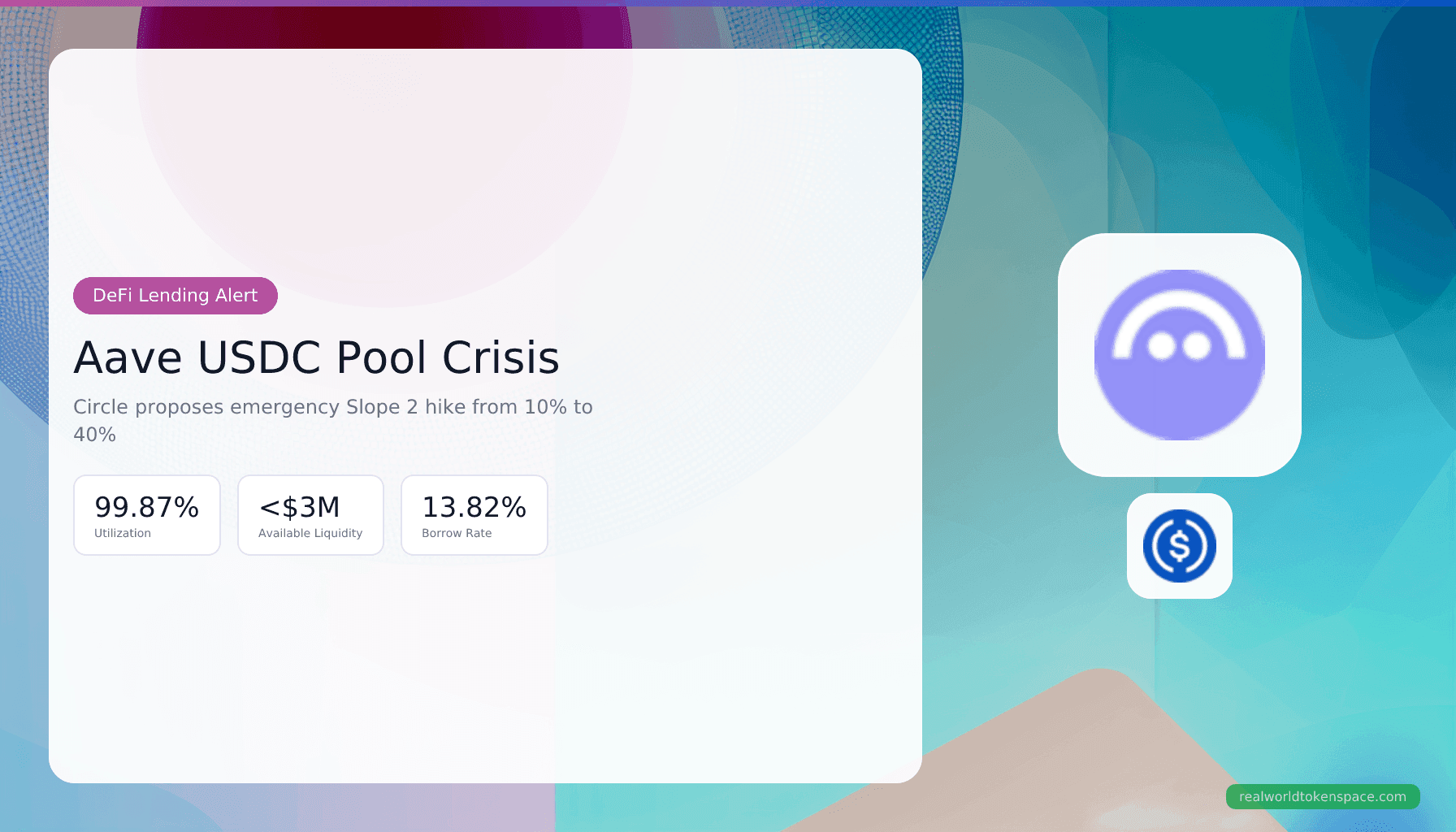
Aave's USDC market on Ethereum mainnet has been functionally frozen since April 18, 2026. Total supply and total borrows have each been pinned near $1.89 billion, available liquidity has hovered under $3 million, and utilization has clung to 99.87% for four consecutive days. The variable borrow rate has been capped at roughly 13.82%, the supply rate around 12.42%, and depositors who try to withdraw have been waiting in a queue rather than walking away with their stablecoins. On April 22, Gordon Liao, the chief economist at Circle, filed a governance proposal asking Aave to lift the USDC Slope 2 parameter from roughly 10% to 40% on a Risk Steward action, then ratify a 50% target through standard governance over the following week. The proposal is the most direct intervention Circle has ever made in Aave's (RWTS Trust Score: 71/100, Tier 3) interest rate machinery, and it is the clearest signal yet that the post-KelpDAO contagion has not finished working through DeFi's largest lending market.
This article walks through how the pool got here, what Circle is actually asking for, why it is controversial, and what an Aave depositor or borrower should think about while the governance vote plays out. None of this is financial advice. Rates and balances quoted are drawn from live protocol dashboards at time of writing and may change rapidly.
How the USDC Pool Got Pinned at 99.87%
The proximate cause is the KelpDAO rsETH exploit on April 18. An attacker exploited the single-verifier configuration in KelpDAO's LayerZero bridge to unlock about 116,500 rsETH from the Ethereum mainnet escrow, then immediately routed those tokens into Aave, Compound, and Euler as collateral. According to Galaxy Digital's post-mortem of the KelpDAO LayerZero exploit, the attacker borrowed an estimated $236 million in WETH and wstETH against the rsETH collateral on Ethereum L1 and Arbitrum, then drained that liquidity off-protocol. Aave's risk team responded by freezing rsETH as collateral and writing down the affected positions, but the secondary effect propagated quickly. Restaking-token holders across the wider DeFi market began rotating into stablecoins, USDC borrow demand spiked, and the V3 Core market on Ethereum hit its kink immediately.
The kink is the inflection point on Aave's interest rate curve. Below it, supply and borrow rates rise gently as utilization climbs. Above it, the curve steepens sharply through Slope 2, which is the rate increment between the kink utilization and 100% utilization. On the Ethereum V3 USDC market, Slope 2 is currently calibrated near 10%, which means even at 100% utilization the all-in variable borrow rate caps near 13.82%. For most of Aave's history that has been a feature rather than a bug, since stablecoin borrowers are usually price-sensitive and a moderate kink slope is enough to clear the market. After KelpDAO, the borrowers who pinned the pool were not price-sensitive. They were holders of restaking-collateral positions trying to bridge to USDC before forced liquidations, plus a smaller cohort of leveraged-yield strategies absorbing the new rate as a tolerable carrying cost while they unwound.
The result was a market that could not clear. As The Defiant explained in its breakdown of Aave's frozen USDC pool, withdrawals queued up against an available-liquidity buffer that never refilled, while the all-in 13.82% borrow rate was treated as a transaction fee rather than a signal to repay. New USDC supply did not come back into the pool because the supply rate, while elevated, was not high enough to compensate for the perceived contagion risk. Without a steeper Slope 2 to widen the spread between deposit and borrow yields under stress, the curve had no mechanism to attract emergency capital.
What Circle Is Actually Proposing
The proposal Liao filed on April 22 has two phases. Phase one is a Risk Steward action that lifts Slope 2 from roughly 10% to 40% immediately. Risk Steward is a delegated authority that lets a small group of approved actors adjust risk-related parameters between full governance votes, subject to caps. A 30 percentage-point Slope 2 increase would push the borrow rate at 100% utilization from 13.82% to roughly 43.82%, and the supply rate would rise correspondingly to the high 30s. Phase two is a longer governance vote that ratifies the new parameter and allows further adjustment toward a 50% target over the following five to seven days.
Per Bitcoin News's coverage of the Liao proposal, the explicit goal of the change is to widen the spread between the kink and the 100% utilization point so the market can perform price discovery again. In Liao's framing, the existing flat post-kink slope means rate-insensitive borrowers can sit through the cap as a tolerable expense. Lift the slope and a meaningful share of those borrowers face a cost-of-carry calculation that flips the trade. Some repay, some get refinanced into other venues, available liquidity returns, depositors get unblocked, and the curve normalizes.
This is not a permanent rate change. The framework is structural. Once utilization falls back below the kink, the all-in cost would settle back into the low single digits because the Slope 1 portion of the curve is unchanged. Borrowers in normal market conditions would not see a different rate environment at all. The 40% slope only bites when utilization climbs above the kink and stays there.
Circle has reasons of its own to want this fixed. USDC's role as a base liquidity asset depends on Aave being a place where supply can flow in at speed. A four-day freeze in Aave's largest USDC market is a credibility problem for the stablecoin itself, particularly while Sky's USDS (RWTS Trust Score: 72/100, Tier 2) and Ethena's USDe are competing for the same institutional flow. Liao's filing is not framed as a Circle commercial intervention, but the alignment of incentives is real. Aave is the largest single USDC integration in DeFi, and a market that fails to clear under stress damages USDC's brand as much as it damages Aave's.
The Pushback
The proposal landed with significant resistance in Aave's governance forum and on community channels. Per CryptoPotato's coverage of the backlash to the rate hike, three main objections surfaced.
The first is procedural. Circle is not a DAO delegate of Aave in the conventional sense, and using a Risk Steward action to push through a 30 percentage-point parameter change feels to some delegates like an end-run around full governance. The Risk Steward framework was designed to allow rapid response to known stress, but a Slope 2 adjustment of this magnitude is closer to a structural change than a tactical patch. Several long-time Aave delegates argued the appropriate path is a single full governance vote with a six-day timelock, not an emergency action.
The second is empirical. Skeptics argue the pool would clear on its own within a week as KelpDAO-related positions get liquidated or refinanced, and that intervening with a steeper slope risks overcorrecting. If a 40% Slope 2 triggers cascade liquidations on leveraged-yield positions that were waiting out the freeze, Aave could end up with bad debt on the supply side that the slope adjustment was supposed to prevent.
The third is competitive. A 40% post-kink slope is significantly steeper than what Compound, Morpho, or Euler run on equivalent USDC pools. Critics argue that institutionalizing a new 40% slope, even temporarily, would tilt USDC yield arbitrage toward the other markets and accelerate liquidity migration off Aave. The proposal acknowledges this risk and asks delegates to revisit the parameter once the post-KelpDAO stress has cleared, but the trajectory of past governance changes suggests calibrated parameters tend to drift in the direction they were last set.
There is a fourth, quieter objection that did not show up in the public threads but is implicit in the Risk Steward debate. Aave's design philosophy has historically separated the protocol from any single counterparty's operating concerns. Letting Circle drive an emergency rate change, even with strong technical justification, sets a precedent that any large stablecoin issuer with sufficient governance influence can do the same. The next time it happens, the issuer's interests may not align with Aave's depositors as cleanly as they appear to here.
What This Means for Depositors and Borrowers
The practical implications fork by user type.
For USDC suppliers currently in the pool, the immediate question is whether to wait for the freeze to resolve or attempt to withdraw against the available liquidity buffer. Withdrawals have been processing intermittently as repayments and small amounts of fresh supply roll in, but the queue is long and unpredictable. Depositors who need certainty have been migrating to Morpho's curated USDC vaults, where the largest curators including Steakhouse and Gauntlet are running Morpho vaults (RWTS Trust Score range 60-72, Tier 3) at supply rates between 5.5% and 7.5%, well below Aave's stressed cap but with available liquidity. The trade-off is curator risk, since Morpho's vaults inherit the underlying market choices each curator makes.
For USDC borrowers who have been camping in the pool, the math after a Slope 2 hike changes quickly. A position carrying a 13.82% borrow cost is uncomfortable but workable for some leveraged-yield strategies. A position at 30 to 43% is not. The most likely outcome of the proposal, if it passes, is that the marginal borrower repays within hours and available liquidity rebuilds within the first day. Borrowers who remain after that are paying the new cap because they cannot find an alternative.
For yield seekers watching from outside, the elevated USDC supply rate is a temporary opportunity that comes with elevated risk. Putting fresh USDC into the V3 Core market today picks up roughly 12.4% APY on the variable supply rate, which is far above Coinbase's institutional USDC earn rate of about 4.5% and meaningfully above any of the curated Morpho vaults. The reason that yield is on offer is that the pool is stressed, and the stress is still resolving. A new depositor effectively earns the spread between the cap and the underlying baseline as compensation for the residual risk that the pool experiences a second wave of withdrawals or an indirect KelpDAO-related write-down. None of that is theoretical. Aave already wrote off a portion of its rsETH exposure earlier this week, and another adjustment is possible if the KelpDAO recovery process produces a different settlement than the protocol's risk model assumed.
For passive holders looking at this from the /defi-yields page or from RWTS's /compare/aave-vs-morpho view, the right framing is that Aave is not broken, it is illustrating the limits of its current parameter regime under a non-standard stress event. The Trust Score does not move materially on this, since the underlying Aave V3 contracts and the bad-debt provisioning logic continue to function exactly as designed. What moves is the conviction that the rate curve is calibrated for the right kind of borrower under the right kind of stress, and that conviction is the thing the Circle proposal is trying to repair.
The Broader Yield Picture
Zooming out, the Aave freeze has compressed DeFi USDC yield curves across every major venue.
| Venue |
USDC Supply APY |
Available Liquidity |
Trust Score |
Notes |
| Aave V3 Ethereum |
~12.4% (capped) |
<$3M |
71/100 (T3) |
Pinned at 99.87% utilization, withdrawal queue active |
| Morpho Steakhouse USDC |
6.5% |
~$120M |
68/100 (T3) |
Curator-managed, risk profile published |
| Morpho Gauntlet USDC |
5.8% |
~$95M |
70/100 (T3) |
Slightly more conservative collateral mix |
| Compound V3 Ethereum |
4.2% |
~$240M |
67/100 (T3) |
Did not absorb KelpDAO collateral, less stress |
| Euler Prime USDC |
5.1% |
~$60M |
60/100 (T3) |
Modest exposure, recovering after April drawdown |
| Coinbase Earn USDC |
4.5% |
n/a (CeFi) |
67/100 (T3) |
US-available, non-rehypothecated |
| Pendle PT-USDG |
5.29% (fixed) |
~$46M pool |
78/100 (T2) |
Locked to May 14, regulated stablecoin underlier |
Numbers are drawn from live dashboards at time of writing. The big takeaway is that Aave's headline supply rate looks dramatic, but the liquidity is not actually accessible to a new depositor in any meaningful way until the pool unfreezes. The realistic alternatives for USDC yield this week sit between 4 and 7%, and the most defensible Trust Score in that range belongs to a Pendle PT against a regulated stablecoin underlier rather than any of the variable lending markets. That is a useful reframing of "highest crypto APY right now" when stress is actively in the system. See our broader /best-usdc-yield-2026 coverage for the cross-ecosystem view.
For comparison, traditional finance USDC analogs continue to look competitive. According to AmbCrypto's account of the proposal, Liao's filing referenced Interactive Brokers' 3.14% USD cash rate as a benchmark Aave's USDC pool needs to beat. Whether the V3 market can re-anchor above that floor on a reliable basis after the parameter change is the question that will define USDC's role in DeFi over the rest of 2026.
Risk Section
Several risks deserve attention.
A 40% Slope 2 cap increases the chance of cascade liquidations among leveraged-yield positions. Aave's bad debt provisioning is robust but not unlimited, and a second wave of write-downs would compress supply yields after they spike. The proposal includes a circuit-breaker provision intended to mitigate this, but the calibration is untested.
The Risk Steward action route is faster than full governance, which is the point, but it sets a precedent for emergency parameter changes that other large counterparties may try to invoke. Aave's governance health depends on resisting that drift.
KelpDAO's recovery process is still active. Aave's current bad-debt provisioning assumes a partial recovery of the seized rsETH collateral. If the LayerZero bridge dispute resolves against Aave's expected outcome, the protocol could face a second write-down on the same exposure, which would re-stress the same USDC pool the proposal is trying to fix.
USDC supply is concentrated. A meaningful share of the USDC sitting on Aave at the moment of the freeze was sourced through Coinbase Prime and Circle's own institutional channels. Concentrated supply is more responsive to issuer-driven incentives than retail supply, which is part of why the freeze persisted, and it could behave differently after the parameter change than retail-dominated pools would.
Subscribe to The Yield Report for weekly yield intelligence on DeFi, RWA, and exchange yield products.
FAQ
Is the Aave USDC pool unsafe right now?
The contracts are functioning correctly and the protocol's bad-debt provisioning has absorbed the KelpDAO rsETH writedown. The pool is illiquid, not insolvent. Withdrawals are queued, not refused, but a new depositor faces non-trivial risk that a second contagion event re-stresses the pool before they can exit.
Why is Aave's USDC borrow rate capped at 13.82% if utilization is at 99.87%?
Aave's interest rate curve has a flat post-kink Slope 2 of roughly 10%. At 100% utilization the all-in rate maxes out near 13.82%. Circle's proposal would raise that Slope 2 to 40%, which would push the post-kink cap above 40% and force rate-insensitive borrowers to clear.
Will the Circle proposal pass?
The Risk Steward action is procedurally available without a full governance vote, but it requires Risk Steward sign-off and faces a vocal community minority. A scaled-down version is likely. Whether the final number lands at 40% or somewhere lower is the open question. See the Aave governance forum for the live thread.
What is the safer place to earn USDC yield while Aave is frozen?
Curated Morpho vaults from Steakhouse and Gauntlet, Coinbase Earn USDC, and Pendle's PT-USDG pool are the three credible options. Each has a different risk profile and a different Trust Score. See /rwts-rating for the methodology that explains the differences.
Is this a sign that DeFi yields cannot compete with TradFi anymore?
Headline DeFi yields have compressed in 2026 as the major protocols have matured and as the Fed has held real rates higher. But the pool freeze on Aave is a parameter and contagion problem, not a structural yield gap. Curated DeFi venues with proper risk management still beat the institutional USDC rates available to the same depositor, and tokenized treasury wrappers like USDY (RWTS Trust Score: 81/100, Tier 2) and BUIDL (84/100, Tier 2) are now offering Treasury-grade yield onchain with stronger Trust Score profiles than the synthetic alternatives.
This is not financial advice. Yields, parameters, and risk profiles change rapidly. Verify all figures against live protocol dashboards before opening any position.