DeFi vaults used to mean Yearn. The user deposited an asset, an automated strategy hunted for the highest yield across a handful of protocols, and a performance fee came off the top. That model still exists, but it is no longer where the capital is flowing. In 2026, the biggest vault protocol in DeFi by a wide margin is Morpho, and the mechanic that is pulling in capital is not automation. It is curation. Morpho Blue is the permissionless base layer. The vaults on top are managed by named professional risk firms, principally Gauntlet and Steakhouse, that publish their allocation logic and take a cut of the yield in return. That is a structural change in how onchain lending works. It is also the reason the Ethereum Foundation parked another 3,400 ETH into Morpho Vaults V2 in March, and why we think curated vaults are the single most important DeFi category to understand this year.
This article explains the architecture of a Morpho vault, walks through the two dominant curators, shows where TVL sits today after the April drawdown, and applies the RWTS Trust Score methodology to the question of whether curated vault exposure is actually safer than holding a raw Aave supply position. Spoiler: sometimes yes, sometimes no, and the answer depends entirely on the curator and the asset selection underneath the vault.
What Morpho Blue Actually Is
The way to understand Morpho is to separate the base layer from the application layer. Morpho Blue, the base layer, is a minimal, immutable lending primitive. It defines isolated lending markets, each with a single collateral asset, a single borrow asset, a single loan-to-value parameter, a single oracle, and a single interest rate curve. Those parameters are chosen at market creation time and cannot be changed afterward. Every Morpho Blue market is therefore a one-line risk contract. You can read it in a paragraph. You can audit it in an afternoon. This is the opposite of Aave's pooled model, where dozens of assets cross-collateralize inside a single liquidity pool and a single bad listing can, as April's KelpDAO rsETH exploit showed, propagate into the rest of the book.
A Morpho vault, in turn, is a share-accounted wrapper that sits on top of a group of Morpho Blue markets. A depositor puts USDC into, say, Gauntlet's USDC Prime vault. The curator allocates that USDC across a curated set of underlying markets according to a published strategy. When rates or risk change, the curator rebalances. The vault itself is ERC-4626, which means downstream protocols, aggregators, and accounting tools treat it as a standard yield-bearing share token. This architecture is laid out in detail in Morpho's own Vault V2 documentation, and it is the reason the protocol has been able to onboard institutional capital without custom integrations.
The practical difference from Aave is that, at Aave, the DAO votes on every listing and every risk parameter. At Morpho, those decisions are delegated to whichever curator you choose to deposit with, and the curator is named, compensated, and directly accountable. You are picking a manager rather than a committee. That shift sounds small. It is the entire reason institutional desks are using the protocol.
Where the TVL Actually Sits
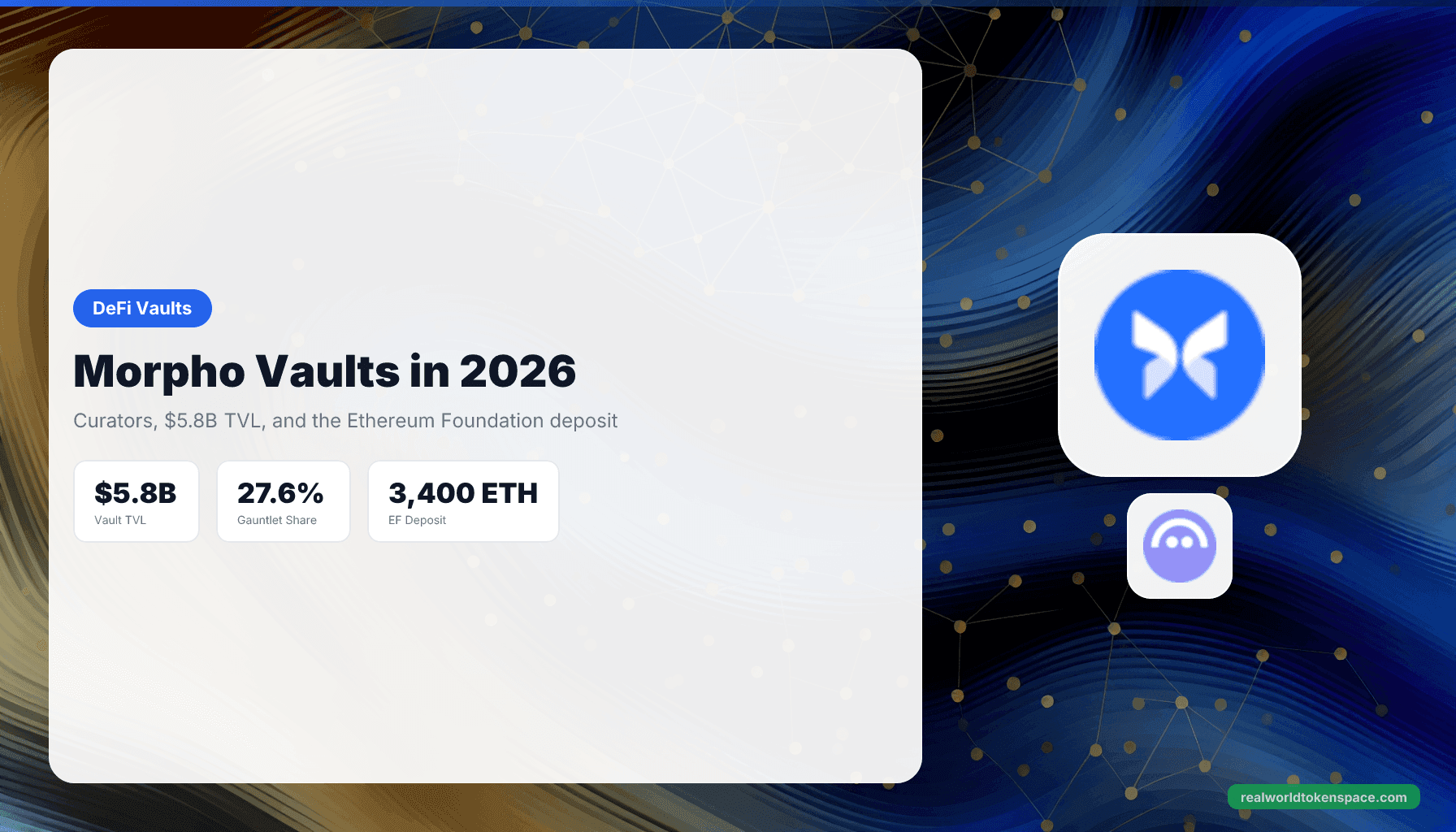
Morpho's curated vault ecosystem holds roughly $5.8 billion in TVL as of late April 2026, which puts it behind only Aave in the DeFi lending category. The distribution is concentrated. Per recent ecosystem data highlighted in DefiPrime's 2026 vault guide, Gauntlet curates approximately $2 billion, or roughly 27.6% of total vault TVL. Steakhouse is next at $1.29 billion, or 17.8%. The remaining share is spread across a long tail of smaller curators including B.Protocol, Block Analitica, MEV Capital, and a handful of newer entrants. Chain distribution is currently roughly $3.4 billion on Ethereum and north of $2 billion on Base, with smaller deployments on Arbitrum, Polygon, and Unichain.
That concentration is worth thinking about. In a curated system, a curator's reputation is effectively the product. Gauntlet and Steakhouse have been running public risk models for years, Gauntlet on Aave and Compound governance and Steakhouse on MakerDAO and Sky's RWA positions. Their published methodologies, internal risk frameworks, and track records are documented. A depositor is not just lending to a pool. They are paying a curator to make ongoing allocation and parameter decisions on their behalf. If the curator gets it wrong, the vault's TVL can walk. If the curator gets it right, the vault attracts more capital and the curator's management fees grow. That is the incentive alignment that makes curation work as a business model, and it is why our recent RWA composability piece flagged curated vaults as the primary institutional onramp for DeFi lending.
There has been turbulence. Morpho's TVL fell roughly 9.62% in the week after the KelpDAO rsETH exploit on April 19, 2026, according to the same market report that tracked the Aave drawdown. The exploit did not originate inside a Morpho vault, but restaking-adjacent collateral sits in multiple Morpho markets, and the wider contagion hit curated vault inflows along with the rest of DeFi lending. AInvest's coverage of the liquidity crunch notes that Morpho's isolated market design contained the damage at the contract level, even as vault curators temporarily reduced exposure to restaking collateral.
The Ethereum Foundation Signal
Institutional validation of Morpho took a concrete form on March 18, 2026, when the Ethereum Foundation disclosed that it had deployed an additional 3,400 ETH, worth roughly $7.6 million at the time, into yield-generating Morpho vaults. Per CoinAlertNews's detailed coverage, the allocation specifically included 1,000 ETH routed into Morpho Vaults V2, the newer architecture designed for institutional treasury use. That March deployment was not the first. The Foundation had previously committed 2,400 ETH and approximately $6 million in stablecoins to Morpho in October 2025. Combined, those deposits make Morpho the only DeFi lending protocol the Foundation has backed twice under its current treasury strategy.
The strategic read is straightforward. The Ethereum Foundation has spent the last two cycles being criticized, fairly or not, for periodically selling ETH to fund operational runway at inopportune moments. The treasury update in late 2025 explicitly shifted to an active, onchain, yield-generating model. Morpho became the first protocol to win a repeat deposit. The reason is the same one that draws other institutional treasuries to curated vaults. The asset sits in an auditable ERC-4626 share, the curator is a named party with a public track record, the underlying markets are isolated and parameterized, and exit liquidity is continuous rather than gated.
Morpho Vaults V2, which launched in November 2025, is the architecture actually receiving the institutional capital. The Vault V2 documentation adds an expanded curator model with configurable compliance hooks, role-based permissioning, and programmable liquidity conditions. For a foundation or a fintech treasury, those features are not optional. They are the reason the deposit was possible at all.
Curator Deep Dive: Gauntlet Versus Steakhouse
Gauntlet's Morpho vaults, tracked in Gauntlet's own VaultBook, lean conservative. The flagship USDC Prime vault allocates primarily to high-quality collateral markets, caps exposure to any single isolated market, and uses a mix of Aave base assets and select staked ETH derivatives as borrow collateral on the other side. Reported APYs across Gauntlet's stablecoin vaults are in the 4 to 7% range, depending on which vault and which chain. The firm's risk model is driven by public simulation infrastructure that Gauntlet has been running for Aave and Compound for years. Depositors are paying for that track record.
Steakhouse's curator book is smaller but differentiated. Steakhouse is best known as a MakerDAO and Sky risk partner, and its Morpho vaults lean into RWA-backed strategies and selectively higher-yielding markets. The firm publishes quarterly DeFi market updates, and its April 9 update on Steakhouse Financial's Kitchen blog is the most transparent public curator note in the ecosystem. Reported APYs on Steakhouse vaults span a wider range, roughly 5 to 12% depending on the strategy, with the higher end carrying more exposure to newer collateral types.
The practical choice between the two is not about yield. It is about what the depositor trusts the curator to actively manage. Gauntlet runs a simulation-heavy, conservative allocation model. Steakhouse runs a research-heavy, selectively aggressive model. Both publish risk frameworks. Both have track records. Both take a management fee that typically sits around 10 to 15% of vault yield, depending on the specific vault.
Where the RWTS Trust Score Lands on Curated Vaults
Our Trust Score methodology scores the underlying asset, not the wrapper. That matters here because a Morpho vault does not have a single clean Trust Score. It has a weighted score derived from whatever mix of collateral and borrow assets the curator is running at any given time. A Gauntlet USDC vault that is concentrated in Aave's USDC collateralized by WETH and wstETH will inherit a risk profile close to wstETH (Trust Score 74/100, Tier 3) and USDC as the lending base. A Steakhouse vault that leans into sUSDe exposure will inherit more of sUSDe's 61/100 Tier 4 profile.
This is the core reason we do not recommend a curated vault as a single replacement for a plain Aave position. The two products are not the same. A plain USDC supply on Aave V4's Core hub is a floating-rate, unsized, unwrapped exposure to a single protocol's pooled risk model. A Morpho Gauntlet vault is a curated exposure to a selected basket of Morpho Blue markets, wrapped in a share token, managed actively for a fee. They are different products with different risk profiles and different yield profiles. For most stablecoin allocators, the right move is to run a position across both. Plain Aave sits as the liquidity leg. A curated vault sits as the yield leg. A fixed-rate Pendle position, like the PT-USDG pool we covered this morning, sits as the dated leg.
For a broader framework on how to allocate across these layers, the RWA yields and DeFi yields pages give current live rates on every asset involved, and the yield calculator can model a blended position.
Where Curated Vaults Actually Break
Curation is not free from failure modes. A short list of the ones that matter. First, curator allocation error. A curator can simply get a risk call wrong, allocate too heavily into a collateral type that depegs or gets exploited, and the vault's NAV takes a hit before rebalancing can catch up. This is not a contract failure. It is a judgment failure, and it is the single most common way a curated vault underperforms. Second, oracle risk on an underlying market. Morpho Blue's isolated markets each use a configured oracle at market creation time. If that oracle is ever mispriced, liquidations can run against the vault. Third, secondary-market discount. During an acute liquidity event, ERC-4626 vault shares can trade at a discount to NAV on secondary venues even when the underlying vault is solvent. A depositor who needs to exit mid-event may take a haircut.
Fourth, and this is the one worth watching in 2026, is curator concentration. Gauntlet and Steakhouse together curate roughly 45% of total Morpho vault TVL. Neither firm has had a material public failure. If either did, the contagion would be meaningful. The structural solution is more curators with published methodologies, which is why we track new curator entries each month in the Yield Report archives.
How This Connects to the Broader Yield Stack
Morpho is one layer in a larger onchain dollar yield stack that now sits at roughly $80 billion across DeFi lending and yield-bearing stablecoins, per Redstone's 2025 yield report and subsequent market updates. The other two layers that matter right now are Aave, which we covered in our Aave V4 hub-and-spoke piece, and Pendle, which is hosting regulated stablecoin pools like PT-USDG. Together, those three protocols are the institutional onramps for DeFi lending. Aave is the pooled, governance-driven liquidity layer. Morpho is the curated, isolated-market layer. Pendle is the dated-yield overlay. Most large onchain treasuries now run across all three.
For retail users, the practical answer is that Morpho vaults are not scary, but they are not a black box savings account either. Pick a named curator. Read the vault's allocation page. Understand which underlying markets the curator is using. Check the directory for Trust Scores on the collateral. Size the position accordingly. That is the curated-vault workflow, and it is materially different from the "pick the highest APY" instinct that characterized DeFi in earlier cycles.
Risk and Disclaimer
Yields in curated vaults are floating, change frequently, and reflect the curator's live allocation decisions. Morpho Blue contracts have been audited and have operated at scale without a material contract failure, but smart contract risk is not zero. Curator allocation risk is the dominant risk on a curated vault and depends on the specific curator's decisions. Underlying assets carry their own peg, reserve, and protocol risks. None of the positions described in this article are insured. This is not financial advice. Consult a qualified advisor for your jurisdiction.
Subscribe
Subscribe to The Yield Report for weekly curator performance updates, new vault launches, and Trust Score revisions across the full Morpho ecosystem.
FAQ
What is a Morpho vault in plain terms?
A Morpho vault is a share-accounted wrapper that pools depositor capital and routes it into a curated selection of Morpho Blue isolated lending markets. A named curator, typically Gauntlet or Steakhouse, chooses which markets to allocate to, sizes the exposures, and rebalances over time. The depositor receives an ERC-4626 share that tracks the vault's underlying NAV.
How is a Morpho vault different from a plain Aave deposit?
Aave runs a pooled, governance-managed lending market where all listed assets cross-collateralize inside a single liquidity pool. Morpho Blue runs isolated one-asset-pair markets, and vaults on top provide curated allocation across those markets. The Aave position is simpler and has deeper liquidity. The Morpho vault position is more modular, can target specific collateral types, and delegates risk management to a named curator for a fee.
Who are Gauntlet and Steakhouse?
Both are professional DeFi risk curators. Gauntlet runs simulation-based risk models and is the largest curator on Morpho by TVL, managing roughly $2 billion across vaults. Steakhouse is smaller at roughly $1.29 billion but is known for transparent public research notes and more active allocation into RWA-backed strategies. Both publish risk frameworks and both charge management fees that typically come out of vault yield.
What does the Ethereum Foundation deposit tell us?
It signals that Morpho Vaults V2 meets the operational and compliance requirements of a major institutional treasury. The March 18 deposit was the Foundation's second Morpho allocation under its active treasury strategy, which is a stronger vote of confidence than any single rate table. See the full coverage on CoinAlertNews for specifics.
Are curated vaults safer than Aave?
They are different, not automatically safer. Isolated markets contain damage at the contract level, which is a structural advantage. But curator allocation risk is the dominant risk on any curated vault, and a wrong allocation call by a curator can underperform a plain Aave supply position. The right framing is that curated vaults and Aave are complementary, not substitutes. For how this fits into a broader yield allocation, see RWA yields and DeFi yields.
Sources: