Pendle yield tokenization has always been a strong idea with a messy application layer. The protocol splits any yield-bearing asset into a Principal Token (PT) that matures at par and a Yield Token (YT) that captures variable returns between now and maturity. In theory, that gives crypto its first clean analog to the fixed-income market. In practice, most of Pendle's pools have been wrapped around restaking receipts, points farms, and sUSDe collateral, which means the "fixed" leg is only as safe as the underlying DeFi primitive. The April rollout of Paxos's Global Dollar (USDG) on Pendle changes the character of the product in a way that matters. For the first time, a regulated, Treasury-backed stablecoin is being pulled onto Pendle rails, a 5.29% fixed PT rate is live, and the new USDG pool maturing on May 14, 2026 now looks like the closest thing DeFi has to a short-duration onchain T-bill curve.
This article walks through what launched, what the rate stack actually looks like, how USDG compares to the other yield-bearing stablecoins sitting on Pendle today, and what the RWTS Trust Score framework says about holding PT-USDG versus the alternatives. If you are new to Pendle, there is a quick primer on PT and YT mechanics about halfway down. If you already know the protocol, skip to the rate analysis.
What Just Launched
Paxos Digital Singapore issues USDG, a US dollar-backed stablecoin maintained at a 1:1 peg. Reserves are custodied and cash-managed by DBS Bank, Southeast Asia's largest financial institution, and the portfolio sits primarily in short-dated US Treasuries. Paxos publishes monthly reserve attestations. The token is supervised by the Monetary Authority of Singapore and is structured to comply with the EU's MiCA regime, which puts it in the same regulatory cohort as USDC and a shrinking list of European-acceptable dollar tokens. That regulatory clearance is the quiet reason USDG matters. It is one of very few tokenized dollars that a European institution can hold without tripping a compliance flag, and it is one of the only Paxos-issued products built for redistribution of yield to partners rather than capture of yield by the issuer.
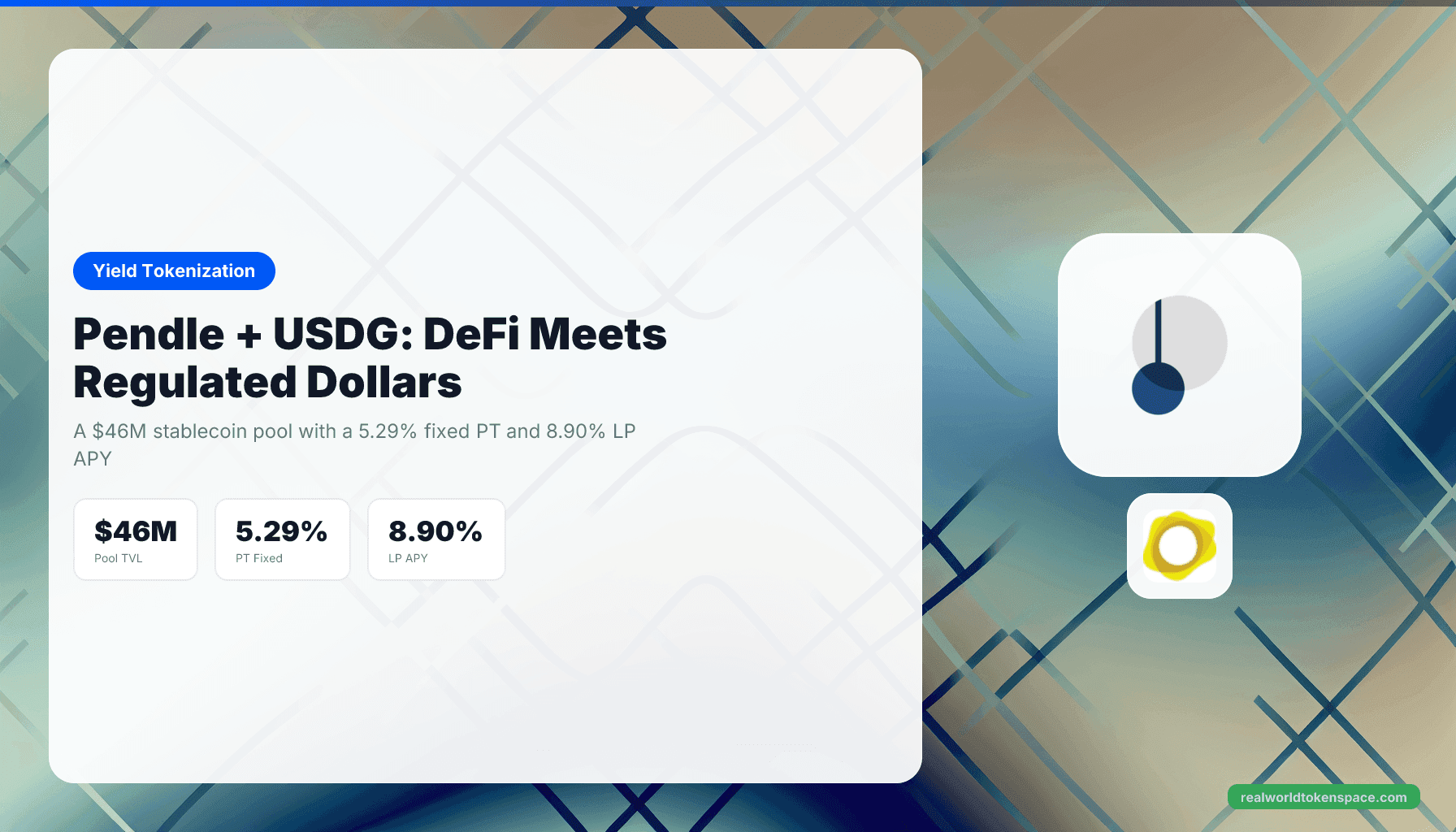
The Pendle launch turned that compliance-first plumbing into an actual onchain yield product. According to Phemex's coverage of the USDG debut, USDG's total value locked on Pendle crossed $46 million in the first weeks after integration. The new pool matures on May 14, 2026. Per CoinGecko's breakdown of the partnership, buyers of PT-USDG lock in a 5.29% fixed annualized return from the entry point through maturity, while liquidity providers in the pool are earning a blended 8.90% APY once Pendle's incentive program is included. That LP number includes PENDLE token emissions and the limit-order reward experiment Pendle ran through April, so it is not directly comparable to the PT leg. It is, however, the most honest published APY for the pool as it sits today.
For context on where Pendle sits overall, DefiLlama's Pendle dashboard shows the protocol at roughly $3.76 billion in TVL as of late April 2026, spread across Ethereum, Arbitrum, Plasma, and a handful of smaller deployments. USDG is currently a small slice of that total, but it is the most regulated asset in the Pendle book by a wide margin.
Why This Is a Bond Market in DeFi Clothing
The way Pendle's mechanics line up with traditional fixed income is clearer with USDG than with any of the protocol's earlier collateral choices. In a traditional market, a short-duration US Treasury bill is priced at a discount to par. You buy it at 97.50, it redeems at 100.00, and the spread is your yield. Pendle's PT works the same way. A buyer of PT-USDG pays some price below $1.00 today, holds to May 14, 2026, and receives $1.00 of USDG back at maturity. The 5.29% APY is the annualized version of that discount. Because the underlying collateral is a Paxos-issued stablecoin whose reserves are Treasury bills managed by DBS Bank, the economic exposure is roughly equivalent to holding a very short US Treasury, wrapped in stablecoin rails, wrapped again in Pendle's share-accounted vault.
The YT side is where it stops looking like a bond and starts looking like a DeFi primitive. A YT-USDG holder receives only the variable yield that accrues to the stablecoin between now and maturity. If USDG's native yield pass-through rises above the fixed 5.29% over the next several weeks, YT wins. If it falls, YT loses. This is the same PT versus YT structure that drove the protocol's original Lido wstETH and Ethena sUSDe pools, but applied to a regulated dollar. For a DeFi-native treasury desk, the practical use case is to buy PT for the predictable leg and keep dry powder in a separate variable-yield wrapper like Ethena's sUSDe (RWTS Trust Score: 61/100, Tier 4) for the higher-risk end of the stablecoin yield stack.
That trust gap matters, and it is the reason USDG is interesting in a way that sUSDe by itself is not. sUSDe's delta-neutral carry has compressed this year as perps funding normalized, while USDG's yield floor is anchored to US Treasury bills through DBS Bank. The two sit in different Trust Score tiers for a reason.
The Rate Stack, Side by Side
Here is what the onchain dollar yield stack looks like across Pendle, Aave V4, and the main yield-bearing stablecoins in late April 2026. Rates are drawn from live protocol dashboards at time of writing and should be verified before any position is opened. This is not financial advice.
| Asset |
Venue |
Net APY |
Trust Score |
Tier |
Notes |
| USDC (plain supply) |
Aave V4 Core hub |
2.61% |
n/a |
n/a |
Utilization-driven, floating |
| USDT (plain supply) |
Aave V4 Core hub |
1.84% |
n/a |
n/a |
Floating |
| PT-USDG |
Pendle, May 14 maturity |
5.29% fixed |
76/100 est. |
Tier 2 |
Paxos/DBS Treasury-backed |
| LP USDG |
Pendle |
8.90% |
76/100 est. |
Tier 2 |
Includes PENDLE incentives |
| sDAI |
Sky / Spark |
3.75% |
66/100 |
Tier 2 |
SSR-linked |
| sGHO |
Aave |
5.10% |
60/100 (GHO base) |
Tier 3 |
Safety module earn |
| sUSDe |
Ethena |
4.25% |
61/100 |
Tier 4 |
Delta-neutral basis |
| BUIDL |
BlackRock via Securitize |
4.10% |
88/100 |
Tier 2 |
Qualified investors only |
USDG's raw 5.29% PT looks modest next to the 8.90% blended LP number, but it is the only line on this table that combines a fixed annualized rate, a sub-30-day maturity, and a reserve structure that maps cleanly onto a regulated Treasury fund. Compare that to the 2.61% Aave V3 USDC supply rate we covered in our April 23 piece on the two-tier stablecoin market, or to the 3.14% that Interactive Brokers currently pays on idle customer cash, and PT-USDG is a legitimately interesting short-duration yield for dollar-denominated capital.
Where PT-USDG Sits in the RWTS Trust Framework
Pendle is a protocol. USDG is an asset. The RWTS Rating methodology scores assets, not wrappers, so the relevant number here is USDG's Trust Score, not Pendle's. We do not have a published USDG score yet, but the inputs are consistent with other regulated Paxos issuances. Asset backing is strong because reserves are short-dated US Treasuries held at DBS Bank. Proof of reserves is strong because Paxos publishes monthly attestations. Redeemability is strong for approved partners in the Global Dollar Network, weaker for retail. Regulatory standing is strong with MAS supervision and MiCA compliance. Track record is moderate since USDG is less than 18 months old at time of writing. A rough consensus score in the mid-70s, putting USDG in Tier 2 with BUIDL, USYC, and USDY, is a reasonable default until the full methodology run is published.
What changes once you move into the Pendle wrapper is that the asset now sits behind a second set of smart contracts. The PT-USDG holder is taking three distinct risks stacked on top of each other. First, the USDG stablecoin has to hold its peg, which depends on Paxos's reserve management. Second, the Pendle AMM and PT minting logic has to behave correctly through maturity. Third, the redemption path from PT back into the underlying USDG has to clear at par on May 14. The first risk is the one a traditional investor would call duration and credit risk. The second and third are DeFi-specific contract risks that a Treasury bill does not carry. That is the honest reason PT-USDG yields 5.29% while an actual one-month T-bill yields in the low threes. The spread pays for the extra contract surface, plus a modest liquidity premium on a pool that is only weeks old.
For strategists sizing a position, the practical framing is that PT-USDG is a stablecoin yield trade with an explicit maturity, not a perpetual product. Once May 14 passes, the capital rolls out of the pool at par and needs a new home. The same framing applies to the other Pendle Treasury-adjacent pools, which makes the protocol feel more like a short-duration curve than a savings product.
A Quick Primer on PT and YT Mechanics
For readers who have not used Pendle before, the architecture is worth a paragraph. Every Pendle pool starts by wrapping a yield-bearing asset into what Pendle calls Standardized Yield, or SY. Pendle then splits SY into two tokens with the same maturity date. The PT, or Principal Token, is the claim on the underlying principal at maturity. The YT, or Yield Token, is the claim on all yield earned between now and maturity. Both are tradable.
A buyer of PT-USDG is buying the right to receive one USDG at maturity for a price less than one USDG today. If the underlying stablecoin holds its peg and the contract pays out at maturity, the PT buyer's annualized return is fixed at the implied discount, which is 5.29% in the current pool. A buyer of YT-USDG is buying the right to receive all yield that USDG pays between today and May 14. That return is variable and depends on what USDG's native yield distribution does over the holding period. A liquidity provider supplies both sides and earns trading fees plus PENDLE incentives, currently blending out to an 8.90% APY in the new pool.
The PT leg is the fixed-income wrapper. The YT leg is the yield-speculation wrapper. The LP leg is a paid position on the shape of the yield curve between today and maturity. This is the same structure Binance Research's Pendle overview documents for the older sUSDe pools, but the credit quality of USDG is a full tier cleaner.
Why Institutions Are Finally Paying Attention
Pendle has been pitching yield tokenization to institutional desks since 2023, but the pitch lands differently now that the underlying assets include a MAS-supervised Paxos stablecoin instead of only sUSDe, eETH, and Spectra points. The 90%-plus yield redistribution model baked into the Global Dollar Network means large partners who mint or hold USDG are not fighting the issuer for economics. That is a structural difference from USDT and most of USDC's distribution model, and it is the reason a treasury desk at a Southeast Asian fintech can justify holding USDG as an operational balance, then parking idle balances in PT-USDG for a short fixed-rate leg. The capital does not have to leave the regulated stablecoin rail to earn a defined yield.
This is the same pattern that is driving Morpho's curated vault growth and the recent flow of Ethereum Foundation treasury ETH onto DeFi lending rails. The common thread is that institutions are no longer willing to accept 2% on idle cash on an exchange when the onchain alternative is a structured product with a posted rate, a defined maturity, and an auditable reserve. For a more detailed look at how the full onchain dollar yield curve fits together, see our DeFi yields overview and the individual asset pages at /directory.
What Could Break It
A short list of things that would change the thesis for PT-USDG. First, a Paxos reserve event. The last time a regulated dollar issuer had a reserve scare was Silicon Valley Bank's weekend in March 2023, and USDC depegged briefly as a result. USDG runs through DBS rather than a single US regional, which is a structural improvement, but any large bank can have a bad weekend. Second, a Pendle contract issue. Pendle V2 has been audited multiple times and has not had a contract failure at scale, but the PT redemption path at maturity has to clear cleanly. Third, a liquidity shock in the pool. If USDG TVL on Pendle collapses before maturity, the implied fixed rate on secondary markets can move sharply in either direction. A holder who planned to hold to maturity is unaffected. A holder who needs to exit early may take a discount.
Fourth, and most interesting for readers who track risk-adjusted yield, is what happens after May 14. Pendle's model is that pools mature and close. New pools launch at new rates. If the Fed begins cutting faster than markets currently price, the follow-on USDG pool would likely set at a lower fixed rate. If inflation surprises to the upside and Treasury yields move back toward 5%, the follow-on pool could set higher. PT-USDG is not a savings account. It is a dated security. The right mental model is the one-month Treasury roll, executed onchain.
How to Compare PT-USDG to Other Short-Duration Yield Plays
For a stablecoin allocator, the practical comparison is between PT-USDG, plain USDC on Aave V4, sGHO on Aave, sDAI on Spark, and BUIDL for accredited capital. Plain USDC on Aave V4 floats in the 2 to 3% range depending on utilization. sGHO is holding in the low 5s but carries GHO peg risk and Aave safety module exposure. sDAI is sitting at the current Sky Savings Rate of 3.75%. BUIDL pays around 4.1% but only to qualified investors through Securitize. PT-USDG's 5.29% fixed is the most generous rate on this list for a product with roughly Tier 2 reserve quality, but it carries duration risk to May 14 and Pendle contract risk.
The retail analog is the same one we flagged in our borrow and lend tooling: compare the APY to the risk, not to the other APYs. Our yield calculator can model a PT-USDG position sized against a plain USDC supply and show the sensitivity to an early exit.
Risk and Disclaimer
Yields quoted in this article are based on publicly visible rates at time of writing and change frequently. Pendle PT rates move with secondary-market pricing and pool liquidity. USDG is a regulated stablecoin, but all stablecoins carry de-peg risk, reserve risk, and counterparty risk. Pendle V2 has been audited and operated at scale since 2023 without a material contract failure, but smart contract risk is not zero. Fixed-income yield in DeFi is not insured by the FDIC, the SDIC, or any deposit insurance scheme. RWTS does not offer financial advice. Verify rates on the protocol's own interface and consult a qualified advisor for your jurisdiction before committing capital.
Subscribe
Subscribe to The Yield Report for weekly yield intelligence across DeFi vaults, tokenized Treasuries, and exchange earn products. We track rate changes, Trust Score updates, and new pool launches across every venue covered on RWTS.
FAQ
What is USDG and who issues it?
USDG is the Global Dollar, a US dollar-backed stablecoin issued by Paxos Digital Singapore and maintained at a 1:1 peg. Reserves are primarily short-dated US Treasuries managed by DBS Bank, with monthly attestation reports published by Paxos. The token is supervised by the Monetary Authority of Singapore and structured for MiCA compliance in the EU.
What is PT-USDG and how does the 5.29% rate work?
PT-USDG is a Pendle Principal Token that claims one USDG at the May 14, 2026 maturity. A buyer today pays a discount to one dollar and receives one dollar back at maturity. The 5.29% is the annualized yield implied by that discount. If USDG holds its peg and the Pendle contract settles correctly at maturity, the holder's return is fixed at the purchase rate.
How is the 8.90% LP APY on Pendle calculated?
The 8.90% liquidity-provider APY is a blended figure that includes trading fees, USDG's underlying yield, and PENDLE token emissions plus the limit-order reward experiment Pendle ran through April. It is not a fixed rate. It reflects what a current liquidity provider is earning and can move either direction as emissions roll off.
Is Pendle safe enough to hold PT-USDG to maturity?
Pendle V2 has been audited by multiple firms and has not had a contract failure at scale since 2023. The PT redemption path at maturity is well-established on other Pendle pools. Smart contract risk is not zero, and any yield product layered on top of a stablecoin stacks the contract risk on top of the stablecoin's own reserve and peg risk. See the RWTS Trust Score methodology for how we frame these layered risks.
How does PT-USDG compare to sUSDe on Pendle?
sUSDe is Ethena's synthetic dollar, backed by a delta-neutral basis trade, and carries an RWTS Trust Score of 45/100 in Tier 4. USDG is a Paxos-issued, Treasury-backed regulated stablecoin that we estimate at a low- to mid-70s Trust Score in Tier 2. sUSDe has historically paid a higher APY but takes a different risk profile. PT-USDG is the more conservative position. For a direct side-by-side, see /compare/susde-vs-usdg.
Sources: