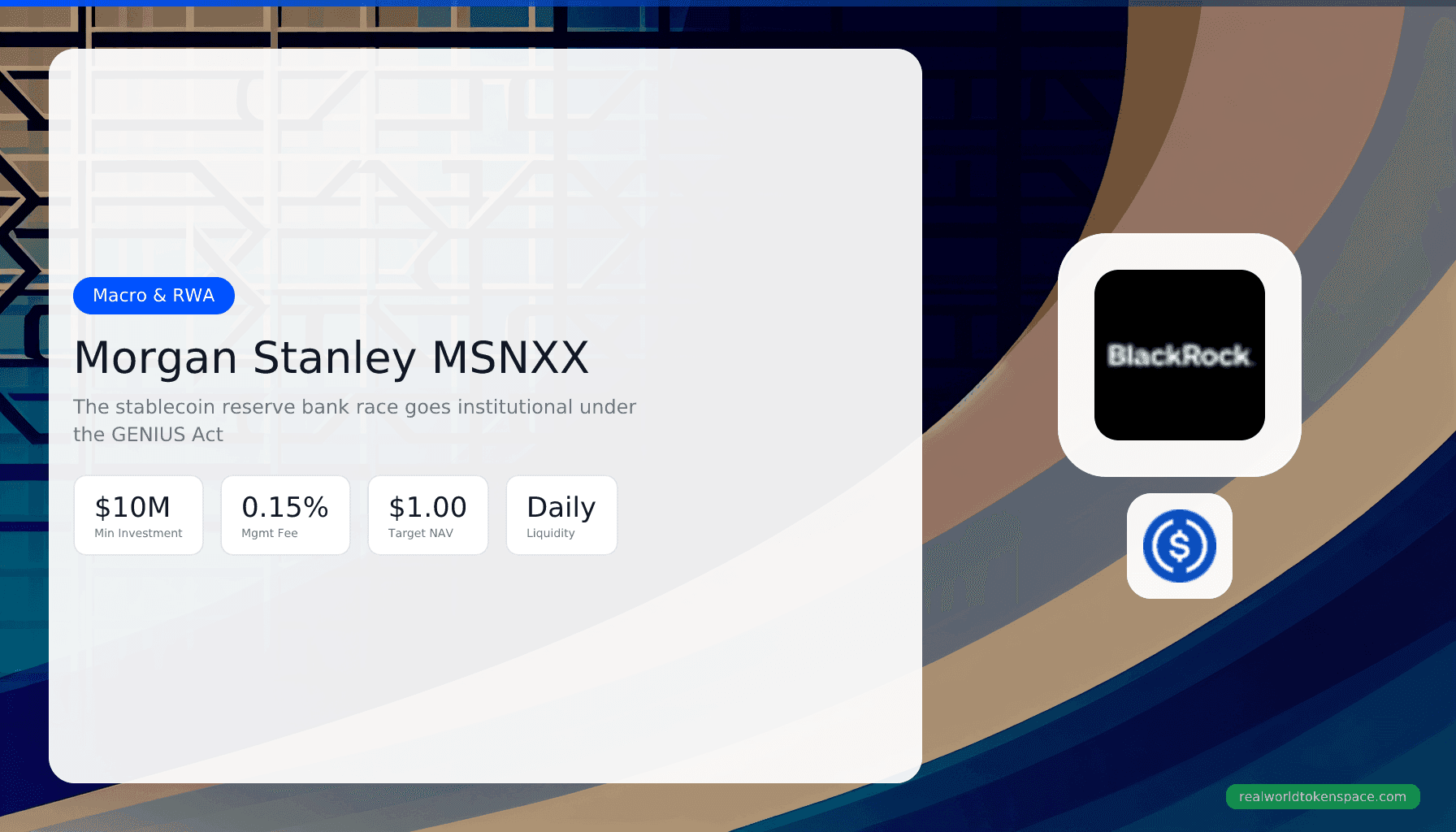
The fund targets a stable $1 NAV and offers same-day liquidity, two features that are non-negotiable for a stablecoin reserve product. Stablecoin issuers cannot tolerate gating or rounding errors on redemptions because those frictions translate directly into peg breakdowns. MSNXX's construction is therefore not exotic. It is deliberately the most boring product that satisfies the regulatory bar. The interesting feature is the customer it is built for.
The fund is sized for institutional demand. The $10 million minimum and 0.15% fee exclude retail entirely, which is appropriate because retail does not run stablecoin reserves. The customer set Morgan Stanley names explicitly in its marketing materials includes Circle, Tether, and World Liberty Financial, alongside the dozen-plus payment stablecoin issuers expected to register under the GENIUS Act once the implementation rules finalize.
The GENIUS Act Forcing Function
To understand why MSNXX exists at this exact moment, it helps to read the regulation rather than the press release. Per the official text of S.1582 on Congress.gov and Paul Hastings's compliance guide to the GENIUS Act, permitted payment stablecoin issuers must maintain reserves at a one-to-one ratio against outstanding tokens, restricted to a specified asset list. The list is short. It includes US dollars, insured deposit accounts, short-duration Treasury bills with 93-day or shorter maturity, overnight repos backed by those same Treasuries, and a few narrowly defined cash equivalents.
That asset list maps almost exactly onto the holdings of a government money market fund. The GENIUS Act effectively nationalizes the asset side of stablecoin balance sheets, channeling reserves into Treasury-related instruments and away from corporate paper, longer-duration debt, or anything resembling a yield-reaching strategy. The Federal Register entry from April 10, 2026 on FDIC implementation rules, available at federalregister.gov, makes the operational requirements clear: monthly attestations, public disclosure of reserve composition, and tight constraints on permissible commingling.
For an issuer like Tether or Circle, the practical effect is that the historical strategy of holding meaningful reserve allocations in commercial paper, corporate debt, or even longer-duration Treasuries is no longer compliant. The reserves either sit in cash, sit in short Treasuries directly, sit in a 2a-7 government money market fund, or get held through a tokenized wrapper of the same. Morgan Stanley's pitch is straightforward: outsource the reserve management to a primary dealer with a Treasury-trading desk that has been running 2a-7 funds for decades.
Why a Bank Wants This Business
Stablecoin reserves are a large and growing pool of dollar liquidity that, until now, has largely been managed in-house by issuers or held at custody banks. Per The Market Periodical's coverage of the launch, the global stablecoin market sits above $230 billion in circulating supply, with reserve assets behind those tokens approaching the same number when held at par. Every basis point of yield differential, every basis point of fee, and every dollar of float matters at that scale.
Morgan Stanley's fee on MSNXX is 0.15%. On a hypothetical $50 billion of stablecoin reserves under management, that translates to $75 million in annual fee revenue. The math is straightforward and structurally similar to what custodians earn on traditional money market sweeps. The strategic angle is more interesting than the fee math. Whoever wins the reserve management business owns visibility into stablecoin issuer cash flows, attestation timing, and growth trajectories, which is competitively valuable for a wholesale bank that is building tokenization infrastructure across other product lines.
This is the same logic that drove BNY Mellon to position itself as the primary custody and attestation partner for BUIDL (RWTS Trust Score: 84/100, Tier 2). It is the logic behind State Street's earlier 2025 push into tokenized fund servicing. Morgan Stanley arrives slightly later than the custody banks, but it brings a different asset, a primary dealer relationship to the Treasury market, and a wealth platform on which the same product can later be cross-sold to family offices and institutional treasuries.
How MSNXX Compares to Tokenized Treasury Products
The natural question for a stablecoin issuer evaluating MSNXX is how it stacks up against the existing tokenized Treasury products that have, until now, been the primary onchain alternative. The answer is that MSNXX and the tokenized Treasury wrappers are not competing for the same use case, even though they hold similar assets.
MSNXX is a traditional money market fund with daily NAV, daily liquidity, and offchain settlement through standard fund administration. It is appropriate for an issuer that wants to hold reserves in a regulated wrapper but does not need those reserves to be onchain. BUIDL, USYC, USDY, JTRSY, and IBENJI are tokenized representations of similar Treasury exposure that can be held onchain, used as collateral in DeFi protocols, and moved between wallets in seconds. Issuers that want their reserves to be programmable choose the tokenized wrapper. Issuers that want their reserves to be operationally simple choose the money market fund.
A direct comparison through the RWTS Trust Score framework, which evaluates Asset Backing, Proof of Reserves, Redeemability, Audit and Security, Regulatory Standing, and Track Record, looks roughly like this:
| Product |
Issuer |
Wrapper |
Onchain? |
Min Investment |
Net Yield (April 2026) |
RWTS Trust Score |
| MSNXX |
Morgan Stanley |
2a-7 Government MMF |
No |
$10M |
~4.6% |
Pending listing |
| BUIDL |
BlackRock + Securitize |
40-Act Fund Token |
Yes |
$5M |
~4.5% |
88/100 (Tier 2) |
| USYC |
Circle |
Hashnote Yield Coin |
Yes |
None (institutional) |
~4.7% |
83/100 (Tier 2) |
| JTRSY |
Centrifuge + Anemoy |
Onchain Treasury Pool |
Yes |
None |
~4.6% |
80/100 (Tier 2) |
| IBENJI |
Franklin Templeton |
OnChain MMF Token |
Yes |
$20K |
~4.4% |
81/100 (Tier 2) |
| USDY |
Ondo |
Tokenized Note |
Yes |
None (non-US) |
~4.8% |
83/100 (Tier 2) |
Net yields cluster in the 4.4% to 4.8% range across the board because all of these products hold the same underlying asset class. The differentiation is structural, not yield-based. Trust Score differentiation tracks the same dimensions: BUIDL scores 88 because BlackRock plus Securitize plus BNY Mellon attestation is a structurally robust stack, while Tier 2 tokenized products with newer issuers or thinner reporting score lower. MSNXX, once it is listed in the RWTS rating database, is likely to score in the same tier as the highest-rated tokenized products, because a 2a-7 government money market fund from a primary dealer is structurally as conservative as anything in the category.
Who Will Actually Use MSNXX
The realistic customer set for MSNXX is narrower than the press cycle suggests, at least in year one. Three groups make sense.
First, US-domiciled stablecoin issuers that want to use MSNXX as a regulated reserve wrapper to satisfy GENIUS Act compliance without rebuilding internal Treasury operations. Circle is the obvious candidate. Per CoinCentral's analysis of the launch, Circle has historically managed USDC reserves through a combination of BNY Mellon custody and direct holdings, and has separately built around USYC for the onchain reserve component. MSNXX gives Circle a third option for the offchain portion of its USDC reserves. World Liberty Financial, the issuer of USD1, is similarly positioned and has already named Morgan Stanley as a banking partner.
Second, non-US issuers operating under foreign equivalents of the GENIUS framework who want US Treasury exposure delivered through a US-regulated vehicle. Tether is the obvious candidate here, and Morgan Stanley has not been shy about naming Tether as a target customer in its marketing materials. Whether Tether actually allocates to MSNXX is a different question, given Tether's preference for direct Treasury holdings, but the option is on the table.
Third, crypto-native institutional treasuries that hold idle USDC, USDT, or USDe and want to convert that into a regulated yield-bearing reserve product without taking on tokenization complexity. Hedge funds, market makers, and DAO treasuries all fit this profile. The $10 million minimum is a meaningful gate, but a non-trivial fraction of the institutional crypto treasury world clears that bar comfortably.
The product is not built for retail. Anyone with less than $10 million looking for a similar yield profile should look at tokenized Treasuries directly, at sDAI for the Sky savings rate (RWTS Trust Score: 72/100, Tier 3), or at one of the higher-yielding lending strategies covered in the DeFi yields directory.
What This Signals for the Tokenization Market
Morgan Stanley's MSNXX launch is the clearest signal yet that traditional finance is no longer treating stablecoin reserves as a peripheral curiosity. The largest US wirehouse, with a multi-trillion-dollar wealth management franchise and one of the deepest Treasury trading desks on Wall Street, is now competing for the asset management mandate behind the stablecoin industry. That competition matters because it puts upward pressure on the quality of reserve management across the industry.
The second-order effect is that pure-play crypto-native reserve products will need to differentiate on something other than yield. The yield is going to be the same across every conservative wrapper because the underlying asset is the same. Differentiation will come from regulatory wrapper, tokenization features, redemption mechanics, and reporting transparency. This is exactly the dimensional space that the RWTS Trust Score was built to capture.
The third-order effect is that the GENIUS Act, by funneling reserves into a narrow asset list, structurally increases demand for short-duration Treasury bills. The Treasury Department's own analysis, referenced in the Treasury Department's GENIUS Act press release, projects that compliant stablecoin reserve demand could absorb $300 billion to $750 billion in incremental T-bill issuance over the next several years. That is a meaningful new buyer base for the front end of the Treasury curve, with implications for short-rate yields, repo rates, and the dollar funding stack that go well beyond crypto.
Risks and What to Watch
Three risks deserve flagging for any institution evaluating MSNXX or its competitors.
The first is regulatory. The GENIUS Act has passed, but the implementation rules are still being finalized. The FDIC, OCC, and Treasury Department are each consulting on different pieces of the regime, with comment windows running through June 2026 and final rules expected in the second half of the year. Until those rules are settled, there is residual uncertainty about exactly which reserve structures qualify and which need to be modified.
The second is concentration. If a meaningful fraction of stablecoin reserves consolidates into a small number of large money market funds, the failure or gating of any single fund becomes a systemic event for the entire stablecoin sector. The 2008-vintage Reserve Primary Fund "breaking the buck" is the historical analogue. SEC reforms after 2008 made breaking the buck materially less likely, but it is not impossible. Stablecoin issuers concentrating reserves in any single product, including MSNXX, take on a tail risk that did not exist when reserves were diversified across direct Treasury holdings, custody bank deposits, and a wider set of money market funds.
The third is custodial. MSNXX shares are held offchain at the fund administrator. An issuer using MSNXX as part of its reserve stack must explain to its own customers and its regulator how MSNXX shares are attested, audited, and reconciled against outstanding stablecoin supply. The operational machinery for this is solvable, but it is not free, and it is exactly the friction that the tokenized Treasury wrappers like BUIDL and JTRSY were built to eliminate.
How RWTS Will Score MSNXX
When MSNXX is added to the RWTS asset directory, it will be evaluated through the same six-dimension Trust Score framework used for every other yield-bearing product. The likely scoring shape, subject to verification of issuer documents and reserve attestations, looks like this:
Asset Backing (25 pts): MSNXX holds direct US Treasury bills and overnight repos backed by Treasuries. This is the highest-quality reserve composition possible. Likely score: 24-25 points.
Proof of Reserves (20 pts): Daily NAV reporting through the standard 2a-7 fund disclosure regime, monthly portfolio composition disclosure, and SEC-mandated stress test reporting. This is robust by traditional finance standards but lacks the realtime onchain attestation that tokenized wrappers provide. Likely score: 17-18 points.
Redeemability (15 pts): Same-day liquidity at $1 NAV under normal market conditions. The fund retains the ability to gate or impose liquidity fees in stressed markets under SEC rules, which is a small structural caveat. Likely score: 13-14 points.
Audit and Security (15 pts): Standard 1940-Act fund audit regime, custody at a major bank, and SEC examination authority. Smart contract risk is zero because the fund is not onchain. Likely score: 14-15 points.
Regulatory Standing (15 pts): SEC-registered, 2a-7 compliant, GENIUS Act-aligned by construction, issued by a tier-one wirehouse. This is the strongest possible regulatory standing in the category. Likely score: 15 points.
Track Record (10 pts): The fund is brand new. There is no track record to evaluate. Likely score: 4-5 points until the fund has at least 12 months of operating history.
Indicative total: 87-92/100, Tier 2. Final score will be published in the RWTS rating directory once the fund's first monthly disclosure cycle completes.
Frequently Asked Questions
What is the MSNXX ticker for?
MSNXX is the SEC ticker for Morgan Stanley Institutional Liquidity Funds Stablecoin Reserves Portfolio. It is a government money market fund designed to hold reserve assets for stablecoin issuers operating under the GENIUS Act framework.
Can retail investors buy MSNXX?
No. The fund has a $10 million minimum investment and is structured for institutional investors, primarily stablecoin issuers and crypto-native treasuries. Retail investors looking for similar Treasury yield exposure should look at tokenized Treasury products like USYC, USDY, or BUIDL through their respective issuer channels.
How does MSNXX yield compare to BUIDL or USYC?
Net yields across MSNXX, BUIDL, USYC, and USDY cluster in the 4.4% to 4.8% range as of April 2026, because all of these products hold short-duration US Treasury bills as their primary asset. Differentiation is structural rather than yield-based.
Is MSNXX onchain?
No. MSNXX is a traditional 2a-7 money market fund with offchain settlement through standard fund administration. Stablecoin issuers that want their reserves to be onchain and programmable use tokenized Treasury wrappers like BUIDL, USYC, JTRSY, or USDY. MSNXX is built for issuers that want a regulated wrapper without the tokenization layer.
Does the GENIUS Act require stablecoin issuers to use a specific reserve product?
No. The GENIUS Act specifies the asset class composition of permitted reserves, requiring short-duration Treasury bills, overnight Treasury-backed repos, insured deposits, and certain cash equivalents. Issuers can hold these assets directly, through money market funds like MSNXX, or through tokenized wrappers, as long as the underlying composition meets the statutory requirements.
What RWTS Trust Score is MSNXX expected to receive?
Indicative scoring puts MSNXX in the 87-92/100, Tier 2 range, similar to BUIDL and slightly above USYC. The final score will be published in the RWTS rating directory once the fund completes its first monthly disclosure cycle and a verified attestation of holdings is available.
The Takeaway
Morgan Stanley's MSNXX launch confirms that stablecoin reserves are now a contested institutional asset management mandate, and that the GENIUS Act is shaping the next phase of the tokenized dollar economy from the reserve side rather than the token side. For stablecoin issuers, the menu of compliant reserve options has expanded. For DeFi users, the practical effect is that the assets backing the stablecoins they hold are increasingly going to sit in regulated money market funds run by familiar Wall Street names, which is a structurally healthier setup than commercial-paper-heavy reserves but introduces a new concentration vector worth watching.
Related research
For the parallel BlackRock BUIDL move into exchange collateral that builds the same on-chain reserve thesis, see the BUIDL on OKX analysis. For the two-tier stablecoin yield structure that reserve choices feed into, see the stablecoin yield two-tier piece. For the broader yield landscape, see the 2026 stablecoin yield comparison.
Subscribe to The Yield Report for weekly yield intelligence across CeFi, DeFi, vaults, and tokenized RWA.
This article is for informational purposes only and is not financial, legal, or investment advice. RWTS Trust Scores are independent research opinions and should not be the sole basis for any investment decision. Verify all yields, fees, and product terms directly with issuers before allocating capital.