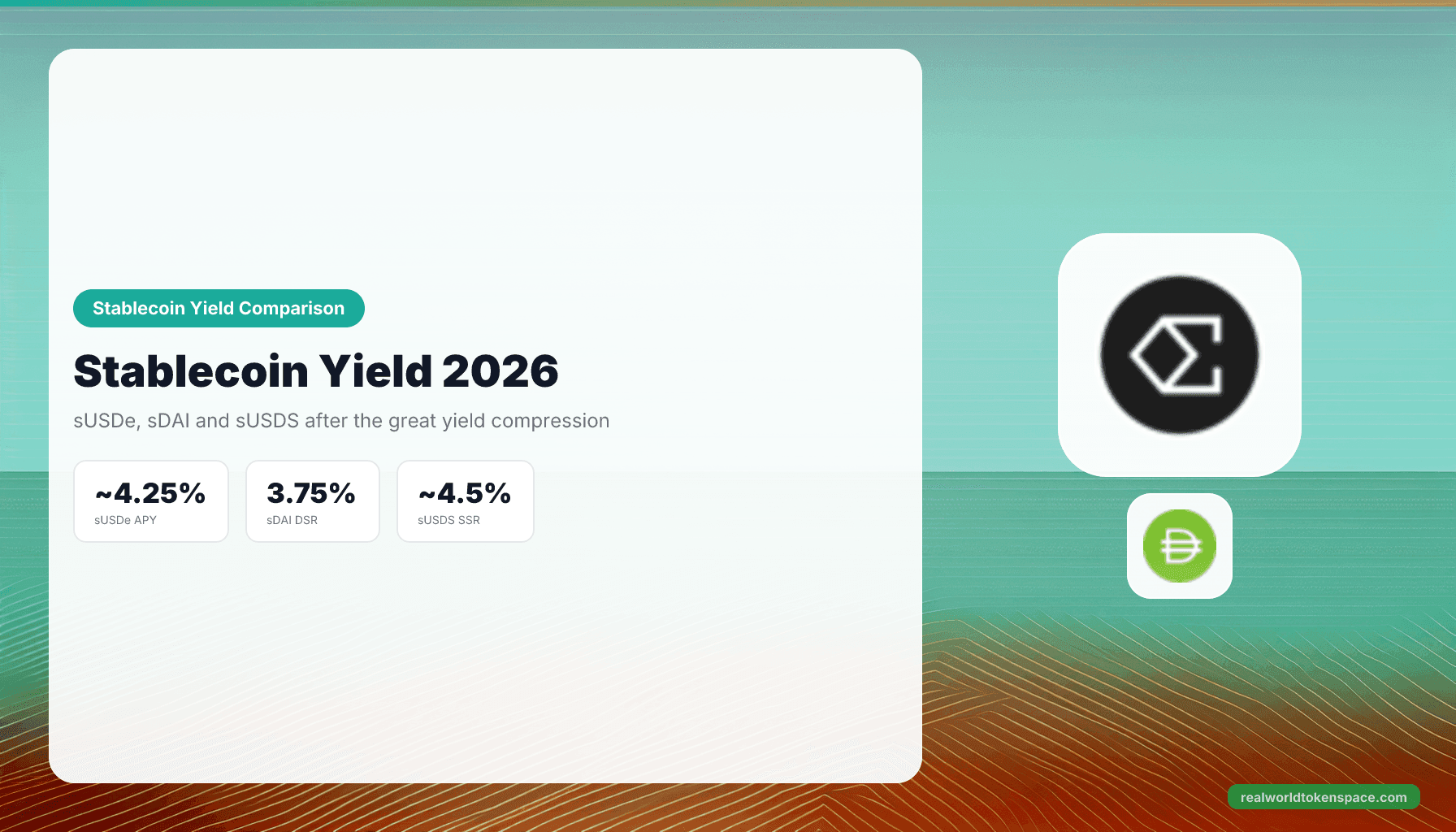
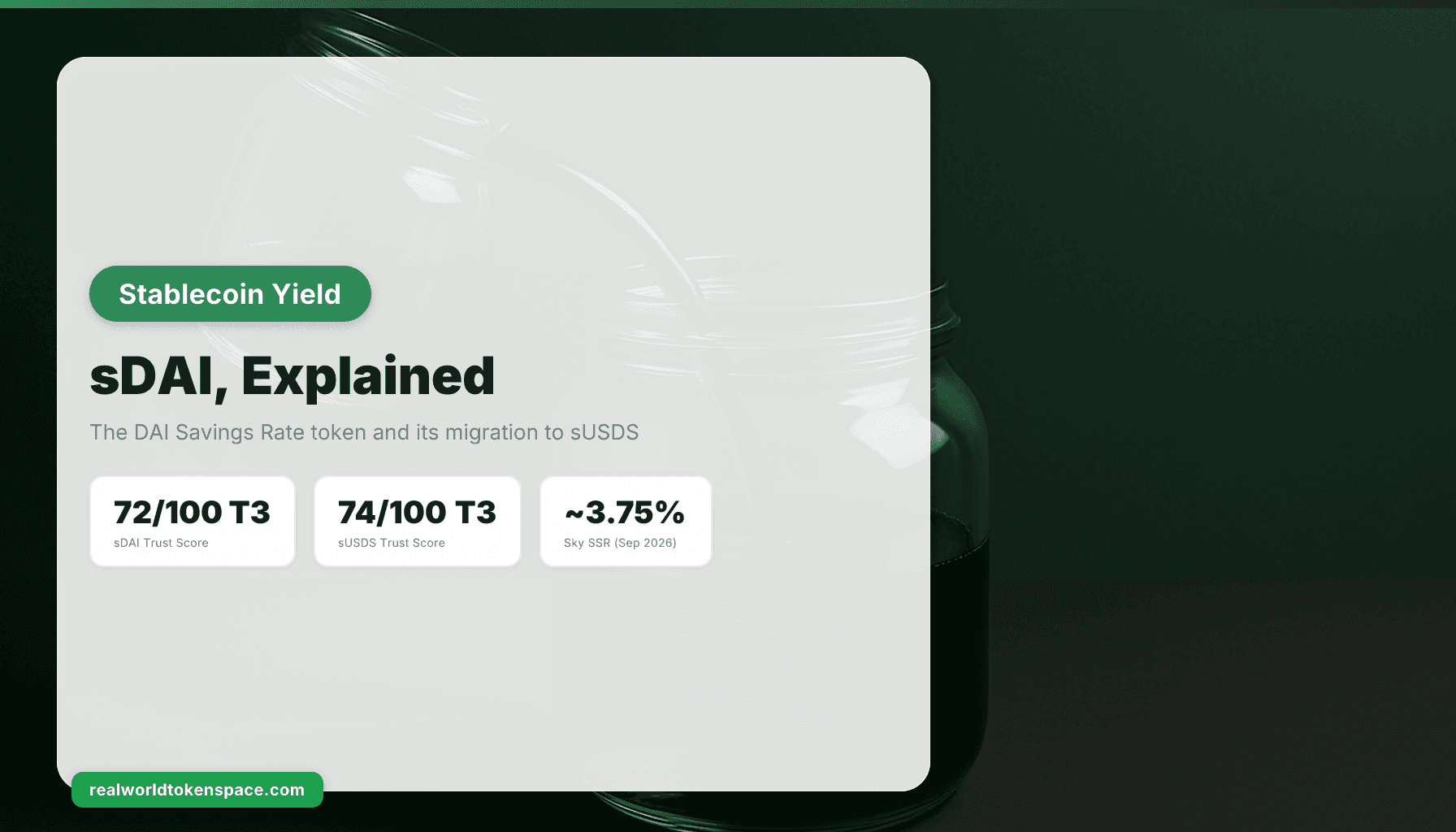
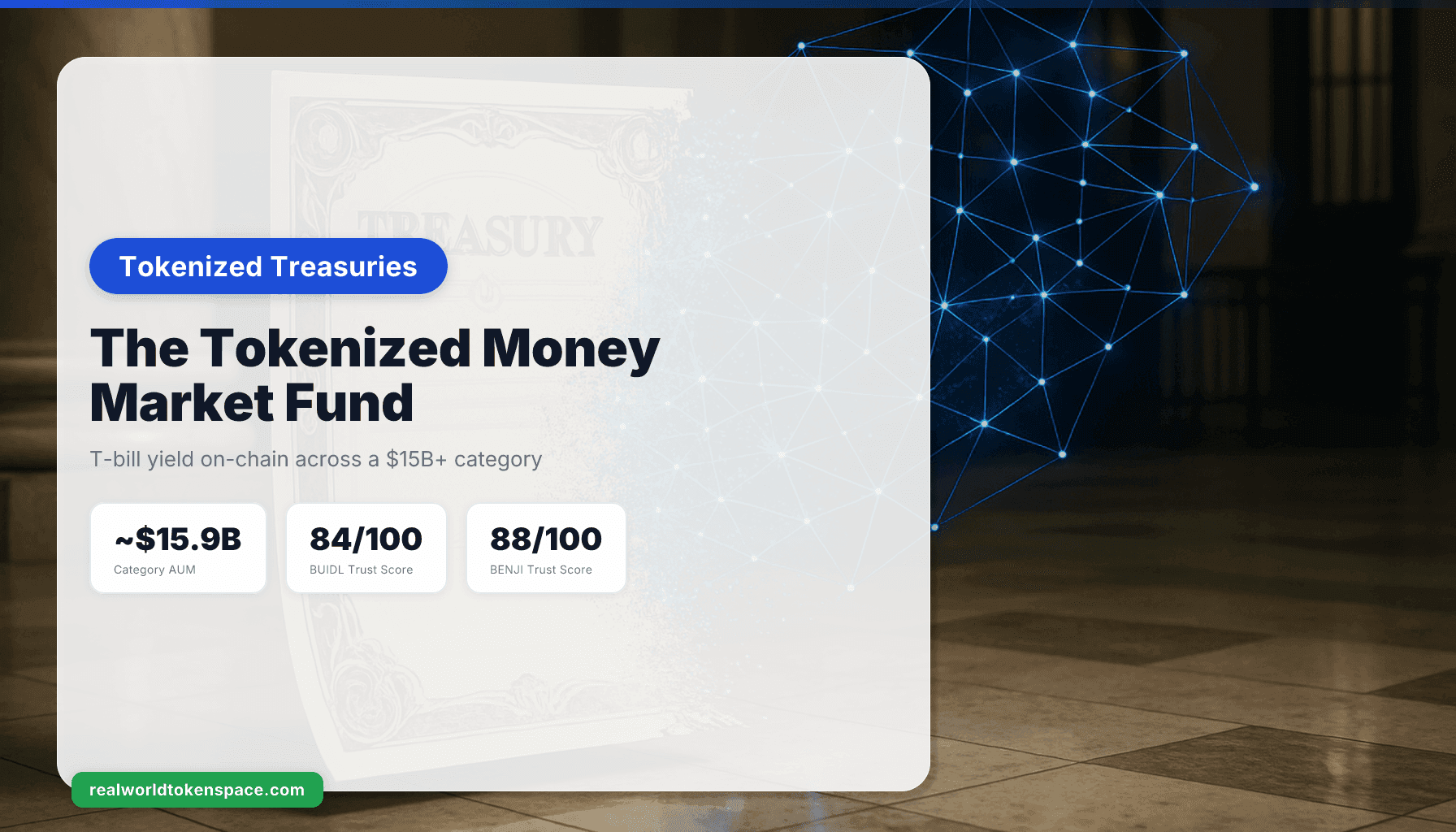
For sophisticated users, the picture is more nuanced. Looped sUSDe positions on Aave V3 or Pendle PT positions on yield-bearing stablecoins can still print 8% to 15% net yield, but introduce liquidation risk, basis risk, and discount rate risk that do not exist in unleveraged holding. The full ranking, sorted by net base yield as of April 28, 2026, looks like this:
| Rank |
Asset |
Issuer |
Base APY |
Structural Risk |
RWTS Trust Score |
Tier |
| 1 |
USYC |
Hashnote (Circle) |
~4.8% |
Treasury-backed, regulated |
83/100 |
Tier 2 |
| 2 |
USDY |
Ondo |
~4.8% |
Treasury-backed, regulated |
83/100 |
Tier 2 |
| 3 |
sUSDS |
Sky |
~4.5% |
Savings rate, RWA-backed |
Sky-derivative |
Tier 3 |
| 4 |
BUIDL |
BlackRock/Securitize |
~4.4% |
Treasury-backed, regulated |
84/100 |
Tier 2 |
| 5 |
sUSDe |
Ethena |
~4.25% |
Synthetic, funding-rate |
61/100 |
Tier 4 |
| 6 |
sDAI |
Sky (legacy) |
~3.75% |
DSR, RWA-backed |
72/100 |
Tier 3 |
| 7 |
C1USD |
Kinesis |
variable |
Bullion-yield backed |
76/100 |
Tier 2 |
The rest of this article walks through each category in depth, explains why the yields converged, and identifies the structural questions an allocator should ask before choosing between them.
Category 1: Synthetic Dollar Yield (sUSDe)
Ethena's sUSDe is the headline synthetic dollar product in 2026 and remains the largest yield-bearing stablecoin by deposit count even after a meaningful contraction in TVL. The current 4.25% APY on sUSDe is the result of a structural compression that reflects both lower funding rates and a deliberate de-risking of the protocol's collateral mix. Per RWTS coverage of the Q1 2026 reset, sUSDe's yield has moved from a 27% launch APY in March 2024 to its current handle, with USDe circulating supply contracting from a $14.6B peak to roughly $5.8B.
The mechanics are unchanged. sUSDe's yield is the pass-through of two streams: the staking yield on the crypto-denominated long leg, primarily stETH, and the funding rate earned on a short perpetual position that hedges the crypto exposure to dollars. When perpetual funding is positive, the basis trade earns; when funding flips negative, sUSDe earns less or could in theory earn nothing. The compressed yield reflects three things: a lower mix of perpetual exposure as Ethena rotates collateral toward USDtb and BUIDL, lower BTC and ETH funding rates through Q1, and a lower base staking yield on the long leg.
For yield allocators, the structural question on sUSDe in 2026 is whether the synthetic dollar premium is still being paid. A year ago, sUSDe paid 800 to 1,500 basis points more than sDAI. Today the premium is 50 basis points. The reserve fund, currently sized at roughly 1.18% of TVL per Ethena's transparency dashboard, is the primary backstop against negative funding regimes. Its size relative to TVL matters far more than the headline yield number.
RWTS rates sUSDe at 61/100, Tier 4 ("Synthetic & Structured"). The score reflects the synthetic nature of the backing, the dependence on perpetual exchange counterparties, and the smaller reserve fund coverage relative to base savings rate alternatives. The full methodology is on the RWTS Rating page. For users who want the structural premium of synthetic dollar yield, sUSDe is still the cleanest expression in DeFi. For users who care about trust-weighted return, the next two categories rank higher.
What Is the Real Yield on sUSDe in 2026?
The reported APY on sUSDe is a 7-day moving average of the actual yield paid to stakers from the protocol's hedging book. Per Stablecoin Insider's tracking of sUSDe APY through Q1 2026, the 7-day moving average has ranged from 3.5% to 7% over the past four months, with the current handle near 4.25% and stretches above 7% during high-funding regimes. The trailing 12-month yield is closer to 6%, but the forward-looking number is what matters for new allocations.
Looped sUSDe positions on Aave V3 or Morpho can amplify the headline yield by 2x to 3x, taking a 4.25% spot yield to 8% to 12% on a leveraged basis. The cost is a liquidation threshold tied to the sUSDe-to-USDC price ratio, which has historically been very stable but is not pegged. RWTS does not recommend leveraged sUSDe positions for retail allocators given the discount rate risk profile, which we covered in our Aave V4 hub-and-spoke analysis.
Category 2: Savings Rate Stablecoins (sDAI and sUSDS)
The Sky ecosystem's two yield-bearing stablecoins, sDAI (legacy) and sUSDS (current), are the cleanest "real yield" expressions in DeFi in 2026. Both pay out a savings rate funded by Sky's own protocol revenue, which is itself a blend of stability fees on Maker-style collateralized debt positions, RWA-backed yield from custodial Treasury managers, and DeFi lending revenue from the Sky Agent Network. The ultimate source of yield for both is the same: real economic activity priced against the risk-free rate of US Treasuries.
The difference between sDAI and sUSDS is mostly migration mechanics. Per Sky's developer documentation, sUSDS is the modern token issued through the rebranded Sky protocol; sDAI is the legacy token still supported but slated for deprecation as the migration to USDS completes. Yield is similar but not identical. The current Dai Savings Rate (DSR) on sDAI prints at approximately 3.75% APY per the live Sky dashboard, while the Sky Savings Rate (SSR) on sUSDS prints higher at roughly 4.5%. Per Eco's USDS Sky Protocol guide, the SSR has ranged from 3.75% to 4.5% APY through Q1 2026, tracking US Treasury yields and Sky governance allocator decisions.
For yield allocators, the SSR and DSR are the closest analog in DeFi to a money market fund yield. The capital is overcollateralized by RWA-backed reserves, the issuer (Sky) has a multi-year operating history dating back to MakerDAO's 2017 launch, and the smart contracts have been battle-tested through multiple market cycles. The structural risk is that the SSR is set by Sky governance and can change at any monthly vote. Holders are exposed to governance risk; they are not exposed to funding-rate risk or perpetual exchange counterparty risk.
RWTS rates sDAI at 72/100, Tier 3 ("Secured DeFi"). The score reflects the strong RWA backing, multi-year track record, and clear redemption mechanism, with the Tier 3 placement reflecting that this is overcollateralized DeFi exposure rather than a directly-redeemable Treasury claim. sUSDS inherits the same risk profile and would score similarly. Compared to sUSDe at 61/100, sDAI offers roughly 60 basis points lower base yield in exchange for a meaningfully different and tighter risk envelope.
Why sUSDS Yield Is Higher Than sDAI
The 75 basis-point spread between sUSDS (4.5%) and sDAI (3.75%) is not a free arbitrage. Sky has structured the SSR as the primary yield product going forward and the DSR as a legacy product slated for sunset. The migration incentive is built into the rate spread. Per Sky's USDS migration documentation, sUSDS holders receive a higher base rate plus access to the Sky Agent Network's diversified yield strategies, which include allocations to Spark, Morpho, and other DeFi protocols approved by Sky governance.
Practically, the migration from sDAI to sUSDS is a one-step swap that takes a few seconds on the Sky dApp. For most allocators, holding sDAI in 2026 is leaving 75 basis points on the table without a corresponding risk benefit. The two products share the same issuer, the same governance, and substantially the same collateral backing. The migration to sUSDS is the dominant strategy for anyone holding legacy sDAI, with the caveat that some DeFi integrations (older Curve pools, some lending markets) still default to sDAI as the canonical asset.
Category 3: Tokenized Treasury Proxies (USYC, USDY, BUIDL)
The third category in any 2026 stablecoin yield comparison is tokenized treasuries. These are not technically stablecoins, but for an allocator looking for dollar-denominated yield with daily settlement, they fill the same role as a yield-bearing stablecoin and have the highest RWTS Trust Scores in the category. As of April 2026, the tokenized US Treasury market sits at $14B, a 37x increase from early 2023.
Per CoinReporter's coverage of the milestone, Circle's USYC leads with $2.9B in assets, BlackRock's BUIDL has surpassed $2.5B, and Ondo's USDY leads the sub-billion pack with $972.2M. The yields have stabilized in April 2026 in the 4.4% to 4.8% range as the 2-year Treasury yield holds near 3.72% and dollar markets digest the indefinite extension of the US-Iran ceasefire.
For yield allocators, the tokenized treasury proxies offer a different value proposition than savings-rate stablecoins. The collateral is a regulated, audited Treasury fund managed by a TradFi sponsor (BlackRock for BUIDL, Circle for USYC, Ondo for USDY), the redemption is structured as a same-day or T+1 redemption against the issuer, and the yield tracks the Federal Reserve's policy rate plus a small spread. The tradeoff is that these are securities, not stablecoins, and require KYC for direct minting. Many are accessible only to qualified or institutional investors at the issuer level, though secondary market liquidity has grown substantially in 2026.
RWTS Trust Scores for the category sit at the top of the entire stablecoin yield universe: BUIDL at 84/100, USYC at 83/100, USDY at 83/100, all Tier 2 ("Treasury & Fiat-Backed"). For an allocator who can access these products, they offer comparable yield to sUSDS at substantially higher trust-weighted return. The full breakdown is in our tokenized treasuries 14B milestone article.
Side-by-Side: When to Use Each
The right stablecoin yield product depends entirely on the use case. The full decision tree splits along three axes: yield needed, risk tolerance, and access requirements.
For a retail user holding USDC who wants the cleanest yield without taking custody risk, the dominant strategy in 2026 is to either swap into Coinbase USDC onchain lending for the 10.8% Morpho-incentivized rate or to swap into sUSDS for the 4.5% savings-rate yield. The first choice maximizes near-term yield with curated DeFi exposure; the second maximizes simplicity and trust-weighted return.
For an institutional allocator with access to issuer-level minting, the dominant strategy is to hold tokenized treasuries directly: BUIDL or USYC for primary allocation, with sUSDS as a secondary DeFi-native exposure for situations where the capital needs to be onchain-composable. The tokenized treasury approach captures the highest RWTS Trust Scores at comparable yield, with a clean redemption path against a regulated TradFi sponsor.
For a yield-maximizer willing to take leverage and basis risk, sUSDe looped on Aave or Pendle is the highest-yielding stablecoin position in DeFi, currently printing 8% to 12% on a 2x to 3x leveraged basis. The structural risks include sUSDe-to-USDC discount rate risk, Aave's recent USDC market freeze, and Pendle PT discount rate dynamics. None of these are catastrophic; all of them are non-zero, and the historical record shows that leveraged stablecoin positions have unwound violently in past stress events.
| Use Case |
Recommended Product |
Expected APY |
Risk Tier |
| Passive retail USDC holder |
sUSDS or Coinbase Onchain |
4.5% to 10.8% |
Tier 2 to Tier 3 |
| Institutional treasury allocation |
BUIDL, USYC, USDY |
4.4% to 4.8% |
Tier 2 |
| DeFi-composable savings |
sUSDS |
~4.5% |
Tier 3 |
| Synthetic dollar premium hunter |
sUSDe (unleveraged) |
~4.25% |
Tier 4 |
| Yield maximizer with leverage |
Looped sUSDe or Pendle PT |
8% to 15% |
Tier 4 |
| Conservative gold-yield blend |
C1USD (Kinesis) |
variable |
Tier 2 |
The Compression Story: Why All These Yields Converged
The convergence of stablecoin yields in 2026 to a 4.25% to 4.8% band is not random. Three structural factors drove it.
The first factor is monetary policy. The Federal Reserve has held the federal funds rate at 4.00% to 4.25% through Q1 2026 after a measured rate-cutting cycle from the 5.25% peak. Every yield-bearing stablecoin in this comparison is ultimately benchmarked against the front-end of the Treasury curve. When the Fed cuts, savings rate stablecoins compress with it; when funding rates compress, synthetic dollar yields compress with them. The 50 basis-point spread between sUSDe and sUSDS reflects the residual synthetic dollar premium, which has shrunk dramatically from earlier cycles.
The second factor is supply normalization at Ethena. As covered in our USDe collateral overhaul article, Ethena has deliberately reduced its perpetual exposure share, moving collateral toward institutional lending and tokenized treasuries. This reduces tail risk on USDe but also caps the upside of the funding-rate hedge. The protocol is structurally smaller and structurally lower-yielding than it was at peak.
The third factor is the maturation of tokenized treasuries. With $14B of tokenized Treasury supply offering 4.4% to 4.8% yields backed by short-duration T-bills, the marginal yield-seeking dollar in DeFi now has a clean alternative to synthetic and savings-rate stablecoins. This places a hard floor on what unsecured DeFi lending can pay before capital rotates out, and it places a hard ceiling on what synthetic stablecoins can charge as a "safety premium" over Treasury-backed alternatives.
The result is a stablecoin yield market that looks more like a TradFi money market in 2026 than the high-variance lottery it was in 2022 to 2024. For most allocators this is a feature, not a bug. The risk-adjusted return on dollar-denominated yield is meaningfully better today than it was when sUSDe was paying 27% on a leveraged perpetual book.
Risk Frameworks: What Each Product Is Actually Exposed To
Yield comparisons that focus only on APY miss the structural risk that distinguishes these products. Each category sits on a different point of the risk curve.
sUSDe is exposed to perpetual funding-rate compression, exchange counterparty risk on the venues where Ethena hedges (primarily Binance, Bybit, OKX, and Deribit), and to the smart contract risk of the Ethena minting and staking architecture. The reserve fund is the first-loss capital against negative funding, and at roughly 1.18% of TVL, it is sized for short-duration adverse periods, not for sustained negative funding regimes. Per OKX's analysis of discount rate risk in PT-leveraged Ethena strategies, looped sUSDe positions also face additional discount rate dynamics that can amplify losses during volatile yield repricings.
sDAI and sUSDS are exposed to Sky governance risk (the rate can be cut at any monthly vote), to the credit risk of the underlying RWA-backed allocators, and to smart contract risk on the Sky DSR and SSR contracts. The track record is excellent; the protocol has not had a yield interruption or a peg event in its decade-plus operating history. The structural risk is governance, not collateral: a Sky vote could cut the SSR to zero, though the protocol's revenue-sharing economics make this extremely unlikely as long as the underlying collateral is earning.
Tokenized treasuries (BUIDL, USYC, USDY) are exposed to issuer credit risk, to the operational risk of the custodian and transfer agent, and to redemption queuing during stress periods. The collateral is the safest in the entire stablecoin yield universe (US Treasuries), but the wrapper introduces a thin layer of TradFi counterparty risk. For most allocators this is a desirable trade.
How RWTS Trust Scores Differentiate
The full RWTS Trust Score methodology is on the RWTS Rating page. The framework scores assets across six dimensions: asset backing (25 pts), proof of reserves (20 pts), redeemability (15 pts), audit and security (15 pts), regulatory standing (15 pts), and track record (10 pts). The dimensional differences between these stablecoins explain why a 4.25% yield on sUSDe does not equal a 4.25% yield on sUSDS or BUIDL.
sUSDe at 61/100 loses points primarily on asset backing (synthetic, not directly redeemable for the underlying), regulatory standing (offshore issuer, no direct US compliance), and proof of reserves (transparency exists but the structure is harder to audit at the collateral level). It earns full marks on smart contract audit quality and a strong track record since launch.
sDAI at 72/100 picks up significant points on asset backing (overcollateralized RWA), audit and security (multi-year battle-tested), and track record (longest in the category by a wide margin). It loses points relative to tokenized treasuries on redeemability (no direct claim against US Treasuries) and on regulatory standing (governance protocol, not a regulated issuer).
BUIDL at 84/100 sits at the top of the entire DeFi-adjacent stablecoin yield universe. The collateral is short-duration US Treasuries managed by BlackRock, the redemption is direct against Securitize, the audit and regulatory framework is full TradFi grade, and the operating record is approaching two years. The only points lost are on smaller-issuer track record (less than five years operating) and a small audit-and-security deduction reflecting the early state of tokenized fund infrastructure.
This is why a stablecoin yield comparison that ignores trust scoring is incomplete. A 4.25% yield with a 45/100 trust score is not the same allocation as a 4.4% yield with an 88/100 trust score, even if the dollar-denominated return is similar.
Practical Allocation: A Sample 2026 Stablecoin Yield Portfolio
For an allocator with $1M of dollar-denominated capital looking to maximize trust-weighted yield in 2026, a defensible portfolio construction looks like this:
40% to BUIDL or USYC (tokenized treasury core), 30% to sUSDS (DeFi-composable savings), 20% to Coinbase USDC onchain or Morpho-curated USDC vault (curated DeFi yield), 10% to sUSDe or looped sUSDe for synthetic dollar premium. The blended yield on this portfolio sits at approximately 5.2% to 6.0% depending on the curated vault selected, with a weighted average RWTS Trust Score above 75/100. This is materially better than a pure sUSDe allocation on both yield and trust-weighted return.
For comparison, a "yield-maximizer" portfolio that goes 100% leveraged sUSDe can print 10% to 12% net yield but does so with a single-product trust score of 61/100 and meaningful liquidation risk. The tradeoff is real; it is not a free lunch. The blended approach captures most of the yield with substantially less tail risk.
Risk and Disclaimer
This article is for educational purposes only and does not constitute financial advice. Yields on yield-bearing stablecoins shift weekly or daily and are not guaranteed. Past performance is not indicative of future results. Synthetic dollar products like sUSDe carry funding rate risk that can result in negative yield periods. Savings rate products like sDAI and sUSDS carry governance risk, and the rates can be changed at any monthly vote. Tokenized treasuries carry issuer credit risk and redemption queuing risk during stress periods. Always verify current rates against the live protocol dashboard before allocating capital, and consider consulting a financial advisor.
Subscribe
Subscribe to The Yield Report for weekly yield intelligence across CeFi exchanges, DeFi vaults, and tokenized assets. Sign up at /newsletter for the curated weekly digest.
FAQ
What is the highest yield stablecoin in 2026?
The highest unleveraged yield stablecoin in 2026 is generally USYC or USDY at roughly 4.8% APY, both backed by short-duration US Treasuries. With curated DeFi exposure, Coinbase USDC onchain lending prints up to 10.8% via Morpho-curated vaults on Base. With leverage, looped sUSDe positions can reach 8% to 12% but introduce liquidation and discount rate risk.
Is sUSDe safer than sDAI?
No. sDAI carries a higher RWTS Trust Score (72/100, Tier 3) than sUSDe (61/100, Tier 4) and is structurally backed by overcollateralized real-world assets via Sky's allocator system. sUSDe is a synthetic dollar backed by a delta-neutral derivatives position. Both are reasonable allocations for different use cases, but on a trust-weighted basis sDAI ranks higher. See our sUSDe safety review for the full risk breakdown.
Should I migrate from sDAI to sUSDS?
For most holders, yes. sUSDS pays roughly 75 basis points higher than sDAI (4.5% vs 3.75%) with substantially the same risk profile, the same issuer (Sky), and substantially the same collateral. The migration is a one-step swap on the Sky dApp. The exception is users with sDAI locked into specific DeFi integrations (Curve pools, older lending markets) where the migration would force a rebuilding of dependent positions.
What is the difference between sUSDS and USDS?
USDS is Sky's flagship dollar stablecoin, the modern successor to DAI, and it does not earn yield by default. sUSDS is the staked or wrapped version of USDS that earns the Sky Savings Rate. Holding USDS gives you the dollar peg without yield; converting to sUSDS layers the SSR on top. The conversion is reversible at any time on the Sky dApp.
How do tokenized treasuries compare to yield-bearing stablecoins?
Tokenized treasuries (BUIDL, USYC, USDY) currently offer comparable yields (4.4% to 4.8%) to the highest-yielding stablecoins, with materially higher RWTS Trust Scores (80 to 84/100, Tier 2). The tradeoff is access: tokenized treasuries typically require KYC for direct minting and may be limited to qualified investors at the issuer level. Secondary market liquidity has grown in 2026 but is still thinner than for yield-bearing stablecoins. For most retail users, sUSDS or curated USDC vaults are easier to access; for institutional allocators, tokenized treasuries are the dominant choice.
What happened to the 27% sUSDe yields?
The 27% sUSDe APY at March 2024 launch reflected an extreme funding-rate environment with Bitcoin perpetuals trading at 80%+ annualized funding plus a high-mix of leveraged collateral. As perpetual funding compressed through 2024 and 2025, as Ethena rotated collateral toward more conservative tokenized Treasury exposure (USDtb, BUIDL), and as the protocol's circulating supply contracted from $14.6B peak to $5.8B today, the headline yield compressed in step. The 4.25% current handle is a more realistic forward-looking yield for the synthetic dollar architecture in a normalized funding environment.