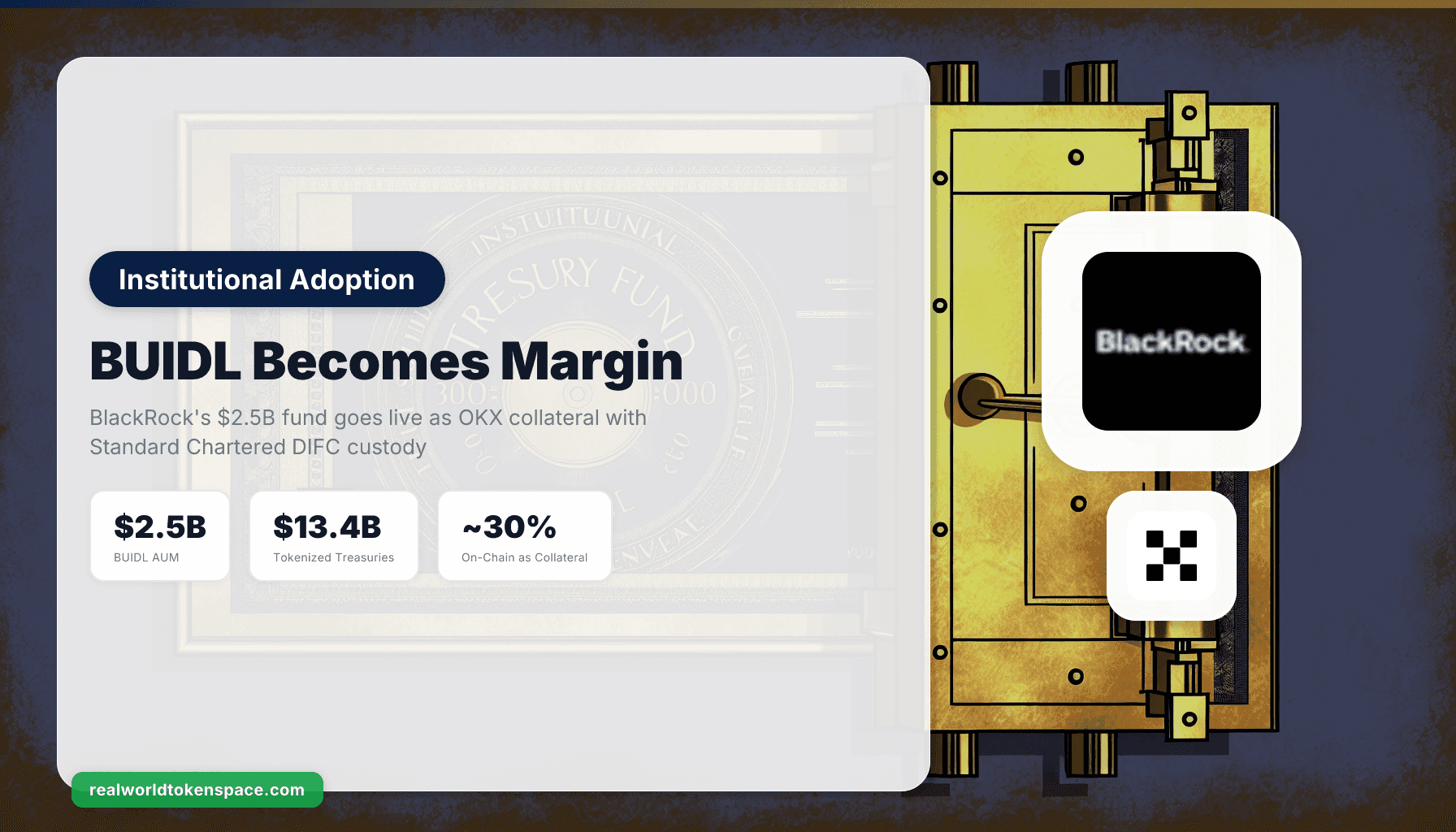
On April 28, 2026, BlackRock's $2.5 billion tokenized money market fund, BUIDL, went live as posted collateral on OKX, with Standard Chartered's Dubai International Financial Centre entity holding the underlying tokens in regulated custody. Per The Crypto Times, traders on OKX can now post BUIDL as margin while the fund continues to accrue Treasury yield, replacing the historically idle USDT and USDC balances that sat in exchange wallets earning nothing.
The move closes a gap that has been obvious to institutional desks for two years: derivatives venues require collateral, money market funds pay yield, and there is no economic reason the same dollar should not do both. With BUIDL on OKX, the dollar finally does.
The Architecture: Custody Off-Exchange, Margin On
The OKX integration uses what Standard Chartered and OKX have described in prior pilots as a "tokenized collateral mirror." BUIDL tokens never leave Standard Chartered DIFC custody. Instead, the custodian publishes a verifiable balance attestation that OKX's risk engine consumes as available margin. If the trader is liquidated, OKX has a contractual claim on the custodied tokens, redeemable in USD or in kind at NAV. Per Edgen's coverage, the structure was approved under the DIFC's regulated digital asset custody regime, which materially de-risks counterparty exposure compared with on-exchange wallets.
This matters because the historical objection to using yield-bearing instruments as exchange collateral was always: "what if the exchange goes down." After FTX, that question has a stricter answer than it did in 2022. By keeping BUIDL custodied at a globally systemic bank rather than on the exchange's balance sheet, the structure is substantially closer to how a prime broker treats Treasury collateral for a hedge fund than to how a crypto exchange historically treated USDT.
Why Now: Capital Efficiency Pressure
Two trends converged to make this launch inevitable in 2026. First, tokenized U.S. Treasuries grew from $380 million in Q1 2023 to $13.4 billion by April 2026, per RWA.xyz data cited in industry coverage. That is a 35x expansion in three years, and roughly 30% of the on-chain Treasury supply, near $2.2 billion, is now actively pledged as DeFi or exchange collateral rather than sitting idle, per BanklessTimes reporting.
Second, the funding rate compression in crypto perpetuals through Q1 2026 has pushed market makers and basis traders to scrutinize every basis point of opportunity cost. With sUSDe yields collapsing toward 3.7% per recent Messari data and Treasury bills printing in the high 3s, a desk holding $100M of stablecoin margin is leaving roughly $3.7M a year on the table. Posting BUIDL instead recaptures that yield with minimal operational change.
OKX is the fourth major venue to take BUIDL as collateral, after Crypto.com and Deribit in mid-2025 and Binance in November 2025, when BlackRock's fund was simultaneously listed as collateral on Binance and expanded to BNB Chain, per CoinDesk. Each integration narrows the spread between holding tokenized Treasuries on-chain and using them in trading workflows.
RWTS Trust Score: Tier 1 Reaffirmed
BUIDL retains a Tier 1 rating on the RWTS Trust Score framework, anchored by:
- Issuer quality. BlackRock is the underlying fund manager; Securitize is the on-chain transfer agent. Both are regulated entities with a multi-year track record on this product.
- Reserve transparency. Holdings are short-duration Treasuries, repurchase agreements, and cash, with daily NAV publication and monthly attestations.
- Custody. Standard Chartered DIFC is a globally systemic bank with a digital asset custody license under a recognized regulator, materially stronger than self-custody or unregulated qualified custodians.
- Redemption. Same-day NAV redemption available via Securitize for accredited holders, with USDC redemption rails for retail-facing wrapped versions.
The OKX integration does not change BUIDL's risk profile materially. The collateral is custodied off-exchange, redemption rights flow through Securitize, and OKX's exposure is operational rather than reserve-related. For a desk evaluating where to park margin, that is a stronger structure than holding USDT directly on OKX, where the user is exposed to both Tether's reserve composition and the exchange's wallet integrity.
What This Signals for Tokenized Treasury Adoption
Three implications stand out.
First, the BUIDL-as-collateral playbook has now been replicated four times in eleven months. That is the pattern of a standard, not a one-off. Expect Coinbase International, Bybit, and Bitget to follow within Q2 and Q3 2026, particularly as competitive pressure on collateral terms intensifies.
Second, this further widens the gap between BUIDL and second-tier tokenized Treasury products. Hashnote's USYC, Ondo's OUSG and USDY, and Franklin's BENJI all have on-chain liquidity, but only BUIDL has the BlackRock brand and the custodial relationships needed for the largest exchanges to underwrite the collateral. The "tokenized Treasury" category is not a commodity; the integration list is the moat.
Third, the structure pulls institutional cash flow on-chain by stealth. A trading firm that posts BUIDL on OKX is, technically, holding a tokenized claim on a BlackRock fund administered by a U.S. transfer agent, custodied by a global systemic bank, that happens to settle on Ethereum. The on-chain components are infrastructure; the financial product is recognizably traditional. This is what mainstreaming looks like, and it does not require retail to ever touch a wallet.
What to Watch
Three signals over the next 60 days will indicate whether the BUIDL collateral model becomes a category standard or stays niche:
- AUM growth at BUIDL. If the OKX integration drives $300M to $500M in net new flows by mid-Q3, that confirms exchange collateral is a meaningful demand channel. BUIDL has hovered near $2.5B for several months; a step-change above $3B would be the tell.
- Competitor responses. Watch whether Franklin Templeton's BENJI or Hashnote's USYC announce comparable integrations. USYC has historically been favored on Deribit and Crypto.com; if it reaches Binance or OKX, the field broadens.
- Cross-margining with crypto. The next frontier is not BUIDL as standalone collateral but BUIDL as part of a portfolio margin calculation alongside BTC, ETH, and altcoin perpetuals. OKX's risk engine has the precedent. If portfolio margining rolls out, capital efficiency for crypto-native funds steps up another order of magnitude.
The simple read on April 28: institutional cash management on crypto exchanges has a new default, and it earns yield. The harder read is that this is the moment tokenized Treasuries graduate from a curiosity to plumbing. The next twelve months will be measured in adoption velocity, not in whether the category is real.
Related research
For the wider tokenized-Treasury landscape this listing slots into, see the tokenized treasuries 14B milestone analysis and the tokenized treasury market competition piece. For Ondo's parallel push past $3B in TVL, see the Ondo $3B TVL breakdown. The RWTS Trust Score methodology is on the RWTS Rating page.
Sources
Stay Ahead of the Yield Curve
Subscribe to The Yield Report for weekly yield intelligence.
Subscribe Now