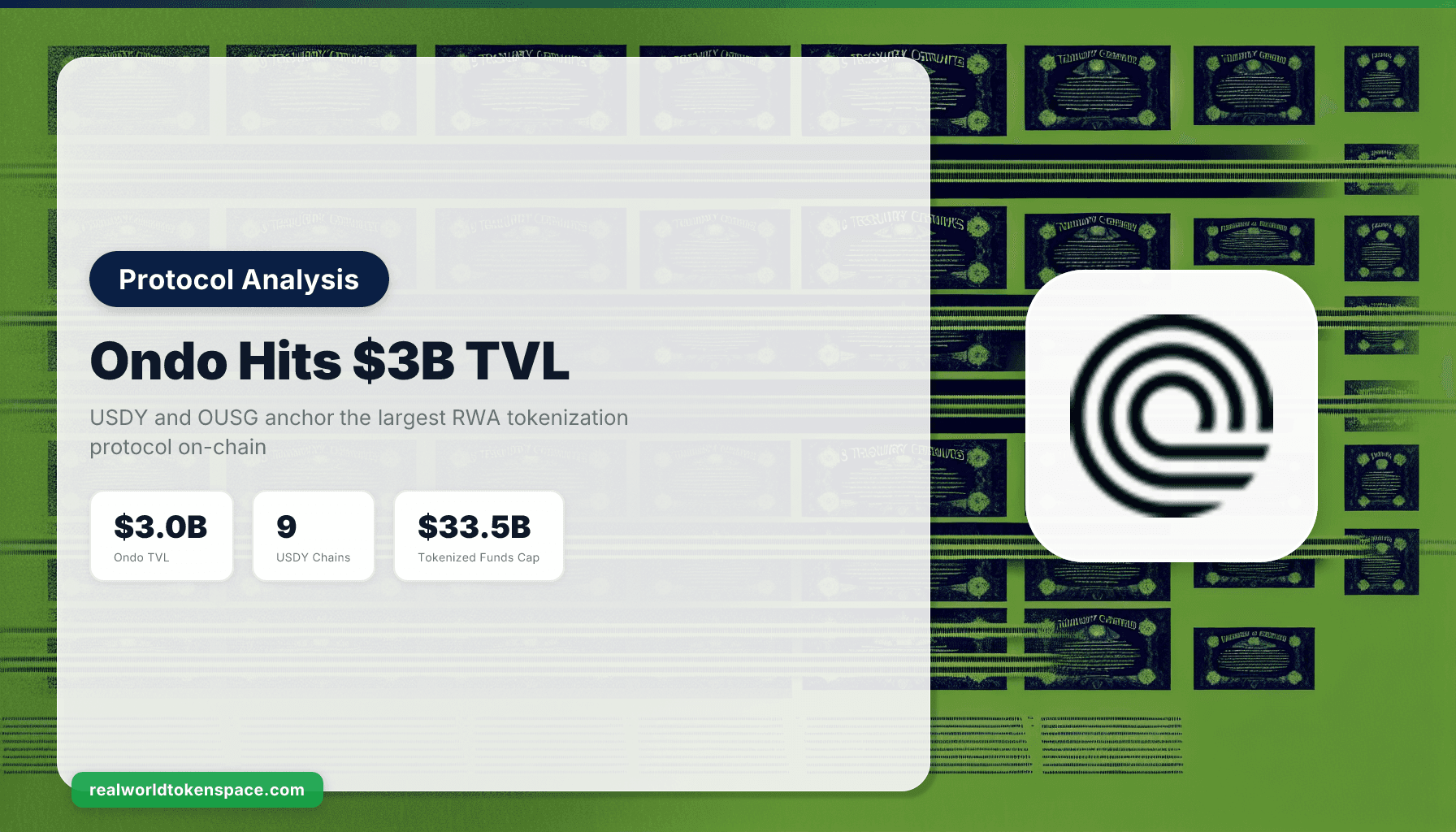
Ondo Finance crossed $3 billion in total value locked in early April 2026, becoming the single largest real-world asset tokenization protocol by managed assets on public blockchains. Per TheStreet's reporting, TVL reached approximately $3.015 billion as of April 9, an 8% step-up from roughly $2.79 billion at the start of the month. The milestone arrives as the broader tokenized funds market hit $33.5 billion in April, a category that effectively did not exist in any meaningful form three years ago.
The headline number flatters Ondo, but the underlying composition is what makes the protocol structurally interesting. Ondo's growth is not concentrated in a single product or a single chain. USDY, OUSG, and the protocol's broader stack each scale on different demand drivers, and the protocol has been quietly building infrastructure that compounds the moat rather than relying on incumbency.
USDY: The Permissionless Yield-Bearing Dollar
USDY, Ondo's permissionless tokenized Treasury for non-U.S. investors, has surpassed $1 billion in TVL and is now live on nine blockchains, per Ondo's product disclosures. The product is structured to deliver a stablecoin-like user experience while passing through the underlying short-duration Treasury yield, currently in the high 3s to low 4s after the Fed's April hold at 3.50% to 3.75%.
The nine-chain footprint matters more than it sounds. Each chain integration is a distribution surface: Solana for high-throughput payments, Sui and Aptos for Asia-pacific institutional flows, Arbitrum and Mantle for DeFi composability, Ethereum for institutional settlement. By being the same token on every chain, USDY becomes the default bridge between native stablecoin liquidity and Treasury yield, without requiring a user to leave their preferred ecosystem. This is the same playbook USDC ran in 2021 and 2022, with one important difference: USDY pays yield by design, where USDC explicitly does not.
For DeFi-native treasuries and offshore funds, that turns USDY into a working balance rather than just a wrapper. Hold USDC and the dollars are dead; hold USDY and the same dollars accrue Treasury yield while remaining transferable on demand.
OUSG: The Institutional Channel
OUSG, Ondo's accredited-only tokenized Treasury, has taken a different path. Where USDY optimizes for permissionless distribution, OUSG is designed for U.S. accredited investors and institutions, with same-day USDC subscription and redemption rails added in 2024 that now dominate institutional access flows. The product holds a mix of BlackRock's iShares Treasury ETFs and BUIDL itself, which is the structural detail that makes Ondo's positioning work even as BUIDL captures direct exchange integrations.
Put differently: when BlackRock's BUIDL went live on OKX on April 28 as exchange margin collateral, the trade was not zero-sum for Ondo. OUSG holds BUIDL as part of its reserves, which means OUSG holders are indirect beneficiaries of BUIDL's institutional adoption while retaining the operational flexibility of an Ondo-native token with USDC subscription and redemption. Ondo built the consumer-facing layer; BlackRock supplies the underlying yield engine.
Ondo Chain and the Vertical Integration Bet
The longer-term thesis on Ondo is not the AUM number but the vertical integration. Ondo Chain, the L1 the team announced in early 2025 and which has been progressively rolling out infrastructure through Q1 2026, is designed as a settlement venue specifically for tokenized real-world assets. The pitch is operational, not speculative: institutional issuers want predictable transaction costs, regulator-friendly validators, and predictable finality for their compliance teams.
Whether Ondo Chain achieves meaningful adoption is an open question. The competing thesis is that issuers do not want a special-purpose chain; they want EVM compatibility on whichever venue their distribution partners use. The answer will be revealed by issuer choices through 2026, not by Ondo's marketing. But the strategic logic is sound: if tokenization grows from $33.5 billion today to $500 billion by 2030, owning the settlement rails captures a layer of fees that issuance does not.
RWTS Trust Score: Tier 1 Assets, Tier 2 Protocol Risk
Ondo's products carry a Tier 1 rating on RWTS Trust Score for the underlying assets, with several caveats at the protocol level:
- Reserve quality. USDY and OUSG hold short-duration U.S. Treasuries, repurchase agreements, and BUIDL itself. Reserve composition is published and attested, comparable to BUIDL.
- Issuer. Ondo Finance Inc. is a U.S.-domiciled entity with a regulated transfer agent (Ankura Trust) and bankruptcy-remote SPV structure for the underlying assets. This is materially stronger than crypto-native stablecoin issuers.
- Custody. Underlying Treasury assets sit at Morgan Stanley and BNY Mellon. Tokenized BUIDL exposure flows through Securitize and BlackRock's existing custody relationships.
- Permissioning. USDY is permissionless globally outside U.S. persons; OUSG requires accreditation. Compliance posture is among the strongest in the category.
The Tier 2 protocol risk reflects two factors: smart contract surface area is larger than BUIDL's, given Ondo's multichain deployment, and the Ondo Chain rollout introduces a new validator set whose decentralization track record is still building. Neither materially affects the underlying yield profile, but they do affect how a risk-conscious treasurer should size exposure.
What the $3B Milestone Means for the Category
Three observations.
First, the tokenization market is now top-heavy. Ondo at $3B, BUIDL at $2.5B, and Hashnote, Franklin, and a long tail behind. The next $10 billion of category growth will likely consolidate further toward two or three winners with the regulatory, custodial, and distribution moats. Ondo's position as the largest protocol with the broadest chain footprint is a meaningful incumbency advantage.
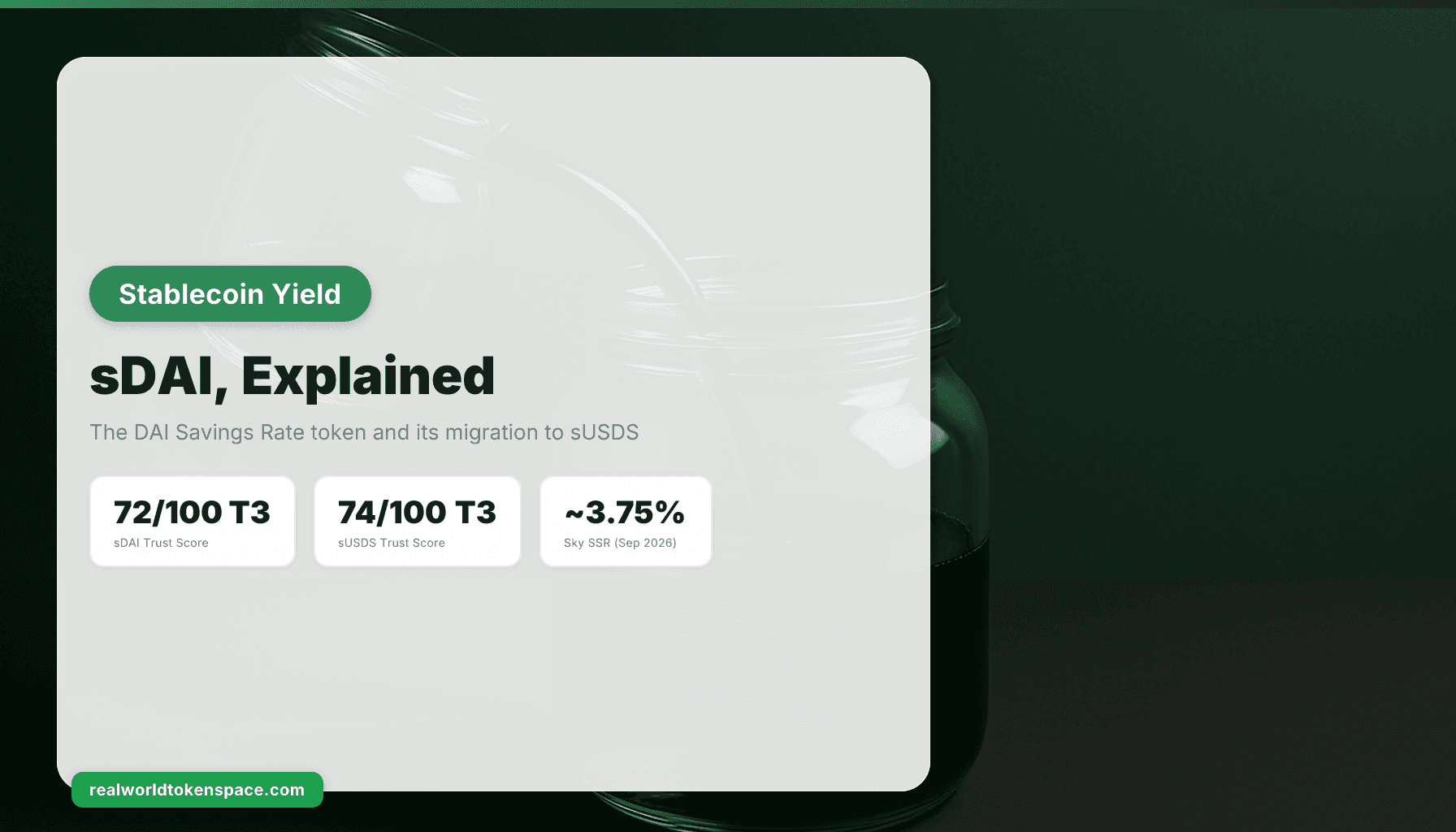
Second, the line between "tokenized Treasury fund" and "yield-bearing stablecoin" has effectively dissolved. USDY is functionally a stablecoin with yield; sUSDS, sUSDe, and sDAI are functionally Treasury-adjacent products via collateral exposure. The user-facing distinction is becoming meaningless, even if the legal structures remain quite different. The competitive frame for Ondo is no longer "other RWA protocols" but the entire $200 billion stablecoin market.
Third, expect the next leg of tokenization growth to come from non-Treasury assets. Private credit has already surpassed Treasuries to become the largest non-stablecoin RWA segment, accounting for roughly $14 billion of the broader $29 billion non-stablecoin RWA total. Ondo has signaled interest in equities and structured credit; the test of whether the protocol can extend its lead is whether it builds in those categories with the same operational rigor it applied to Treasuries.
What to Watch Through Q2 2026
Three signals to track:
- Net flows into USDY versus competitive products. If the next $500M of yield-bearing stablecoin growth flows disproportionately into USDY rather than sUSDS or PYUSD-yield variants, that confirms multichain distribution is the primary growth lever.
- Ondo Chain mainnet adoption. Watch which institutional issuers commit assets to Ondo Chain by July. If flagship issuers stay on Ethereum or Base, the vertical integration thesis softens.
- New product categories. Ondo has telegraphed expansion into tokenized equities and structured products. The launch quality and compliance posture of those products will determine whether $3B is a milestone or a ceiling.
The $3B mark is a useful round number for headlines. The real story is that Ondo has positioned itself as the operational backbone for non-U.S. dollar yield, the institutional bridge for accredited Treasury access, and a credible venue for the next category of tokenized assets to launch from. None of those positions are guaranteed. All three are defensible.
Related research
For Ondo's earlier ascent past $3B and the Ondo Chain perps launch, see the Ondo Finance $3B TVL Ondo Chain piece. For the BlackRock BUIDL competitor's collateral-rail expansion, see the BUIDL on OKX analysis. For the broader category context, see the tokenized treasuries 14B milestone. The RWTS Trust Score methodology is on the RWTS Rating page.
Sources
Stay Ahead of the Yield Curve
Subscribe to The Yield Report for weekly yield intelligence.
Subscribe Now