Tokenized Gold in Focus as Goldman Lifts 2026 Target to $4,900
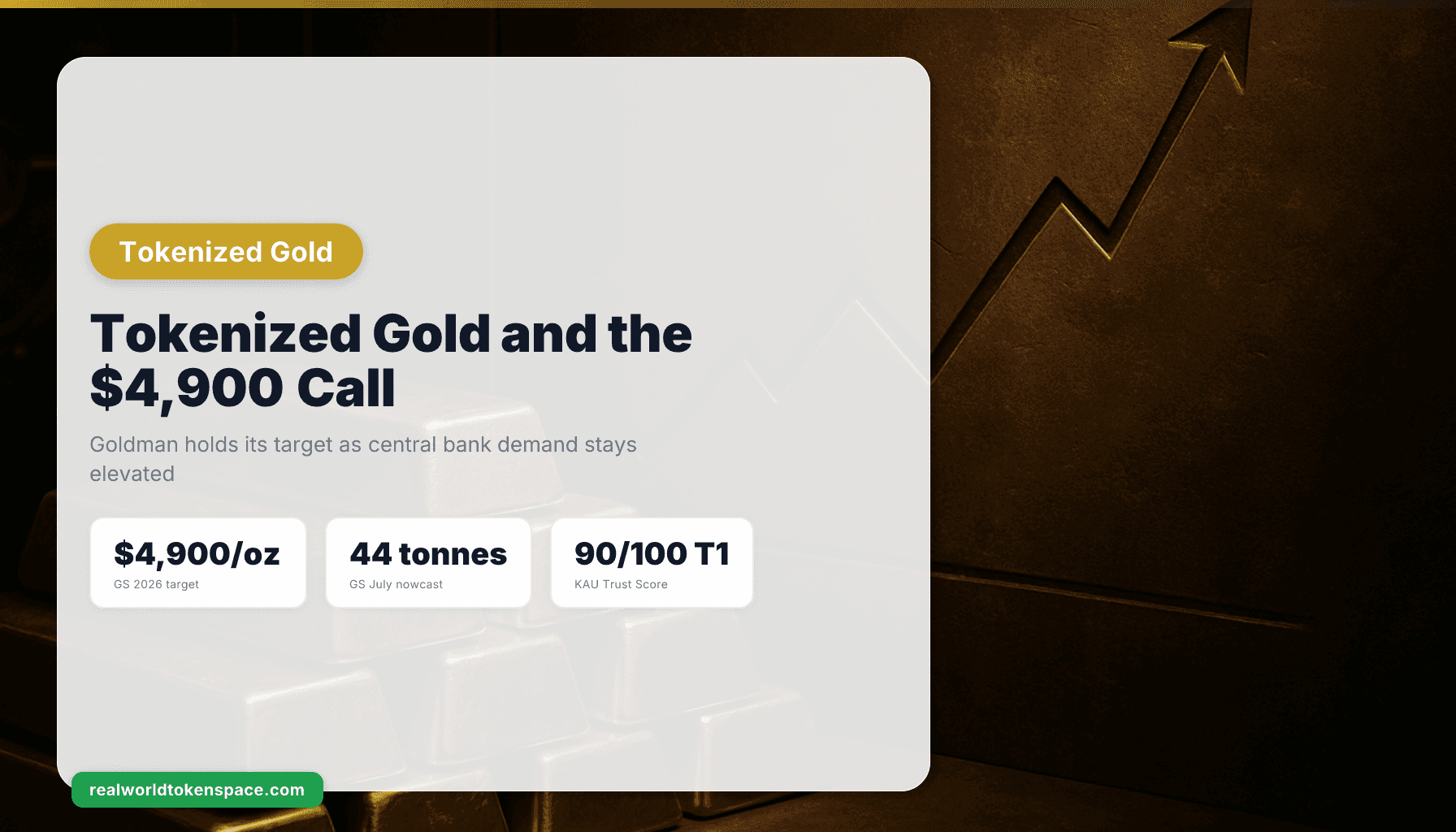
The macro backdrop for tokenized gold firmed again this week. Central bank gold purchases remained strong through July, and China appears to be buying far more bullion than official reports have disclosed, supporting a year-end price target of $4,900 per ounce, according to Goldman Sachs Research. That is the institutional anchor for today's note, and it matters for every allocated holding on-chain.
The physical picture is what drives the token. Goldman's nowcast estimates central bank purchases of 44 tonnes in July, versus a pre-2022 average of 17 tonnes, with a large contribution from China. On a 3-month seasonally adjusted basis, the trend stands at 91 tonnes per month. The bank's read is that reported figures understate the real flow. Goldman concluded that additional recent central bank purchases are not captured in its July nowcast estimate.
RWTS is not bullish or bearish on gold. We are the credit-rating agency for tokenized real assets. We rate, you decide. So here is the framing we can stand behind: the demand thesis, not a price prediction.
Will gold reach $4,900 in 2026?
Verdict: Goldman holds the call, but it is a conditional forecast, not a fact. Goldman's fair-value forecast of $4,900 per ounce by end-2026 assumes continued strong central bank demand, with average purchases of 50 tonnes per month in 2026 and 40 tonnes per month in 2027, alongside a recovery in private investor ETF demand as the Fed remains on hold in 2026. If those two conditions hold, the base case stays intact. If central bank buying cools or the Fed turns hawkish, the path forks lower.
Price context is worth naming honestly. Gold pulled back hard from its January record before stabilising. Gold reached an all-time high near $5,590 to $5,608 per ounce in January 2026 before a 22% peak-to-trough drawdown, stabilising around $4,350 per ounce by mid-September 2026, still above every prior cycle high. That is the humility variable: the drawdown was real, and the recovery leans on flows that could change month to month. The Fed dot-plot and appetite for risk remain the swing factors.
The physical reality behind the token
Every credible tokenized gold product is a claim on metal in a vault, so the demand story that moves spot moves the token. Central banks purchased a record 289 tonnes of gold in Q2 2026, a 62 to 74% year-over-year increase, buying aggressively into the quarterly price decline. The behavioural read is that sovereigns treated the correction as an accumulation window rather than an exit. Allocators booked into weakness; ETF holders were slower to follow.
Goldman frames this as structural, not tactical. Its analysts write that they continue to see elevated central bank gold accumulation as a multi-year trend, as central banks diversify their reserves to hedge geopolitical and financial risks, consistent with recent survey evidence. Central banks have been diversifying their holdings using gold, which is considered less likely to be frozen than reserves held in foreign currencies.
The RWTS Trust Score angle on tokenized gold
For readers who want allocated gold on-chain rather than a sovereign reserve, the question is which product to hold. On our scorecard the highest-rated tokenized gold is Kinesis Gold (KAU) at T1 (90/100), with its silver counterpart Kinesis Silver (KAG) also at T1 (90/100). PAXG scores T1 (90/100) and XAUT T1 (82/100).
Be clear on what that ranking means: KAU and KAG are highest-rated, not biggest. XAUT and PAXG are the larger products by market cap. Tokenized gold's category market cap has held in the $4.8 billion to $6 billion range through 2026, up from roughly $1 billion in early 2025, with Tether Gold (XAUT) and Pax Gold (PAXG) together accounting for roughly 90% of the category and Kinesis Gold plus smaller issuers making up the remainder. Size and score are different questions. Deep liquidity is a real advantage for active traders; the Trust Score measures custody, attestation, redemption and issuer integrity.
The mechanics differ too. KAU represents one gram of allocated, vaulted gold per token, and unlike PAXG or XAUT it shares a portion of network fees with holders. Kinesis Gold (KAU) and Kinesis Silver (KAG) pay a share of network fees back to holders, which gives them a yield profile unlike PAXG or XAUT. We rate that fee-share program, Kinesis Earn, T2 (76/100). Live circulation for the Kinesis tokens is published on the Kinesis explorer at explorer.kinesis.money; check the on-chain figure and date it before you size a position, as thinner books mean wider spreads than XAUT or PAXG.
For a fuller side-by-side of how these products differ on custody and redemption, see our guide on switching from PAXG or XAUT to KAU. The scoring inputs behind every number here are documented in the RWTS methodology, and the full ranking sits on the tokenized gold hub.
What we would watch
If central bank buying holds near Goldman's 50-tonnes-per-month assumption and the Fed stays on hold, the demand floor under allocated gold stays firm. Below that pace, or into a hawkish surprise, the thesis softens and price discovery gets choppier. The token you hold does not change the metal's direction. It changes your custody, redemption and yield profile, and that is what the Trust Score is built to rate.
RWTS isn't bullish or bearish on gold. We're the credit-rating agency for tokenized real assets. We rate. You decide.
Related on RWTS
Stay Ahead of the Yield Curve
Subscribe to The Yield Report for weekly yield intelligence.
Subscribe Now