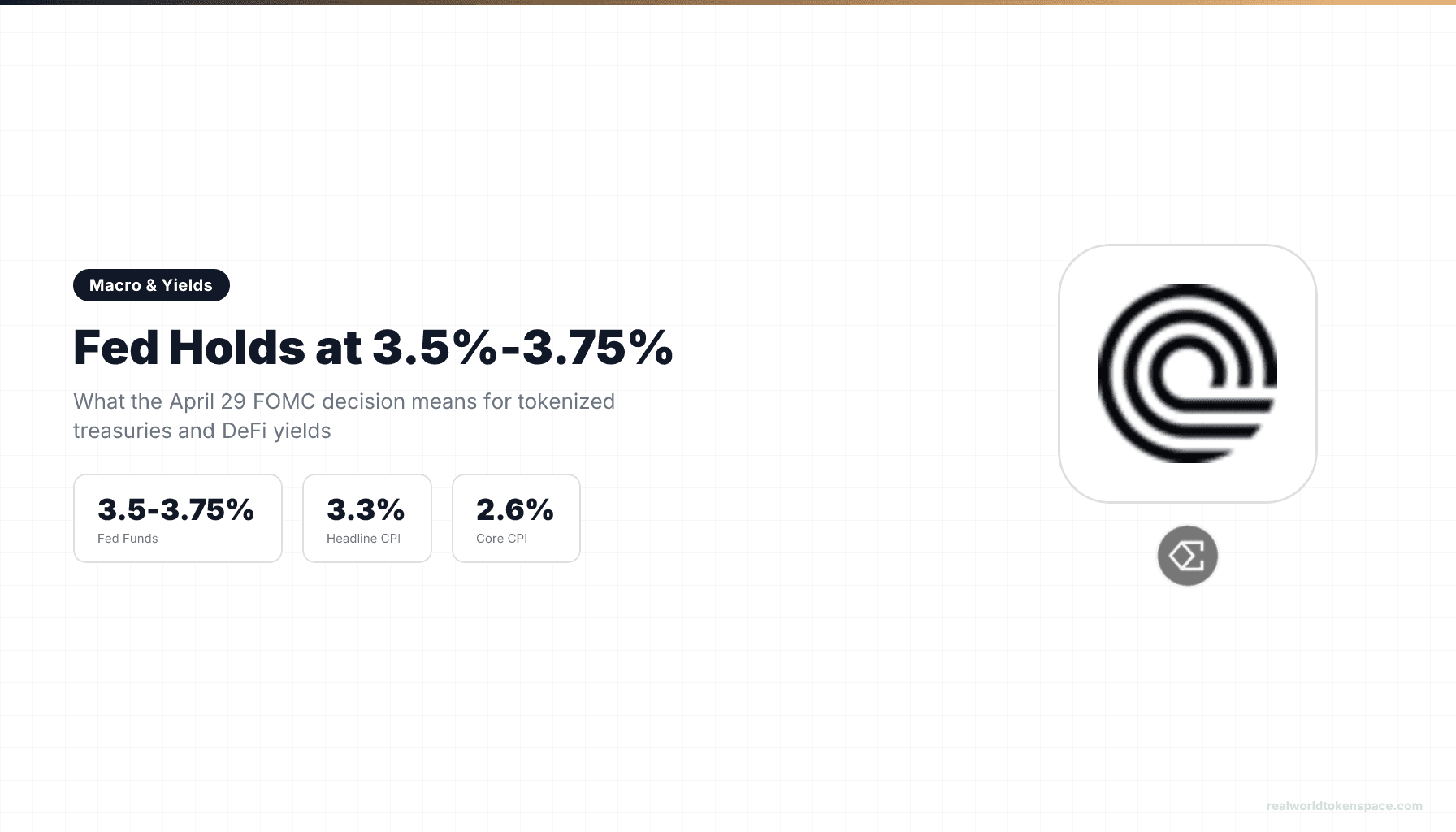
The Federal Reserve held the federal funds target range steady at 3.50% to 3.75% on April 29, 2026, marking the third consecutive pause this year. According to CBS News, the decision was widely expected, with traders on Polymarket pricing in a 99.9% implied probability of no change ahead of the meeting. For yield-bearing real-world assets, DeFi vaults, and stablecoin holders, the more interesting signal is what Chair Jerome Powell said about energy-driven inflation, what the median dot still implies for 2026 cuts, and how the post-decision Treasury curve adjusts. None of this is financial advice. Yields move daily and any number quoted here should be verified against live dashboards before allocating capital.
This piece breaks down the macro read for the four buckets that matter most to RWTS readers: tokenized treasuries, fiat-collateralized stablecoin yield wrappers, DeFi lending vaults, and Pendle PT/YT fixed-rate markets.
The Quick Answer
Fed funds at 3.50%-3.75% means short-duration tokenized treasury products like USYC, BUIDL, and USDY continue to print net yields in the 4.00% to 4.50% band, before fees. Yield-bearing stablecoins remain compressed in the 3.5% to 5% range for unleveraged base rates, with sUSDe leading on funding-rate-driven yield and sDAI/sUSDS anchored to their savings rate parameters. DeFi vault yields on USDC remain in the 4% to 8% range depending on curator strategy and utilization. Pendle PT implied fixed yields stay clustered around the 4% to 6% band for stablecoin-denominated terms maturing inside 2026.
The interesting development is not the held rate. It is that core CPI for March came in at 2.6% year-over-year, below expectations, while headline CPI hit 3.3% on energy-driven pressure, per CNBC's CPI report. That divergence keeps the Fed in a hold-and-watch posture and pushes the median expected cut to September or December. For DeFi yields, this is the third quarter in a row where the macro setup has favored stable, slowly compressing yields rather than the kind of sharp moves that would force rebalancing.
Tokenized Treasury Yields: Steady at 4.0%-4.5%
Tokenized U.S. Treasuries crossed $14B in aggregate outstanding by mid-April 2026, per MEXC News, with USYC at roughly $2.9B, BUIDL at $2.5B+, and USDY at approximately $972M. With the Fed funds upper bound at 3.75%, the front-end Treasury bill curve continues to print 4.00% to 4.30% on 1-month and 3-month bills, and the largest tokenized funds pass through net yields after fees in a 4.00% to 4.50% window.
For institutional allocators, the practical implication of today's hold is continuity. A treasury allocator using USYC or BUIDL as on-chain cash management does not need to rebalance. The product is doing exactly what it was designed to do: pay close to the risk-free rate, in stablecoin-denominated tokens, settled on-chain, with daily NAV. The slow drift in fees among the major issuers continues to be the more relevant variable than the headline rate. RWTS Trust Score implications for tokenized treasuries remain unchanged on this print: top-tier products like USYC and BUIDL retain their high marks for transparency, custody, and reporting cadence.
The retail-accessible products in this category, particularly USDY, deserve a closer look. With the Fed paused and the front of the curve trading in a tight band, the spread between USDY's 4.10% net yield and a comparable money market fund at a top broker is small in absolute terms but meaningful in distribution mechanics. USDY can move on-chain, can be used as collateral on Aave and Pendle, and can be wrapped into PT tokens for fixed-rate exposure. None of those features are available with a traditional money market fund. The hold extends the runway for that distribution thesis.
Yield-Bearing Stablecoins: Compression Holds
The major yield-bearing stablecoins have settled into a 3.5% to 5% base-rate band that has tracked Fed policy more tightly than at any point since 2023. Per Stablecoin Insider, sUSDe yields ranged from roughly 4% to 15% across 2025, with the high-water marks coming during periods of elevated perpetual funding rates. In April 2026, sUSDe is printing in the lower half of that range, with funding rates compressed and ETH staking rewards modest.
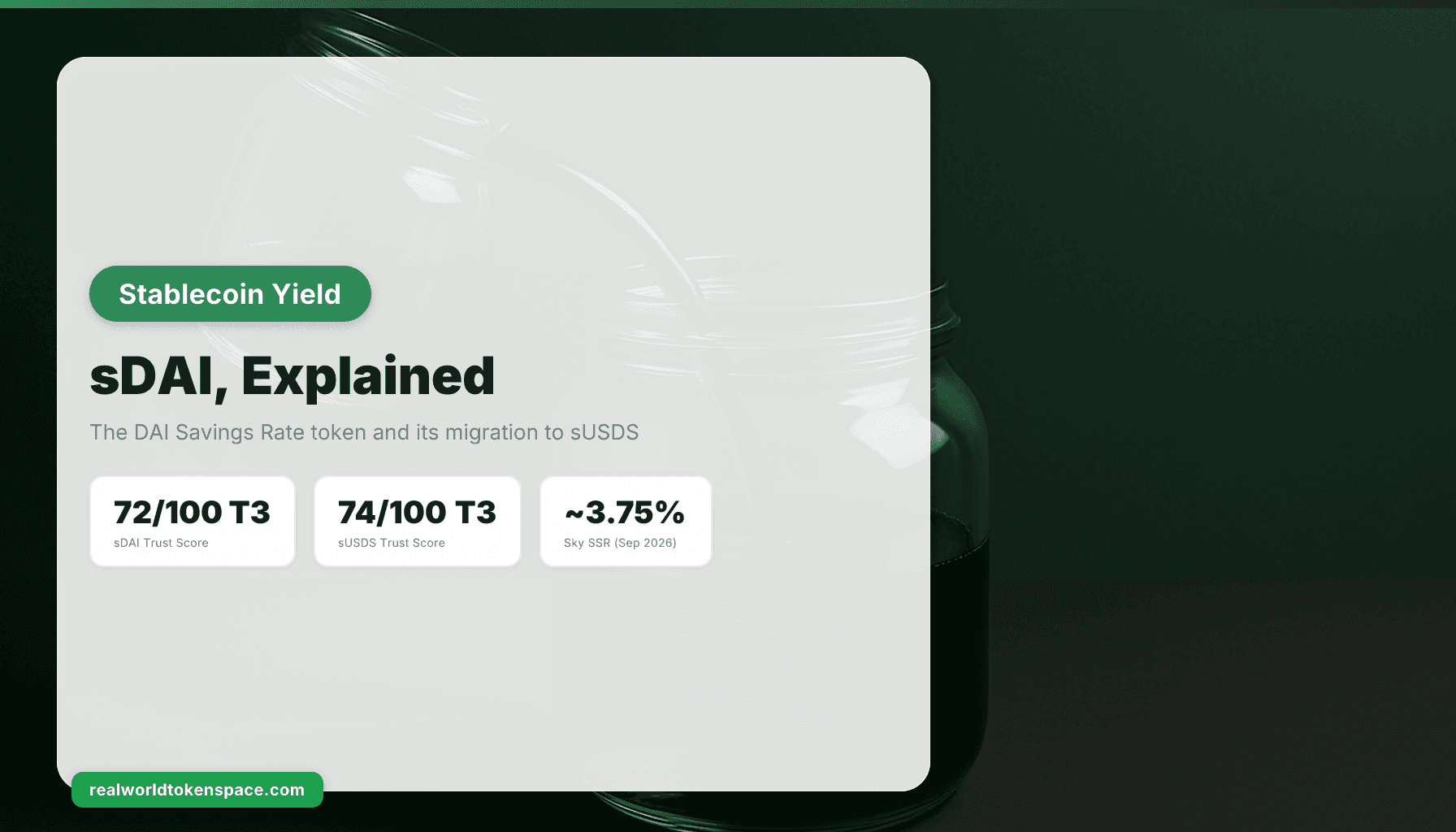
For Sky's sUSDS and the Sky Savings Rate (SSR), the parameter is governance-set and adjusts deliberately. Today's Fed hold removes any near-term pressure on Sky to shift the SSR. The Maker DAO playbook of tracking the front of the Treasury curve with a small spread continues to hold, and sUSDS yield around 4.5% looks well-calibrated to the post-decision macro setup.
The user-facing question after a Fed hold is always the same: should I look up to leveraged strategies for higher yield, or is the base rate good enough? On the RWTS framework, our answer remains that for capital that genuinely cannot tolerate liquidation risk, the 3.5% to 5% base rate is a feature, not a bug. The era of unleveraged 12% stablecoin yield is gone, and any product still claiming numbers in that range outside of looped or leveraged strategies should be treated as suspect.
DeFi Vaults: Coinbase Onchain Lending and Morpho Curators
DeFi lending vaults have absorbed most of the institutional flow that used to live in cefi yield products. Per The Block, Coinbase launched a USDC onchain lending feature in early 2026 with yields up to 10.8%, routed through Morpho Vaults curated by Steakhouse Financial. By April 2026, Coinbase Loans manages over $1.6B in collateral powered by Morpho Blue, per industry reporting.
Today's Fed hold is a tailwind for these vault rates, in a counterintuitive way. With short-end rates anchored, DeFi borrowers (mostly leveraged traders, basis-trade desks, and structured-product issuers) face stable hedging costs. That stability lets curators allocate to longer-tail collateral with confidence. A conservative USDC vault on Morpho currently yields 4% to 5%, while more aggressive curator strategies reach 6% to 8% on the same underlying asset. The ceiling at the top of that range, in the high single digits, looks durable while the macro environment stays in the current band.
For yield seekers, the practical comparison after today is between a Coinbase USDC reward at 3.5% (Coinbase One only), a tokenized treasury at 4.0% to 4.5%, a conservative Morpho vault at 4% to 5%, and an aggressive Morpho vault at 6% to 8%. The risk gradient across that ladder is real, and the Fed's hold flattens the macro contribution to that gradient. Most of the spread now comes from credit risk and curator skill, not from rate volatility.
Pendle PT Pricing: Fixed Rates Cluster at 4-6%
For Pendle's PT (principal token) markets, today's decision is a non-event in the best sense. With the front of the curve anchored, implied fixed yields on Pendle PTs maturing inside 2026 stay clustered in the 4% to 6% band for stablecoin-denominated terms. Per Pendle's protocol dashboard, PT positions on sUSDe, sUSDS, and syrupUSDC continue to anchor the largest share of TVL, with the AMM-implied curves staying close to flat across the 30 to 180-day terms.
A Pendle user looking at PT-sUSDe with a 90-day maturity today is locking in roughly the same fixed rate they could have locked in 30 days ago. That stability is exactly what fixed-rate users want. The flip side is that yield tokens (YTs) on the same assets remain unattractive for users hunting variable-rate upside, because the variable rate is anchored. YT outperformance requires either a Fed surprise (no signal of one today) or a protocol-level event that lifts the underlying floating yield.
What Changes Next
The next data points worth watching for the RWA and DeFi yield complex are the May FOMC dot-plot guidance, the May 15 expiry of Powell's term as chair, and the late-summer 2026 inflation prints. Per CBS News, Powell's term as chair ends May 15, 2026, with the open question of whether he stays on as a Fed governor through the remainder of his board seat or steps off entirely. A new chair pick from the administration would inject the only meaningful surprise risk left in the front-end rate path for 2026.
For RWTS readers, the practical takeaway today is to do nothing. Tokenized treasury allocations stay where they are. Stablecoin yield wrappers continue to print inside their normal bands. DeFi vault yields are durable. Pendle PT positions are well-priced. The macro setup is one of those rare intervals where the rate environment is not the variable that matters; protocol-level execution and curator skill are.
If the September FOMC delivers the cut that the median dot still pencils in, the entire yield ladder above will compress by roughly the cut size, and the relative ordering will stay intact. That is a clean, predictable distribution to plan against. Until then, today's hold is exactly what the on-chain yield economy needed.
Related research
For the live yield ladder this article references, see the stablecoin yield comparison for 2026 and the best USDC yield ranking. For Pendle PT mechanics under compression, see the Pendle TVL collapse analysis. The full RWTS Trust Score methodology is on the RWTS Rating page and protocol scorecards are in the directory.
This article is for informational purposes only and does not constitute financial advice. Verify all yield numbers and protocol metrics on official dashboards before allocating capital.