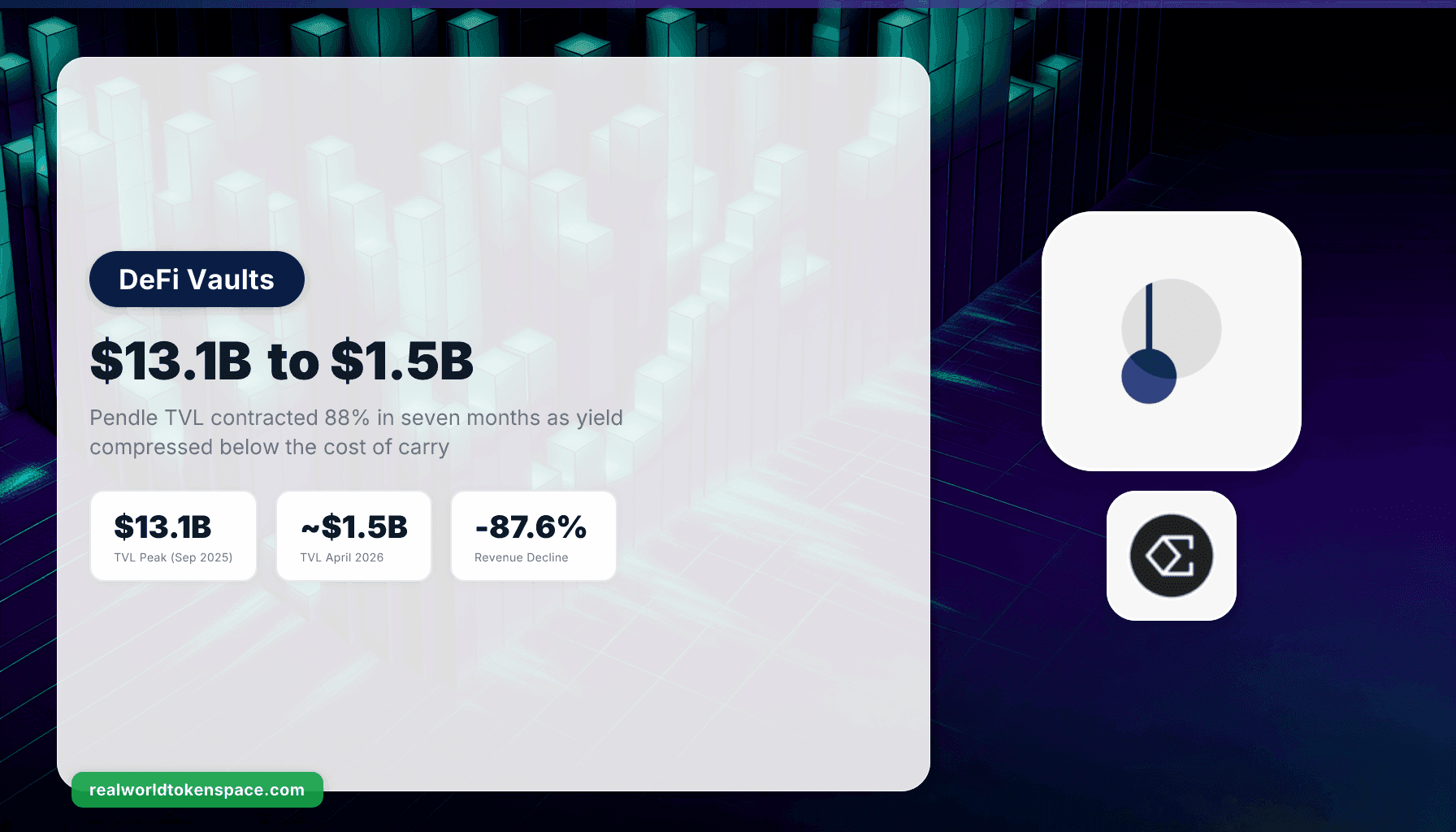
Pendle's total value locked has contracted from a September 2025 peak of $13.1 billion to roughly $1.5 billion in late April 2026, per DefiLlama's protocol page. The drawdown is 88% over seven months, one of the deeper TVL collapses in DeFi outside of an exploit or a depeg. Protocol revenue tells the same story in a different form: per LiveBitcoinNews's coverage of the buyback pivot, monthly income fell from $4.44 million in August 2025 to roughly $552,000 in March 2026, an 87.6% compression that tracks the TVL move almost exactly.
The cause is not a security event, a governance failure, or a competitor stealing share. The cause is mechanical. Pendle's primary use case in 2024 and most of 2025 was a carry trade: deposit a yield-bearing stablecoin (most commonly Ethena's sUSDe), tokenize the future yield as a YT, sell or hedge the YT, and roll the resulting fixed-rate position. When the underlying yield is high and the cost of carry is low, the trade prints. When the yield compresses and funding turns against the position, the trade reverses, and the TVL that supported it leaves at the speed of the next expiry.
That is what Q1 2026 tested, and the Ethena dependency is the variable that broke first.
The Ethena Dependency, Quantified
Per TokenInsight's deep dive, more than $4.6 billion of Pendle's September 2025 TVL peak was sourced from Ethena yield-bearing stablecoins, primarily sUSDe. That is roughly 35% of the protocol's TVL concentrated in a single yield source whose APY had been driven by perpetual funding rates on centralized exchanges.
Ethena's funding-rate yield is a function of long-bias on BTC and ETH perpetuals. When markets are risk-on and longs pay shorts to hold positions, sUSDe earns. When the market turns defensive and funding flattens, sUSDe yield compresses toward Treasury rates without the operational and counterparty risk that Treasury holdings avoid. From November 2025 through March 2026, that is what happened. sUSDe APY moved from double digits to roughly 3.5% in late April, per Messari project data referenced in our May 1 Ethena coverage.
The Pendle carry trade structure assumed the yield differential between sUSDe and the cost of borrow on the leverage leg would stay positive. Once it inverted, the position bled, and users redeemed at expiry rather than rolling. The mechanical TVL exit that followed is the chart on DefiLlama.
Why This Is a Structural Test, Not a Failure
It is worth being precise about what failed and what did not. The Pendle protocol did not break. The smart contracts did not break. The yield curve construction did not break. What broke is the assumption that one carry trade structure built on one yield source could anchor a multi-billion-dollar TVL.
Per Sandmark's recent analysis of the fixed-leg market, Pendle's product-market fit is the fixed-rate leg of DeFi, not the speculative leg of crypto. In a healthy fixed-income market, multiple yield sources flow through the same yield-tokenization protocol: tokenized Treasuries, GLP-style perpetual fees, restaking rewards, allocated tokenized commodities, money-market vault yields. The September 2025 peak had a concentration problem. The April 2026 trough is what diversification looks like in early form.
Per DLNews's reporting on Pendle's settlement volume, the protocol has settled $69.8 billion in yield to date and continues to onboard new asset classes. The TVL number is what it is, but the throughput number suggests the venue has not lost its core function.
The sPENDLE Pivot and the Buyback Mechanic
The protocol's response to the revenue compression was the January 2026 sPENDLE upgrade, which we covered in our April 28 Pendle analysis. sPENDLE replaced vePENDLE locks with a 14-day liquid staking position and routes up to 80% of protocol revenue into PENDLE buybacks rather than vePENDLE distributions.
The mechanic is straightforward. At $552,000 in monthly revenue, 80% buybacks return roughly $440,000 per month to PENDLE holders through token reduction. At a fully-diluted valuation that has compressed alongside the price, the buyback yield is meaningful in percentage terms but small in absolute terms. The thesis, as the team has framed it, is that buybacks compound on token reduction while revenue rebuilds on new product flows (mEVUSD targeting EU institutions at 7-12% APY, integrations with tokenized Treasury yield curves, and continued Aave-collateral pairs).
Risk factors to state upfront: the sPENDLE structure depends on revenue recovery, the EU institutional product is unproven at scale, and the yield-tokenization market is increasingly contested by simpler products that do not require a forward-curve view. The buyback math is sensitive to all three.
What This Changes for DeFi Fixed Income Allocators
For an allocator building a DeFi fixed-income book in May 2026, three things are worth pricing in.
First, single-source yield concentration is the risk that just printed. Any protocol whose TVL is anchored to a single underlying yield should be sized accordingly. The Ethena dependency was the exposure that hurt Pendle. The next protocol to face the same test will be the one whose biggest pool is still sUSDe-shaped.
Second, the cost-of-carry math has to hold across the cycle, not just the bull leg. A 14% APY that compresses to 3.5% does not just reduce returns. It can flip the carry trade negative if the leverage leg is structured for the higher yield. Fixed-rate products that lock the higher rate before compression hold their value. Floating-rate products do not.
Third, yield-source diversity is now a feature, not a hedge. The tokenized Treasury market crossed $14 billion to $21 billion in TVL in Q1 2026 per rwa.xyz data, with BUIDL at $2.58 billion and USDY at $2.14 billion. Restaking yield, tokenized commodity yield, and money-market vault yield all sit alongside as alternate flows. A yield-trading protocol's TVL is now a function of how many of those flows it can route, not how high the headline APY of one flow runs.
RWTS Trust Score Posture on Pendle, Today
Pendle remains in the Trust-Score-eligible category on the protocol side. The smart contract record is clean, the audit cadence is current, the team is responsive to the revenue compression, and the venue has not been compromised. The Trust Score we publish reflects the structural risk that a yield-trading protocol carries by definition: dependence on yield-source quality, dependence on the leverage stack, and dependence on user willingness to roll positions through compression cycles.
We do not score TVL. We score custody, audit, mechanism transparency, redemption, and counterparty quality. Pendle clears those bars. Whether the protocol is the right fit for a given allocator's fixed-income book is a portfolio question, not a Trust-Score question.
The Bottom Line
Pendle's TVL went from $13.1 billion to $1.5 billion because one carry trade structure unwound when one yield source compressed. The protocol did not break. The structure that anchored the peak did.
What survives is the part of Pendle that always made sense: a venue for fixed-rate positions in a DeFi market that is becoming more fixed-income-shaped over time. What does not survive is the assumption that one yield source can anchor a multi-billion-dollar TVL through a compression cycle.
For RWTS readers building yield books in May 2026, the lesson is concentration risk applied to yield, not to assets. We rate the protocols. You decide the allocation.
Related research
For the Ethena-side mirror of this story, see the USDe redemptions and yield compression analysis. For Pendle's parallel revenue pivot to spendle/buyback, see the Pendle spendle buyback breakdown. For Pendle's USDG fixed-income product line, see the Pendle USDG global dollar piece. For the broader yield landscape after the compression, see the 2026 stablecoin yield comparison.
Methodology: rwts.com/methodology
Not financial advice.