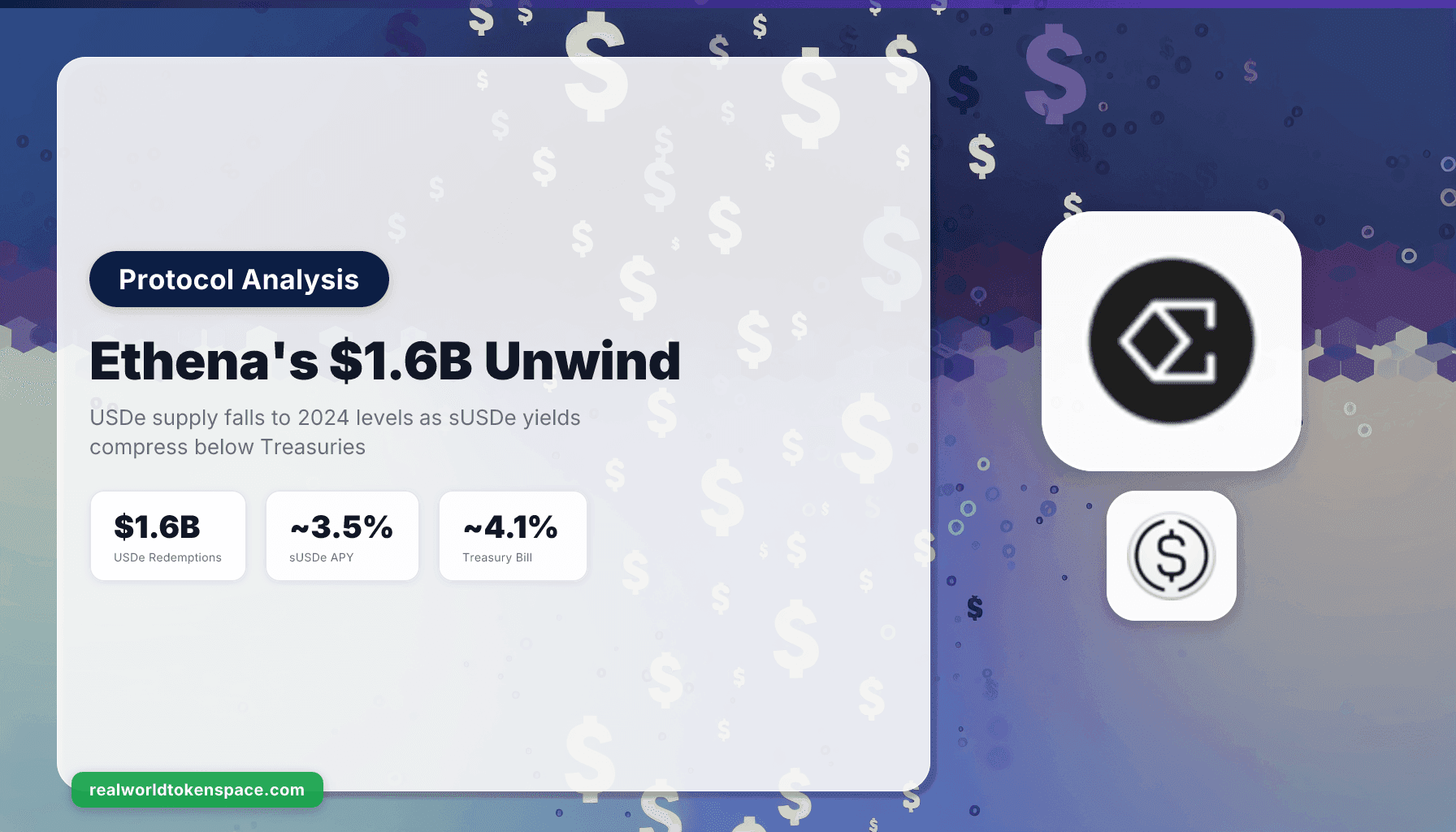
Ethena's USDe supply has fallen back to early 2024 levels after roughly $1.6 billion in net redemptions, the cleanest unwind of the synthetic-dollar trade since the protocol launched. Per Crypto Economy's reporting, the contraction tracks a sustained compression in sUSDe staking yields, which now sit near 3.5% according to Messari project data. Three-month Treasury bills, by contrast, still clip just over 4% even after the Fed's April hold at 3.50% to 3.75%.
The arithmetic is straightforward and somewhat brutal: when a fully-collateralized, custody-grade Treasury wrapper pays more than a delta-neutral synthetic dollar that takes funding-rate, exchange, and liquidation risk, the marginal capital walks. That is exactly what has happened over the past forty-five days, and it is worth understanding the mechanics before assuming the redemption is a verdict on Ethena itself.
How the USDe Yield Engine Actually Works
USDe is a synthetic dollar collateralized by long staked-ETH and staked-BTC positions hedged with short perpetual futures on centralized exchanges. The protocol earns three streams of yield: staking rewards on the long collateral leg, funding rates on the short perp leg, and a small allocation to liquid USD reserves. Stakers in sUSDe receive the residual after operating costs, with a smoothing mechanism that distributes funding-rate volatility across days rather than instantly.
When perp funding is positive and elevated, which historically meant when crypto markets were leveraged-long and traders were paying to be long BTC and ETH, the short leg of Ethena's hedge collected meaningful coupons. In 2024, those funding rates pushed sUSDe variable yields above 15% at peaks. By early 2026, with markets digesting the October 2025 deleveraging and perpetual open interest down across the board, funding has compressed materially. The hedge no longer earns a fat premium, so neither does sUSDe.
This is not a bug. It is exactly how the protocol is supposed to behave. USDe is, in effect, a leveraged short on perp funding. When the curve normalizes, the spread normalizes with it.
Why the Redemptions Are Rational, Not Panicked
The composition of the redemption flow matters. Per on-chain data and protocol disclosures, the pullback has not been concentrated in any single venue or whale, and Ethena's solvency, peg, and reserve composition have remained intact through the unwind. What is leaving is yield-seeking capital that came in during 2024 and 2025 expecting double-digit returns.
For that cohort, the trade is mechanical: when sUSDe yields below 3.5% and a Coinbase USDC reward account or Kraken+ pays 3.75% to 4.5% with no smart-contract risk, the rational allocator unwinds. Add tokenized Treasury wrappers like USDY and BUIDL paying high 3s to low 4s with bankruptcy-remote SPV structure, and the yield-adjusted-for-risk math gets harder for synthetic dollars to win. The redemptions look orderly because they are.
What this leaves behind is a smaller but stickier USDe supply. The capital that has stayed is either using sUSDe as collateral in DeFi (often via Pendle YT or Morpho leveraged loops), or holding USDe for non-yield reasons such as venue access, basis trading, or as a hedge component in a broader portfolio. That cohort is less rate-sensitive.
The Pendle Implications
Pendle's sUSDe markets have been the dominant DeFi yield trade for two years. With sUSDe yield at 3.5%, the YT (yield token) leg compresses, and PT (principal token) holders lock in a higher fixed rate as future variable yield drops. Per Pendle's pool data, implied yields on certain Pendle sUSDe expiries are still showing elevated rates relative to spot, which historically reflects either residual leverage demand or bets on a funding regime change.
Two scenarios are worth pricing here. If perp funding stays compressed through Q2 and Q3, Pendle YT writers continue to lose against PT buyers, and the trade rolls into smaller and smaller carry pools. If, however, BTC and ETH catch a bid that re-leverages perpetual markets, funding rebuilds, and sUSDe yields could reflate into the 7% to 10% range. That second scenario is the implicit option the remaining USDe holders are paying for.
What This Means for the Broader Yield Stack
The Ethena unwind is not isolated. It is one expression of a broader compression cycle that has hit the entire DeFi yield stack since the Fed parked rates at 3.50% to 3.75%. sDAI sits near 4.5%, sUSDS in the high 4s, and Maple's syrupUSDC ranges from 6% to 9% depending on tranche, with Tier 2 institutional credit risk attached. None of these are currently paying enough to dominate a same-day-redemption tokenized Treasury yielding 4% with tier-1 reserves.
That competitive pressure is why exchange yield products, Coinbase USDC at 4.1%, Kraken+ USDC at 3.75%, and the new on-chain Coinbase lending product at up to 10.8%, are starting to peel off the lower tiers of DeFi yield demand. Synthetic dollars now have to outpay both the risk-free rate and the centralized-exchange convenience yield to attract new flows. At 3.5%, USDe does not.
RWTS Trust Score: Tier 2 Synthetic, Reserve-Visible, Smart-Contract-Exposed
Ethena's USDe and sUSDe carry a Tier 2 rating on RWTS Trust Score, with the following considerations:
The reserve composition is published and includes a meaningful and growing allocation to BUIDL and USDtb (which is itself BUIDL-backed), reducing the synthetic-only nature of the collateral pool relative to 2024. Custody for the spot collateral leg is split across Copper, Ceffu, and Cobo, with off-exchange settlement to limit counterparty exposure. The hedge legs sit on Binance, Bybit, OKX, and Deribit, which is the venue concentration that makes USDe a Tier 2 rather than Tier 1 product. A simultaneous outage or insolvency at multiple of those venues during a deleveraging would stress the hedge.
Smart contract risk is well-audited and mature, with no major incidents since launch. The peg has held through every major stress event in 2024 and 2025, including the October 2025 cascade. What investors should watch is reserve concentration shifts and any signs that perp funding has structurally repriced lower, which would make even the smaller post-redemption USDe supply less yield-attractive.
What to Watch Next
Three signals will tell the story over the next forty-five days. First, whether USDe supply stabilizes near current levels or continues to bleed: a base under $4 billion would suggest the rational unwind has fully cleared and the remaining pool is sticky. Second, whether perp funding reflates: a sustained move above 10% annualized across BTC and ETH perps would resurrect sUSDe yields to a level that competes with tokenized Treasuries. Third, whether Ethena pivots additional capacity into BUIDL-style reserve-backed products like USDtb, which decouples Ethena's supply from the synthetic-dollar trade and lets the protocol grow even when funding is compressed.
The redemption is not a death blow. It is a reset to fair value. Whether the trade comes back depends on conditions outside Ethena's control: leverage, funding, and where the Fed parks rates through the back half of 2026.
Related research
For Ethena's earlier collateral overhaul that set up the current reserve structure, see the USDe collateral overhaul piece and the sUSDe yield compression analysis. For the Pendle TVL drawdown that this unwind partially explains, see the Pendle TVL collapse breakdown. For the broader yield landscape, see the 2026 stablecoin yield comparison. The RWTS Trust Score methodology is on the RWTS Rating page.
Sources: