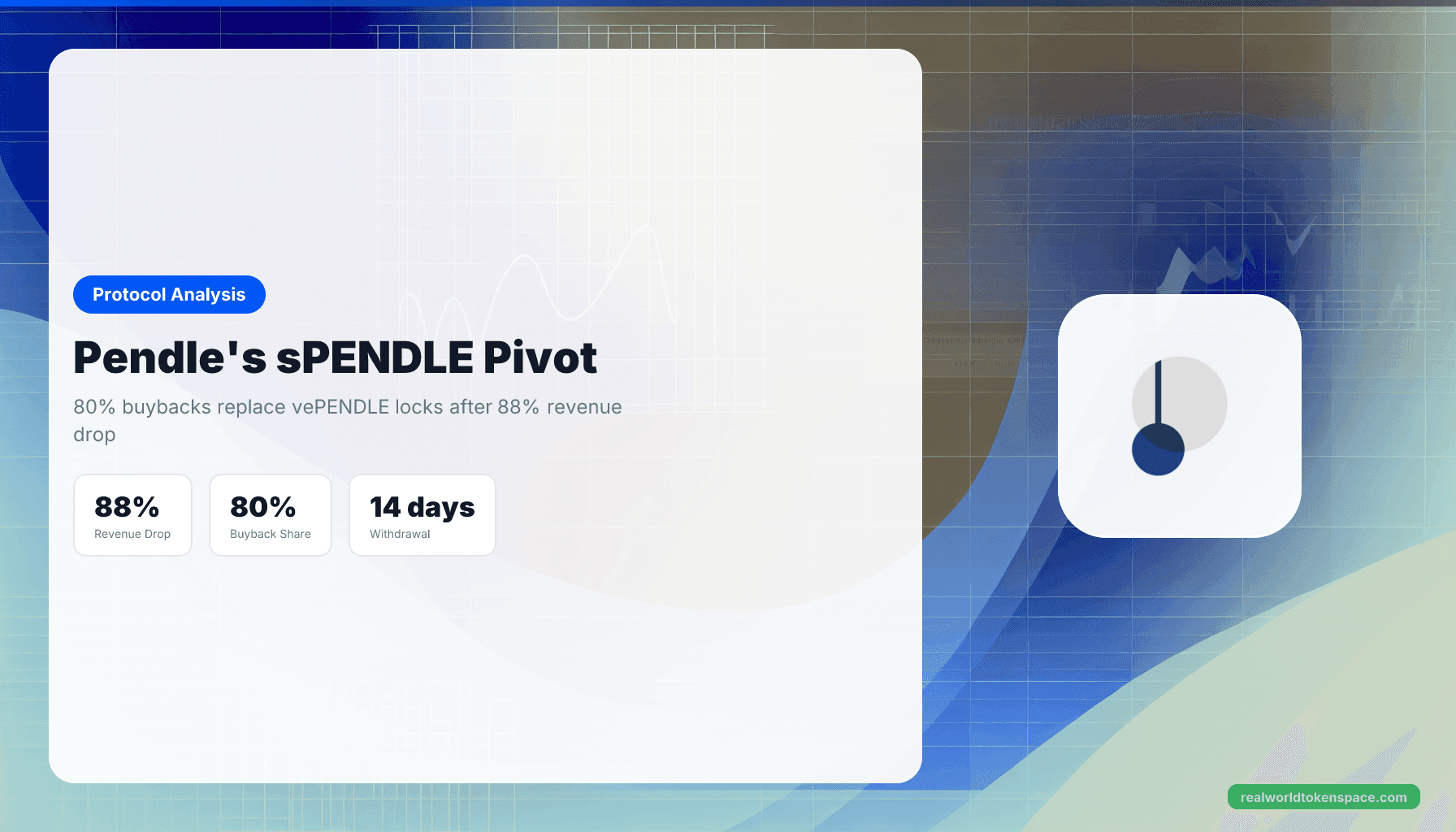
The pivot was driven by two concurrent pressures. Per Pendle's introduction post on Medium, the team had been signaling a tokenomics rework since mid-2025 in response to the chronic vePENDLE liquidity discount and the difficulty of attracting new lockers in a maturing market. Per Ainvest's coverage of the Q1 2026 revenue collapse, monthly revenue fell from a $4.44M August 2025 high to roughly $552K in March 2026, an 87.6% drop attributable to broader yield compression across DeFi.
For users of Pendle's PT/YT yield tokenization mechanics, the underlying product is unchanged. PTs (principal tokens) still represent a fixed-yield claim against the underlying asset, YTs (yield tokens) still capture the variable yield over the term, and the constant-function AMM still prices both. What changed is who captures the protocol's revenue and on what time horizon. The downstream effects for traders, liquidity providers, and stablecoin allocators are real but secondary to the underlying yield product.
Pendle Yield Tokenization Explained
For readers new to the architecture, a brief recap. Pendle is a yield-tokenization protocol that splits a yield-bearing asset into two components: a principal token (PT) that represents the right to redeem the underlying at maturity, and a yield token (YT) that represents the right to claim the variable yield over the term. Both trade independently on Pendle's AMM, and the relative pricing of PT to underlying defines the implied fixed yield to maturity.
A practical example. If sUSDe currently yields 4.25% floating and a Pendle PT for sUSDe with a 90-day maturity trades at 0.99 USDC (a 1% discount to par), the PT holder locks in roughly 4.04% annualized fixed yield to maturity by buying the PT and holding to redemption. The YT buyer captures the floating yield, and if floating beats 4.04% over the period, the YT outperforms; if floating compresses below, the YT underperforms. The architecture lets the same underlying asset support a fixed-rate buyer (the PT holder), a variable-rate hunter (the YT holder), and a liquidity provider who earns trading fees from both.
Pendle's primary value to DeFi has been creating fixed-rate yield curves on assets that natively only have variable yield. As of April 2026, PT positions exist on more than a dozen yield-bearing stablecoins and LSTs, including sUSDe, sUSDS, weETH, ezETH, USDS, syrupUSDC, and several Maple credit tokens. Per Pendle's protocol revenue reporting, the underlying TVL has remained robust through the revenue compression, sitting at approximately $3.5B as of late April 2026 across 11 chains.
What Changed: vePENDLE to sPENDLE
The vePENDLE model launched in 2022 was a direct port of Curve's vote-escrow design. PENDLE holders could lock tokens for up to 2 years, receive vePENDLE in proportion to lock duration, and earn governance power, gauge votes for liquidity emissions, and a share of protocol revenue. The model worked through 2023 and 2024 when lock incentives were strong, but ran into structural headwinds as the lock market matured.
The first headwind was the liquidity discount. vePENDLE positions were illiquid for up to 2 years, which meant secondary markets priced them at meaningful discounts to spot PENDLE. New lockers were effectively buying a position that was less valuable than the spot token, and existing lockers had no clean exit even when their views or capital needs changed.
The second headwind was governance concentration. Vote-escrow systems concentrate power in long-term holders, which is a feature when those holders are aligned with the protocol's long-term interests but a drag when their preferences diverge from the broader user base. By 2025, the gauge-vote ecosystem around Pendle had developed enough complexity that emission allocations were being shaped more by bribe markets than by underlying yield demand.
The third headwind, and the proximate trigger for the pivot, was the revenue collapse. Per Pendle's introduction post on Medium, the team identified that compressed revenue against a fixed emission schedule was creating a structural deficit between value distributed to vePENDLE holders and value being created by the protocol. The sPENDLE redesign restores alignment by tying distributions directly to revenue rather than to a fixed emissions schedule.
Mechanics: How sPENDLE Works
The sPENDLE token is a liquid staking wrapper for PENDLE. Per Pendle's documentation on the migration, staking PENDLE for sPENDLE creates a fungible, transferable token that earns a pro-rata share of the protocol's buyback revenue. Withdrawal mechanics offer two options: a 14-day cooldown for the standard exit (no fee) or an instant exit with a 5% fee that flows back to remaining sPENDLE holders.
The distribution mechanic flows in three steps. First, Pendle's protocol revenue is collected from PT/YT trading fees, swap fees, and yield-tokenization fees. Second, up to 80% of that revenue is directed to a buyback program that purchases PENDLE on the open market and distributes it pro-rata to sPENDLE holders. Third, the remaining revenue funds the treasury and core team operations.
The 80% figure is a ceiling, not a floor. In practice, Pendle governance can adjust the ratio between buybacks and treasury based on operational needs. Per current parameters, the buyback share has been running at the full 80% to maximize yield to sPENDLE holders during the migration period. Emissions, separately, have been cut by approximately 30% to reduce sell pressure on the spot PENDLE market.
The governance design under sPENDLE is flatter than vePENDLE was. sPENDLE holders vote on protocol parameters with token-weighted votes rather than time-weighted votes, which removes the dynamic where a small group of long-term lockers could outvote a much larger holder base on near-term decisions. Bribe markets continue to exist for gauge votes, but with reduced influence given the flatter governance structure.
Why Revenue Dropped 88%
Pendle's revenue collapse from $4.44M in August 2025 to $552K in March 2026 is the direct economic context for the tokenomics rework. Three factors drove the decline.
The first factor was yield compression on the underlying assets. Per RWTS coverage of the Ethena reset, sUSDe yields compressed from 27% at peak to 4.25% currently. Lower yields on underlying assets translate directly to thinner PT/YT spreads, which translates to lower trading volume on Pendle's AMM, which translates to lower fee revenue for the protocol. The same compression hit Aave and Morpho lending rates, sUSDS, and most other yield-bearing assets that PT/YT markets are built on.
The second factor was the maturity of yield-tokenization markets. Pendle is the dominant yield-tokenization protocol in DeFi, with no meaningful competitor at scale, but the addressable market has matured. Sophisticated allocators have built positions, fixed-rate strategies are now standard institutional practice, and the marginal new user is harder to acquire than it was in 2024. Volume per dollar of TVL has compressed as the user base became more efficient.
The third factor was the rotation toward tokenized treasuries. As covered in our stablecoin yield comparison piece, the stablecoin yield market in 2026 looks more like a TradFi money market than a high-variance DeFi product. With $14B of tokenized US Treasuries offering 4.4% to 4.8% with regulated issuer backing, the case for taking yield-tokenization basis risk on lower-yielding underlying has thinned. Some capital that would have flowed through Pendle PT positions is flowing directly to BUIDL or USYC instead.
The pivot to sPENDLE is in part an acknowledgment that the old model was sized for a much higher-revenue protocol. By tying distributions to actual revenue rather than to fixed emissions, the protocol can now scale up or down with the underlying market without creating a structural deficit.
What sPENDLE Means for PT/YT Users
For users of Pendle's PT and YT products, the sPENDLE migration changes very little at the underlying mechanics level. PT positions still trade at a discount to par, still redeem at maturity for the underlying, and still allow fixed-rate exposure on yield-bearing stablecoins and LSTs. YT positions still capture the variable yield over the term and still expire at maturity. The AMM curve, the maturity dates, and the redemption mechanics are unchanged.
What does change is the nature of the relationship between heavy users of Pendle and the protocol's value capture. Under vePENDLE, deep users were incentivized to lock PENDLE to direct emissions toward their preferred markets and to capture revenue share. Under sPENDLE, the value capture is direct (buybacks, no time-weighting), but the gauge-direction incentive is weaker. Heavy market makers and curators may need to adjust their participation strategies.
For passive PT holders looking for fixed-rate yield, the migration is largely irrelevant. A PT-sUSDe position with a 60-day maturity yields the same fixed rate today as it would have under vePENDLE. The migration affects who captures Pendle's protocol revenue, not what the protocol actually does for end users.
For PENDLE token holders considering whether to stake into sPENDLE, the calculation depends on view of forward revenue. At the current $552K monthly revenue handle, 80% buyback share translates to roughly $5.3M annualized buyback flow. Spread across the circulating supply, this implies a buyback yield in the 1% to 2% range at current prices. If revenue recovers toward the August 2025 peak, the buyback yield could approach 8% to 10%. The forward call on sPENDLE yield is essentially a forward call on Pendle's revenue trajectory.
How Pendle Stacks Up: PT Yields vs Spot Stablecoin Yields
For the audience that cares most about Pendle, PT positions on yield-bearing stablecoins, the relevant comparison is between locking a fixed PT yield to a near-dated maturity and holding the underlying floating asset. Per the live Pendle dashboard as of late April 2026, the typical fixed-rate spread looks like this:
| Underlying |
Floating APY |
PT Maturity |
PT Fixed APY |
Spread |
| sUSDe |
~4.25% |
60 days |
~6.5% to 8% |
+225 to +375 bps |
| sUSDS |
~4.5% |
90 days |
~5.5% to 6% |
+100 to +150 bps |
| weETH |
~3.0% |
90 days |
~4% to 5% |
+100 to +200 bps |
| Maple syrupUSDC |
~6.0% |
60 days |
~7% to 9% |
+100 to +300 bps |
| BlackRock BUIDL |
~4.4% |
varies |
~4.5% to 4.8% |
+10 to +40 bps |
The PT premium reflects the optionality the YT buyer is paying for plus a small basis-discount for locking liquidity to maturity. For an allocator with a strong view that floating yields will compress further, the PT lock captures the premium without exposure to further compression. For an allocator who wants upside in a yield expansion, the YT side is the cleaner expression.
The standout in 2026 is the PT-sUSDe maturity stack, where 6.5% to 8% fixed-rate yields are still available on near-dated maturities backed by Ethena's collateral. This is the highest fixed-rate stablecoin yield in DeFi at this maturity range, and it remains a primary use case for Pendle in 2026 even after the underlying floating yield has compressed materially.
Risk Considerations
Pendle PT and YT positions carry several distinct risks beyond the underlying asset risk. The first is discount rate risk. Per OKX's analysis of PT-leveraged Ethena strategies, looped PT positions used as Aave collateral can face cascading liquidations when discount rates reprice rapidly. This is a structural feature of holding PTs as collateral rather than a flaw in Pendle's architecture, but it is material for users running PT-leveraged strategies.
The second is smart contract risk. Pendle has been audited by multiple firms and has a strong operational track record, but yield-tokenization architecture is non-trivial and any new chain deployment introduces incremental risk. Pendle deploys on 11 chains as of April 2026, and integration risk varies by chain.
The third is the underlying asset risk. A PT-sUSDe position is exposed to whatever happens to sUSDe over the maturity period. Pendle PTs do not eliminate the underlying risk; they fix the rate at which that risk is priced. If sUSDe were to depeg or experience a significant collateral event, PT holders are exposed proportionally to the principal loss.
The fourth, specific to sPENDLE, is the governance and revenue risk we discussed above. The 80% buyback ratio is a governance parameter and can be adjusted. The forward yield to sPENDLE holders depends on Pendle's revenue trajectory, which has been declining for several quarters and may or may not recover.
RWTS Trust Score Context
Pendle as a protocol does not receive a single Trust Score because the underlying assets it tokenizes are scored individually. A PT-sUSDe position inherits the Trust Score of sUSDe (61/100, Tier 4); a PT-BUIDL position inherits the score of BUIDL (84/100, Tier 2). Pendle's role is to fix the rate at which yield is priced, not to alter the underlying collateral risk.
For framework users evaluating Pendle exposure, the right question is "what is the underlying asset I am taking exposure to" rather than "is Pendle safe." Pendle is the wrapper; the underlying is the risk. The full RWTS Trust Score methodology is on the RWTS Rating page. For comparisons of underlying assets, see our stablecoin yield comparison and tokenized treasuries milestone analysis.
Subscribe
Subscribe to The Yield Report for weekly yield intelligence across CeFi exchanges, DeFi vaults, and tokenized assets. Sign up at /newsletter for the curated weekly digest.
Risk and Disclaimer
This article is for educational purposes only and does not constitute financial advice. Pendle PT and YT positions carry smart contract risk, discount rate risk, and underlying asset risk. PT yields are fixed at the rate at which the position is opened but can show mark-to-market losses if discount rates move against the position before maturity. sPENDLE forward yield depends on Pendle's revenue trajectory, which has been declining. Always verify current rates against the live Pendle dashboard before allocating capital.
FAQ
What is Pendle yield tokenization?
Pendle is a DeFi protocol that splits a yield-bearing asset (like sUSDe or stETH) into two tradeable components: a principal token (PT) representing the right to redeem the underlying at maturity, and a yield token (YT) representing the right to claim the variable yield over the term. The relative pricing of PT to underlying defines an implied fixed yield to maturity. PT buyers lock fixed yield, YT buyers speculate on variable yield, and liquidity providers earn trading fees from both sides.
What is the difference between vePENDLE and sPENDLE?
vePENDLE was a 2-year vote-escrow lock that gave holders governance power and a share of protocol revenue. sPENDLE is a liquid staking token with a 14-day standard withdrawal (or 5% instant exit fee) that earns a pro-rata share of buyback revenue equivalent to up to 80% of protocol fees. sPENDLE was introduced in January 2026 to replace vePENDLE, with the goal of restoring alignment between protocol revenue and value distribution.
Why did Pendle's revenue drop 88%?
Per Ainvest's analysis, Pendle's monthly revenue fell from approximately $4.44M in August 2025 to $552K in March 2026 due to broad yield compression across DeFi (sUSDe yields fell from 27% to 4.25%, Aave and Morpho rates fell similarly), maturity of the yield-tokenization market, and rotation of stablecoin capital toward tokenized treasuries. The protocol's underlying mechanics are unchanged; the addressable revenue pool simply shrank with the broader yield environment.
Is sPENDLE a good investment?
This is not financial advice. Forward yield to sPENDLE holders depends on Pendle's revenue trajectory. At the current $552K monthly revenue handle, 80% buyback share implies roughly $5.3M annualized buybacks, or 1% to 2% buyback yield at current prices. If revenue recovers toward August 2025 levels, the implied yield could approach 8% to 10%. The investment thesis is essentially a forward call on whether DeFi yield-tokenization revenue stabilizes or continues to compress.
Are Pendle PT positions safe?
Pendle PTs carry the smart contract risk of the Pendle protocol plus the underlying asset risk of the tokenized yield. PT-sUSDe inherits sUSDe risk (RWTS Trust Score: 61/100, Tier 4); PT-BUIDL inherits BUIDL risk (84/100, Tier 2). Pendle does not eliminate underlying risk; it fixes the rate at which the underlying yield is priced. PT positions can also experience mark-to-market losses if held to maturity is not the holder's intent and discount rates reprice unfavorably mid-term.
Where can I see live Pendle PT yields?
The live PT and YT yields are available on the Pendle dApp. Yields shift hourly as the AMM curve responds to underlying yield changes and trading flow. For broader cross-protocol comparison of fixed-rate stablecoin yields, see our best USDC yield 2026 ranking.