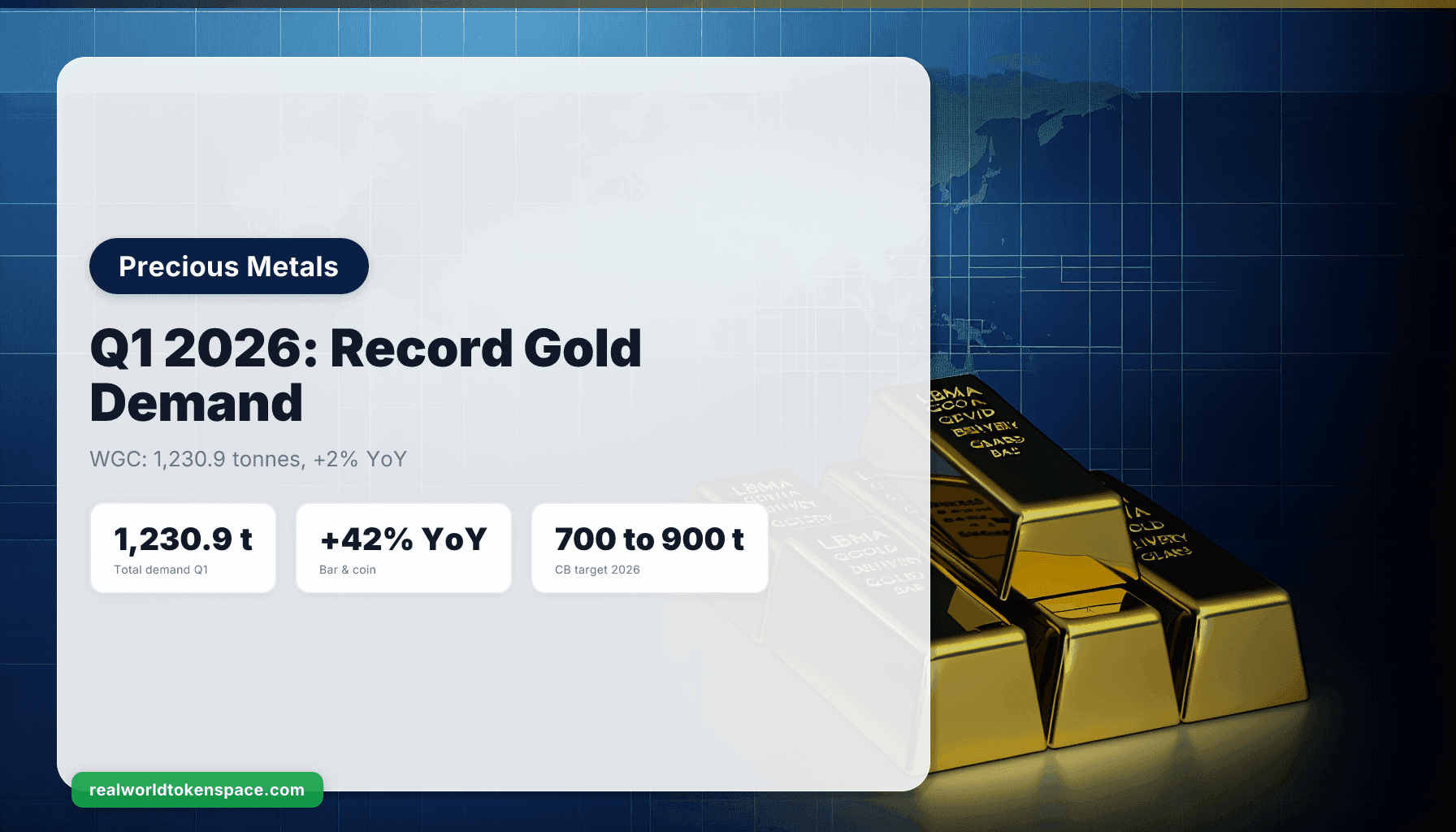
The World Gold Council just published its Q1 2026 Gold Demand Trends report, and the headline number is unambiguous. Total gold demand reached 1,230.9 tonnes for the quarter, a 2% gain year over year and the highest first-quarter print in the WGC dataset. The composition matters more than the total: bar and coin demand alone reached 474 tonnes, up 42% year over year, which is the second-highest quarterly figure on record. Central banks remain net accumulators, and JPMorgan's 2026 commodities outlook flags an expected 700 to 900 tonnes of official-sector buying for the year against a peak-of-cycle 1,000-plus tonnes seen in each of the last three years.
We do not have a directional call on the gold price. RWTS isn't bullish or bearish on gold or silver. We're the credit-rating agency for tokenized real assets. We rate. You decide. What the WGC data does tell us is that physical demand is broadening, not narrowing, and that the audience for allocated, audited, redeemable on-chain holdings is growing alongside the physical stack.
Spot gold settled near $4,681 on May 6 per LBMA reference pricing. JPMorgan, in its 2026 Global Research outlook, places the next 12-month target above $4,800 if central bank buying holds the 755-tonne range its analysts expect. Deutsche Bank's commodities desk has been more aggressive, citing real-yield compression and BRICS settlement diversification as catalysts. None of these forecasts are RWTS positions; they are the institutional anchors for the conversation our readers want us to have about tokenized options.
Physical Reality: What The Quarter Actually Showed
The Q1 demand mix is a useful read on who is buying. Asian investors drove the bar and coin surge, with WGC noting record retail accumulation in China, India, Vietnam, and Thailand. ETF flows turned positive after seven straight quarters of net outflows, adding roughly 73 tonnes to global holdings. Jewellery demand softened on price sensitivity, which is the typical pattern when prices clear $4,500 per ounce. Central bank buying came in at 244 tonnes for the quarter, consistent with the WGC's 700 to 900 tonne full-year guide.
For stackers, none of this is news. The "if you don't hold it, you don't own it" axiom has not changed. What has changed is the size of the audience that wants a parallel, allocated, on-chain holding next to the bars in the safe, for portability, for fractional ownership, for 24/7 settlement. That audience is what the tokenized gold market actually serves.
Tokenized Gold: The Trust Score View
We score tokenized precious metal products on backing quality, custodian, audit cadence, redeemability, and protocol risk. Three options sit in our Tier 1 band heading into May.
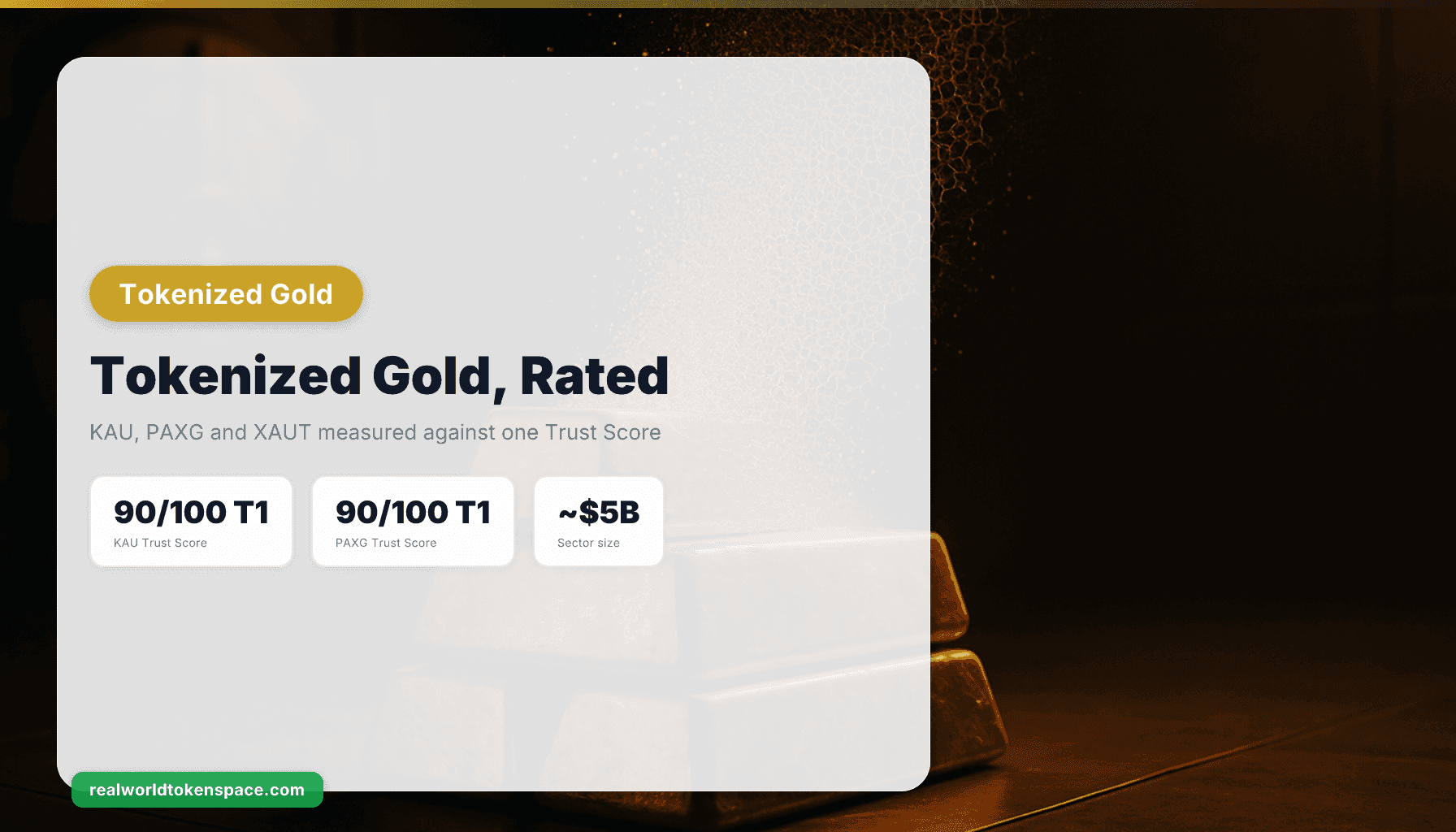
Kinesis Gold (KAU) holds an RWTS Trust Score of 92. The token represents 1 gram of allocated, LBMA Good Delivery gold held in Brink's vaults across Switzerland, the UK, Australia, and Singapore. Audits run quarterly through independent third parties, and redemption to physical bars is supported through the Kinesis Mint at standard fabrication thresholds. The Kinesis ecosystem also generates a yield on holdings (approximately 0.45% to 0.7% APY depending on tier), funded from transaction fees rather than rehypothecation. That mechanism design is what keeps the yield from being structural risk.
PAX Gold (PAXG) carries an RWTS Trust Score of 89. Each PAXG is one fine troy ounce of London Good Delivery gold custodied by Brink's London under the regulatory oversight of the New York Department of Financial Services. Redemption is supported at the bar level (400 oz) for institutional users, with smaller fractional redemption routed through partner refiners. PAXG's edge is regulatory: NYDFS oversight gives it the cleanest US institutional onboarding path of any gold token in our coverage. The tradeoff is that PAXG is non-yielding by design, which keeps its model simple but does not address the cash-drag problem stackers cite when comparing to interest-bearing alternatives.
Tether Gold (XAUT) sits at an RWTS Trust Score of 84. XAUT is one troy ounce of allocated gold held in a Swiss vault, with redemption supported in 430 oz increments. The score is one tier below KAU and PAXG primarily because of audit cadence and disclosure granularity, not because of any specific concern about backing quality. For users already inside the Tether ecosystem, XAUT is the path of least friction. For users prioritizing audit transparency, KAU and PAXG remain the better-rated options.
A common question on the precious-metals side of crypto Twitter is why anyone needs a tokenized version at all when allocated bars at Brink's or Loomis already exist. The honest answer is that most stackers do not need one. The tokenized version solves three specific problems: settling cross-border in seconds rather than days, fractional ownership below the bar threshold, and using the holding as collateral on lending markets without selling the underlying. If none of those problems apply to a given holder, physical-only is the rational choice. If one or more does, the Tier 1 tokens listed above are the audited, redeemable options we score.
What Would Change Our View
If gold holds above $4,500 per ounce, the WGC's 700 to 900 tonne central bank thesis stays intact and the supportive flow picture continues. Below $4,400, the dollar-strength bid takes over and Q1's record demand starts to look like the cycle high rather than a continuation pattern. On the tokenized side, our Trust Scores would move on three triggers: a missed audit cycle, a redemption restriction event, or a custodian change at any of the named vaults. None of those signals fired in Q1.
The credit rating angle matters here. If a tokenized gold issuer changed its custodian, weakened its redemption policy, or fell behind on its audit cadence, we would downgrade the score and publish the rationale. That is the role we are here to play. We are not telling readers to buy KAU, PAXG, or XAUT, and we are not telling them to sell. We are scoring the products, publishing the methodology, and updating the score when the underlying changes.
The Bottom Line
The WGC's Q1 2026 report tells the same story the COMEX delivery notices and LBMA inventory data have been telling for a year. Physical gold demand is real, broad, and being driven by both retail accumulators and central bank reserve managers. JPMorgan's 755-tonne 2026 forecast is the institutional anchor; the WGC's 700 to 900 tonne range is the consensus band. Tokenized gold, sized correctly inside a portfolio that already prioritizes physical first, gives stackers and allocators a parallel allocated holding with on-chain settlement properties. The Trust Scores are how we communicate which of those products we believe meet the bar.
Physical first. Tokenized second. Not financial advice.
Related research
Stay Ahead of the Yield Curve
Subscribe to The Yield Report for weekly yield intelligence.
Subscribe Now