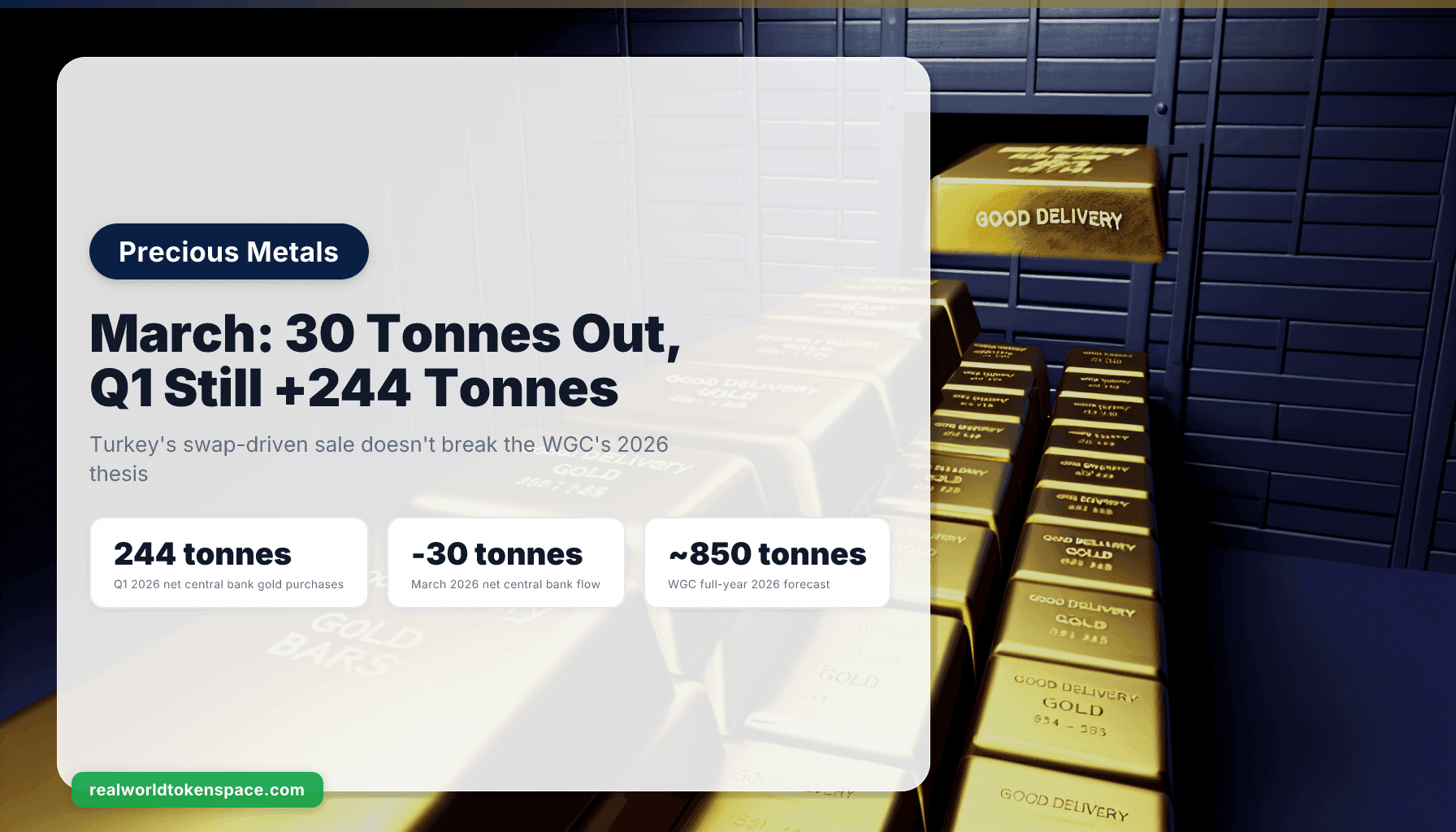
The World Gold Council's monthly central bank statistics, released this week, broke a 17-month streak. Central banks were net sellers of approximately 30 tonnes of gold in March 2026, the first month of net outflows since late 2024. The headline ran on Kitco and across the gold-focused press, and the question every allocator paying attention has to answer is the same: does this break the structural central bank bid that has been the most important macro signal of the cycle, or is it noise inside a thesis that still holds.
Our reading is that the thesis still holds, with conditions. The mechanism behind March's outflow is not an allocation reversal. It is monetary policy. Naming the lever changes the inference, and the WGC's full-year 2026 forecast of approximately 850 tonnes of net central bank purchases still has the room it needs.
What Actually Happened in March
The 30-tonne March net outflow is a single number that hides the dispersion underneath it. Turkey's central bank was the world's largest gold seller in Q1 2026 by a wide margin, unloading roughly 79 tonnes over the quarter through gold swap arrangements aimed at obtaining US dollar liquidity to defend the Turkish lira. Most of that activity concentrated in March. On the other side of the ledger, the National Bank of Poland added 31 tonnes in Q1, bringing its reserves to 582 tonnes. The Central Bank of Uzbekistan added 25 tonnes. The People's Bank of China added 7 tonnes, bringing its declared reserves to 2,313 tonnes (approximately 9% of total reserves, per WGC).
The March net outflow, in other words, was Turkey monetizing a strategic gold position to fund a currency defense. The buyers behind the multi-year structural bid (Poland, China, Uzbekistan, India, Singapore, the smaller central banks of the Gulf and Central Asia) did not change their behavior. The Q1 net of +244 tonnes is still the cleaner read on the underlying demand, and that read is consistent with the WGC's full-year 850-tonne thesis.
The Mechanism: Currency Defense Is Not Allocation Reversal
The lever that distinguishes a Turkey-style sale from a structural reversal is the use of proceeds. When a central bank sells gold to defend its currency, the proceeds buy dollars to support the FX rate. The reserves rebalance from gold into dollars. This is the same monetary tool central banks have used for decades when their currency comes under pressure, and it does not change their long-run gold allocation target. When Turkey's lira pressure abates (or when the swap rolls off), the bank typically buys gold back. The Central Bank of Turkey has been a consistent net buyer over a multi-year window even with this kind of episodic selling.
Contrast this with what an allocation reversal would look like. If the structural thesis (gold as a sanctions-resistant reserve asset, gold as a hedge against US Treasury concentration, gold as a non-fiat reserve in a world of debt monetization) were unwinding, we would see selling from a different group of buyers. We would see the large Asian net buyers slowing or reversing. We would see the Gulf central banks stepping back. We would see the European banks (Germany, France, Italy) reducing their already-high allocations. None of that is in the data. The WGC's accumulation index for major reserve managers remains in expansion territory.
The current shape of the data, in one sentence: structural buyers are still buying, one swap-driven seller dominated a single month, and the aggregate Q1 number was still strongly positive at 244 tonnes.
Where the Conditions Bind
The 850-tonne 2026 thesis remains intact at current levels, but the conditional framing matters. If Q2 monthly prints come back in net positive territory and the aggregate H1 number tracks toward the WGC's 700 to 900 tonne range, the thesis is doing what it should and gold's structural bid stays in place. If Q2 produces another net outflow month and the H1 cumulative number undershoots 350 tonnes, the WGC will revise downward and the structural bid weakens. The signal to watch is whether Turkey's selling is repeated by a different buyer with different motivation, not whether Turkey itself sells more.
A second condition is the dollar. Gold's most direct macro driver is the dollar index and real Treasury yields. With the Fed at 3.50% to 3.75% and US debt-to-GDP above 130%, the structural case for gold as a hedge against dollar debasement is unchanged. If real yields compress further (Fed cuts, inflation prints stay elevated, debt service costs accelerate), gold's structural bid strengthens regardless of monthly central bank flows. If real yields expand sharply (unlikely on the current path but possible), gold faces a more direct headwind than any single month of central bank selling can produce.
What Stackers Already Know
The physical reality has not changed. Allocated bullion in Brink's, Loomis, and Swiss vaults is still allocated. LBMA Good Delivery bars are still LBMA Good Delivery bars. The "if you don't hold it, you don't own it" calculus is unaffected by a Turkey gold swap. Stackers reading this week's WGC release should not be reading it as a reason to change their physical-first allocation. They should be reading it as confirmation that one country used gold as the strategic reserve asset it is supposed to be: a tool that can be deployed to defend a currency when the situation requires it, then rebuilt when the situation allows.
The quote from a WGC analyst we keep coming back to is roughly: "Central banks are not buying gold because they are bullish. They are buying gold because they are diversifying away from dollars." That structural motivation has not weakened in March. The data confirms one country took an expected step in a multi-year cycle.
The RWTS Edge: Tokenized Allocations
For allocators who want to participate in the central bank gold thesis without managing physical custody (or who want to layer a tokenized allocation on top of an existing physical position), the Trust Score view on the major tokenized gold products gives them a way to read this market.
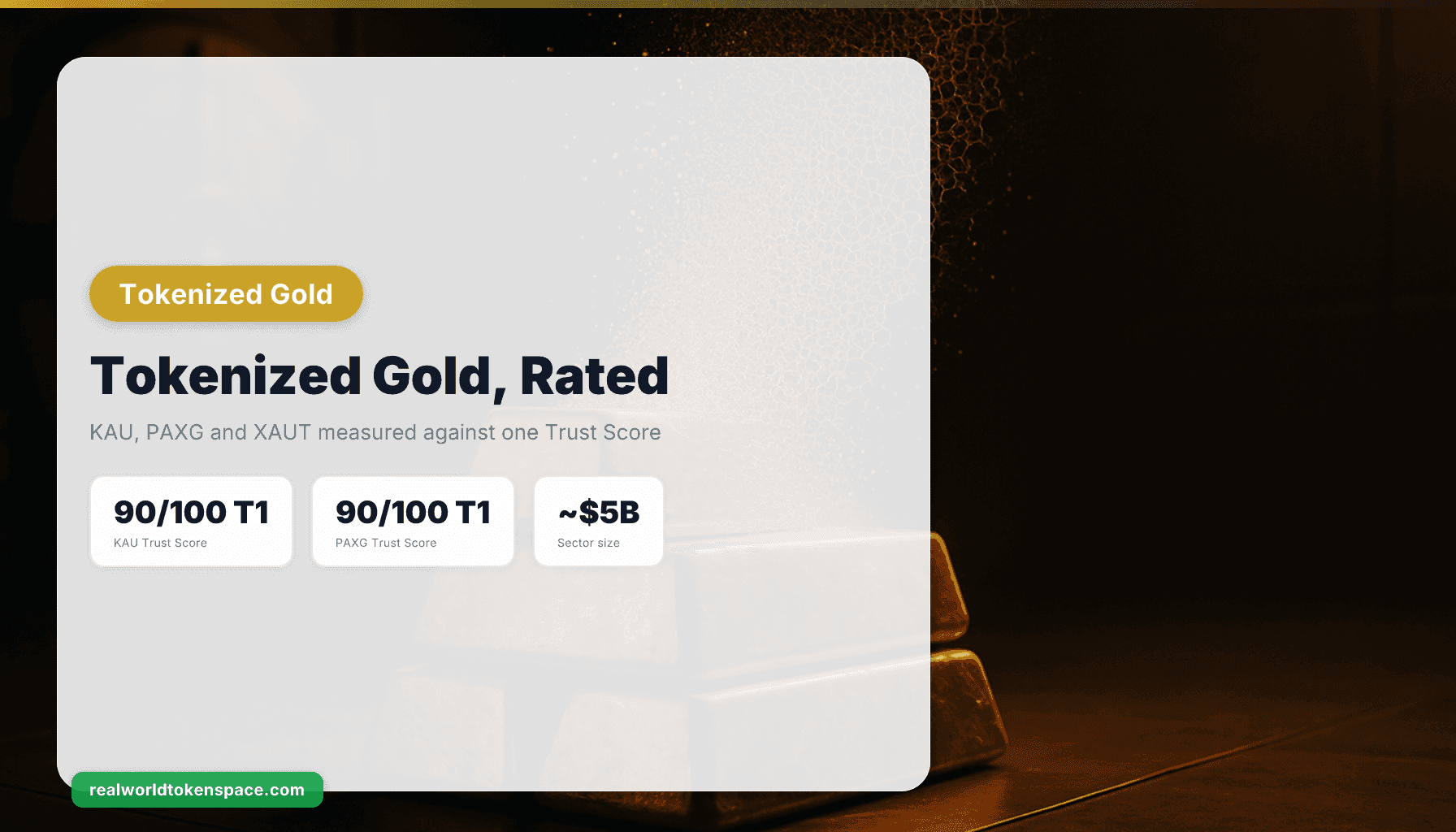
KAU (Kinesis Gold) at Trust Score 92 is the cleanest read. KAU represents 1 gram of allocated gold in the Kinesis vault network, audited monthly, redeemable into physical at vault locations, and pays a small minting yield for movement velocity. The product is allocated, audited, redeemable, and uses LBMA Good Delivery bars as its underlying reserve. The Tier 1 designation reflects the operational quality across all four pillars of the RWTS methodology.
PAXG (Paxos Gold) at Trust Score 89 is the institutional-grade tokenized gold product. Each PAXG represents one fine troy ounce of LBMA Good Delivery gold held in Brink's vaults under NYDFS regulation. The product trades on most major venues at minimal premium to spot, redemption to physical is supported above the standard threshold, and the regulated structure makes it the cleanest fit for institutions that need a 1099 trail.
XAUT (Tether Gold) at Trust Score 86 is the third major option. Each XAUT represents one fine troy ounce of LBMA gold held in Swiss vaults under Tether's custody arrangement. The product has the largest secondary market liquidity outside PAXG and is favored in environments where the redemption mechanics are less of a concern than the spread to spot.
For allocators rotating dollar reserves toward gold in response to the WGC data and the structural thesis it confirms, all three products are functional ways to participate at scale without bar logistics. The choice between them comes down to regulatory venue (NYDFS for PAXG, FCA-regulated parent for XAUT, multi-jurisdiction for KAU), redemption mechanics (PAXG and KAU support redemption; XAUT is more constrained), and yield (KAU pays minting yield, PAXG and XAUT do not).
The Bottom Line
The WGC's March data shows central banks were net sellers of approximately 30 tonnes of gold, the first net outflow in 17 months. The seller was Turkey, executing gold swaps for dollar liquidity to defend the lira. Q1 was still net +244 tonnes of central bank purchases. The structural bid driven by Poland, China, Uzbekistan, India, and the smaller diversifying central banks did not slow. The WGC's full-year 2026 forecast of approximately 850 tonnes still has the room it needs.
The thesis holds with conditions. If Q2 returns to net positive territory, the structural thesis is doing what it should. If Q2 produces a second outflow month with different sellers, recalibrate. The signal to watch is the breadth of selling, not the magnitude of any single swap.
RWTS isn't bullish or bearish on gold. We're the credit-rating agency for tokenized real assets. We rate. You decide.
Physical first. Tokenized second.
Not financial advice.
Related research