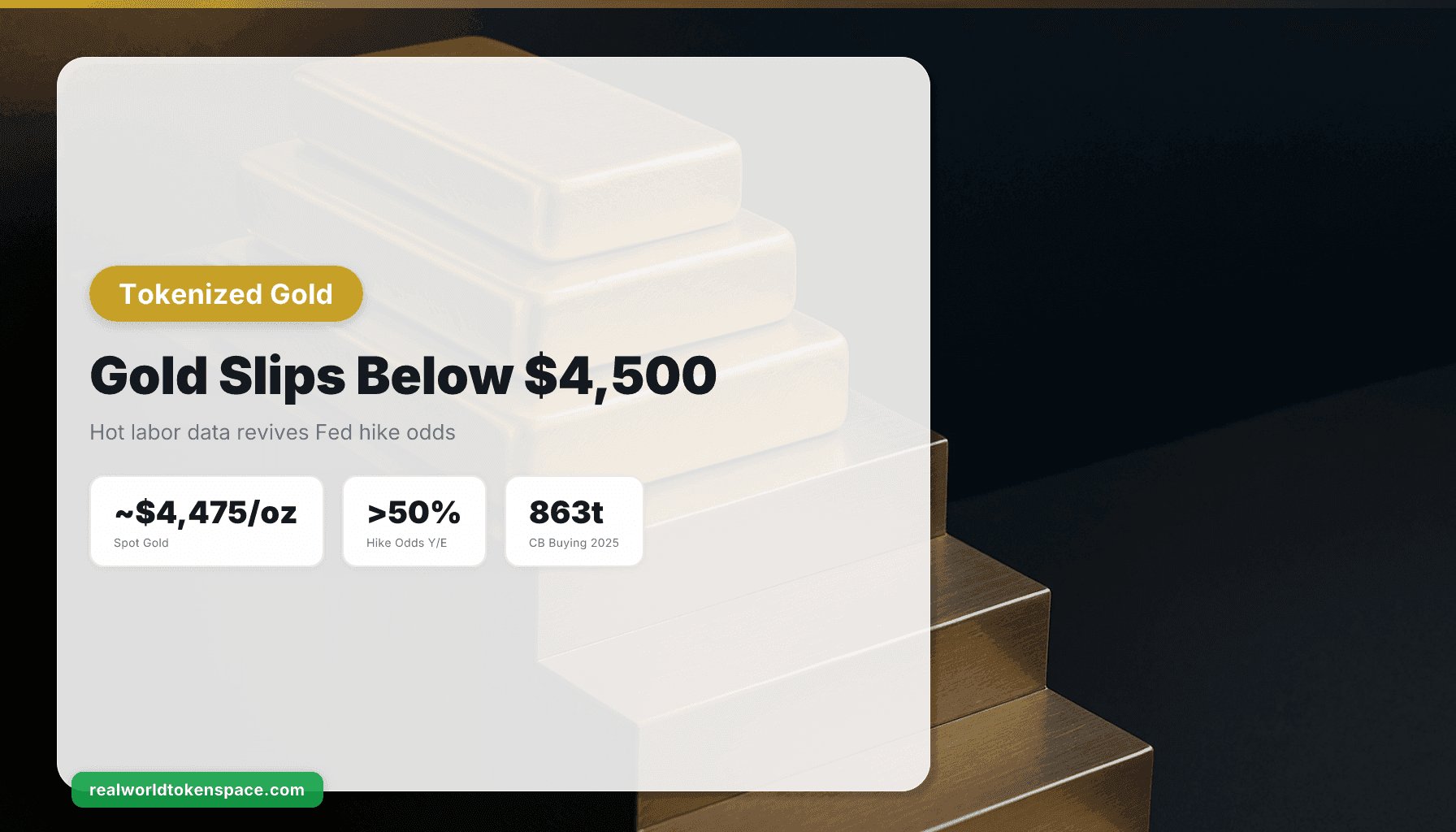
Gold fell below $4,500 an ounce this week, extending a multi-week pullback as labor-market data forced a sharp repricing of Federal Reserve expectations. Silver slid to roughly $74.74 in early Wednesday trading on June 3, as gold dropped below $4,500 after a stronger-than-expected JOLTS print, with the CME FedWatch December rate-hike probability hovering near 40%. By Thursday the benchmark had not recovered the level, leaving the metal on track for another weekly decline.
The proximate cause is a mechanism, not a mystery. The yield on the US 10-year Treasury note hovered around 4.48% on Thursday after climbing in the previous session, as stronger-than-expected labor market data reinforced expectations of tighter Federal Reserve policy. The ADP report showed private-sector employment rose by 122K in May, beating forecasts and reaching its highest level since January 2025. Earlier in the week, JOLTS data indicated that job openings increased in April to their highest level since November 2024. When the market prices a higher path for real rates, the opportunity cost of holding a non-yielding metal rises, and allocators trim. Investors continue to price in the possibility of a Federal Reserve rate hike before year-end, potentially as early as October, as higher energy prices add to inflationary pressures.
RWTS does not forecast the gold price. We are the credit-rating agency for tokenized real assets, we rate, you decide. What this week clarifies is the gap between price action, which is volatile, and structural backing, which is not.
The physical reality: central banks are still buying
Beneath the screen volatility, the demand structure that has anchored gold for three years remains intact. Central banks bought 244t (+3% y/y) of gold on a net basis in Q1 despite a visible uptick in selling activity during the quarter. That follows a full year of heavy official-sector accumulation: the World Gold Council reported that central banks globally purchased 863 tonnes of gold in 2025, remaining above the 2010–2021 annual average of 473 tonnes and well above pre-2022 norms.
The first quarter also set a price record even as the metal corrected from its January high. The LBMA (PM) gold price set a new quarterly average record of US$4,873/oz. The price hit a historical high of US$5,405/oz in January, followed by a notable correction. During Q1, the gold price returned 6%.
Bank desks remain constructive on the medium term while trimming near-term assumptions. J.P. Morgan lowered its 2026 annual average gold price forecast to $5,243/oz from $5,708/oz, while maintaining its base-case year-end target of around $6,000/oz. The humility variable here is the Fed posture. If labor data stays hot and the year-end hike gets priced as a near-certainty, the near-term fork tilts lower. If the disinflation narrative reasserts and cuts return to the table, the structural bid from central banks and ETFs has room to lift prices back toward bank targets.
The RWTS angle: price moves, custody does not
This is the distinction that matters for token holders. A 2% slide in spot does not change whether a token is fully allocated, independently audited, and redeemable for metal. Trust Scores measure that structure. They do not move with the tape. For the full framework, see our Trust Score methodology.
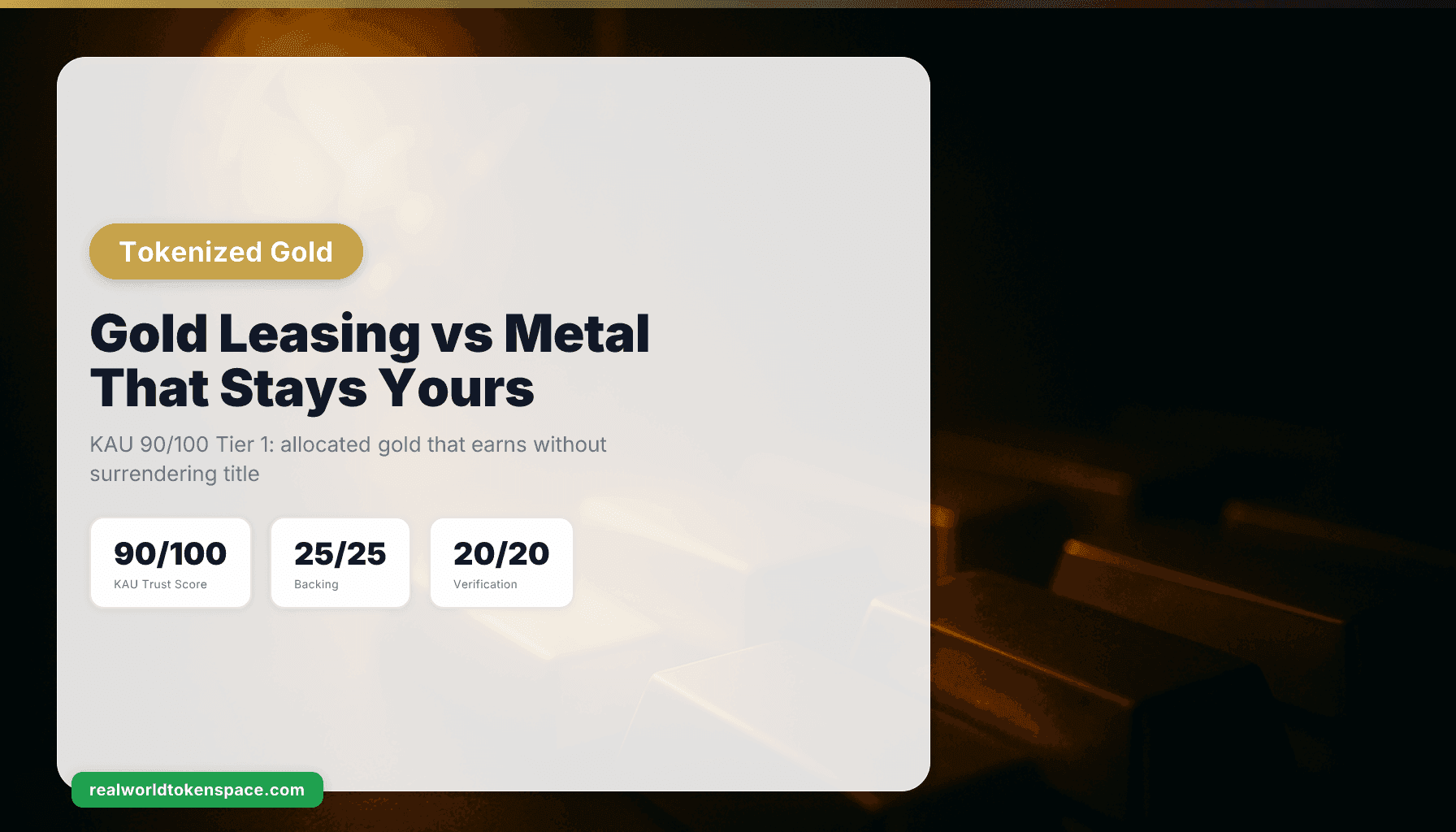
Among tokenized gold, the Kinesis tokens lead on quality. KAU, Kinesis Gold, holds a Trust Score of 90/100 (T1), and its silver counterpart KAG matches at 90/100 (T1), the two highest-rated tokenized metals we track. KAU is the highest-rated, not the biggest. Live circulation is published on the Kinesis explorer at explorer.kinesis.money; verify the current figure there before sizing any position (figure as of 2026-06-05 should be read live).
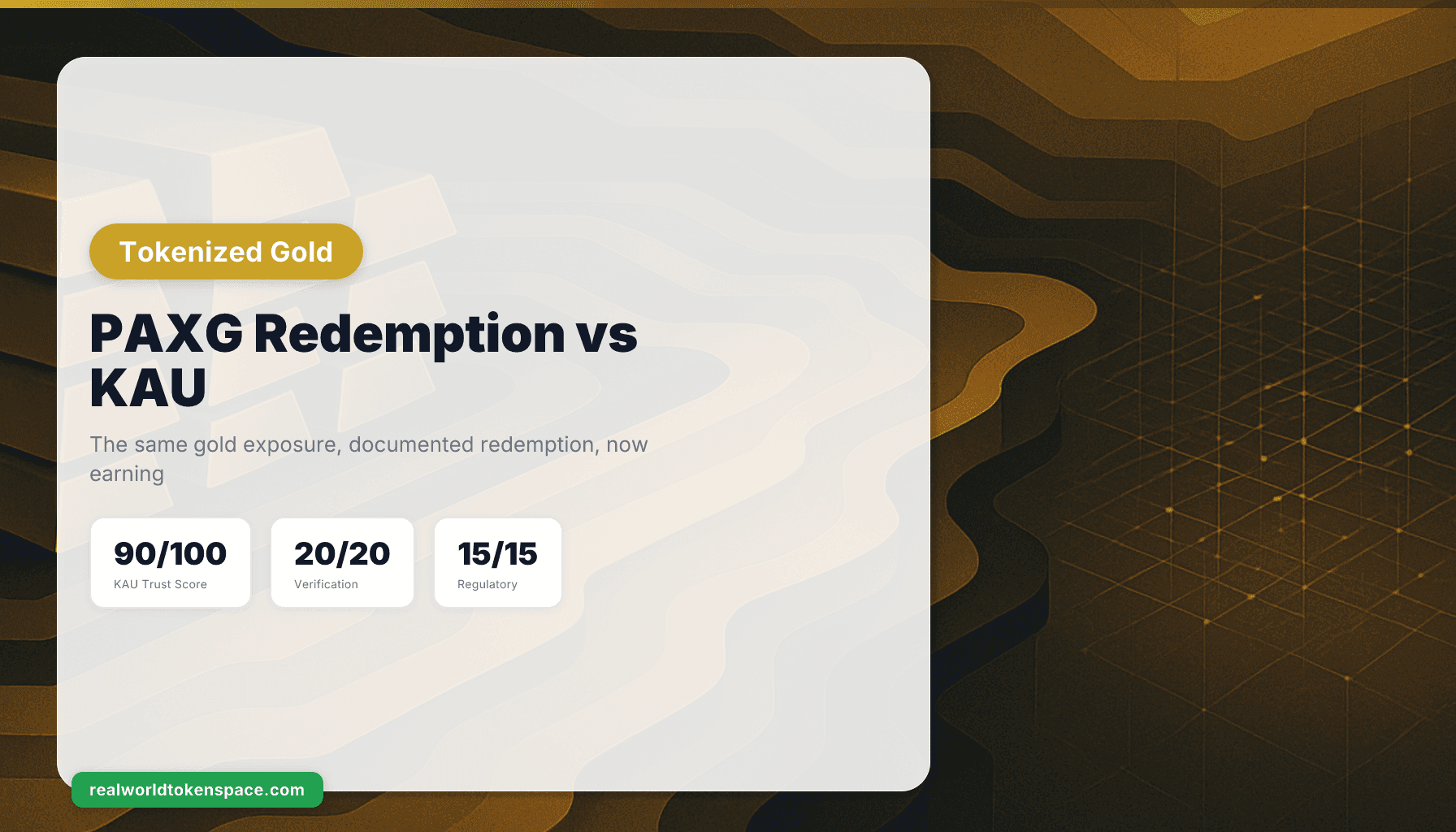
The larger tokens by market value score lower. PAXG, Paxos Gold, holds 90/100 (T1), backed by allocated London Good Delivery bars. XAUT, Tether Gold, holds 82/100 (T1). Both are larger allocated holdings than the Kinesis tokens but carry lower scores on attestation cadence and disclosure. Each represents ounces of vaulted, audited, redeemable metal, the token is a transfer layer over physical bullion held in professional vaults, not a substitute for it.
For a deeper look at how custody, attestation, and redemption separate these products, see our companion piece, Is Tokenized Gold Safe? PAXG and XAUT Trust Score and Custody Breakdown. For the category overview, the tokenized gold hub tracks every rated product.
What to watch next
The near-term path runs through three data points: Friday's nonfarm payrolls, the next CPI print, and the Fed's revised dot-plot. Recent labor market data have pointed to a resilient US economy, with employment conditions strengthening over the past two months. Friday's jobs report is expected to provide further insight into the underlying strength of the labor market and its implications for monetary policy. If payrolls confirm the ADP and JOLTS strength, hike odds firm and the near-term pressure on gold persists. A soft print would loosen that grip and hand the structural buyers the initiative.
Either way, the rating does not move with the headline. Central bank demand provides a floor that price volatility does not erase, and the tokenized products that wrap that demand are scored on the same custody and attestation criteria today as last week. We rate. You decide.
Related on RWTS
Stay Ahead of the Yield Curve
Subscribe to The Yield Report for weekly yield intelligence.
Subscribe Now