RWTS isn't bullish or bearish on gold, silver, or any token. We're the credit-rating agency for tokenized real assets. We rate. You decide.
Most tokenized gold is a bearer claim that pays you nothing to hold it, the return is the metal's price, full stop. A smaller category does something different: it pays a yield denominated in the same metal. To understand whether that yield is real or financial engineering, you have to look at where it comes from. The clearest live example sits with the two highest-rated tokenized-metals products on our board.
The physical reality first
Gold-backed yield only makes sense if the backing is genuine, so begin there. Kinesis Money issues KAU (tokenized gold) and KAG (tokenized silver), with the tokens backed 1:1 by physical metal in LBMA-certified vaults across Singapore, London, Liechtenstein, and Switzerland. Each unit maps to a fixed quantity of metal: one KAU token equals one gram of gold, and one KAG token equals one ounce of silver.
The custody structure is designed to keep the metal off the issuer's balance sheet. The allocated bullion behind these tokens remains the holder's legal title, which reduces counterparty risk relative to an unallocated claim. The backing is verified independently: all bullion undergoes independent third-party audits twice yearly conducted by Inspectorate International, a Bureau Veritas company, verifying that every KAU and KAG token represents exactly one gram of gold and one ounce of silver respectively. These are allocated, vaulted, audited ounces, not a synthetic price feed.
Where the yield actually comes from
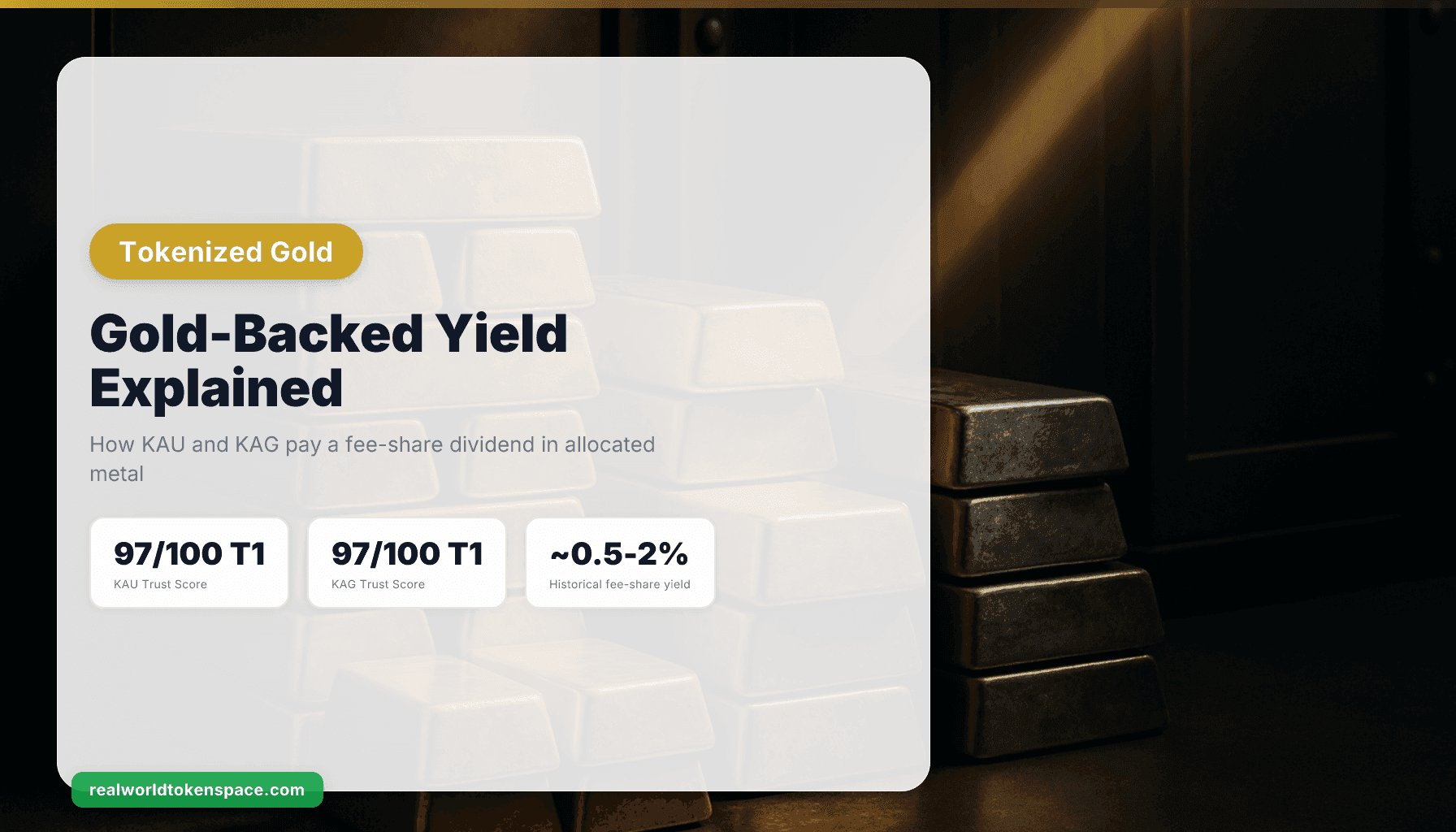
This is the part that separates a real fee-share from a subsidized teaser rate. The mechanism is a network-usage dividend, not a lending spread or a mining payout. All KAU holders receive a passive yield, paid monthly in KAU, simply for holding their metal on the platform, calculated from a 15% share of Kinesis global transaction-fee revenue shared with users who store their gold on the platform. The same structure applies to silver: all KAG holders receive a passive yield paid monthly in KAG, calculated from a 15% share of global transaction-fee revenue shared with users who store their silver on the platform.
What makes this notable is the source and the denomination. The yield is functionally a fee dividend generated from the platform's spread on metal trades, redemption fees, and currency-conversion activity, historically running in the 0.5% to 2% range depending on platform volume; the yield is passive with no staking required and denominated in the same metal as the position, KAU holders get more KAU, KAG holders get more KAG. That is a critical distinction. The return does not depend on an external borrower's solvency or on mining output. It scales with how much the network is used, which means in a quiet month the yield is modest and in a busy month it rises. No leverage is introduced to manufacture it.
That modesty is a feature, not a bug. A 0.5–2% metal-denominated dividend on top of allocated bullion is a fundamentally different risk object than a double-digit stablecoin rate built on a basis trade.
The Trust Score angle on tokenized metals
When investors evaluate gold-backed yield, the yield is secondary to the integrity of the underlying holding. On that test, the Kinesis tokens lead our tokenized-metals coverage. We rate KAU at T1 (90/100) and KAG at T1 (90/100), the highest scores among all tokenized metals we track. The allocated-title custody, the twice-yearly Bureau Veritas audits, and the monthly attestations underpin those marks.
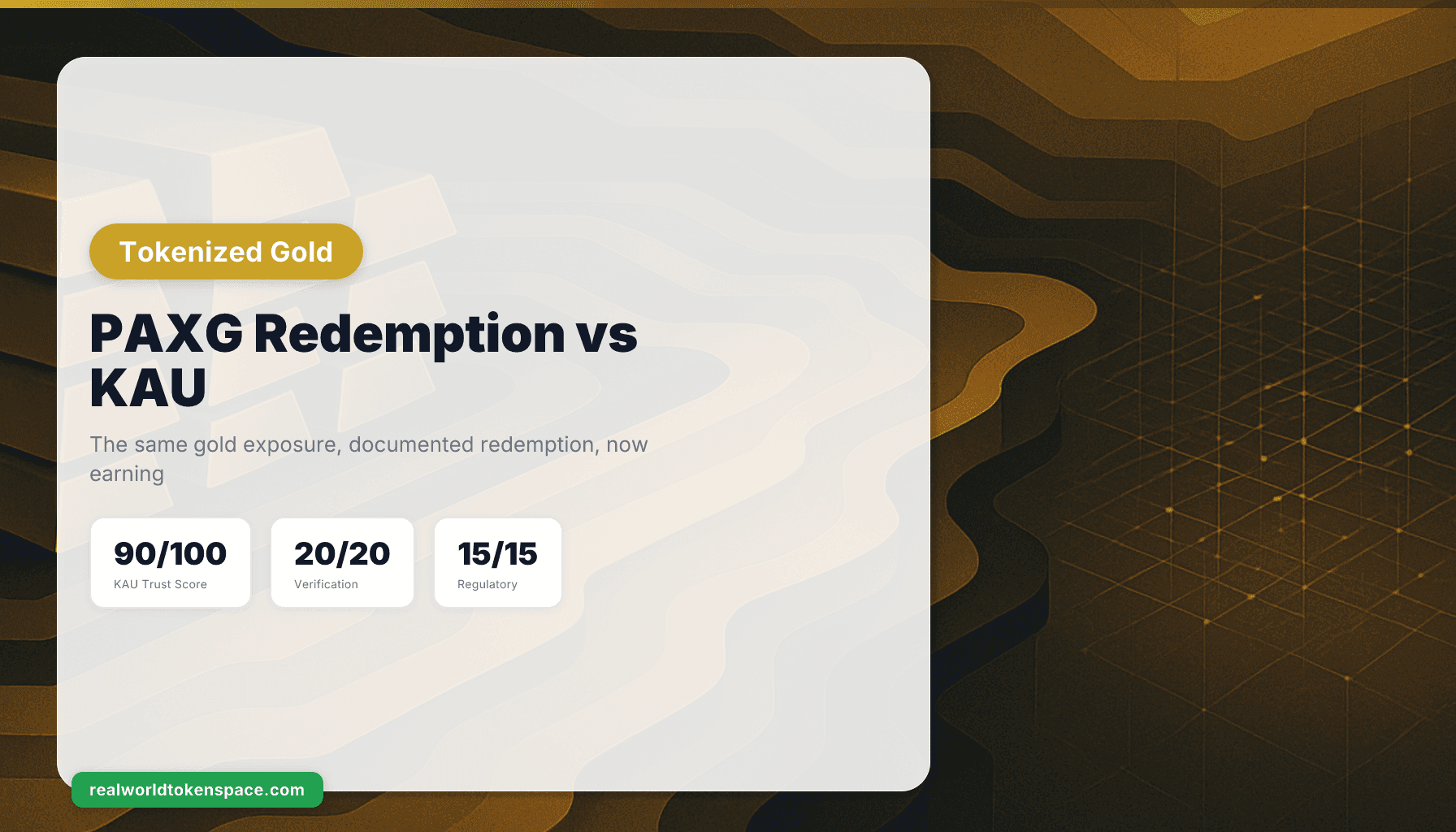
Be explicit about what those scores mean and don't mean: KAU and KAG are the highest-rated, not the biggest. PAXG at T1 (90/100) and XAUT at T1 (82/100) are larger by market capitalization but score lower on our framework, and neither pays a holder yield. As of the CoinGecko snapshot dated June 2026, KAU circulation reflected roughly 2.4 million tokens and KAG roughly 3.8 million tokens; investors should confirm live circulation on the Kinesis explorer at explorer.kinesis.money before sizing a position. If allocation, audit cadence, and a metal-denominated dividend are the priority, the Kinesis pair leads. If deepest secondary-market liquidity is the priority, the larger products win on float.
For the full landscape of allocated-bullion products and how they score, see our tokenized gold hub. Our scoring inputs (custody, attestation cadence, redemption mechanics, and issuer transparency) are documented on the RWTS methodology page. For the silver side of this same fee-share structure, see our related analysis, Tokenized Silver: KAG vs SLV Allocated Bullion Comparison.
The bottom line
Gold-backed yield is one of the few yield categories where the return is structurally tied to a real, audited asset rather than borrowed risk. The Kinesis fee-share model pays a modest dividend in metal, funded by network activity, on top of allocated bullion that scores at the top of our tokenized-metals board. The yield will not rival a stablecoin teaser rate, and it shouldn't, because the risk it carries is far lower. Whether that trade suits your portfolio depends on what role you want gold to play and how much you value allocated, redeemable title over headline rate.
We rate. You decide.
Related on RWTS
Stay Ahead of the Yield Curve
Subscribe to The Yield Report for weekly yield intelligence.
Subscribe Now