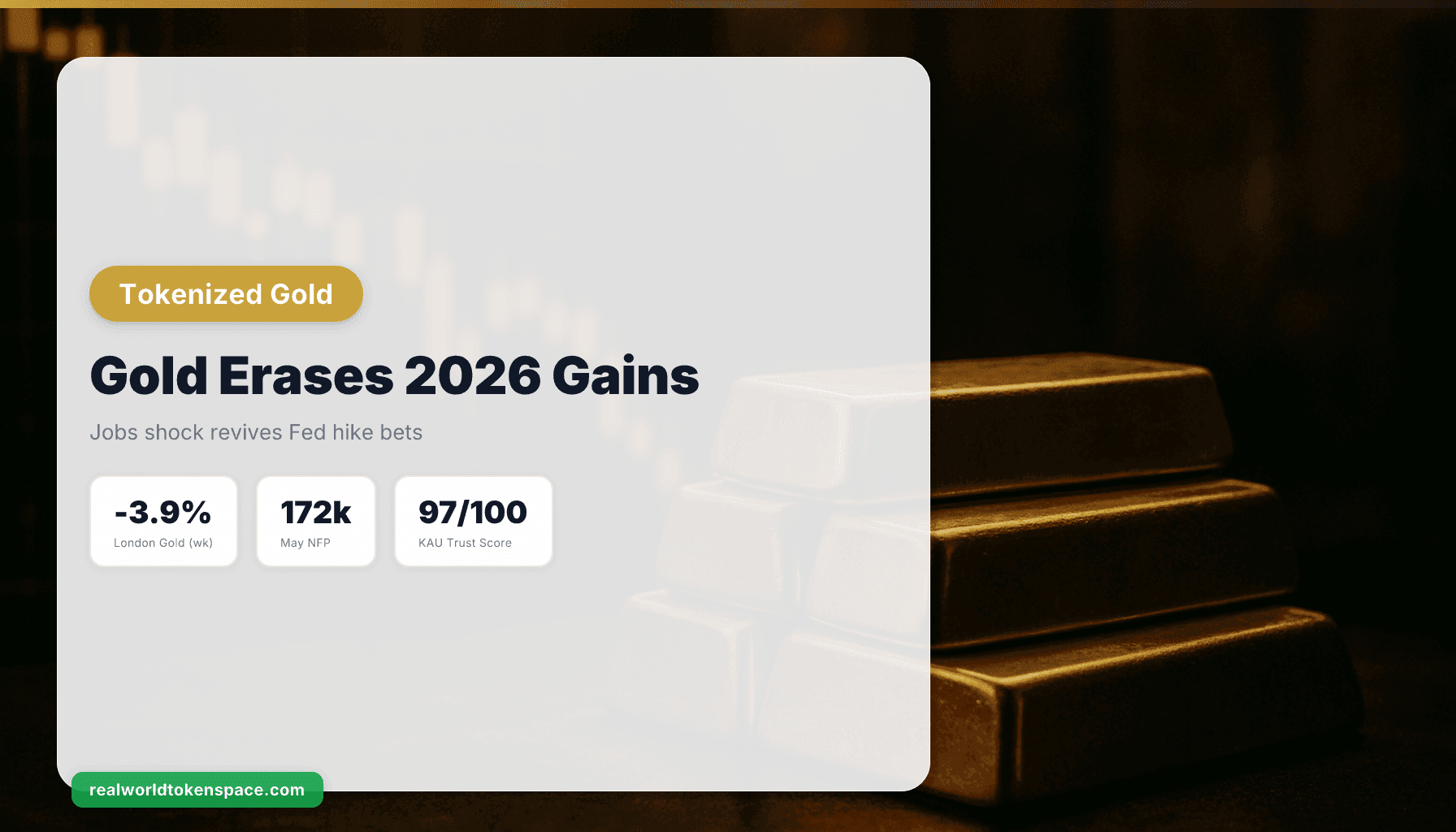
The institutional anchor for today's move is the US Bureau of Labor Statistics. Gold prices dropped below $4,370 per ounce on Friday, reaching their lowest level of 2026 and heading for a weekly decline of nearly 4%, as the May nonfarm payroll report revealed the US economy added 172,000 jobs, significantly above the forecasted 85,000, while the unemployment rate held steady at 4.3%. That single print did what weeks of geopolitical noise could not: it reset the rate path.
London gold bullion lost 3.9% from last Friday's finish, dropping over $100 per troy ounce on the stronger-than-expected US jobs figures and setting its lowest London 3pm auction price since the first trading day of the year. The mechanism is straightforward. A hotter labor market lifts the odds the Federal Reserve holds (or hikes) rather than cuts. This prompted investors to increase bets on a Federal Reserve interest rate hike, with markets now pricing in a quarter-point increase by year-end. Gold pays no coupon, so when real yields rise, the opportunity cost of holding it rises with them.
For context on how far the round-trip has run: the highest gold price ever occurred on Jan. 28, 2026, when gold reached $5,589 per ounce. From that January record near $5,600 to Friday's sub-$4,370 print, the metal has surrendered every gain booked this year. RWTS is neither bullish nor bearish on that path. We rate the tokens. You decide on the metal.
The physical reality
Underneath the tape, the bullion story is steadier than the chart suggests. Specialist consultancy Metals Focus, launching its Gold Focus 2026 this week, argued the structural drivers remain in place. For gold, "the drivers from 2025 remain intact: ongoing US policy uncertainty, persistent concerns about the dollar's long-term outlook, elevated geopolitical risks, and stretched equity valuations." Notably, the consultancy did not endorse the consensus that rate hikes are imminent over the next year, a reminder that the Friday repricing is a market reflex, not a settled fact.
Physical demand has held its own through the volatility. Despite the conflict in the Middle East, investor demand for gold bars remained strong in the first quarter, totaling 397.7 tonnes, an increase of 20% quarter-on-quarter and 50% year-on-year. The behavioral pattern matters: allocators treating dips as re-entry windows tend to absorb paper-market selling. If spot holds the $4,370–$4,400 zone, the structural thesis stays intact. Below it, the next fork hinges on the Fed dot-plot and the path of the Iran conflict, both unknowns we will not pretend to forecast.
What the drop does (and does not) change for tokenized gold
A spot move changes the dollar value of a gold token. It does not change the ounces. Every credible tokenized-gold product remains backed one-for-one by allocated bullion in audited vaults; a 4% weekly slide simply re-marks the same metal at a lower price. The relevant question for an allocator is not the candle, it is whether the custody, attestation and redemption mechanics behind a given token are sound. That is what the RWTS Trust Score methodology measures.
On that basis, the highest-rated tokenized gold is not the largest. KAU (Kinesis Gold) carries a Trust Score of T1 (90/100), the top mark in the category. Each Kinesis gold (KAU) token is backed by 1 gram of investment-grade gold bullion, securely stored in Kinesis' fully insured, audited vaults. Circulation is verifiable on the Kinesis explorer; as of recent ledgers in mid-March 2026, circulation stood at approximately 2,586,188 KAU, equivalent to about 2.586 metric tons of gold. KAU's allocated-bullion model (where the bullion behind the Kinesis real-world assets will never appear on the Kinesis balance sheet, reducing counterparty risk) is a structural strength the score reflects.
The larger products score lower but remain Tier 1. PAXG (Paxos Gold) sits at T1 (90/100) and is bigger than KAU by market cap, backed by LBMA Good Delivery bars. XAUT (Tether Gold) carries T1 (82/100) and is the largest of the three by circulation. The hierarchy is deliberate: KAU and KAG are the highest-rated tokenized metals on the RWTS board, while PAXG and XAUT are the bigger, more liquid alternatives. Size and structure are not the same thing, a distinction this week's volatility makes concrete.
For a deeper read on custody and attestation across these products, see our companion analysis, Is Tokenized Gold Safe? PAXG, XAUT Trust Score and Custody Breakdown. For the full category, see our tokenized gold hub.
The conditional read
Here is the analyst frame, not a forecast. If gold defends $4,370 into the next FOMC, the correction looks like a rate-driven repricing inside an intact structural bull case. If it breaks lower, the fork runs through two humility variables we cannot price: the Fed's posture under its current leadership and the trajectory of Middle East de-escalation. Iran-backed Hezbollah rejected a US-mediated ceasefire proposal between Israel and Lebanon, adding to doubts over efforts to de-escalate regional hostilities. Elevated oil keeps inflation risk live, which cuts both ways for gold.
None of that changes the grams in the vault. RWTS isn't bullish or bearish on gold. We're the credit-rating agency for tokenized real assets. We rate. You decide.
Related on RWTS
Stay Ahead of the Yield Curve
Subscribe to The Yield Report for weekly yield intelligence.
Subscribe Now