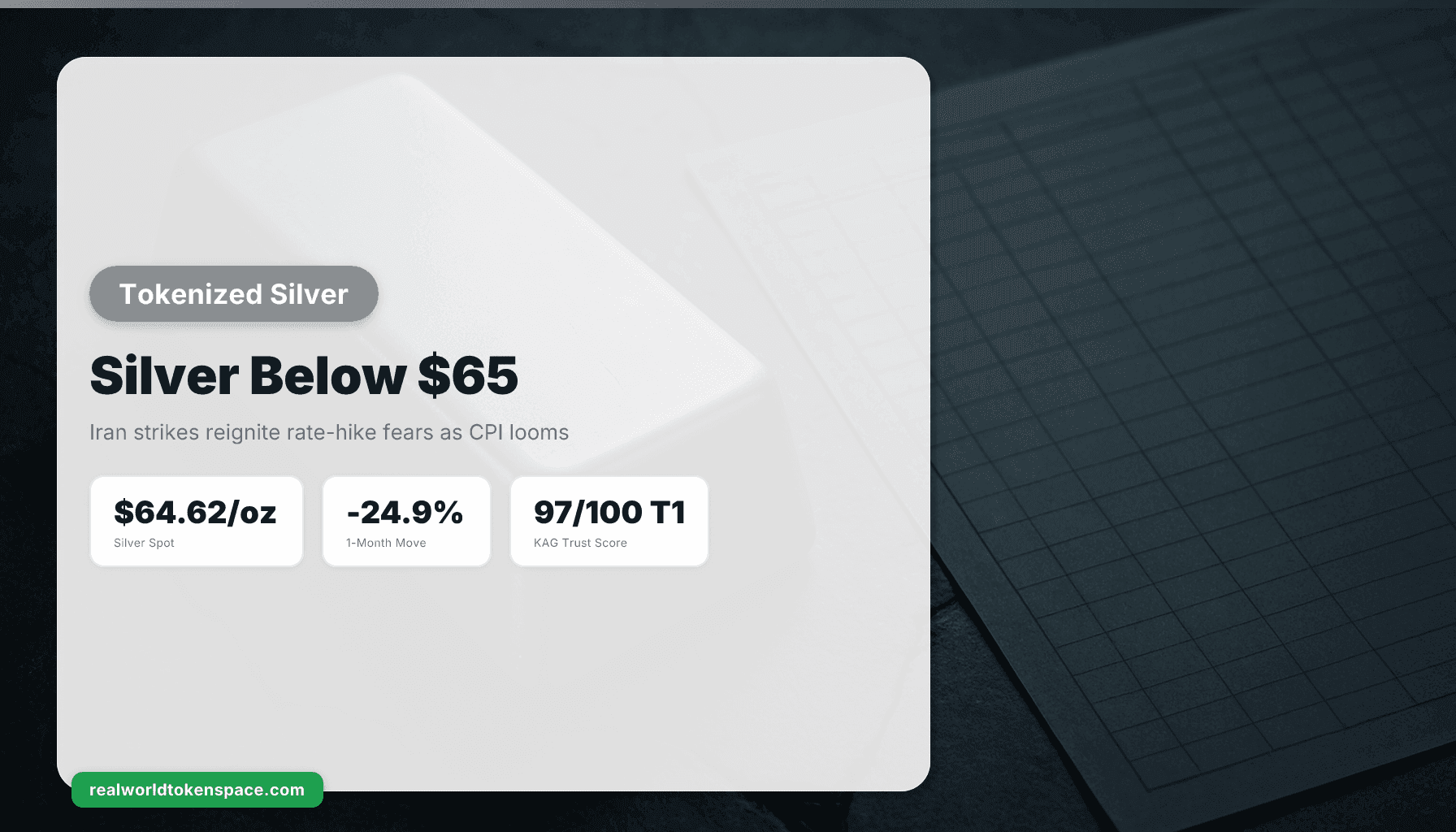
Silver broke a key level overnight. Silver fell to 64.62 USD/t.oz on June 10, 2026, down 1.06% from the previous day. The deeper damage is on the monthly tape: over the past month, silver's price has fallen 24.94%, but it is still 78.27% higher than a year ago. That monthly drawdown clears the Tier 1 coverage threshold, and the catalyst is geopolitical, not monetary.
According to Trading Economics, silver slipped below $65 an ounce on Wednesday, falling to its lowest level since March 23 after the US launched new strikes against Iran following the downing of an American helicopter, driving oil prices higher and fueling inflation concerns. The mechanism is direct: higher energy costs raise the odds the Federal Reserve keeps tightening, and a higher-for-longer rate path weighs on metals that pay no coupon. Rising energy costs linked to the conflict have heightened fears of persistent inflation and the possibility of further central bank tightening, weighing on non-yielding precious metals.
The timing matters. The May Consumer Price Index lands today. The Consumer Price Index for May 2026 is scheduled to be released on Wednesday, June 10, 2026, at 8:30 a.m. Consensus is hot: the CPI is forecast to rise 0.5% overall in May from the previous month and 4.2% from a year earlier, according to FactSet. A reading at that level would mark the highest since April 2023. Layered on last week's payrolls, the rate picture has shifted hard: this has led investors to ramp up bets on Federal Reserve rate hikes this year, with traders now pricing in a 70% chance of a December increase.
The physical reality
Strip out the screen volatility and the metal is doing what it always does in a tightening scare. Silver carries a dual identity (monetary hedge and industrial input) which makes it more reactive than gold. Silver is a widely traded precious metal with both industrial and investment applications. It is used extensively in electronics, solar panels, and medical technologies, while also serving as a store of value and portfolio diversification tool. As a result, silver prices are influenced by both industrial demand and investor sentiment.
The World Gold Council framed last week's broad sell-off as a convergence, not a single trigger. In its Weekly Markets Monitor published June 8, 2026, the World Gold Council identified six converging forces that simultaneously drove gold, silver, and bitcoin lower on "Red Friday," June 5, the day gold hit its lowest level in more than two months. The honest read for allocators: the move was a positioning and rate-expectations reset, accelerated by a Middle East peace probability that has since reversed with fresh strikes.
If silver holds above the $63–$65 band into the CPI print, the structural thesis (industrial demand plus a year-over-year gain still near 78%) stays intact. Below $63, the next test is a sentiment question tied to two unknowns: the Fed's December posture and whether the Iran conflict pushes oil high enough to bleed into core inflation.
The RWTS Trust Score angle on tokenized silver
Price is the headline. Structure is what RWTS rates. For allocators who want silver in tokenized form, the highest-rated option is Kinesis Silver. KAG carries a Trust Score of T1 (97/100), the top rating in tokenized silver. Be precise about why: KAG is the highest-rated tokenized silver product, not the largest. Silver tokenization remains a smaller market than tokenized gold.
The backing is allocated and physical. Kinesis KAU and KAG are issued by Kinesis Cayman and are in turn backed 1:1 by fully allocated physical bullion stored in insured third-party vaults by ABX's vault partners. Each token maps to an ounce: each Kinesis silver (KAG) token is backed by one ounce of investment-grade silver bullion, securely stored in Kinesis' fully insured, audited vaults. Circulation is verifiable on-chain, the Kinesis explorer at explorer.kinesis.money shows KAG circulation near 3.82 million ounces as of early June 2026, per third-party trackers.
KAG's stablemate, Kinesis Gold KAU, shares the same T1 (97/100) rating for allocators rotating between metals. The larger but lower-scored alternative in the precious-metals tokenized stack is PAXG at T1 (89/100), bigger by market cap but rated below the Kinesis pair on our framework. For the full breakdown of how custody, audit cadence, and redemption mechanics map to a numeric score, see our methodology.
One structural note for the skeptics: independent commentators have long pressed Kinesis on audit scope and the on-chain visibility of circulation. We treat that scrutiny as a feature of the rating process, not a footnote, the Trust Score reflects redemption friction and attestation quality, which is exactly where these questions belong.
What changes today
The CPI print is the variable that resolves the near-term path. A hot headline driven mostly by gasoline is a softer signal; a broadening into shelter and services would be the harder one. As Wells Fargo framed the energy channel, we estimate the Consumer Price Index rose 0.52% in May, which would push the year-over-year rate up to a three-year high of 4.2%. Higher costs of necessities continue to pinch consumers. We estimate energy goods (primarily gasoline) rose 8% in May.
For readers weighing tokenized silver against the legacy ETF route, our companion piece (Tokenized Silver KAG vs SLV: Allocated Bullion Comparison) walks the allocation and redemption differences in detail. For the broader category map, the tokenized silver hub tracks every rated product.
RWTS isn't bullish or bearish on silver. A 25% monthly drawdown does not lower KAG's backing, and a rally would not raise it. We're the credit-rating agency for tokenized real assets. We rate. You decide.
Related on RWTS
Stay Ahead of the Yield Curve
Subscribe to The Yield Report for weekly yield intelligence.
Subscribe Now