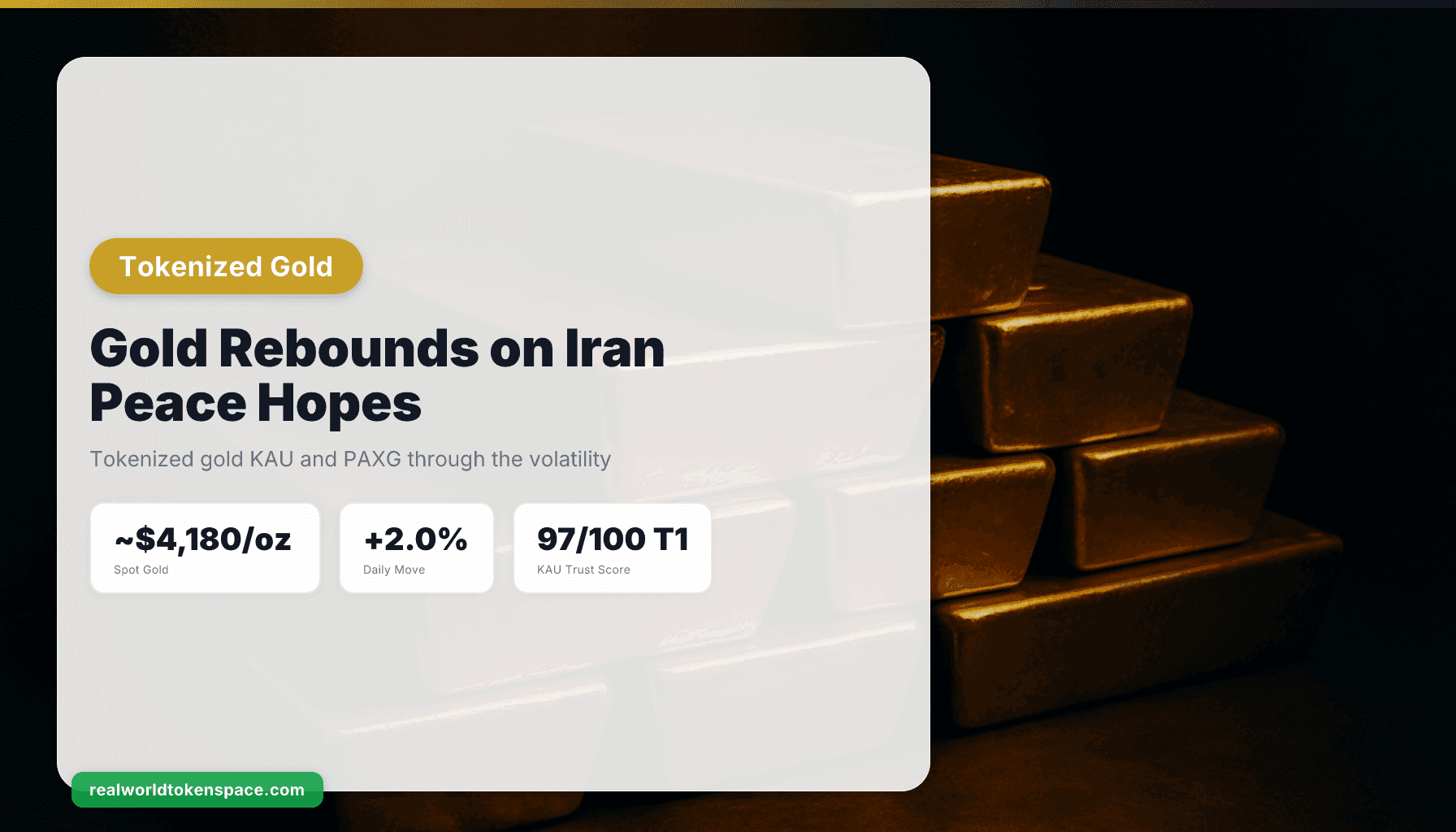
Gold clawed back ground on Friday. According to Trading Economics spot data, gold rose to 4,225.99 USD/t.oz on June 12, 2026, up 0.31% from the previous day. Earlier reporting from Indian markets put the move sharper still, with spot gold up 2.04 per cent to $4,181.55 per ounce, and silver gained 4.44 per cent to $66.76 an ounce. The catalyst was diplomacy, not data.
The driver is a cooling of the inflation panic that had pummeled both metals through the week. Gold eased below $4,200 an ounce on Friday but held most of the gains from the previous session, as growing optimism over an imminent peace deal between the US and Iran eased concerns about persistent inflation and potential interest rate hikes. President Donald Trump said a deal with Iran could be reached as early as this weekend after postponing planned attacks and warning that the US could target the country's oil infrastructure.
That marks a turn from a brutal stretch. Just one day earlier, gold gave up most of its gains to trade at $4,080 per ounce on Thursday, their lowest level since November 2025, as investors processed fresh US PPI data, the European Central Bank's rate hike, and intensifying Middle East tensions. The inflation print underneath it was real: US producer prices surged 6.5% year-over-year in May, the highest since November 2022 and above forecasts of 6.4%, underscoring the mounting impact of the energy-price shock from the Strait of Hormuz closure on the US economy.
The physical reality: a Hormuz-driven inflation shock
The mechanism behind the past month's drawdown is unusual. Gold normally rallies on geopolitical stress. This time the stress arrived through energy, and energy fed inflation, and inflation fed rate-hike expectations, which raise the opportunity cost of holding a zero-coupon metal. The result was a metal caught between two forces.
Central bank demand, long the structural pillar under gold, has also wobbled. From 2021 to 2025, central bank gold purchases averaged 225 tons per quarter, roughly double the pace from 2016 to 2020. But central banks sold 129 tons of gold in the first quarter of the year, headlined by Türkiye's sale of 60 tons in March. Meanwhile, net reported purchases of gold amounted to only 16 tons in the first quarter of 2026, representing a sharp drop in momentum. The reported figure understates the truth, though. Using alternative data from the London over-the-counter market and observing trade flows from Swiss refineries, the World Gold Council estimates that the amount of gold purchased in the first quarter of 2026 actually increased over the fourth quarter of 2025 (244 tons in the former, up from 208 tons in the latter). At least one buyer is identifiable: Chinese net imports of gold have inflected higher, coming in at 317 tons in the first quarter of 2026, up by nearly three times compared to the previous quarter.
If the Iran peace deal holds and energy prices retreat, the inflation thesis softens and rate-hike pressure eases, supportive for gold. If talks collapse and Hormuz stays shut, the inflation-then-hikes channel reasserts itself, and the metal stays capped. The fork runs through the Strait, not the chart.
The RWTS Trust Score angle on tokenized gold
For allocators who want the ounce on-chain, RWTS rates the tokenized options. We do not forecast the metal. We rate the wrapper around it.
KAU, Kinesis Gold, carries the highest Trust Score in the category at T1 (90/100). It is the highest-rated tokenized gold, not the biggest. Each KAU is backed by one gram of allocated, audited physical gold, with live circulation viewable on the Kinesis explorer at explorer.kinesis.money. As of June 12, 2026, allocators should read that figure live rather than from a stale snapshot.
The larger products by market capitalization sit lower on our scale. PAXG, Paxos Gold, scores T1 (90/100) and is redeemable for LBMA Good Delivery bars held in Brink's vaults. XAUT, Tether Gold, scores T1 (82/100) and is backed by allocated gold in a Swiss vault. All three are allocated holdings, the token tracks the physical ounce. Today's 2% bounce moved each in lockstep with spot, because tokenization changes the settlement rail, not the price exposure.
For the full breakdown of how Kinesis pays a yield on allocated metal, see our explainer on gold-backed yield: how KAU and KAG share fees. For the complete category ranking, see our tokenized gold hub. The numbers above come straight from the RWTS methodology, which scores custody, attestation, redemption rights and issuer transparency rather than price momentum.
What we're watching
The near-term variables are named and few: the Iran peace timeline, the durability of the Hormuz closure, and the Fed's posture toward energy-driven inflation at next week's meeting. Traders slightly scaled back expectations for Federal Reserve rate hikes this year, although a quarter-point increase in December remains fully priced. Longer term, the bank desks stay constructive, J.P. Morgan Global Research forecasts prices per ounce to average $6,000/oz by the final quarter of 2026, rising toward $6,300/oz by the end of 2027.
RWTS isn't bullish or bearish on gold. We're the credit-rating agency for tokenized real assets. We rate. You decide.
Related on RWTS
Stay Ahead of the Yield Curve
Subscribe to The Yield Report for weekly yield intelligence.
Subscribe Now