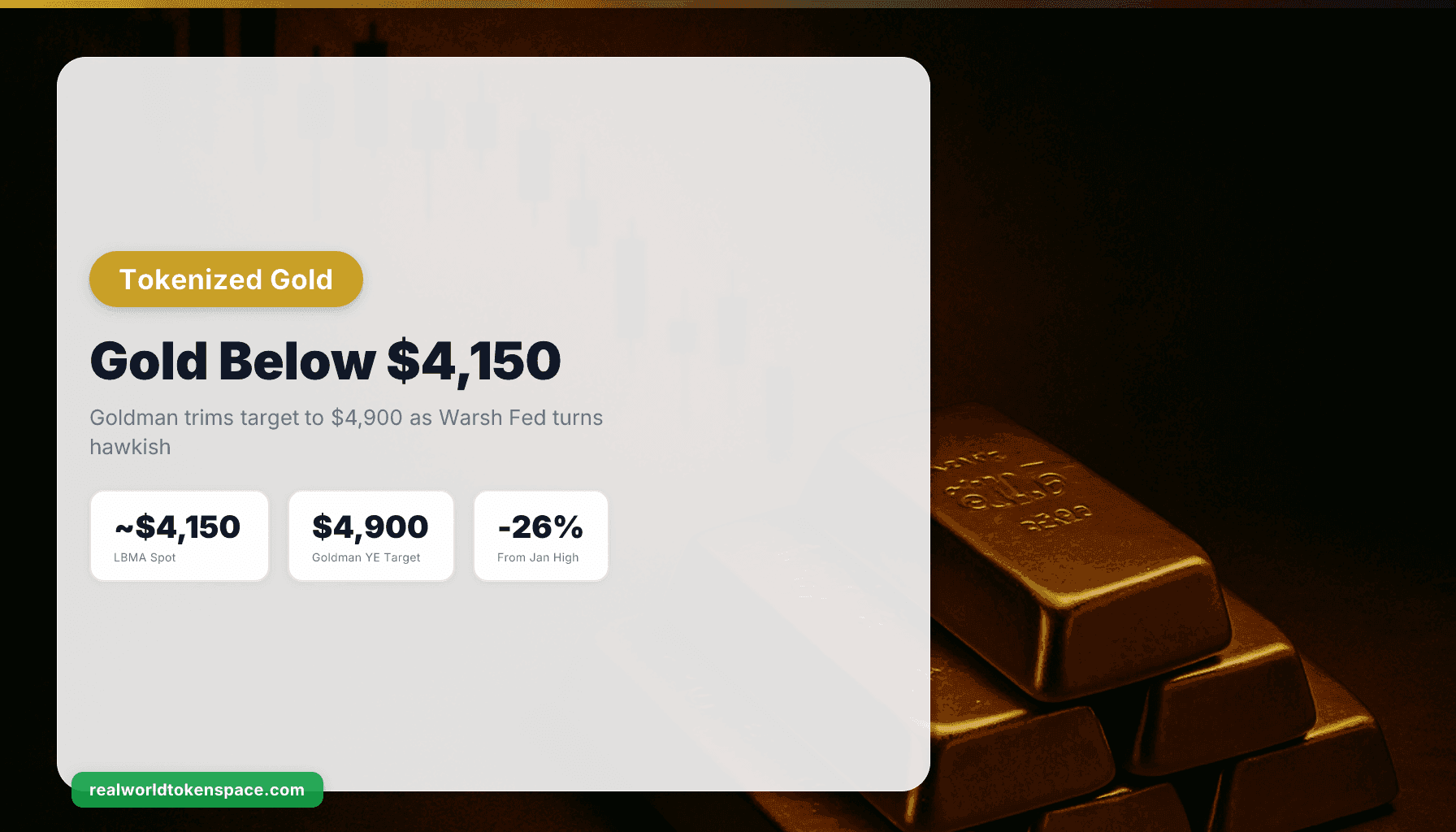
Gold has slipped below $4,150 a troy ounce, on track for a third consecutive weekly decline, and Goldman Sachs has trimmed its forecast. Goldman Sachs lowered its year-end 2026 gold price target to $4,900 per ounce from $5,400, citing a more hawkish Federal Reserve outlook and weaker expectations for gold ETF demand. The bank's note, published June 19 by analysts Lina Thomas and Daan Struyven, is the clearest institutional marker yet of a regime shift in the metal's rate backdrop.
The trigger was the Fed. The revised forecast reflects delayed rate cuts and fading concerns about central bank independence following the first Federal Open Market Committee meeting under Fed Chair Kevin Warsh. Markets had expected a softer tone; they got the opposite. Concerns over central bank independence may be limited given the "surprisingly hawkish" first Fed meeting under Warsh's leadership.
The price reaction was mechanical, not sentimental. Gold fell to $4,150 per ounce on Friday, its lowest level since June 11, and was on track for a third consecutive weekly decline as a stronger US dollar and rising expectations for tighter monetary policy weighed on demand. Higher borrowing costs tend to reduce the appeal of non-yielding assets such as gold by increasing their opportunity cost. That is the whole story in one sentence: when the curve prices hikes instead of cuts, gold's carry disadvantage widens.
The physical reality: central banks are still buying
Price and physical demand are diverging, and that gap matters. The official sector has not blinked. The World Gold Council's annual Central Banks Gold Reserves Survey reveals that 89% of reserve managers expect global central bank gold holdings to continue increasing over the next 12 months. A staggering 45% of respondents anticipate their gold reserves to increase over the next year, which is the most bullish reading observed since the survey began in 2018.
The flow data backs the survey. Global central banks added a net 290 tonnes in the first quarter of 2026, the strongest start to a year on record. Purchases have averaged 1,000 tonnes per year over the past four years, compared with a 500-tonne average in the preceding decade. That accumulation is a slow-moving structural bid that does not unwind on a single FOMC meeting.
Goldman frames the same tension directly. The revised target of $4,900 an ounce for December implies bullion is still expected to gain ground in the second half, although less than previously expected. "Our gold price views remain structurally constructive but tactically cautious, with near-term downside risk and medium-term upside risk," they said.
The fork from here
This is a conditional setup, not a forecast. If gold holds above the $4,100–$4,150 band and the Warsh Fed stops short of an actual hike, the structural central-bank bid and de-dollarization theme keep the longer thesis intact. Below $4,100, the unwind accelerates. Should the Federal Reserve proceed with tightening monetary policy, Goldman cautioned that precious metals could experience additional losses, potentially declining to $4,400 by December. The humility variable is explicit: it hinges on whether Warsh's Fed actually delivers the hikes the curve is now pricing, or whether the hedge that drove gold to records reasserts itself before the cuts finally arrive.
For context on how far the metal has travelled, prices have now reversed back to the $4,100 level, a 27% decline from its January highs.
The RWTS Trust Score angle on tokenized gold
RWTS does not call the price. We rate the tokenized allocated holdings that let you hold ounces on-chain. Among them, the Kinesis tokens lead on quality.
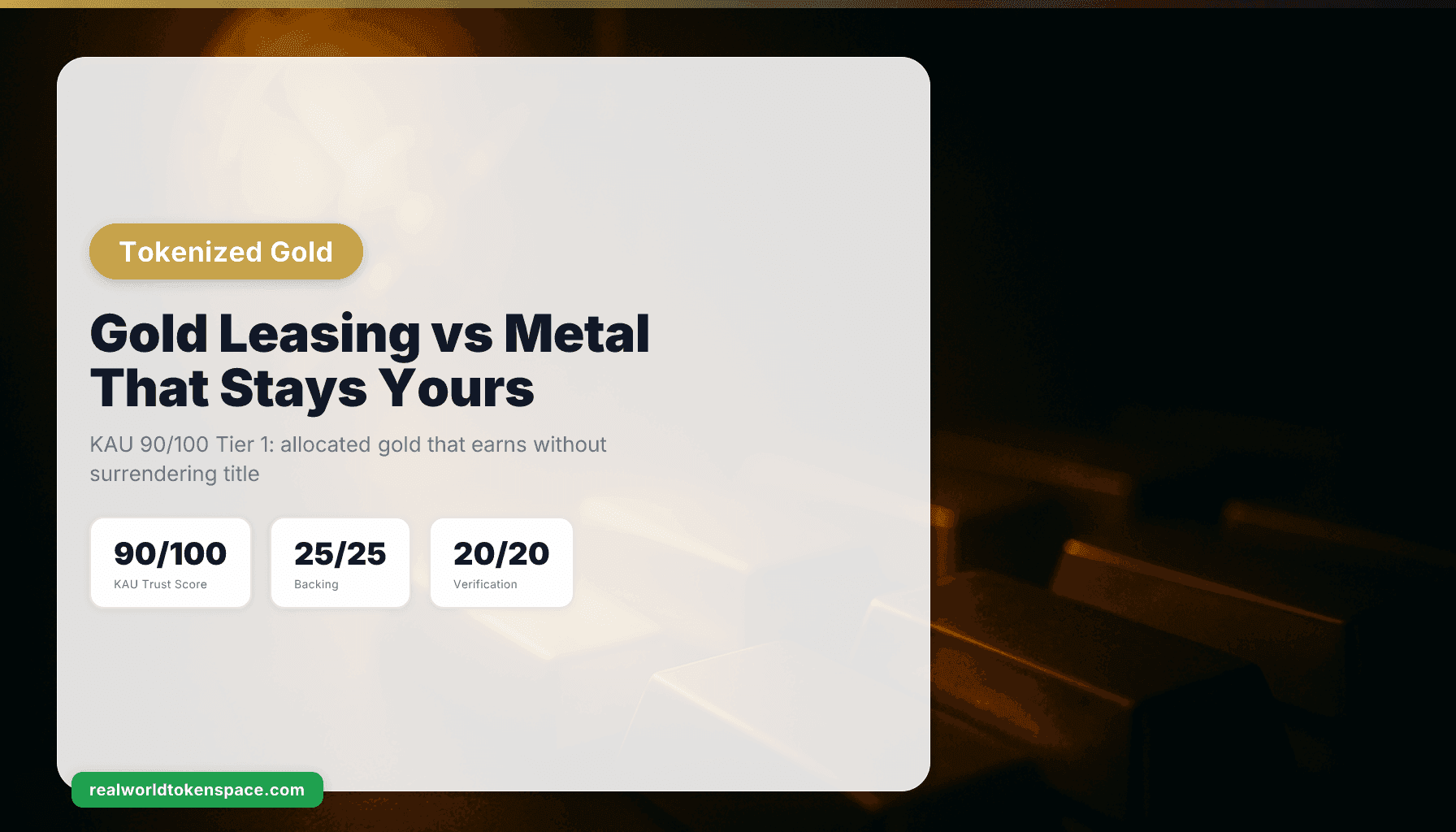
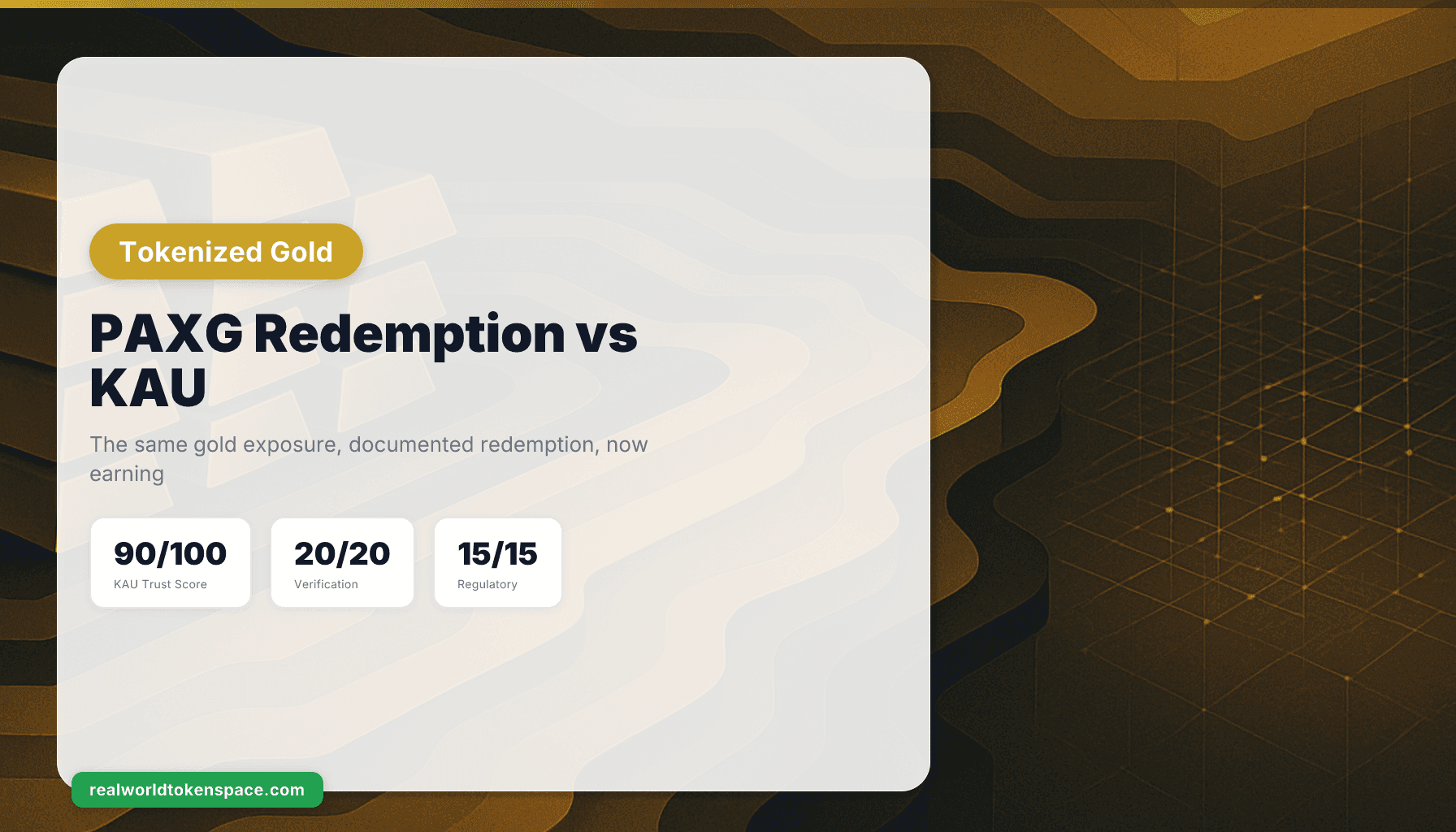
KAU, Kinesis Gold, carries the highest RWTS Trust Score in the category at T1 (90/100). It represents allocated, vaulted, audited ounces with on-chain redeemability, and live circulation is published on the Kinesis explorer at explorer.kinesis.money (figure as of 2026-06-20). The larger products by market value score lower: PAXG sits at T1 (90/100), and XAUT at T1 (82/100). Be clear about the distinction, KAU is the highest-rated tokenized gold, not the biggest. PAXG and XAUT carry larger market caps.
All three are allocated against physical metal held in professional vaults, with attestation and defined redemption terms. The differences our Trust Score methodology captures (custody arrangements, audit cadence, redemption friction, issuer disclosure) are precisely what a price drawdown does not change. A token rated on its plumbing stays rated on its plumbing whether spot is $4,150 or $5,600.
For the macro thread driving this move, see our related analysis in Gold and Silver Rebound on Iran Peace Deal: Tokenized Gold KAU, PAXG. For the full category, our tokenized gold hub tracks every rated product.
Bottom line
The near-term tape belongs to the Fed. A hawkish Warsh and a stronger dollar reset the rate-cut trade, Goldman cut $500 off its target, and gold gave back ground toward $4,100. The structural bid (record central-bank survey intentions and the strongest Q1 buying on record) has not gone anywhere. Those two forces will resolve over quarters, not days. RWTS isn't bullish or bearish on gold. We're the credit-rating agency for tokenized real assets. We rate. You decide.
Related on RWTS
Stay Ahead of the Yield Curve
Subscribe to The Yield Report for weekly yield intelligence.
Subscribe Now