Tokenized Money Market Fund: BUIDL vs USYC vs BENJI 2026
A tokenized money market fund is a blockchain token that represents a share of a fund holding short-duration US Treasuries and overnight repo. You capture the underlying bill yield on-chain, with settlement that runs around the clock instead of through multi-day fund plumbing. The category has scaled fast: tokenized U.S. Treasury products crossed $15.9 billion in on-chain assets under management as of September 2026, up from $6.5 billion a year ago and less than $1 billion in early 2024.
RWTS isn't bullish or bearish on any issuer. We're the credit-rating agency for tokenized real assets. We rate, you decide. So the question that matters isn't which fund is biggest, it's which one fits your wrapper, your jurisdiction, and your redemption needs at an acceptable Trust Score. Here is the verdict.
Which tokenized money market fund has the highest Trust Score?
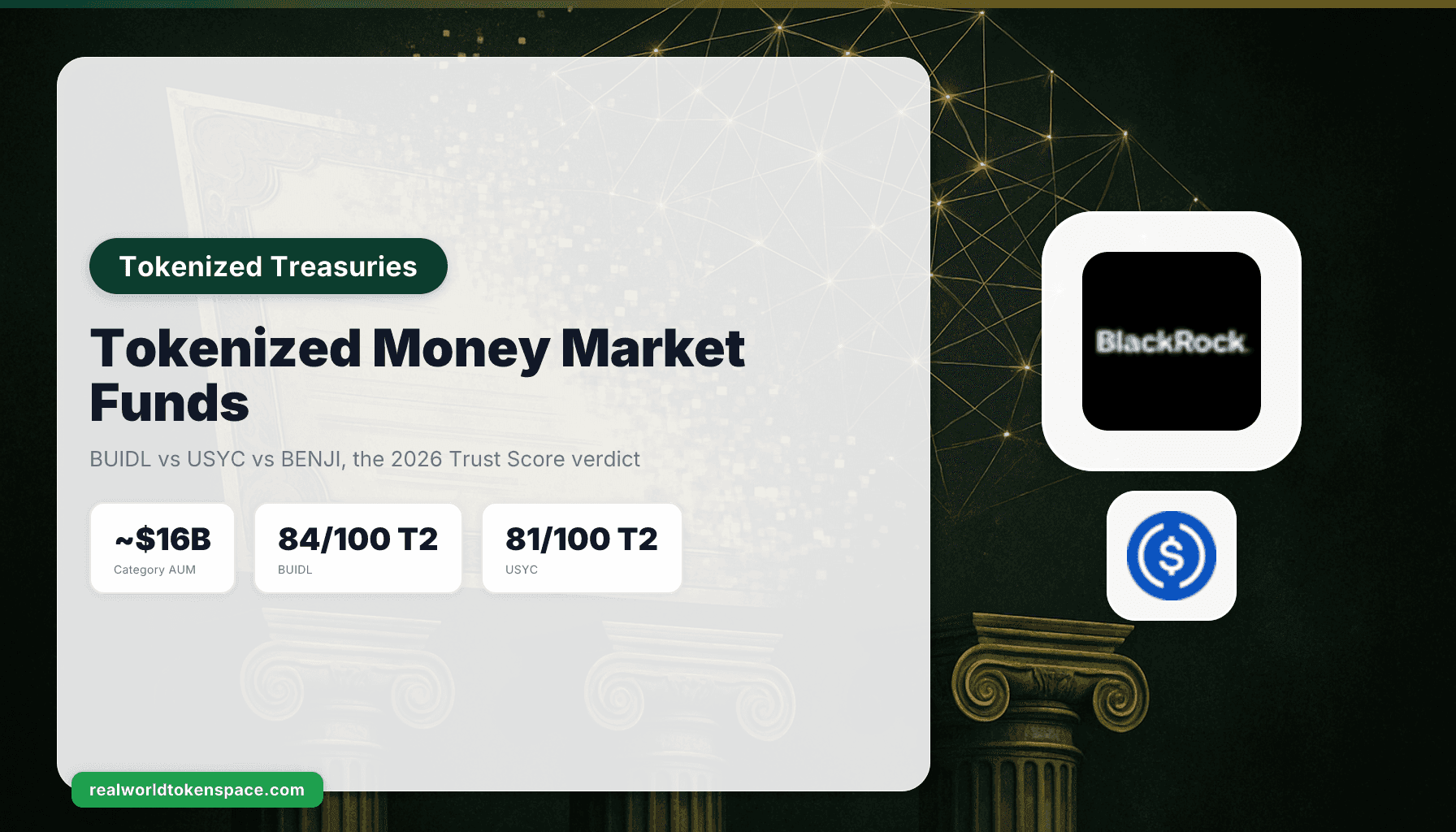
Verdict: among the largest products, Franklin Templeton's BENJI leads at T2 (88/100). BUIDL follows at T2 (84/100). USYC, USDY and USTB cluster at T2 (81/100). Every headline name is Tier 2, solid, institution-grade, but none reaches the Tier 1 ceiling. The gaps between them come down to disclosure depth, wrapper transparency, and redemption mechanics, all detailed in our Trust Score methodology.
| Product |
Issuer |
Trust Score |
Wrapper |
Redemption |
| BENJI |
Franklin Templeton |
T2 (88/100) |
US 1940 Act fund |
Daily, transfer-agent rails |
| BUIDL |
BlackRock / Securitize |
T2 (84/100) |
Reg D (qualified purchasers) |
Daily |
| USDY |
Ondo Finance |
T2 (81/100) |
Reg S (non-US) |
Multi-day |
| USYC |
Circle (Hashnote) |
T2 (81/100) |
Reg S (non-US) |
Near-instant into USDC |
The wrapper decides almost everything
Before yield, before minimums, the regulatory wrapper determines who can hold the product and how fast money moves. The decision tree is wrapper-first. If you need a US-registered 1940 Act fund, BENJI is the cleanest answer. If you want maximum institutional AUM signal and Securitize infrastructure, BUIDL leads. If you are inside Circle's USDC stack and want the tightest cash-to-yield round-trip, USYC fits.
That framing matters because the products are not interchangeable. Reg D private placements are the path used by BUIDL and OUSG. The wrapper restricts the product to accredited investors and qualified purchasers in the United States, with subscription routed through a registered broker-dealer or transfer agent. Reg D access depth is high (these are the largest-AUM products in the category) but the gate is also high, which is why the Reg D names dominate institutional flow rather than retail.
USYC sits on the other side of the line. USYC is the tokenized money market fund originally built by Hashnote and now operated under Circle, which acquired Hashnote in January 2025. The fund holds short-term US Treasuries and overnight reverse repos, with the USYC token representing a share in that pool. As of mid-2026, USYC sits around $3B in assets under management. It is a Reg S product, each USYC token represents a share of a Cayman Islands registered mutual fund, and shares are only available to non-U.S. persons as defined under the Securities Act of 1933.
Is BUIDL safer than USYC?
Verdict: both are Tier 2 and both hold effectively the same underlying assets, short-dated Treasuries and repo. BUIDL edges USYC on Trust Score, T2 (84/100) versus T2 (81/100), largely on issuer credit and disclosure. But "safer" depends on your risk. The BUIDL fund invests in US Treasury bills, repurchase agreements, and cash. Each BUIDL token is worth exactly $1 and accrues yield daily. The Reg D gate is steep, BUIDL is a qualified-purchaser product with a high minimum, not a retail account.
USYC's differentiator is redemption speed, not backing. By bringing assets on-chain, USYC delivers around-the-clock access to capital, and can be redeemed into USDC in near real time up to the instant-redemption capacity. USYC yield accrues automatically through a rising token price, with no staking or claiming. For a treasury desk already living inside USDC, that round-trip is the whole point. Redemption flows back to USD or USDC through Hashnote's process, now integrated with Circle, letting holders convert USYC and USDC against each other subject to cut-off times, meaningfully different from a typical fund redemption that ends in a bank wire two business days later.
Where BENJI and USDY fit
BENJI carries the highest Trust Score of the group because it is the most conventionally regulated. BENJI predates BUIDL and was the first U.S.-registered tokenized money market fund, which set the regulatory precedent. By 2026 BENJI runs on multiple chains and serves as a working example of a traditional fund that operates on-chain with regulated transfer-agent rails. If your priority is a familiar 1940 Act structure with an on-chain layer bolted on, BENJI is the reference point.
USDY is the retail-adjacent option, with the trade-offs that implies. USDY's non-U.S. retail footprint added about $1.5B as the product expanded to Solana, Aptos, Sui, Mantle, and Noble. Broader access and lower minimums come at the cost of slower redemptions and thinner secondary liquidity than the Reg D leaders.
The honest caveat on secondary liquidity
Primary-rail redemption is fast for the top names, but the category still leans on issuer subscription and redemption windows rather than deep secondary markets. If US short-end yields stay in the 4–5% band, the yield case is clean: capture the bill yield without leaving the stablecoin rails you already use. If the Fed cuts hard, the spread these products carry over a plain USDC balance compresses, and the wrapper friction stays. That is the variable to watch: Fed posture, not issuer marketing.
For the deposit-token side of this decision (whether to hold a tokenized fund or a yield-bearing stablecoin instead) see our companion analysis on USDC yield and how much you can actually earn. For the full category and every product we rate, start at our tokenized treasuries comparison hub.
The bottom line: there is no single "best" tokenized money market fund. There is the one that matches your wrapper, your jurisdiction, and your redemption tolerance at the highest Trust Score you can access. We rate. You decide.
Related on RWTS
Stay Ahead of the Yield Curve
Subscribe to The Yield Report for weekly yield intelligence.
Subscribe Now