Tokenized Gold: KAU, PAXG, XAUT Rated and Compared
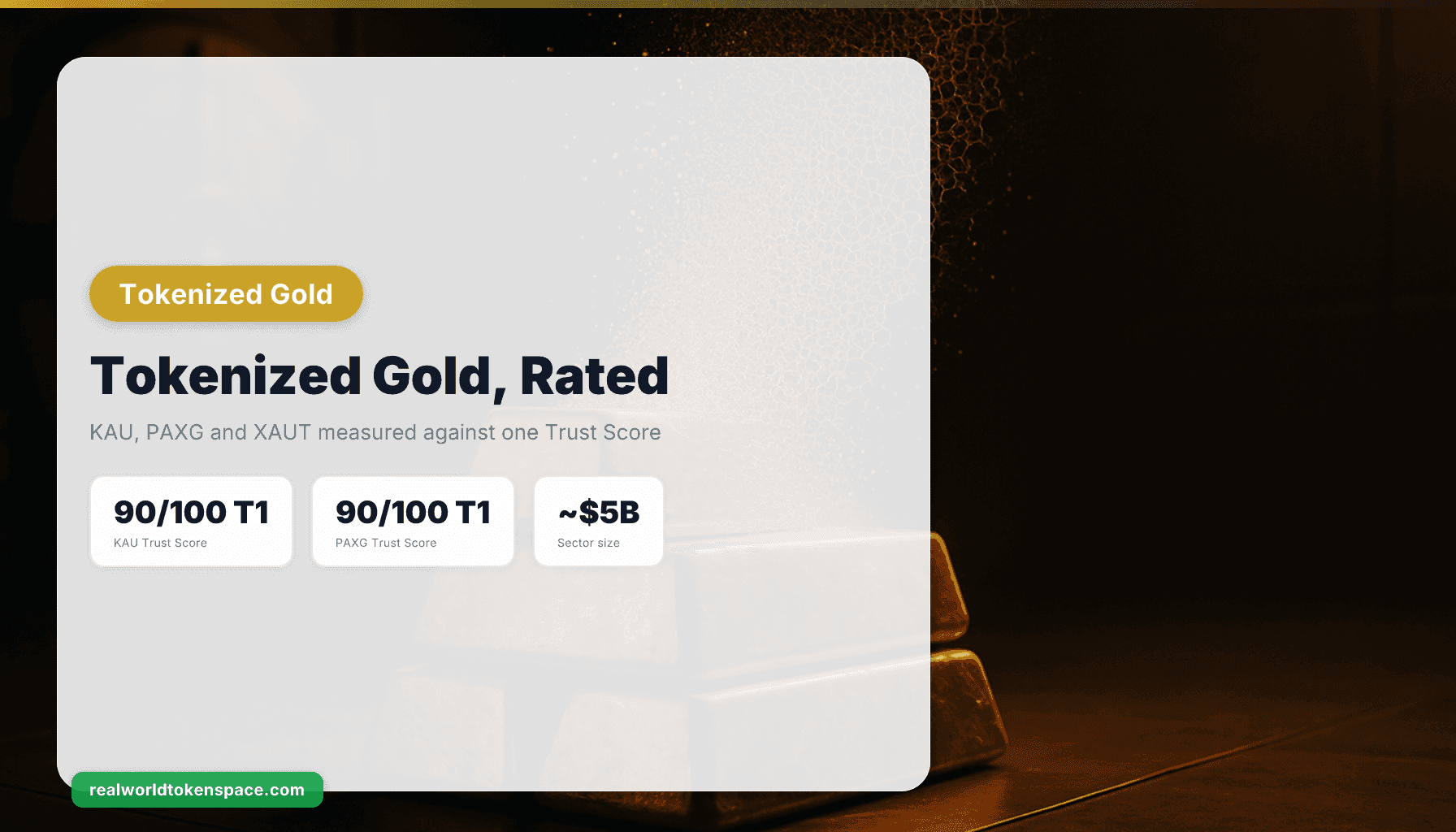
Tokenized gold now sits around $5 billion on-chain, a figure that has roughly tripled since late 2024. The tokenized gold market cap was sitting below $1.5B in late 2024. It has more than tripled since then. Against the roughly $30 trillion physical gold market, that is a rounding error. But the growth curve, and the arrival of institutional-grade attestation, is why tokenized gold has become a serious allocation question rather than a novelty.
RWTS does not take a view on where gold is headed. We rate the tokens, you decide. This guide covers what tokenized gold is, who leads on our Trust Score, and where the biggest products diverge from the highest-rated ones.
The physical reality behind the token
Every credible tokenized gold product is a claim on allocated metal. Each token corresponds to a defined weight of audited physical gold held in professional vaults, redeemable through the issuer. KAU represents one gram; PAXG and XAUT each represent one troy ounce. The backing is confirmed through periodic attestation rather than a marketing promise.
The macro backdrop matters for why allocators care. Gold traded in a tight band near $4,120 to $4,190 an ounce in early October. Gold edged above $4,160 an ounce as fading expectations of a Federal Reserve rate hike this month offset pressure from a firm US dollar and elevated Treasury yields. Markets have scaled back bets on an October rate hike following weaker-than-expected job growth in September. Traders now see only about a 20% chance of a rate increase this month, while still pricing in nearly a 70% probability of a hike in December. If gold holds above the $4,100 support zone, the store-of-value thesis stays intact. Below it, the Fed posture and dollar strength become the deciding variables.
Central-bank demand remains the structural driver. Analysts expect official and inelastic demand from the world's central banks to propel prices higher. Third-quarter central-bank demand was 220 tonnes, the third-highest on record, and markedly higher than the second quarter despite much higher prices. That is a flow tokenized products do not create, but it is the current they float on.
The Trust Score angle: highest-rated is not biggest
Here is where tokenized gold gets interesting, and where the sector's own numbers mislead. By market size it is a two-token race. The tokenized gold sector is essentially a two-horse race. Tether Gold (XAUt) commands roughly $2.4B to $2.7B in market capitalization, while Pax Gold (PAXG) holds approximately $1.8B to $1.9B. Together, those two tokens represent somewhere between 89% and 98% of all tokenized gold supply.
By our rating, the order shifts. KAU, Kinesis Gold, earns T1 (90/100). PAXG, Pax Gold, also earns T1 (90/100). XAUT, Tether Gold, earns T1 (82/100) despite being the largest by market cap. The lesson for allocators: size and rating are different measurements. XAUT wins on liquidity and depth; KAU and PAXG win on the custody, attestation, and governance factors our methodology weighs.
We lead with the Kinesis tokens as primaries because they are the highest-rated tokenized metals we cover, not because they are the biggest. KAU's gram-denomination also lowers the entry point. KAU represents one gram of gold and carried a market cap of roughly $340 million as of September 19, 2026, compared with PAXG at $1.89 billion and XAUT at $2.72 billion, offering a lower entry point. Live circulation should be checked against the Kinesis explorer at explorer.kinesis.money; the $340M figure is dated September 19, 2026.
For silver stackers, the sibling token KAG, Kinesis Silver, also earns T1 (90/100) and anchors the tokenized silver side of the same vault infrastructure.
KAU vs PAXG vs XAUT: how to choose
The three serve different buyers.
- KAU (T1, 90/100) suits allocators who want the highest-rated product and a low entry point. One gram per token means fractional buying without wide spreads, and the Kinesis system is built around spendability and redemption.
- PAXG (T1, 90/100) suits those who want deep liquidity plus a strong attestation record. PAXG posted the biggest market share gain, climbing from 36.8% to 41.8% of the category. Its market capitalization increased to $2.32 billion. Supply floats with demand. Each PAXG token corresponds to an ounce of gold in storage. This means the number of PAXG tokens in circulation fluctuates frequently, mirroring the available gold supply for backing.
- XAUT (T1, 82/100) is the largest and most heavily traded, so it suits size-first buyers who prioritize market depth over the governance and disclosure gaps that keep its score below KAU and PAXG.
One newer wrinkle: Paxos has extended PAXG into a yield product. Paxos Labs launched PAXGy on September 24, 2026 as a token built on PAX Gold. Holders deposit PAXG or swap approved stablecoins to receive PAXGy whose underlying gold is lent to vetted institutional borrowers in the gold leasing market. Gold leasing adds counterparty risk that plain allocated holdings do not carry. That is a separate risk regime from holding PAXG itself, and worth underwriting deliberately.
Why tokenization augments physical, not replaces it
Tokenized gold does not change what gold is. It changes how you hold and move it. The token gives you 24/7 settlement, fractional ownership, and on-chain verifiability, while the metal still sits allocated in a vault. For a fuller treatment of the Kinesis model specifically, see our Kinesis Money review. For the broader category, the tokenized gold hub tracks every product we rate.
The two risks that matter most are the same two that have always governed allocated gold: who holds the metal, and how credibly they prove it. That is exactly what the Trust Score isolates.
RWTS isn't bullish or bearish on gold. We're the credit-rating agency for tokenized real assets. We rate. You decide.
Related on RWTS
Stay Ahead of the Yield Curve
Subscribe to The Yield Report for weekly yield intelligence.
Subscribe Now