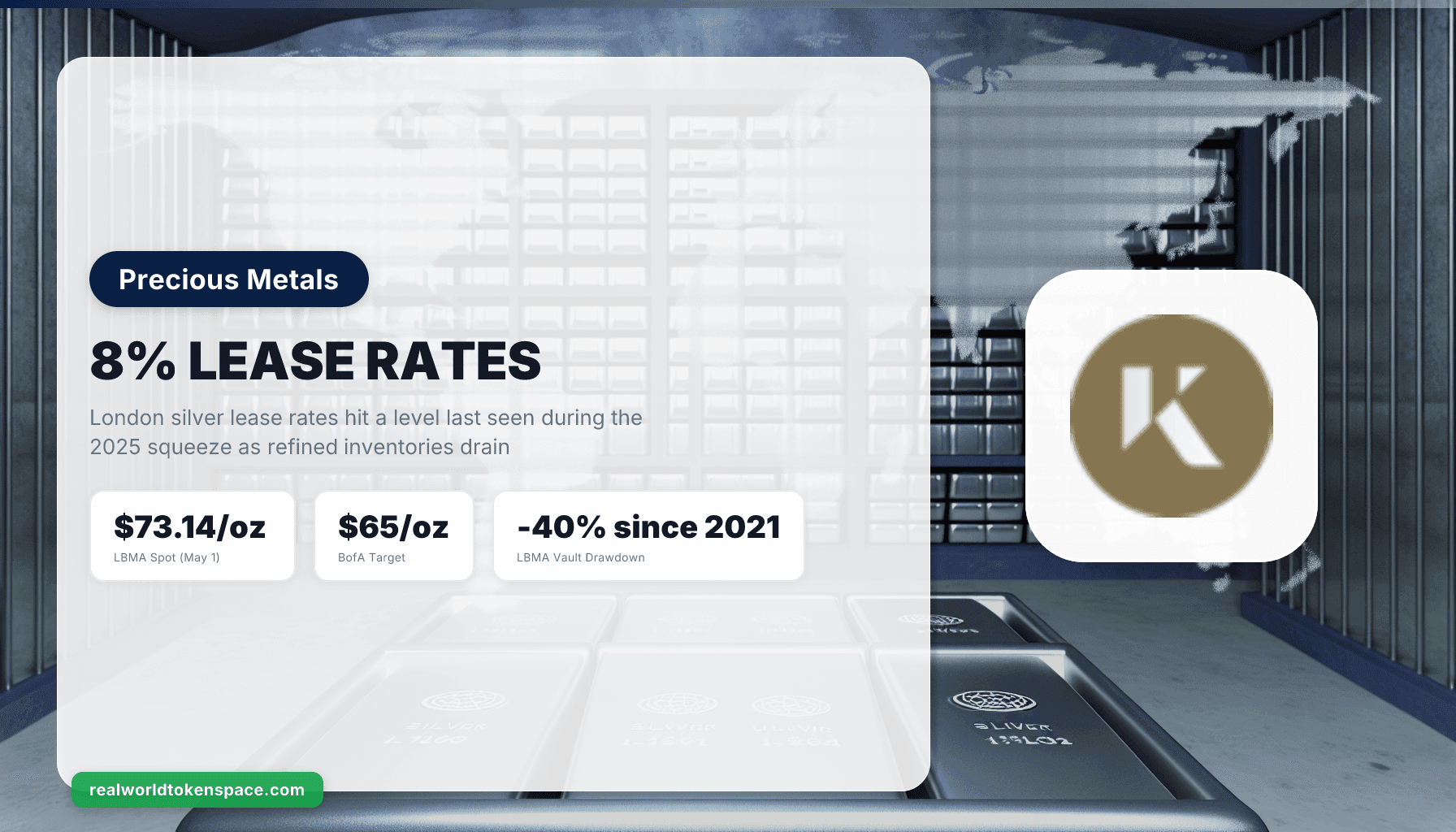
London silver lease rates climbed back to 8% this week, returning to a level last seen during the October 2025 squeeze that briefly pushed the 1-month rate to 35%. The LBMA's own data shows total silver holdings in London vaults have fallen close to 40% since 2021, one of the steepest sustained drawdowns the float has ever recorded. Bank of America's Global Metals desk repeated its $65 per ounce 2026 silver target on April 28, citing the LBMA vault drawdown and the COMEX registered inventory floor as the structural reasons price has stayed bid above $73.
For a market where lease rates usually trade in the 0.2 to 0.8% range, a sustained 8% print is not noise. It is the cost of borrowing physical silver that does not want to be lent. Rates of that magnitude reflect refiners, ETFs, and bullion banks unable to source unallocated metal at any reasonable price, and they tell a clear story about who is and is not getting deliveries.
RWTS does not take a directional view on silver. We rate tokenized real assets. The reason a refined shortage matters to our readers is straightforward: when paper silver dislocates from physical silver, the only on-chain products worth holding are the ones that are actually allocated, audited, and redeemable for ounces. That is a Trust Score question, not a price question.
What the institutional sources are saying
Bank of America's Michael Widmer wrote in the firm's late-April global metals note that "the physical market is showing the kind of stress consistent with a multi-year deficit cycle, and we expect lease rates to remain elevated through the second half." BofA's $65 target sits below where spot is already trading, which makes the call less of a price prediction and more of a structural floor. Reuters' April analyst poll has 2026 silver averaging $79.50.
The World Silver Survey 2026 from the Silver Institute projects a fifth consecutive annual structural deficit at roughly 184 million ounces, with industrial demand again leading the gap. China's reclassification of silver as a strategic material in late 2025 added export friction on top of the existing supply picture. The COMEX registered inventory has been bouncing around the 76 to 80 million ounce range, which we covered in our May 4 piece on COMEX silver delivery.
Three institutional signals, one direction.
What is actually happening with the metal
Two things are true at the same time, and they are not contradictory.
First, silver is not running out. Above-ground stocks across mints, refiners, ETFs, and private vaults still measure in the multiple billions of ounces. Anyone framing this moment as a global supply collapse is selling something.
Second, the part of the float that LBMA bullion banks can actually lend at short notice has been shrinking for five years. That is what an 8% lease rate measures. ETFs holding allocated bars do not lend them. Sovereign accumulators do not lend theirs. Refiners hold what they need for industrial deliveries. The lendable inventory, the part that lubricates daily price discovery, has thinned.
The stacker community on X has been pricing this for years. The "if you don't hold it, you don't own it" axiom is not a slogan. It is a market structure observation: paper silver and physical silver are two different products, and lease rates are one of the few public prices that measure how far apart they are trading.
Where tokenization fits, and where it does not
Tokenization does not replace a Good Delivery bar in your safe. It augments physical ownership for the slice of an allocation that needs to be moved, fractionalized, used as collateral, or settled outside business hours. RWTS rates products on whether they actually deliver on those properties. The Trust Score methodology weights allocation, custody, audit cadence, redemption mechanics, and chain-level integrity.
Two silver products sit on our active rating list:
$KAG (Kinesis Silver), Trust Score 91, Tier 1. Each KAG represents 10 grams of physical silver held in Brink's vaults across London, Zurich, Singapore, and Sydney. Allocation is 1:1, attestations run monthly through Inveniam, and redemption is available in physical form at four supported vault locations. The product trades 24/7 on the Kinesis Monetary System. The score reflects clean custody, regular audits, and a working redemption path. The drag on the score is jurisdictional concentration in Cayman and chain-level reliance on the KMS settlement layer.
$XAGm (Matrixdock Silver), Trust Score 78, Tier 2. XAGm represents allocated LBMA Good Delivery silver bars vaulted in Singapore through Matrixdock. Audits are quarterly. Redemption is available for 1,000 oz minimum lot sizes, which puts physical redemption out of reach for most retail allocations but works for institutional desks. The product is newer, the audit cadence is wider, and the issuer concentration is higher than KAG. We have it under active review for a Q3 2026 score update.
For comparison, paper SLV and PSLV continue to trade where they trade. Whether they reflect the underlying metal price is a question lease rates are answering for us in real time.
What this changes for an allocator
If you already hold physical and you are looking for the on-chain slice of a silver allocation, the lease rate spike does not change the recommendation. It reinforces it. Pick the products with the cleanest allocation language, the shortest audit cadence, and a real redemption path. Both KAG and XAGm clear that bar, with the score gap reflecting custody and operational specifics rather than directional risk on silver itself.
If you do not hold physical and you are using tokenized silver as your only silver position, the lease rate environment is the moment to read the issuer's audit reports cover to cover. A monthly attestation that names the bars by serial number is the only thing that lets you treat tokenized silver as the same asset as the bars in a Brink's vault. Anything less is a derivative on the bars.
If you are running a treasury and silver is part of an inflation hedge sleeve, the relevant question is settlement speed, not yield. Tokenized silver settles in minutes. LBMA-cleared physical settles T+2. In a stress window, the ability to move collateral inside an hour is worth more than 30 basis points of yield.
The credit-rating frame
The reason RWTS exists is that this market needs an independent ratings layer. Bullion banks rate themselves. Token issuers rate themselves. Influencers rate whoever pays them. None of that helps a serious allocator size a position.
We rate against published methodology. The silver products we cover are graded on the same axes as the gold products we cover and the tokenized treasury products we cover, with the precious-metals-specific weights documented at rwts.com/methodology. When BofA says $65 and the LBMA vault drawdown says 40%, our job is not to add a price prediction to the pile. Our job is to tell you whether the on-chain product you are looking at would survive a lease rate spike intact.
We rate. You decide.
Bottom line
LBMA silver lease rates at 8% are not a panic signal. They are a structural stress signal that has been building for five years. Allocators with physical exposure already know what this looks like. Allocators using tokenized silver as a portfolio sleeve should pull up the audit reports for whatever they hold and confirm the allocation language before this cycle ages further.
Physical first. Tokenized second.
Not financial advice.
Related research
Sources