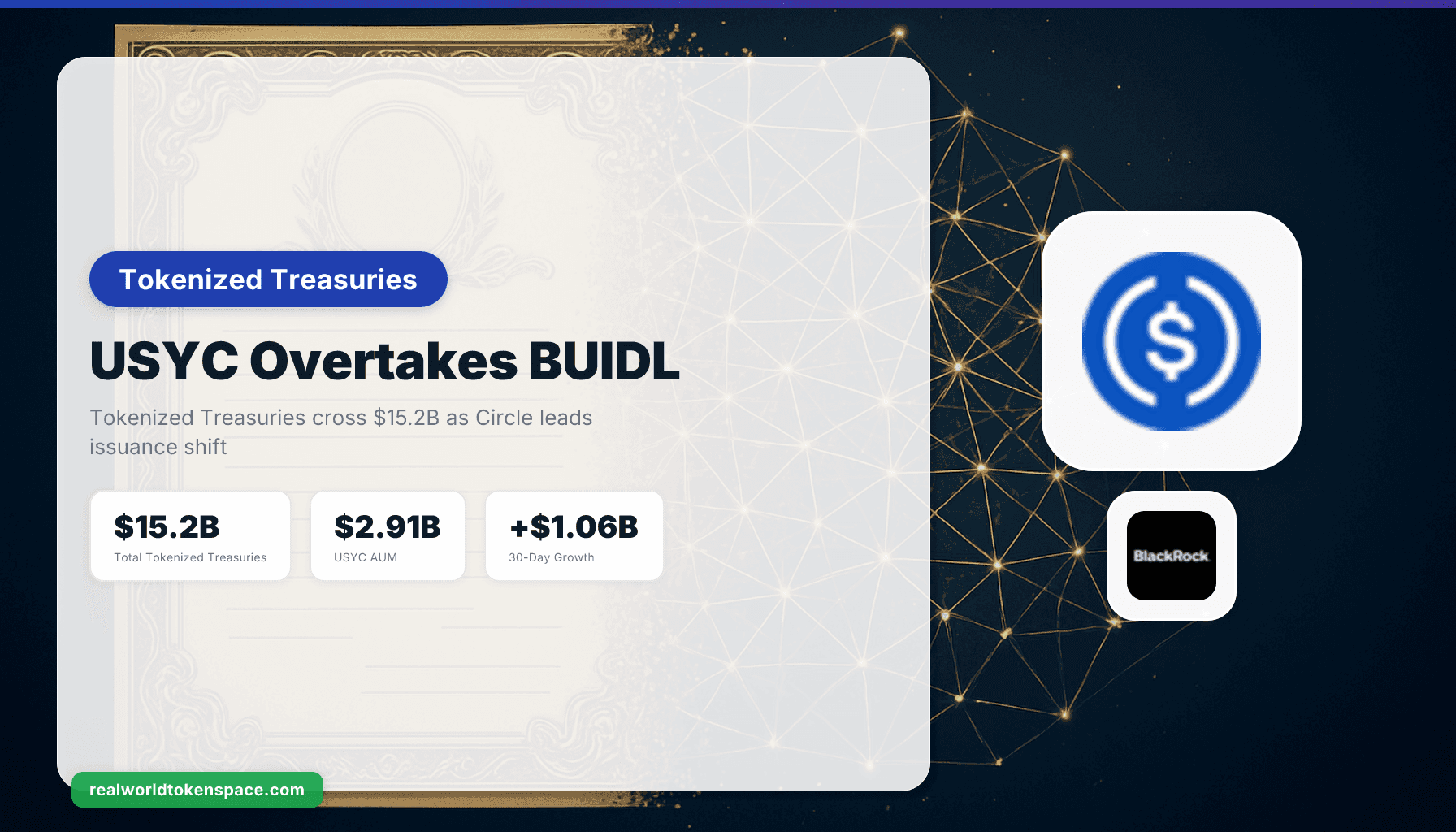
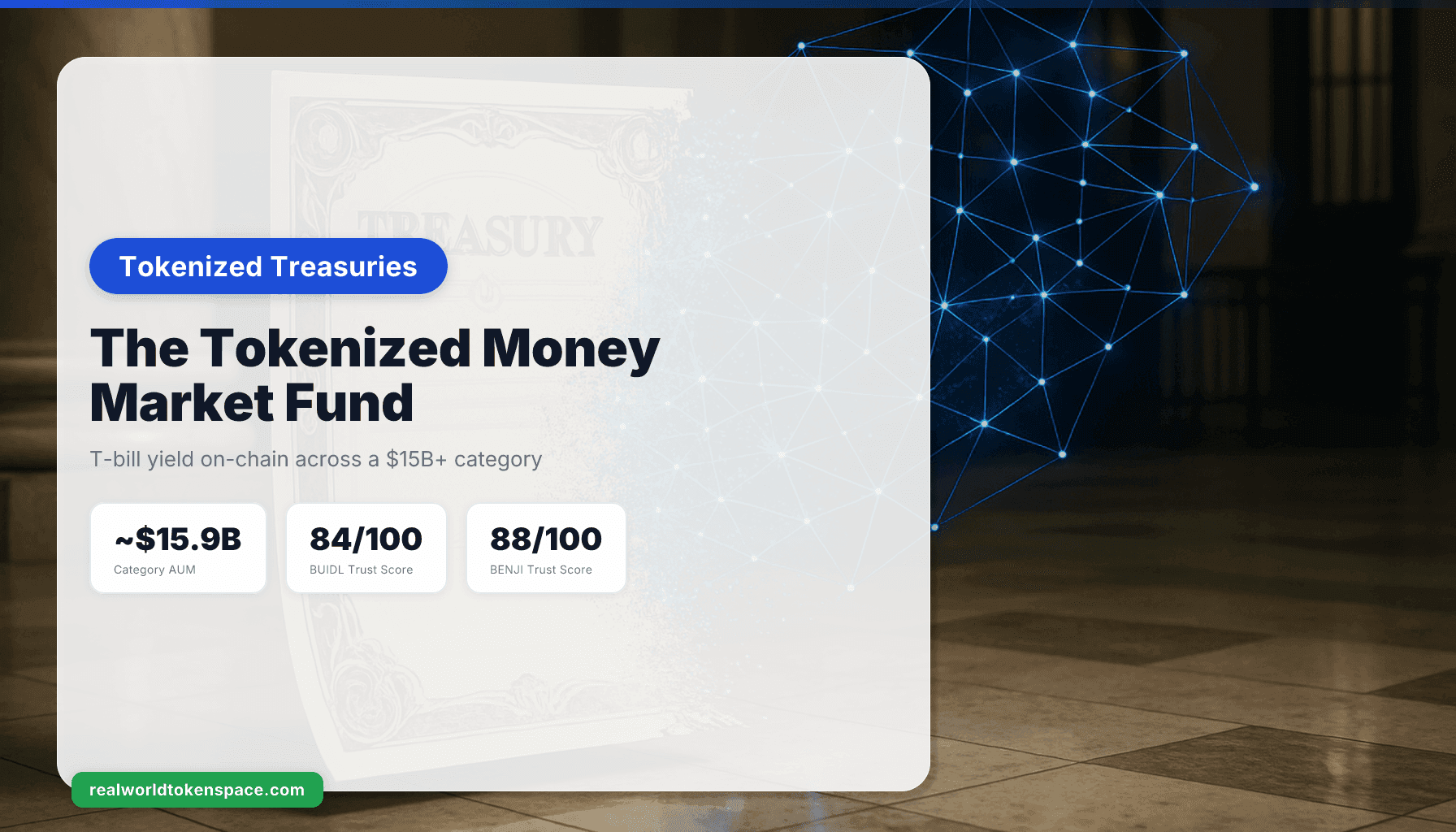
Tokenized US Treasuries surpassed $15.35 billion in total value locked as of May 13, 2026, marking a structural shift in how institutional capital parks idle dollars. The milestone arrived during a week when spot crypto markets remained pinned above $80,000 for bitcoin but faced difficulty breaking higher as inflation and real rates kept rising. The allocator response: rotate into yield-bearing tokenized products backed by short-duration government paper.
Circle's USYC held $2.91 billion in assets under management, overtaking BlackRock's BUIDL at $2.58 billion for the first time since BUIDL launched. The sector added $1.06 billion in net inflows over the trailing 30 days, driven by what one allocator called "programmatic money"—B2B corridors, payroll settlement, and treasury management rather than retail speculation.
The Institutional Narrative
Public dashboards placed the bulk of Ethereum-based tokenized Treasury supply across BlackRock's BUIDL, Ondo's USDY and OUSG, Franklin Templeton's BENJI, and Superstate's USTB, with USYC now leading the category. The shift reflects two forces: regulatory positioning ahead of stablecoin legislation and the composability of USYC across DeFi protocols.
USYC operates on Binance Smart Chain, Ethereum, and Solana, while BUIDL is issued through Securitize and available on eight blockchains. That multi-chain presence matters. When Ondo, JPMorgan, Mastercard, and Ripple completed the first near real-time, cross-border redemption of tokenized US Treasuries settled atomically across four separate infrastructure layers, the underlying asset was Ondo's OUSG—partially backed by BUIDL. The pilot demonstrated the settlement speed that traditional correspondent banking cannot match.
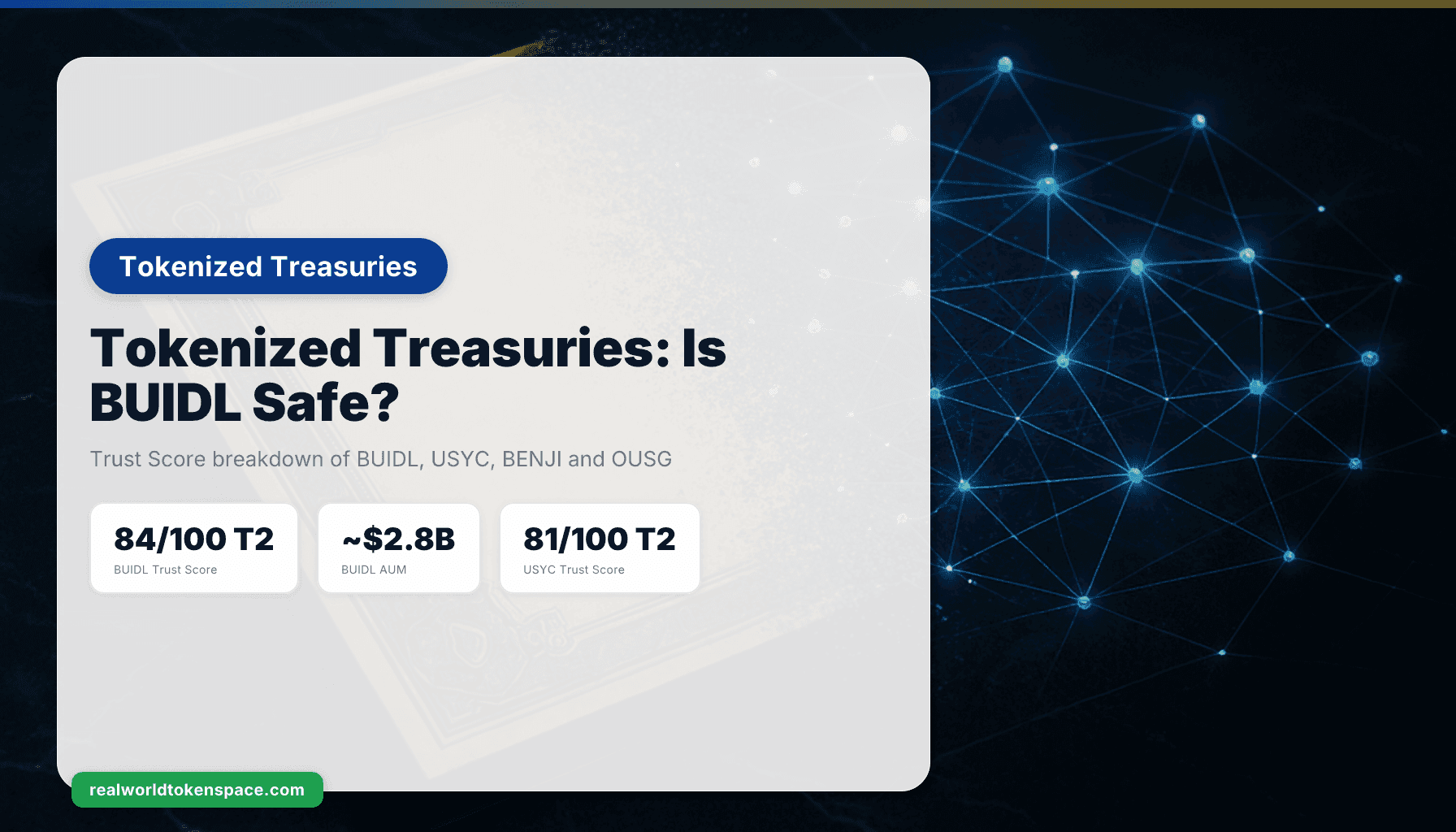
RWTS rates USYC at 9.2 (Tier 1) and BUIDL at 9.4 (Tier 1). Both products offer institutional-grade reserve transparency and monthly attestations. BUIDL's $5 million minimum investment restricts access, while USYC's lower barrier and broader chain coverage have driven retail and mid-tier institutional adoption. The rating differential reflects BUIDL's deeper institutional custody infrastructure and BlackRock's balance sheet. Both products sit well inside RWTS's investable universe.
The Stablecoin Reserve Angle
A holder rotating from a stablecoin into a tokenized Treasury accepts a different set of legal wrappers, custody arrangements, and operational risks. The reserves backing the stablecoin balance you load onto a card are increasingly composed of tokenized Treasury exposure, either directly or through a money market structure.
USDC held $77.6 billion in circulating supply as of April 29, 2026, with USDC now attested by Deloitte and regulated across 20+ chains. The convergence is clear: stablecoin issuers are deploying reserves into the same short-duration Treasuries that back tokenized products. The difference is whether the yield accrues to the issuer or flows through to the token holder.
Flows into yield-bearing tokenized Treasuries could rise further if the U.S. producer price index points to persistent inflationary pressures in the pipeline. Consensus was for the April print to come in at 4.9% year-on-year, up from 4.0% in March. An elevated reading adds to Fed rate-hike expectations and reinforces the case for parking capital in government-backed instruments that move at the speed of blockchain settlement.
The Liquidity Competition
Total stablecoin supply reached a record $315 billion in Q1 2026, rising roughly $8 billion quarter-over-quarter. USDC supply surged 220% since late 2023 to approximately $78 billion, driven by institutional B2B settlement, payroll infrastructure, and programmatic payment rails built by Visa and Stripe. That programmatic money is the same capital now flowing into USYC.
The allocator calculus is straightforward: if USDC yields zero and USYC yields 4.8%, the opportunity cost of holding the stablecoin becomes hard to defend. With GENIUS Act implementation rules due July 18, 2026, USDT, USDC, and other major dollar stablecoins are required to maintain 100% reserves and undergo regular audits. That shifts stablecoins from a gray-zone product into a licensed, audited financial instrument comparable to a money market fund.
The regulatory floor creates a level playing field. The yield spread determines the flow.
Where RWTS Stands
RWTS is not bullish or bearish on tokenized Treasuries. We rate the underlying reserve quality, the issuer's operational track record, and the transparency of the redemption mechanism. USYC's overtaking of BUIDL reflects market dynamics, not product superiority. Both tokens offer exposure to the same asset class: short-duration US government debt wrapped in programmable form.
The Trust Score framework evaluates custody (Tier 1 for both), attestation frequency (monthly for both), and redemption mechanics (institutional KYC for BUIDL, broader access for USYC). The difference is distribution strategy. BlackRock built BUIDL for large allocators. Circle built USYC for the on-chain economy.
Ondo's USDY held $2.14 billion, Franklin Templeton's BENJI had $2.05 billion, and Janus Henderson's JTRSY stood at $1.24 billion. Those five funds together account for about $10.92 billion of the market. The remaining $4 billion sits across smaller issuers, most of which lack the institutional backing and reserve transparency that RWTS requires for Tier 1 classification.
The tokenized Treasury category is no longer experimental. It is infrastructure. The question is not whether these products belong in institutional portfolios. The question is which issuers will maintain reserve discipline when the next liquidity stress arrives. RWTS tracks both. You decide which fits your allocation framework.
Trust Score Reference:
USYC: 9.2 / Tier 1 — Monthly Deloitte attestation, multi-chain presence, regulated issuer
BUIDL: 9.4 / Tier 1 — Institutional custody, BlackRock balance sheet, Securitize infrastructure
USDY: 8.8 / Tier 1 — Ondo-managed, partially backed by BUIDL, non-US retail accessible
All scores current as of May 2026. For full methodology, visit https://www.realworldtokenspace.com/trust-scores.
Related research
Stay Ahead of the Yield Curve
Subscribe to The Yield Report for weekly yield intelligence.
Subscribe Now