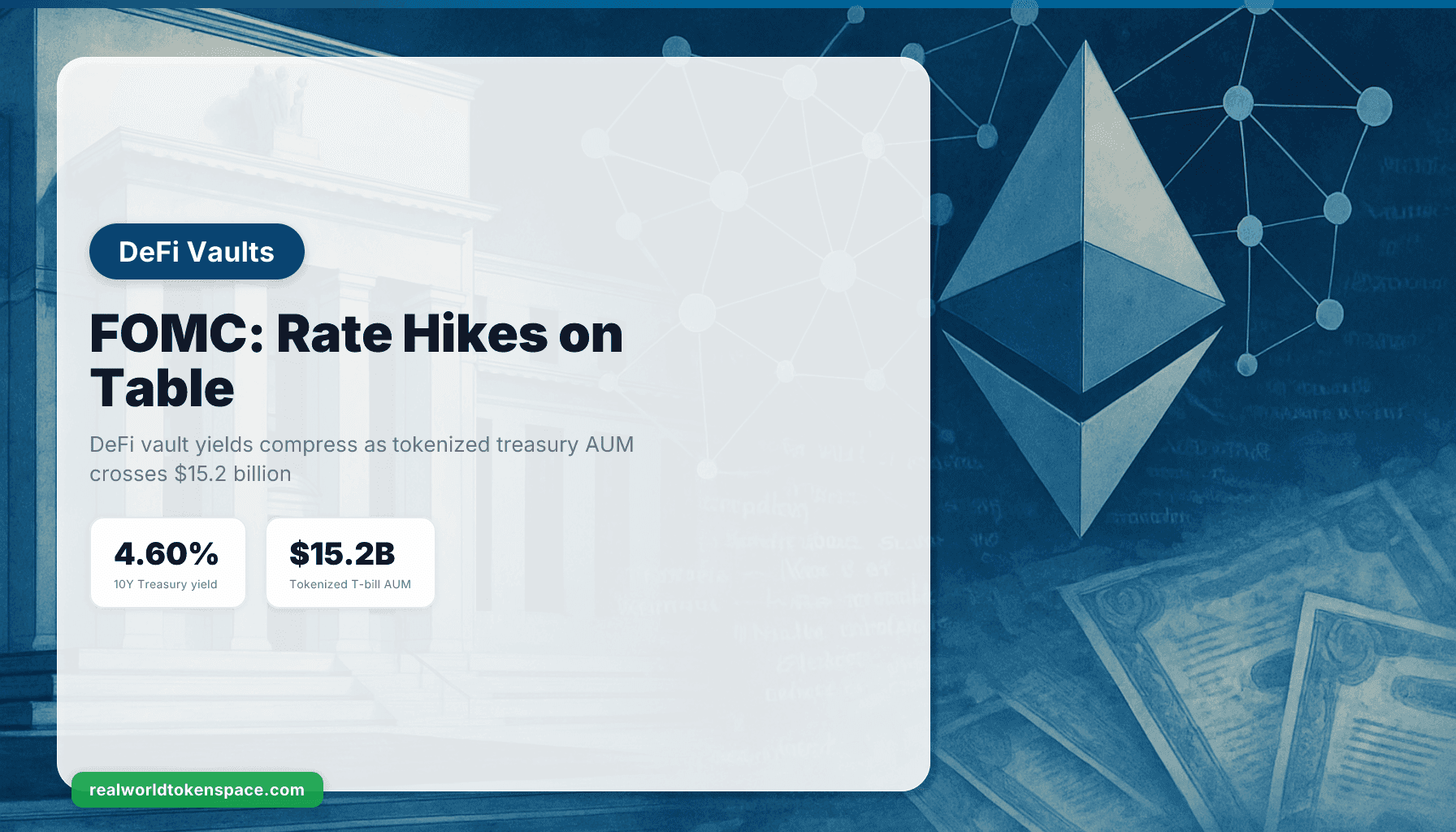
The Federal Reserve's April 28–29 FOMC meeting statement, released April 29, maintained the target range for the federal funds rate at 3.5% to 3.75%. In considering the extent and timing of additional adjustments to the target range for the federal funds rate, the Committee will carefully assess incoming data, the evolving outlook, and the balance of risks. Minutes from that meeting, released May 20, showed that a majority of policymakers believe additional rate hikes may be warranted if inflation remains persistently above the Federal Reserve's 2% target. A majority of FOMC members noted that it may be appropriate to raise rates to tame inflation this year if underlying inflation gauges remain above 2%.
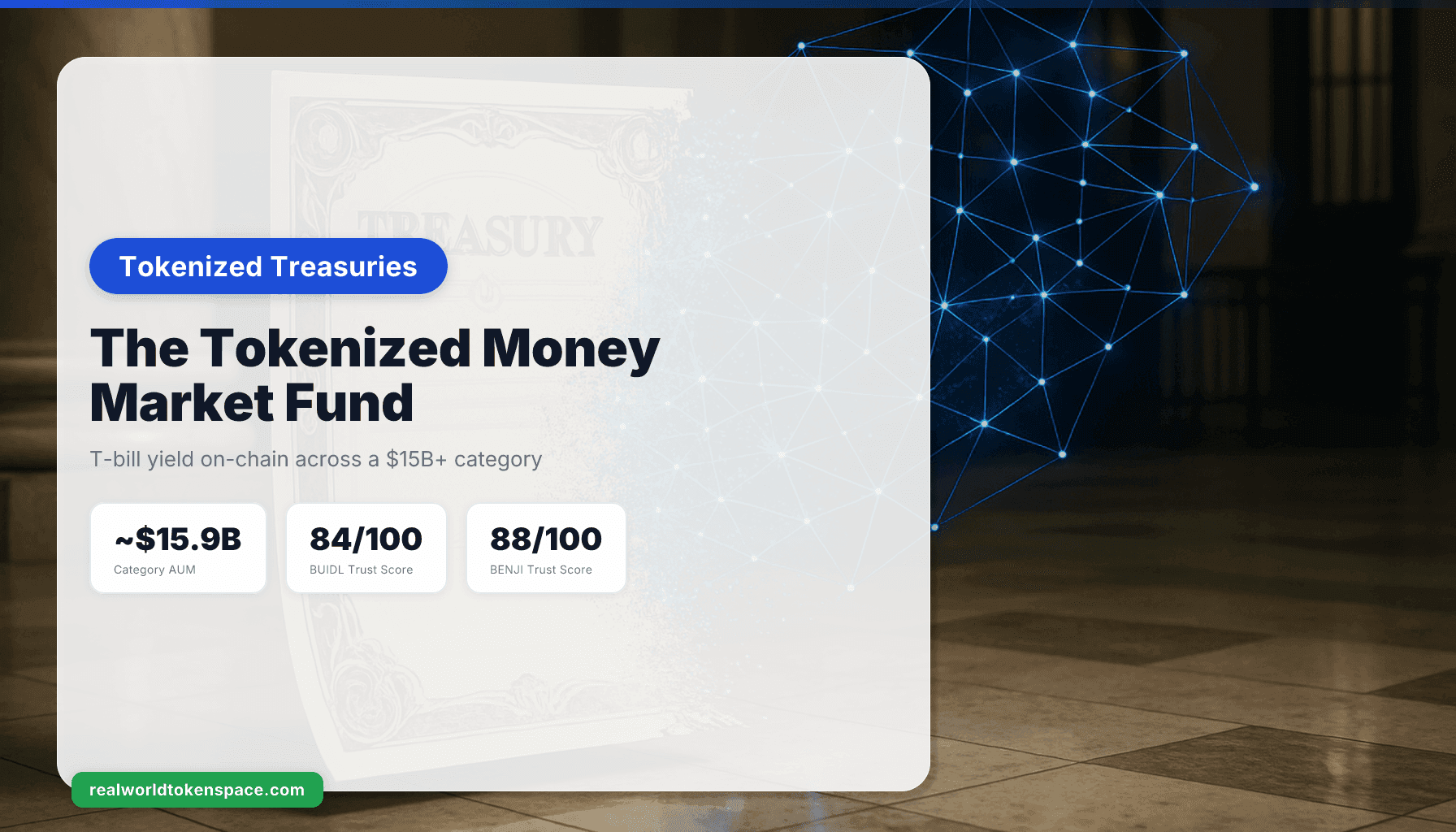
The hawkish tilt has compressed DeFi vault yields and accelerated capital rotation into tokenized U.S. Treasuries, which crossed a record $15.35 billion total value locked on May 13, with Circle's USYC surpassing BlackRock's BUIDL as the largest fund at $2.9 billion. As of late May, USYC holds approximately $3.0 billion, BUIDL approximately $2.5 billion, and Ondo's USDY approximately $2.1 billion, according to RWA.xyz data.
Treasury Yields at 16-Month High
The yield on the 10-year US Treasury note fell to 4.60% on Wednesday from the 16-month high of 4.7% in the previous session after Washington signaled it is close to signing an agreement with Iran to end their conflict, taming pro-inflationary risks. President Trump stated the US was on the final stages of talks with Tehran. The surge in energy inflation this year had already shown signs of spreading to core areas of the economy, resulting in hawkish dissents in the last Fed rate decision.
Recent indicators suggest that economic activity has been expanding at a solid pace. Job gains have remained low, on average, and the unemployment rate has been little changed in recent months. Inflation is elevated, in part reflecting the recent increase in global energy prices. Developments in the Middle East are contributing to a high level of uncertainty about the economic outlook. The Committee is attentive to the risks to both sides of its dual mandate.
The 10-year yield's climb to 4.7% last week marked the highest level since January 2025, when the benchmark rate briefly touched 4.8% during the peak of last year's inflation re-acceleration concerns. The selloff was driven by renewed oil price spikes tied to the U.S.-Iran standoff and fears that energy-driven inflation would force the Fed's hand on rate hikes despite fragile employment data.
DeFi Vault Yields Compress to 4–6% Range
The top 7-day average APY across Morpho vaults is currently 11.61%, from Api3 dCOMP USDC on Ethereum. Across 50 tracked Morpho vaults, rates range from 4.22% to 11.61%. The conservative USDC vaults that institutional allocators favor—Gauntlet Core, Steakhouse Financial, Block Analitica—are clustered in the 4.5–6% range as of mid-May, down from the 6–8% range that prevailed through Q4 2025.
USDC supply APYs on Morpho Blue range 4–9%, with the higher end coming from markets that accept volatile or yield-bearing collateral. Steakhouse, Gauntlet, and Block Analitica run the most-deposited USDC vaults as of Q1 2026. Aave v3 USDC supply rates on Ethereum mainnet are printing 4.1–4.8% variable APY, compressed from the 5.5–6.5% band that held through January and February.
The mechanism is straightforward: Morpho sits on top of protocols like Aave and Compound, automatically matching lenders and borrowers peer-to-peer when possible. This reduces spreads and often improves rates for both sides. When borrowing demand contracts—either because rates are too high or because leveraged positions are unwound—supply rates compress. The April FOMC statement and May 20 minutes release both signaled that the Fed sees upside inflation risk, which keeps real rates elevated and reduces the appeal of leveraged crypto strategies that drive DeFi borrowing demand.
Tokenized Treasuries: The Flight to Real Yield
As of late April 2026, USYC leads the tokenized Treasury market with approximately $2.9 billion in assets, while BlackRock's USD Institutional Digital Liquidity Fund (BUIDL) sits in second place at around $2.58 billion, reinforcing both firms' positions as the main institutional drivers of the RWA narrative. By mid-May, USYC had crossed $3.0 billion and BUIDL approximately $2.5 billion.
Much of USYC's recent growth is tied to its use on BNB Chain, with Binance introducing the token as off-exchange collateral for institutional derivatives trading. Circle's positioning ahead of potential U.S. stablecoin legislation has been deliberate. With the Clarity for Payment Stablecoins Act still under debate and regulatory frameworks for digital assets evolving in Washington, regulated issuers like Circle have a structural advantage in onboarding compliance-sensitive institutional capital.
BlackRock's role in this market is bigger than the raw asset number suggests. Yes, BUIDL's roughly $2.58 billion in late-April value is large on its own. But the real importance of BUIDL is symbolic as well as financial. When the world's largest asset manager launches and scales a tokenized Treasury product, it changes how the rest of the market thinks about tokenization.
The three largest tokenized treasury products—USYC, BUIDL, USDY—offer yields in the 4.5–5.5% range, derived from short-duration U.S. Treasury bills and repo agreements. That yield is now competitive with or above the risk-adjusted return available in DeFi vaults, especially after accounting for smart-contract risk, liquidation risk, and the operational complexity of vault strategies.
The RWTS Trust Score Lens
RWTS rates three tokenized treasury products at Tier 1 with institutional-grade attestation and transparent reserve composition. Each targets the same yield source—short-duration U.S. Treasuries—but with different structural wrappers and distribution models.
Circle USYC, Trust Score T1, is structured for non-U.S. investors with 24/7 create-and-redeem functionality using USDC. Circle acquired Hashnote in January 2025 and integrated USYC into its stablecoin infrastructure. The product offers accumulating yield (interest accrues within the token balance) and is deployed as collateral on BNB Chain through Binance institutional partnerships. Reserve attestations are published monthly by a Big Four accounting firm.
BlackRock BUIDL, Trust Score T1, targets U.S. Qualified Purchasers with a $5 million USDC minimum entry. The product is managed through Securitize and distributes yield separately rather than through balance compounding. BUIDL is available across Ethereum, Solana, Avalanche, Aptos, Optimism, Polygon, Arbitrum, and BNB Chain. Monthly attestations confirm 1:1 backing by cash and short-duration U.S. Treasuries.
Ondo USDY, Trust Score T2, is structured for non-U.S. retail and institutional holders with a lower minimum entry ($100,000 USDC equivalent in some jurisdictions). The product has over 17,000 holders and offers 24/7 mint-and-burn liquidity on Ethereum and Solana. The T2 score reflects smaller operational scale relative to Circle and BlackRock, but the reserve composition and attestation cadence meet institutional thresholds.
All three distribute yield derived from the same underlying assets: short-duration U.S. Treasury bills and overnight repo agreements. The difference lies in access restrictions, yield-distribution mechanics (accumulating vs. distributing), and chain deployment.
Why It Matters
When the Fed signals that rate hikes remain on the table, two things happen simultaneously. First, risk-free rates stay elevated, compressing the spread that DeFi vaults can offer over Treasuries. Second, tokenized treasury products become structurally more attractive because they offer real yield without leverage risk, smart-contract risk, or liquidation exposure.
DeFiLlama's USDC yield dashboard tracks live APYs across roughly 1,000 USDC pools. Eleven routes cover roughly 95% of real USDC yield flow. The FOMC's May 20 minutes shifted the risk-reward calculation across all of them. At 4.6% 10-year Treasury yields and 3.5–3.75% Fed funds, the opportunity cost of holding DeFi vault exposure with smart-contract and liquidation risk rises. Tokenized treasuries offer 4.5–5.5% yield with no liquidation threshold, no vault curator risk, and monthly attestations from Big Four firms.
RWTS isn't bullish or bearish on DeFi or tokenized treasuries. We're the credit-rating agency for tokenized real assets. We rate. You decide. For allocators rotating capital in response to the FOMC's hawkish tilt, the three Tier 1 options above offer institutional-grade yield derived from U.S. government obligations, redeemable 24/7, with transparent reserve composition and no leverage exposure.
Data sources: Federal Reserve FOMC meeting minutes (April 28–29, 2026, released May 20, 2026), Trading Economics U.S. 10-year Treasury yield data, RWA.xyz tokenized treasury dashboard, Morpho vault yield data (vaults.fyi), DeFiLlama protocol TVL and yield aggregator, RWTS Trust Score methodology v4.2.
Related research