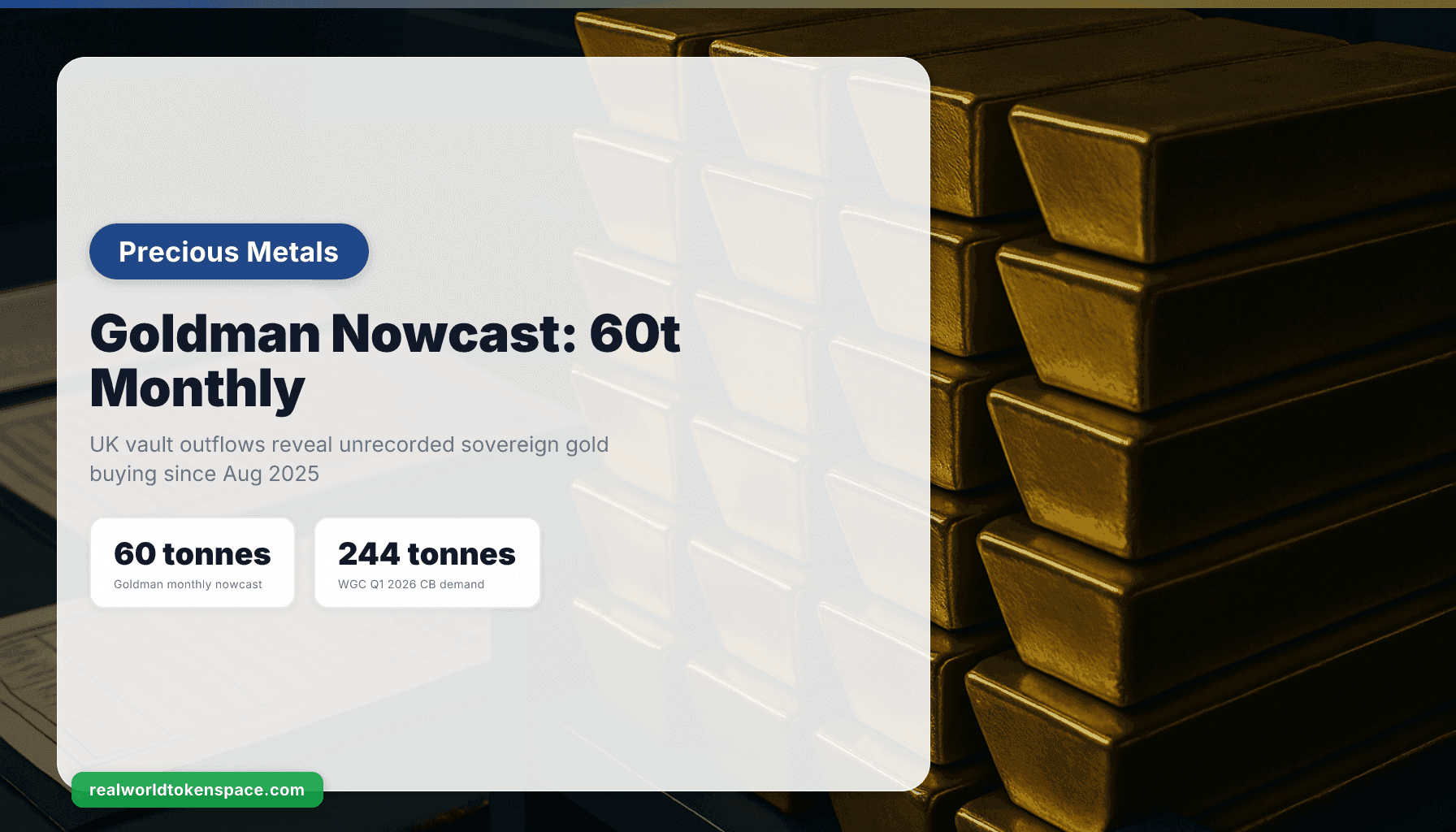
Goldman Sachs revised its central bank gold demand model to account for gaps in official trade data, raising its nowcast to approximately 60 tonnes per month through 2026, supported by continued diversification demand amid geopolitical uncertainty. The investment bank's previous estimates had underestimated sovereign demand since August 2025, when UK trade data began failing to fully capture gold outflows from London vaults, resulting in unrecorded sovereign buying.
The revision comes three weeks after the World Gold Council reported central bank gold demand began 2026 strongly, with estimated net purchases of 244 tonnes in Q1, exceeding both the previous quarter and the five-year average. If Goldman's 60-tonne monthly run rate holds through year-end, full-year 2026 sovereign demand would reach approximately 720 tonnes, broadly in line with J.P. Morgan's forecast of around 755 tonnes of central bank purchases for 2026, a step lower than the peak of the last three years of more than 1,000 tonnes but still elevated when compared with pre-2022 averages closer to 400–500 tonnes.
The London Vault Data Gap
Goldman revised its nowcast from approximately 29 tonnes to 50 tonnes per month after identifying gaps in UK trade data that had been failing to capture gold outflows from London vaults since August 2025, pointing to significant unrecorded sovereign purchasing activity that its earlier methodology had not accounted for. The latest revision to 60 tonnes reflects continued analysis of those flows.
Back in March, the investment bank raised its nowcast of central bank purchases to about 50 tonnes per month on a 12-month moving average basis, up from 29 tonnes under its earlier methodology. The bank now expects central banks to average around 60 tonnes per month through 2026. The discrepancy matters: at 60 tonnes monthly, annualized demand is roughly 150 tonnes higher than the pre-revision model implied.
Gold traded in a $4,524–$4,530 range on May 22, down 0.42% from the previous day, as hopes for a US-Iran peace deal faded following reports that Iran's Supreme Leader Ayatollah Mojtaba Khamenei issued a directive ordering the country's uranium to remain on Iranian soil, contradicting Israeli officials' claims that Iran's highly enriched uranium would need to be transferred out of the country as part of any peace deal. The metal has consolidated near the $4,500–$4,540 band through mid-May, well below the $5,405 January peak but holding structurally above the $4,400 support that defined late-2025 range floors.
Q1 Sovereign Flows: Poland, Uzbekistan, China
The National Bank of Poland was once again the largest purchaser in Q1, increasing its gold reserves by 31 tonnes over the quarter to 582 tonnes. Despite recent statements from Governor Adam Glapiński about the possibility of selling some of its gold, the central bank appears to remain focused on reaching its 700-tonne target. The Central Bank of Uzbekistan added 25 tonnes to its gold reserves during the quarter, lower than its Q4'25 net purchases of 29 tonnes. The latest buying lifts its gold holdings to 416 tonnes, representing 87% of the bank's total reserves. The People's Bank of China increased its gold reserves by 7 tonnes in Q1, more than doubling its net purchase in the previous quarter (3 tonnes). This lifts the PBoC's total gold reserves to 2,313 tonnes (9% of total reserves).
During the quarter, central banks had to contend with heightened uncertainty on multiple fronts. The conflict involving Iran, the US and Israel added to an already fraught geoeconomic environment, driving greater volatility across markets including gold. Continued central bank gold demand against this backdrop underscores the broadly strategic nature of their purchases and continued confidence in gold's role as a store of value during periods of uncertainty.
The RWTS Trust Score Angle on Tokenized Gold
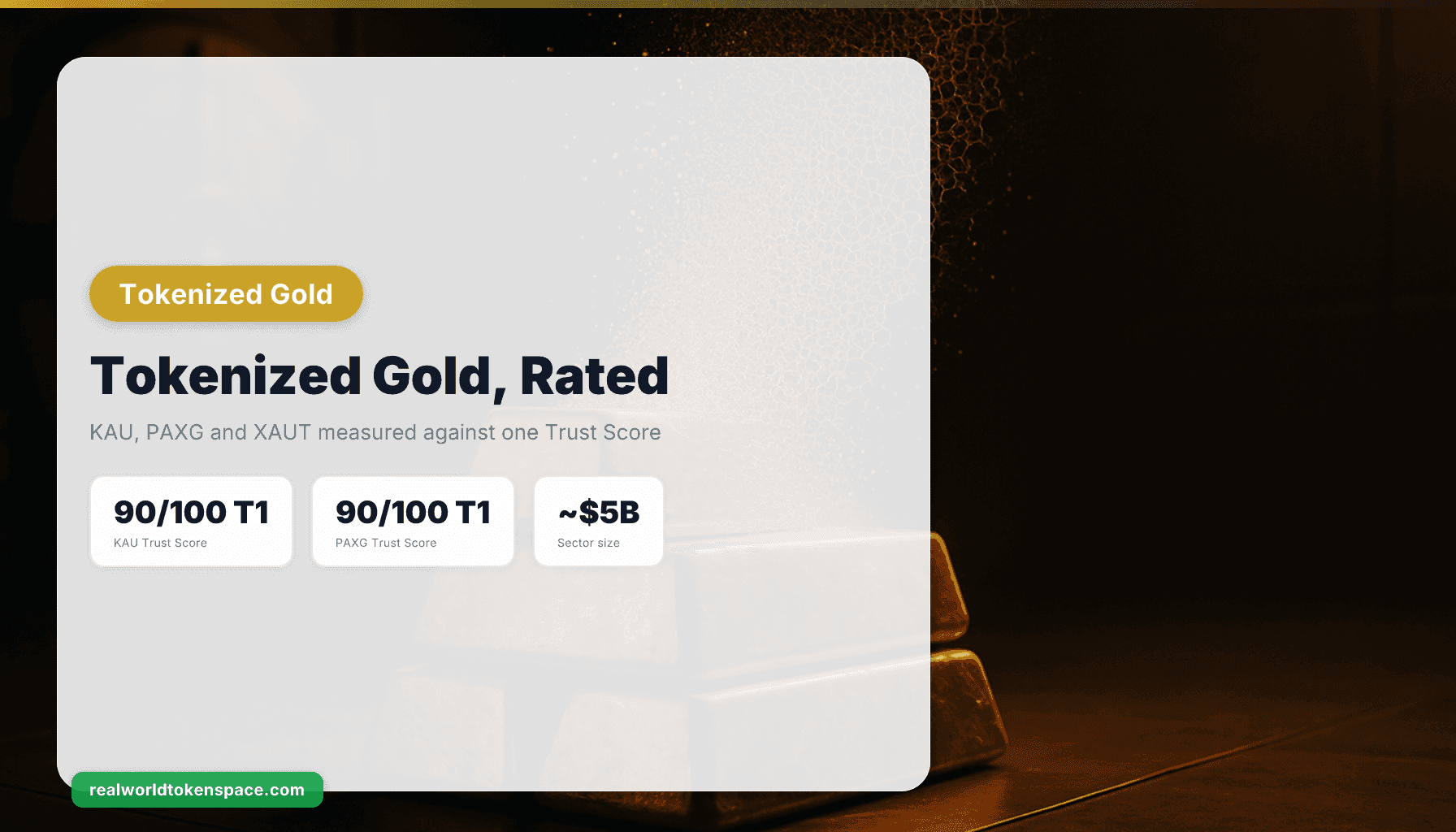
RWTS doesn't predict gold's path from here—we rate the products that let allocators hold it on-chain. Three Tier 1 options carry institutional-grade attestation and vault-level transparency, each with distinct custody and redemption structures.
Paxos Gold (PAXG), Trust Score T1, holds each token backed by one fine troy ounce of London Good Delivery gold stored in Brink's vaults. Paxos publishes monthly attestations and supports physical redemption for holders above the minimum threshold. The product has operated since 2019 with zero reported custody incidents.
Kinesis Gold (KAU), Trust Score T2, backs each gram with allocated gold stored in third-party vaults across multiple jurisdictions. The lower score reflects smaller market liquidity and a yield-distribution mechanism that adds operational complexity relative to pure allocated models. Kinesis offers a redeemable structure for holders meeting size thresholds.
Tether Gold (XAUT), Trust Score T1, represents one troy ounce of physical gold on a London Good Delivery bar held in a Swiss vault. Tether provides chain-of-custody verification and supports redemption into physical bars for qualifying holders. The product launched in 2020 and maintains monthly reserve attestations.
All three products function as tokenized allocated gold, not derivatives. The on-chain holder owns a claim on specific ounces in specific vaults, redeemable under defined terms. None depend on a synthetic hedge structure or algorithmic peg.
Why It Matters
Emerging market central banks are likely to continue the structural diversification of their reserves into gold. The debasement trade is also prompting physical bullion purchases by high-net-worth families and investor call-option buying amid mounting concerns over the long-term monetary and fiscal policy trajectories in major economies. Risks to the updated forecast are significantly skewed to the upside because private-sector investors may diversify further on lingering global policy uncertainty.
If Goldman's 60-tonne monthly nowcast holds and the London vault data gap continues to reveal unrecorded flows, the actual sovereign demand picture may be running 20–30% above what standard trade-balance models capture. On an annualized basis, this implies roughly 720 tonnes of official-sector demand for the full year, a figure broadly consistent with the World Gold Council's independently reported data showing 244 tonnes of central bank purchases in Q1 2026 alone.
RWTS isn't bullish or bearish on gold. We're the credit-rating agency for tokenized real assets. We rate. You decide. For allocators building exposure to the metal that central banks are accumulating at 60 tonnes per month, the three Tier 1 tokenized options above offer vaulted, audited, redeemable pathways—no synthetic wrapper, no algorithmic risk, just allocated ounces on-chain.
Data sources: Goldman Sachs commodity research (May 2026), World Gold Council Gold Demand Trends Q1 2026, J.P. Morgan Global Research commodities outlook, Trading Economics gold spot data, RWTS Trust Score methodology v4.2.
Related research
Stay Ahead of the Yield Curve
Subscribe to The Yield Report for weekly yield intelligence.
Subscribe Now