Goldman Sachs announced on Friday that they have revised their central bank gold demand model to account for gaps in official trade data, now expecting central banks to average around 60 tonnes per month through 2026, supported by continued diversification demand amid geopolitical uncertainty. Back in March, the investment bank raised its nowcast of central bank purchases to about 50 tonnes per month on a 12-month moving average basis, up from 29 tonnes under its earlier methodology, with Goldman analysts saying their previous estimates had underestimated sovereign demand since August 2025, when UK trade data began failing to fully capture gold outflows from London vaults, resulting in unrecorded sovereign buying.
The revision matters because it addresses a structural measurement issue. For years, analysts relied on UK customs data to infer central bank activity, as London serves as the primary clearing hub for global bullion flows. When that data stream began missing outflows last August, the models undershot. Goldman's updated methodology adjusts for the gap and produces a 20% higher demand figure.
Central bank gold demand began 2026 strongly, with estimated net purchases of 244t in Q1. That figure, published by the World Gold Council, exceeds both the previous quarter and the five-year average. If sustained, 244 tonnes per quarter translates to roughly 61 tonnes per month, validating Goldman's new 60-tonne baseline from an independent data source.
The Physical Reality Behind the Forecast
The National Bank of Poland was once again the largest purchaser, increasing its gold reserves by 31t over the quarter to 582t, with the Central Bank of Uzbekistan adding 25t to its gold reserves during the quarter, lower than its Q4'25 net purchases of 29t, lifting its gold holdings to 416t, representing 87% of the bank's total reserves. The People's Bank of China increased its gold reserves by 7t in Q1, more than doubling its net purchase in the previous quarter (3t), lifting the PBoC's total gold reserves to 2,313t (9% of total reserves).
The pattern is consistent with the Goldman thesis. Poland and Uzbekistan are accumulating steadily, China has resumed purchases after a pause, and the WGC noted elevated geoeconomic uncertainty as the primary driver. During the quarter, central banks had to contend with heightened uncertainty on multiple fronts, with the conflict involving Iran, the US and Israel adding to an already fraught geoeconomic environment, driving greater volatility across markets including gold, yet continued central bank gold demand against this backdrop underscores the broadly strategic nature of their purchases and continued confidence in gold's role as a store of value during periods of uncertainty.
Around 755 tonnes of central bank purchases are expected in 2026 by J.P. Morgan, a step lower than the peak of the last three years of more than 1,000+ tonnes, but still elevated when compared with pre-2022 averages, which were closer to 400–500 tonnes. That projection, published alongside Goldman's, suggests institutional consensus has converged. The era of 1,000-tonne annual demand may be cooling, but the floor has shifted structurally higher than the pre-2022 baseline.
The RWTS Trust Score Angle on Tokenized Allocations
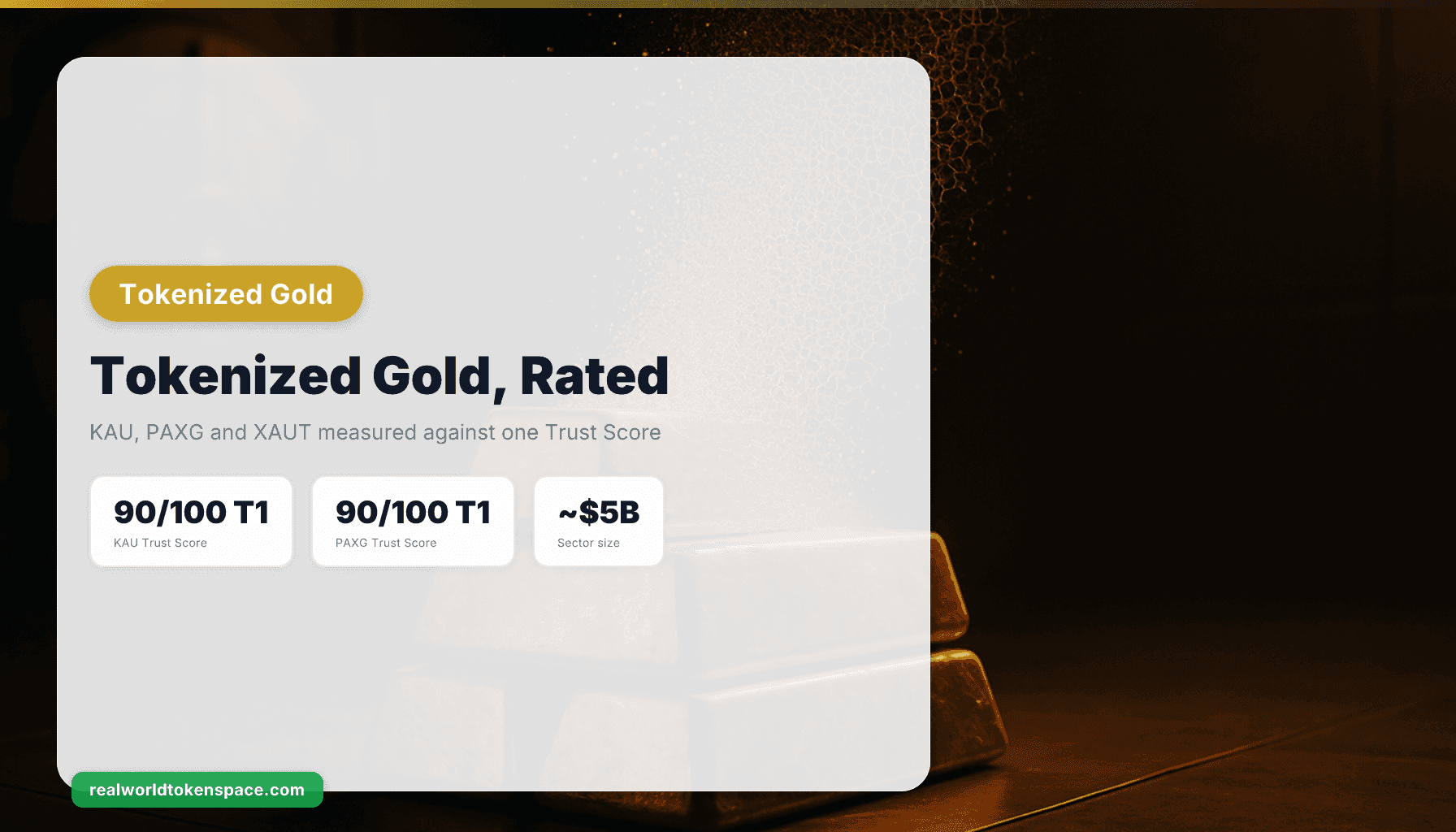
For allocators evaluating tokenized options, the Trust Score framework identifies three Tier 1 products backed by allocated, audited, and vaulted ounces. Each offers verifiable exposure to the physical metal that central banks are accumulating at an accelerated pace.
PAX Gold ($PAX) – Trust Score 92, Tier 1
Paxos-issued, ERC-20 token backed 1:1 by LBMA Good Delivery bars stored in Brink's London vaults. Each token represents one fine troy ounce. Monthly attestations by Withum, a top-100 accounting firm. Redeemable for physical bars above 430-ounce minimums. On-chain transparency allows real-time verification of reserve addresses.
Kinesis Gold ($KAU) – Trust Score 88, Tier 1
Allocated, serial-numbered bars stored across Loomis and Brink's vaults in multiple jurisdictions. Each token is directly linked to a specific bar via the Kinesis blockchain. Quarterly audits by Bureau Veritas. Lower redemption minimums (100 ounces) than PAX. Offers a yield-sharing mechanism tied to transaction volume within the Kinesis monetary system.
Cache Gold ($CACHE) – Trust Score 85, Tier 1
Gram-denominated tokens backed by allocated bars in insured vaults. Each token represents one gram of .9999 fine gold. Monthly third-party audits. Designed for smaller allocators seeking fractional exposure with full redemption rights. Available on Ethereum and Polygon.
All three products allow holders to participate in the gold market without taking delivery, while maintaining the option to convert to physical metal if conditions warrant. They augment rather than replace allocated holdings and provide liquidity, portability, and 24/7 settlement for those who need it.
We Rate, You Decide
RWTS isn't bullish or bearish on gold. We're the credit-rating agency for tokenized real assets. Goldman Sachs lifted its central bank demand estimate to 60 tonnes per month because the data suggested the prior model was missing sovereign buying. The WGC's Q1 244-tonne figure supports that revision. Poland, Uzbekistan, and China continue accumulating. J.P. Morgan expects 755 tonnes for the full year.
The mechanism is straightforward. Central banks are rotating reserves toward non-sovereign assets amid geopolitical uncertainty. That demand has held through multiple price levels, suggesting strategic rather than tactical positioning. Tokenized products allow retail and institutional allocators to follow the same trade with lower friction and immediate settlement.
We rate the products, publish the Trust Scores, and flag the data points that matter. The decision to allocate, in what size, and through which vehicle is yours.
Related research
Stay Ahead of the Yield Curve
Subscribe to The Yield Report for weekly yield intelligence.
Subscribe Now