Parking USDT on an exchange earn desk is the most common stablecoin yield decision retail makes, and the least scrutinized. The APY is front and center. The counterparty risk is in the fine print. RWTS does not tell you where to deposit, we rate the structures so you can weigh yield against who is actually holding your dollars.
Three names dominate the comparison: Binance, OKX, and Kraken. Each runs a flexible-savings product on USDT, each posts a different rate, and each carries a different risk and transparency profile. Start with the live numbers, then read the structure underneath them.
The headline rates
The spread between these platforms is real. On Binance, Simple Earn currently offers around 1.25 to 3.85% APR for USDT and 3.36 to 5.74% APR for USDC, depending on the product format. OKX tends to post higher base ranges: OKX Earn offers Flexible Savings on USDT at a rate of around 8 to 15% base, with regular limited-time boosts and dual-asset products.
Kraken sits between the two on a security-versus-yield basis. Kraken balances security and competitive rates of 6 to 10% with proof-of-reserves transparency. The broad pattern across the regulated-versus-aggressive divide is consistent: USDT yields in 2026 typically range from 4 to 8% on highly regulated platforms to 15 to 20% plus on CeFi promotions and higher during short-term flash events.
One caveat dominates all of these figures. All numbers are live platform data; always verify directly on each exchange because rates move daily and promos fill fast. Treat any posted APY as a snapshot, not a contract.
What you are actually trading for the yield
The higher the exchange APY, the more important the question: where does the money come from? Tokenized Treasury products like USYC or money-market wrappers pass through T-bill returns near the Fed funds rate, call it 4 to 5%. When an exchange posts double digits on a stablecoin, the extra yield is being manufactured somewhere, usually by lending your USDT to leveraged traders or by subsidizing the rate to win deposits.
That is the core trade-off behind the rate gap. The promotional ranges that look most attractive carry the least transparency about funding. Stablecoins do not make an investment completely risk-free. Exchanges can change rates at any time, impose limits on high-yield allocations, or end promotions. The number you signed up for is rarely the number you keep for long.
The Trust Score lens
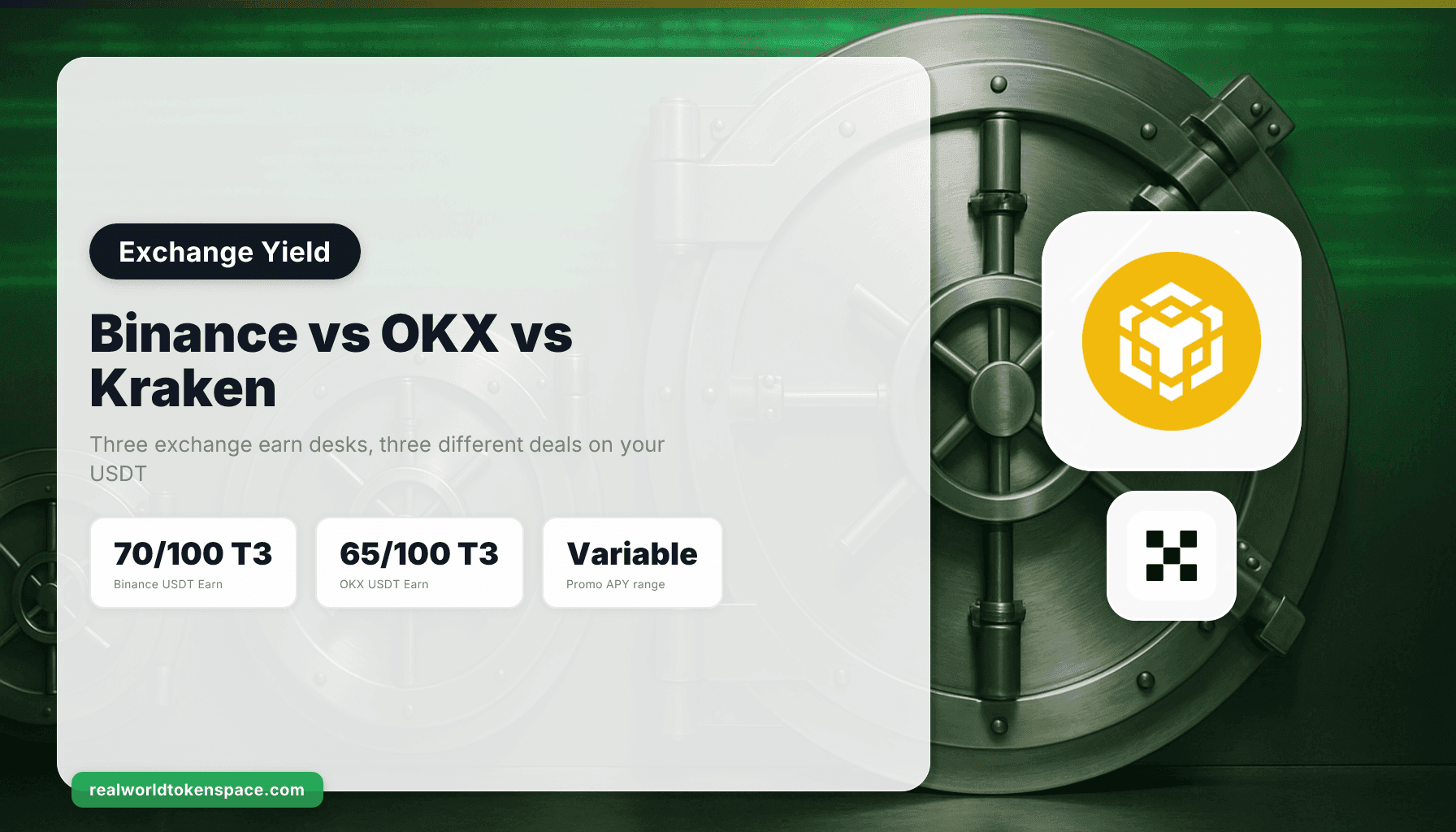
This is where RWTS scores the structures rather than the marketing. On our scale, Binance USDT Simple Earn carries a Trust Score of T3 (70/100), and OKX USDT Simple Earn sits at T3 (65/100). Both scores reflect the same underlying reality: a custodial product where your USDT lives on the exchange's balance sheet and yield sourcing is only partially disclosed.
The Trust Score weighs custody arrangement, transparency, redemption terms, and counterparty strength. A higher posted APY does not lift the score; if anything, an opaque promotional rate can weigh against it. For the full breakdown of how we weight these factors, see the RWTS methodology. For context on how a US-regulated venue's staking desk scores, Kraken's ETH product (Kraken ETH staking at T3 (75/100)) illustrates how regulatory posture and disclosure lift a score even when raw yield is lower.
Flexibility, lock-ups, and access
Beyond rate and risk, the product mechanics differ. Flexible savings let you redeem at any time; locked products pay more for a commitment. OKX leans into optionality with structured products on top of flat savings, it offers Flexible Savings with regular limited-time boosts and dual-asset products. Dual-investment and similar structures are not plain savings; they embed a price bet and can return a different asset than you deposited. Read the product type, not just the APY.
For US users, the practical menu narrows. The aggressive promotional rates often sit on platforms with limited or no US access, leaving regulated venues with lower but more transparent yields as the realistic option.
A conditional framework
If your priority is the highest posted number and you accept custodial and promotional risk, OKX's base range has typically led this group. If your priority is transparency and proof-of-reserves discipline, Kraken's middle-band rate is the more conservative deal. Binance's base Simple Earn rate is the lowest of the three on USDT but pairs with the deepest liquidity and the longest operating history.
The decision hinges on a variable none of these platforms control: how long the current rate survives. Promotional APYs decay; base rates track lending demand and the broader rate environment. If the Fed holds and lending demand stays firm, the higher ranges may persist. If risk appetite cools, expect convergence toward the regulated band. For the wider menu of exchange options and how they compare on safety, see our exchange yield hub and the companion piece USDC Rewards vs Stablecoin Yield: Coinbase, Kraken, Binance Compared.
RWTS isn't bullish or bearish on any exchange. We're the credit-rating agency for tokenized real assets. We rate. You decide.
Related on RWTS
Stay Ahead of the Yield Curve
Subscribe to The Yield Report for weekly yield intelligence.
Subscribe Now