RWTS isn't bullish or bearish on Coinbase, Circle, or any token. We're the credit-rating agency for tokenized real assets. We rate. You decide.
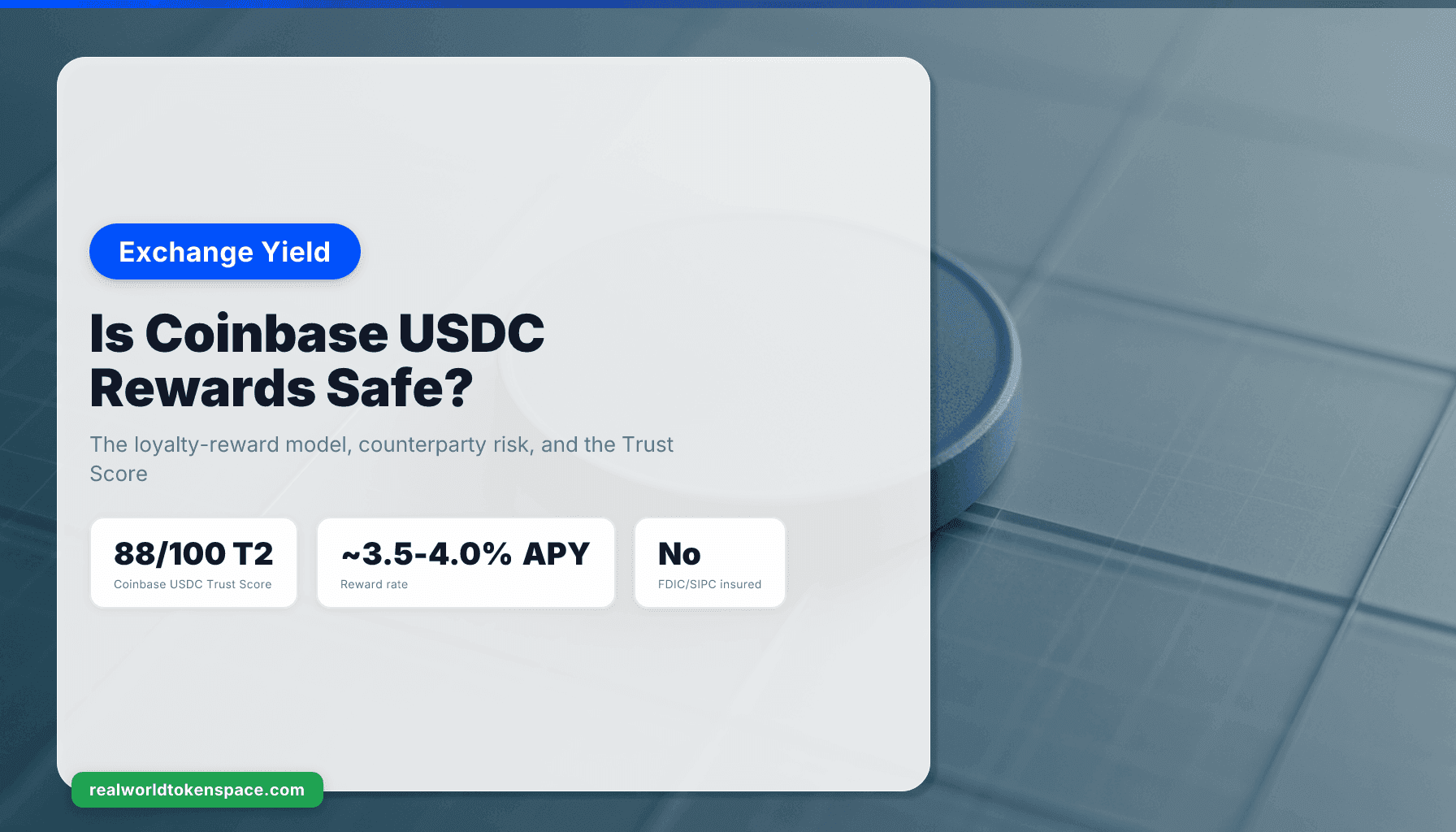
Coinbase USDC Rewards is the default on-ramp to dollar yield for millions of retail users. The pitch is simple: hold USDC, earn a reward, no lockup. The structure underneath is less simple, and the safety question turns on three things, who the counterparty is, where the money sits, and whether the rate can be cut. We carry the Coinbase USDC Rewards product at a Trust Score of T2 (88/100). Here is what that number reflects.
The reward is a reward, not interest, and that matters
Start with the legal architecture, because it drives everything else. The GENIUS Act, enacted in July 2025, prohibits permitted stablecoin issuers from paying interest or yield to holders. That bar applies to Circle, the issuer of USDC. So the income does not flow as issuer interest. Instead, SEC filings revealed that the stablecoin issuer gives 50% of the interest earned on its reserves to Coinbase. Coinbase then routes a share to holders as a loyalty reward.
The mechanism is, in plain terms, regulatory arbitrage. Issuers like Circle can still effectively pay yield to holders by distributing rewards to exchanges like Coinbase, which does not hold the asset itself but can pass on these rewards to holders who keep the assets in Coinbase accounts. The economic result resembles interest; the legal form does not. For a depositor, the practical takeaway is that the payment is discretionary, and Coinbase has been explicit on that point.
What you give up: counterparty and insurance
Coinbase is clear in its own disclosures about what the program is and isn't. USDC Rewards is a loyalty program funded by Coinbase, designed to incentivize using Coinbase to hold USDC, and Coinbase does not use or lend your USDC without your instruction. That is a meaningful protection, it is not a rehypothecation product. But the insurance picture is unambiguous: USDC is a digital currency, not legal tender, Coinbase does not have the right to use any USDC you hold, USDC balances are not considered deposit accounts, and your USDC balance is not insured by the FDIC or SIPC.
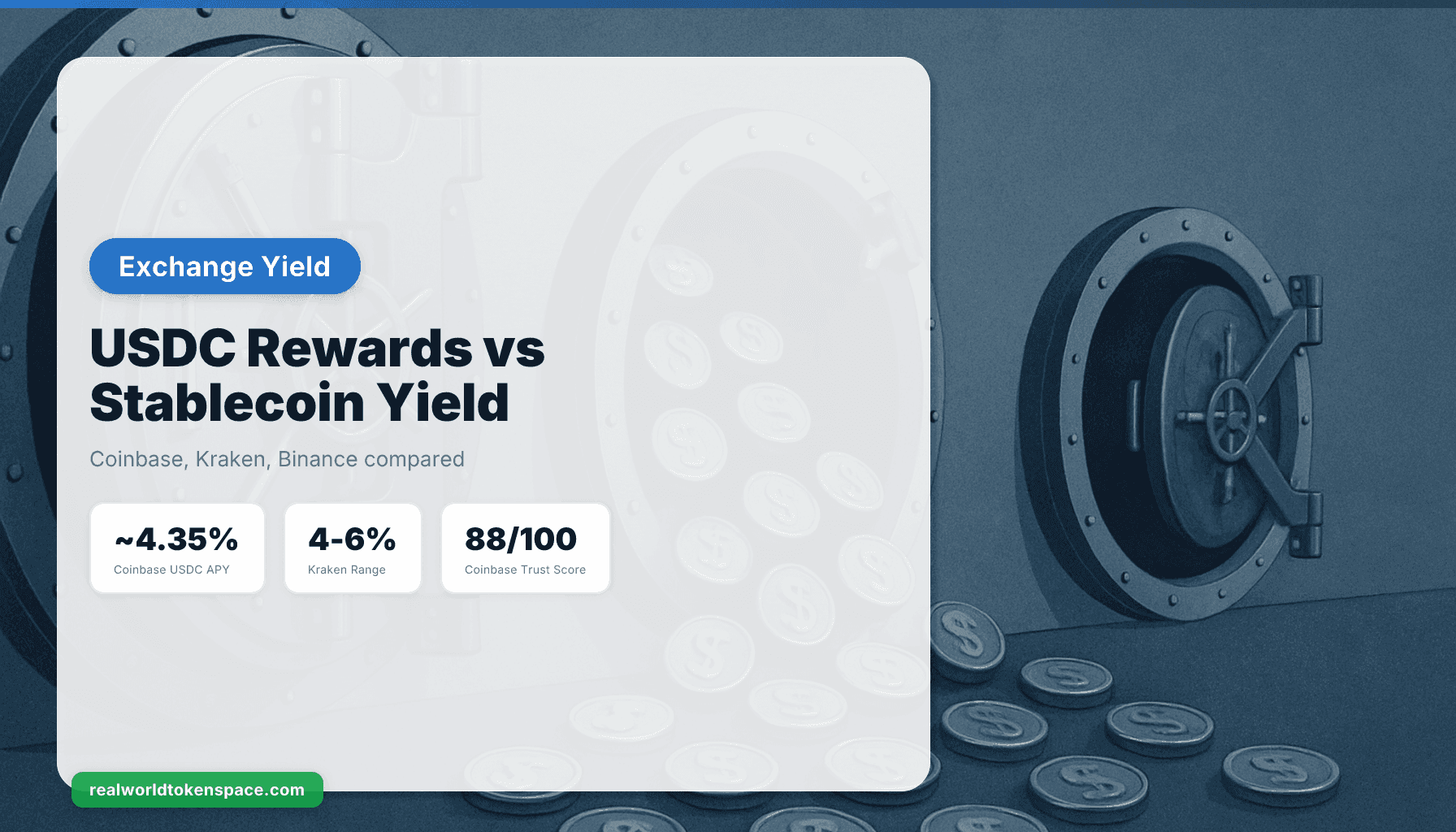
The rate is also at the platform's discretion. Coinbase reserves the right to change or discontinue USDC Rewards at any time by reasonable means of notice, and the rates can vary by country, ongoing experimentation, and account type. That discretion has been exercised. Through 2025, falling rates and a policy shift pushed the program behind a paywall, with the standard reward landing near the 3.5% to 4.0% band for eligible US users and the headline benefit increasingly bundled into Coinbase One. The reward tracks the rate cycle closely, analysis of the program found USDC rewards correlate near-perfectly with short-term Treasury yields, so a falling-rate Fed posture compresses what you earn.
How it compares to tokenized treasuries
The honest comparison is not Coinbase versus a bank account, it is Coinbase USDC Rewards versus the tokenized-treasury rail that pays the same underlying T-bill income through a different structure. We rate the Coinbase USDC Rewards product T2 (88/100). For context, two of the most-used tokenized treasuries score in the same tier: BUIDL at T2 (84/100) and USYC at T2 (81/100).
The structural difference is the point. The risk categories that matter in 2026 are custodial credit risk for products like Coinbase, DeFi smart-contract risk, basis-trade and funding-rate risk, and tokenized-treasury risk for products like BUIDL, OUSG, and USDY. Coinbase USDC Rewards sits squarely in the custodial-credit bucket: your dollars are on an exchange's books, and your reward is the exchange's call. BlackRock BUIDL, Ondo OUSG, and Ondo USDY are tokenized US Treasury products that pay T-bill yield on-chain, with APYs sitting near the SOFR rate. The trade-off is access, tokenized treasuries often require accredited or non-US onboarding, while the Coinbase reward is one tap for retail.
For a fuller breakdown of the access tiers and redemption mechanics across the treasury rail, see our tokenized treasuries comparison hub, and our related deep-dive, BUIDL vs USYC: 2026 Tokenized Treasury Comparison.
The verdict, conditionally framed
If your priority is a simple, liquid, low-friction dollar reward and you accept Coinbase as the counterparty, the product is fit for purpose for sub-$10k balances. The Trust Score reflects that: strong issuer transparency and clear disclosures earn the T2 grade, while exchange custody, the lack of FDIC/SIPC coverage, and a discretionary rate keep it out of the top tier. If your priority is bankruptcy-remote structure or institutional treasury parking, a regulated tokenized-treasury wrapper is the more defensible choice, and the rate gap is narrower than it looks once you net out the Coinbase One subscription fee.
The variable that decides the next 12 months is Fed posture. Rewards track short-term Treasury yields almost one-for-one, so the direction of the dot-plot, not Coinbase's marketing, will set what you actually earn. Our scoring rationale is documented on the RWTS methodology page.
We rate. You decide.
Related on RWTS
Stay Ahead of the Yield Curve
Subscribe to The Yield Report for weekly yield intelligence.
Subscribe Now