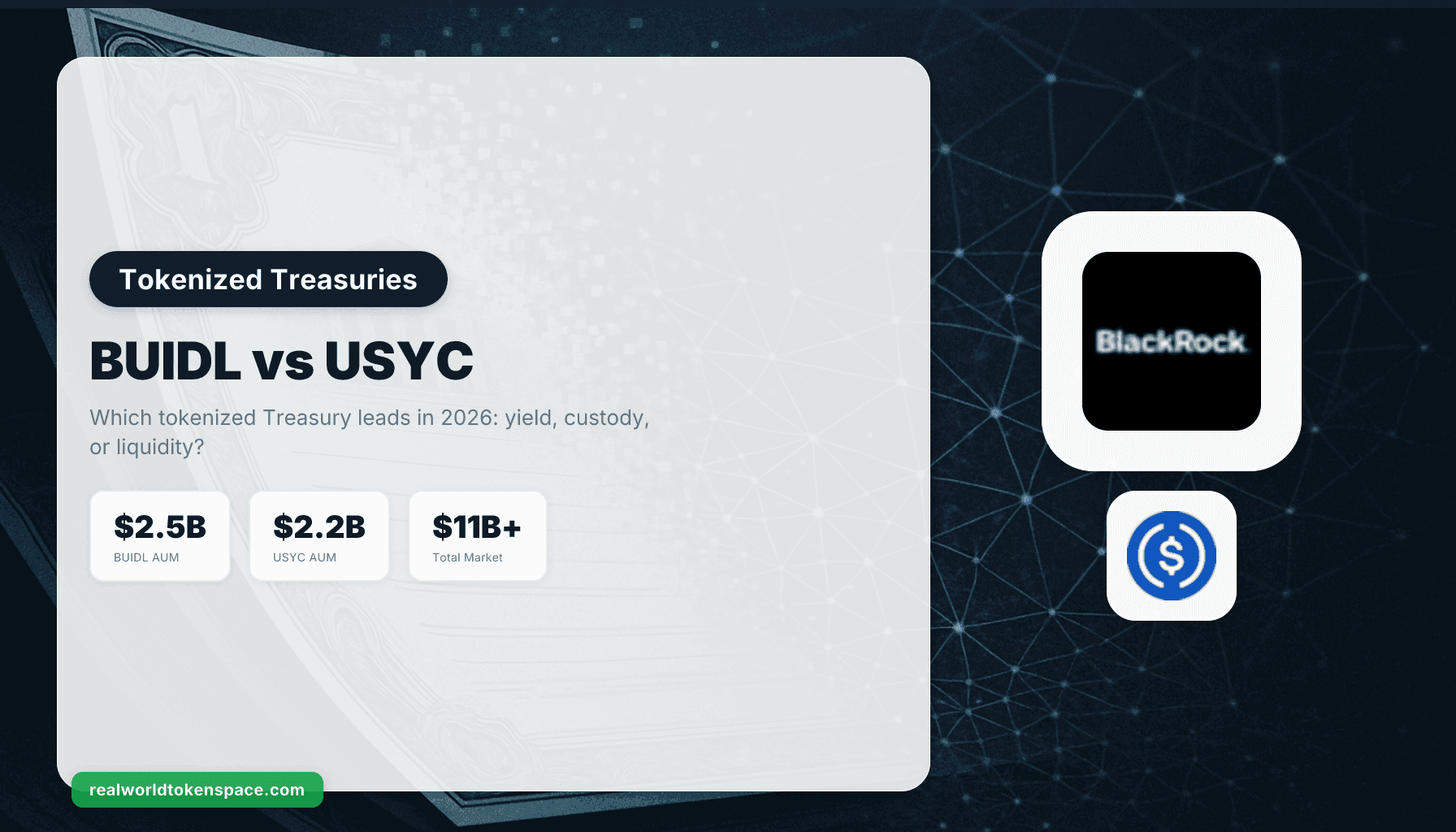
BlackRock's USD Institutional Digital Liquidity Fund holds approximately $2.5 billion in assets under management as of mid-May 2026, making it the second-largest tokenized money market fund behind Circle's USYC at roughly $2.2 billion, according to RWA.xyz data. The total tokenized US Treasury market has reached a record $11 billion, driven by institutional allocators seeking on-chain yield without the operational overhead of traditional brokerage accounts.
For treasury managers choosing between BUIDL, USYC, and USDY, the decision hinges on three variables: minimum investment threshold, redemption mechanics, and DeFi composability. This comparison applies the RWTS Trust Score methodology to evaluate custody infrastructure, regulatory standing, and liquidity backstops across the three largest products.
The Trust Score Breakdown
BUIDL scores 91 on the RWTS Trust Score, driven by BlackRock's institutional-grade custody through BNY Mellon and audits by Deloitte. USYC scores 88, reflecting Circle's regulatory framework and its integration into the broader USDC reserve infrastructure. USDY, issued by Ondo Finance and restricted to non-US investors, scores 84, a function of its bankruptcy-remote structure and narrower auditor footprint.
All three products hold short-duration US Treasuries, overnight repo agreements, and cash equivalents. The score differential reflects custody depth, not credit risk. BUIDL's higher score is a function of BlackRock's $10 trillion AUM parent and the transparency of its Securitize transfer-agent layer. USYC benefits from Circle's multi-year operational history as the USDC issuer. USDY's lower score reflects the smaller scale of Ondo Finance as issuer and the offshore-only structure.
If the thesis is "park institutional capital in government-backed yield with minimal smart-contract risk," all three products clear the Tier 2 threshold. The choice depends on access, not safety.
Yield Mechanics: Rebasing vs Price Accrual
BUIDL maintains a stable $1.00 price and distributes yield by minting new tokens at regular intervals, typically monthly or daily. This rebasing model simplifies DeFi collateral pricing because smart contracts can assume a constant $1.00 value without complex net-asset-value tracking. The tradeoff: each yield distribution is likely a taxable income event for US holders.
USYC's price appreciates daily as yield accrues, making it a more tax-efficient structure for holders who want to accumulate yield without triggering regular income recognition. The same structure applies to USDY. This approach produces a single capital-gain event on sale rather than multiple taxable income events throughout the holding period. The tradeoff: DeFi integrations require NAV-aware pricing oracles, which add complexity to protocol integrations.
For protocol treasuries or DAO allocations that value accounting simplicity over tax optimization, BUIDL's rebasing model is the default. For institutional holders in tax-sensitive jurisdictions or those planning multi-year holds, USYC or USDY's accrual model reduces reporting overhead.
Redemption and Liquidity
Both BUIDL and USYC offer T+0 settlement, allowing holders to create and redeem 24/7/365. BUIDL requires a whitelisted Ethereum address and Securitize KYC. USYC redemptions flow through Circle's existing infrastructure, with the same compliance layer that governs USDC minting. USDY redemptions also settle T+0 but are restricted to non-US persons under Regulation S.
Liquidity during stress depends on the issuer's treasury management and the ability to liquidate underlying collateral. BlackRock's fund has distributed dividends exceeding $100 million since inception, a signal that cash-management protocols are functioning as designed. Circle's USYC is part of the top six funds that collectively control 88% of the tokenized Treasury market, providing scale advantages in repo markets.
Neither product has faced a run scenario. The test will come when a spike in redemptions coincides with a Treasury market dislocation. The rebasing vs accrual distinction matters less than the issuer's ability to access overnight liquidity.
DeFi Composability and Collateral Acceptance
BUIDL's integration with on-chain liquidity providers like UniswapX has enhanced its appeal, allowing qualified investors to trade shares with low slippage. The product is accepted as collateral on Deribit and Crypto.com, and DAOs leverage it for lending, trading, and credit.
USYC's composability advantage is its integration into the Circle reserve-products family, giving Circle's institutional clients an on-chain alternative to overnight repo. The token is integrated into Morpho vaults and select Aave markets, though adoption lags BUIDL in derivatives venues.
USDY offers the most chain-distributed deployment among tokenized Treasury products, with approximately 40% on Ethereum, 35% on Solana, 12% on Mantle, and smaller allocations on Sui and Aptos. For Solana-native teams, USDY is the most accessible Treasury exposure without bridging from Ethereum. The tradeoff: USDY's composability ceiling is higher than permissioned tokens like BUIDL or USYC, but its regulated non-US-only status limits some integrations.
For allocators prioritizing derivatives-collateral acceptance, BUIDL leads. For cross-chain treasury allocations, USDY's multi-chain distribution wins. For allocators seeking the simplest path from USDC reserves to on-chain yield, USYC's Circle ecosystem integration is the natural choice.
Regulatory Standing and Issuer Risk
BlackRock BUIDL operates under a permissioned structure with KYC/AML checks and qualified-access requirements, compliant with US regulatory expectations. Circle USYC is part of Circle's broader regulatory engagement, including its positioning as a publicly traded entity and its multi-year relationship with US banking regulators. USDY is structured as a Regulation S offshore product, limiting US person access but providing a compliant path for non-US institutional allocators.
The issuer-risk hierarchy follows institutional scale. BlackRock's $10 trillion AUM and 35-year operating history anchor BUIDL's credit profile. Circle's $200+ billion USDC circulation and public-company governance anchor USYC. Ondo Finance, while audited and backed by venture capital, operates at a smaller scale. The Trust Score differential reflects this.
None of the three products carry FDIC insurance or SIPC protection. Holders are unsecured creditors of the issuing fund, with a claim on the underlying Treasury portfolio. The risk is not default of the underlying collateral (US Treasuries carry sovereign credit) but operational failure of the issuer or custodian.
The RWTS Verdict: We Rate, You Decide
BUIDL leads on institutional custody infrastructure and derivatives-collateral acceptance. USYC leads on tax-efficient yield accrual and integration into the Circle stablecoin ecosystem. USDY leads on multi-chain distribution and access for non-US allocators.
For DAO treasuries prioritizing simplicity and collateral utility, BUIDL is the default. For institutional treasuries optimizing tax treatment and planning multi-year holds, USYC or USDY's accrual model reduces overhead. For cross-chain protocols, USDY's Solana and alt-L1 presence is the natural fit.
The tokenized treasuries hub tracks the full market. The Trust Score methodology applies the same custody, regulatory, and liquidity tests to every product. The right choice depends on your allocation priorities, not on which issuer has the largest marketing budget.
For further reading, see our analysis of Morpho vault yields for stablecoin allocators and the RWTS methodology for tokenized money market fund scoring.