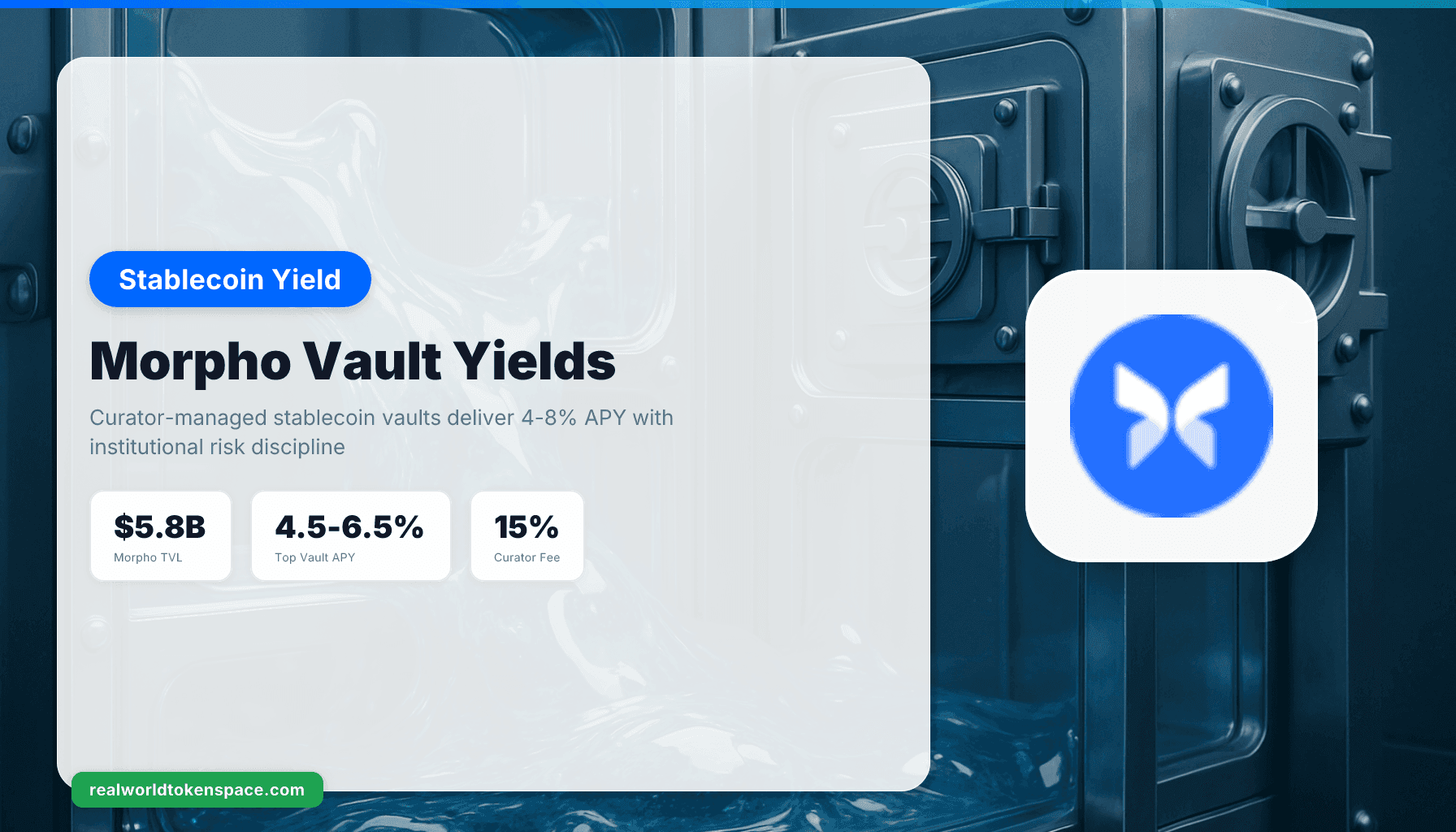
Morpho's curated vault system holds approximately $5.8 billion in total value locked as of early 2026, making it the second-largest DeFi lending protocol behind Aave. The protocol's two-layer architecture separates the lending primitive (Morpho Blue) from the risk-management layer (MetaMorpho vaults), allowing independent curators to deploy capital across isolated markets while depositors earn optimized yields without evaluating individual collateral parameters.
For allocators seeking on-chain yield on USDC, USDT, or USDS, the curator selection determines risk exposure, fee structure, and net APY. This guide evaluates the top institutional curators (Steakhouse Financial, Gauntlet, and Morpho Labs) and applies the RWTS Trust Score methodology to assess their track records, allocation transparency, and risk disciplines.
How Morpho Vaults Work
A stablecoin vault is an ERC-4626 contract that accepts deposits of a single stablecoin, routes those deposits across a curated basket of lending or yield markets, and issues share tokens that represent a pro-rata claim on the underlying assets plus accrued yield. Curators (specialist risk teams) choose which markets the vault enters, set supply caps and loan-to-value limits, and rebalance on a published cadence.
Morpho Blue markets are permissionless and isolated. Anyone can deploy a lending market by specifying a loan asset (e.g., USDC), a collateral asset (e.g., wstETH), a liquidation LTV, an oracle, and an interest rate model. Once deployed, the market's parameters are immutable. This eliminates governance risk (your LTV will never change mid-position) but shifts due diligence to the curator or depositor.
Morpho typically produces 100-300 bps higher USDC yield through curator-routed allocation, but requires depositors to pick a curator. Aave offers deeper liquidity and simpler UX, but the shared-pool model dilutes returns when capital sits idle. Most institutional treasury stacks use both protocols.
Steakhouse Financial: Treasury-Grade Conservative
Steakhouse started as a treasury and stablecoin research shop and migrated into direct vault curation as Morpho Blue matured. Today Steakhouse runs flagship USDC and USDT vaults on Ethereum mainnet and Base, plus specialized vaults for wstETH-backed borrows and PYUSD. The firm publishes monthly vault reports and allocation breakdowns.
Steakhouse's methodology leans conservative: the firm concentrates exposure in blue-chip markets (wstETH/USDC, WBTC/USDC, cbBTC/USDC) with tight loan-to-value caps, and avoids experimental collateral. Typical 2026 APY for Steakhouse USDC is 4.5-6.5%, with the flagship vault holding $436.95 million and maintaining over $110 million in available liquidity. Management fee is 15% of yield.
If the mandate is treasury-grade stablecoin exposure with a slight APY discount to more aggressive curators, Steakhouse is the default pick for institutional allocators. The firm's public track record since 2023 and its monthly transparency reporting provide the audit trail most compliance teams require.
Gauntlet: Scenario-Tested Prime and Frontier
Gauntlet spent years as the risk-management provider to Aave, Compound, and MakerDAO, tuning parameters, running stress tests, and building the quantitative infrastructure that now anchors its vault curation. By 2026 Gauntlet runs one of the deepest stablecoin curator books across Morpho, Aave v4, and Euler. The firm publishes its risk methodology and vault performance on its research site.
Flagship vaults include Gauntlet USDC Prime (conservative, Morpho-only), Gauntlet USDC Frontier (higher-yield, broader market set), and Gauntlet USDT Core. Methodology centers on scenario-tested risk: each market the vault enters has a modeled bad-debt probability at multiple volatility regimes, and position sizing scales inversely with that probability. Typical 2026 APY is 5-7.5% for Prime and 6-8.5% for Frontier. Fees mirror Steakhouse at 15% of yield.
Gauntlet is the pick when you want institutional risk discipline but a slightly higher yield than treasury-grade. The firm's stress-testing infrastructure and its public track record managing Aave and Compound parameters provide the due-diligence trail for allocators comfortable with modestly higher collateral exposure.
Morpho Labs and the Long Tail
Morpho is both the underlying platform and a meaningful curator in its own right. Morpho Labs curates first-party vaults that allocate across a broader set of markets than Steakhouse or Gauntlet, often including newer collateral types or higher-LTV markets. APY targets are typically 100-200 bps above Steakhouse's conservative vaults, at the cost of higher collateral risk.
Beyond the institutional trio, a long tail of DeFi-native shops (Re7 Labs, MEV Capital, Block Analitica) curate smaller vaults with APY targets in the 7-10% range. These vaults accept more experimental collateral (PT tokens, newer LSTs, RWA-backed markets) and may have less transparent allocation methodologies. For allocators prioritizing yield over institutional audit trails, these curators deliver higher returns. For allocators prioritizing transparency and conservative risk, they fall outside the institutional threshold.
Yield vs Risk: The Curator Decision Tree
APYs fluctuate with borrowing demand but generally range from 3-8% for conservative stablecoin vaults. Kraken DeFi Earn does essentially the same thing with an exchange wrapper, advertising up to 8% APY through Veda-powered vaults.
If the mandate is "maximize on-chain stablecoin yield while maintaining institutional-grade risk discipline," the curator hierarchy is clear:
- Steakhouse USDC/USDT: 4.5-6.5% APY, treasury-grade collateral concentration, monthly reporting. Best for allocators who can tolerate no collateral surprise and value transparency over the last 50 bps of yield.
- Gauntlet Prime/Frontier: 5-8.5% APY, scenario-tested risk, broader market set. Best for allocators comfortable with modestly higher LTV exposure and who trust quantitative stress-testing over name-brand collateral.
- Morpho Labs and long-tail curators: 6-10% APY, experimental collateral, less transparent methodologies. Best for allocators chasing yield and comfortable conducting their own collateral due diligence.
The stablecoin yield hub tracks the full DeFi lending landscape, including Aave, Compound, and Sky. The Trust Score methodology applies the same custody, liquidity, and transparency tests to every protocol.
Institutional Adoption and the Coinbase Integration
Coinbase launched USDC lending for US retail customers in September 2025, routing deposits through a Morpho Vault curated by Steakhouse Financial. By April 2026, Coinbase Loans manages $1.6 billion-plus in collateral powered by Morpho Blue, including a UK expansion that shipped in early 2026.
This single integration validated Morpho as enterprise-grade infrastructure. When a publicly traded US exchange with 100+ million users routes retail deposits through a DeFi protocol, it signals that custody, regulatory, and operational risks have cleared the institutional threshold.
The second institutional inflection was Apollo Global Management, a firm managing $940 billion in traditional assets, signing a deal to acquire up to 9% of Morpho's token supply over four years. Apollo's involvement reflects the traditional finance appetite for on-chain credit infrastructure, not speculative token positioning.
For allocators evaluating Morpho vaults, these integrations provide external validation that the protocol's risk architecture, custody infrastructure, and regulatory posture meet institutional standards. The curator decision (Steakhouse vs Gauntlet vs long-tail) determines yield and collateral exposure, not base-layer protocol risk.
The RWTS Verdict: We Rate, You Decide
Morpho vaults deliver 4-8% APY on stablecoins via curator-managed allocation across isolated lending markets. Steakhouse curates the most conservative institutional vaults at 4.5-6.5% APY. Gauntlet curates scenario-tested Prime and Frontier vaults at 5-8.5%. Long-tail curators deliver 7-10% at the cost of higher collateral risk and less transparent methodologies.
For DAO treasuries, institutional allocators, and protocol reserves seeking on-chain stablecoin yield with institutional risk discipline, Steakhouse or Gauntlet USDC vaults are the default. For allocators chasing the last 100-200 bps of yield and comfortable conducting collateral due diligence, the long-tail curators offer higher returns.
The choice depends on your risk tolerance, not on which curator has the flashiest dashboard. The DeFi yields methodology scores every protocol and curator on the same custody, transparency, and liquidity tests. For further reading, see our comparison of BUIDL vs USYC tokenized treasuries and the stablecoin yield hub.