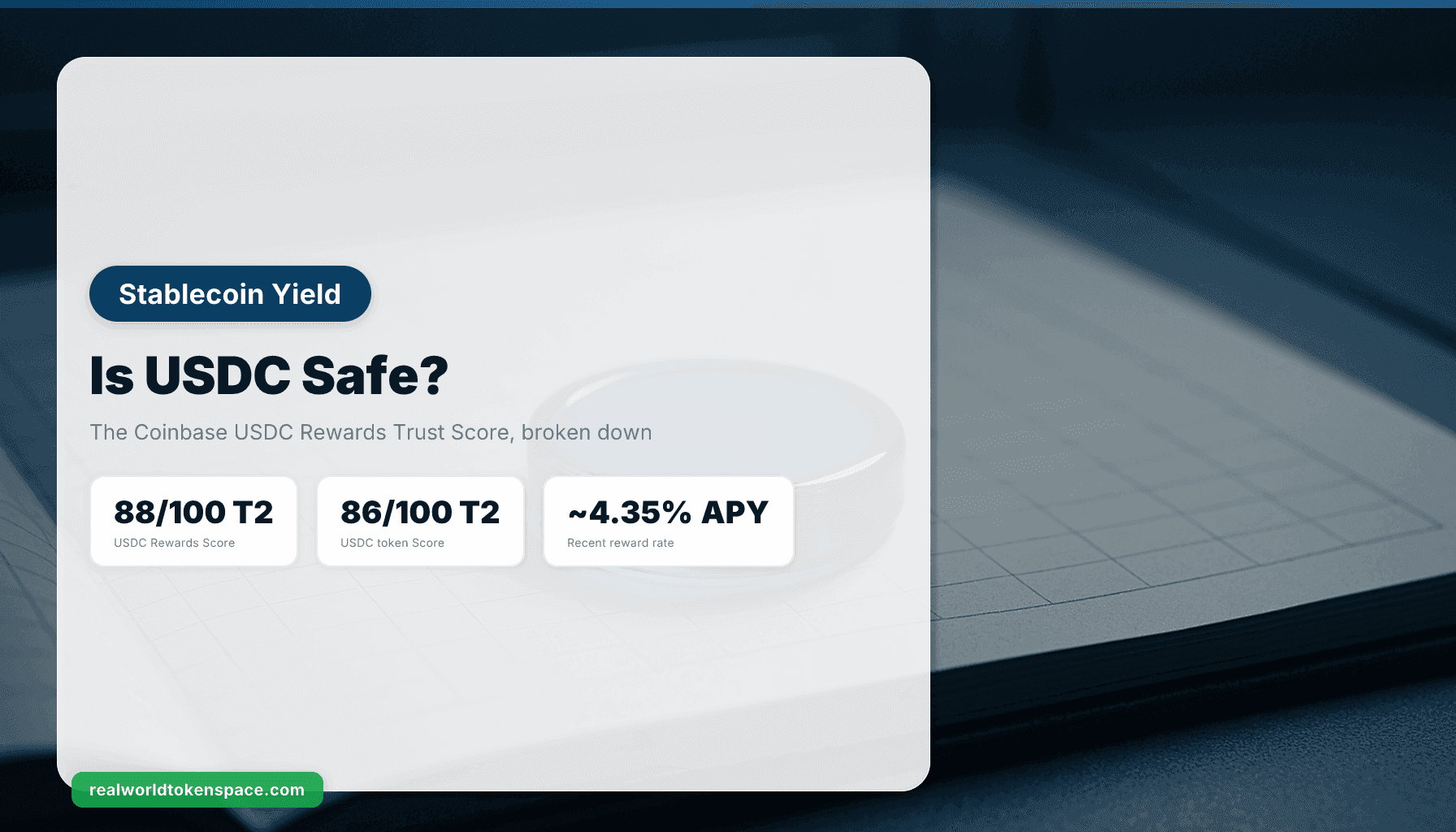
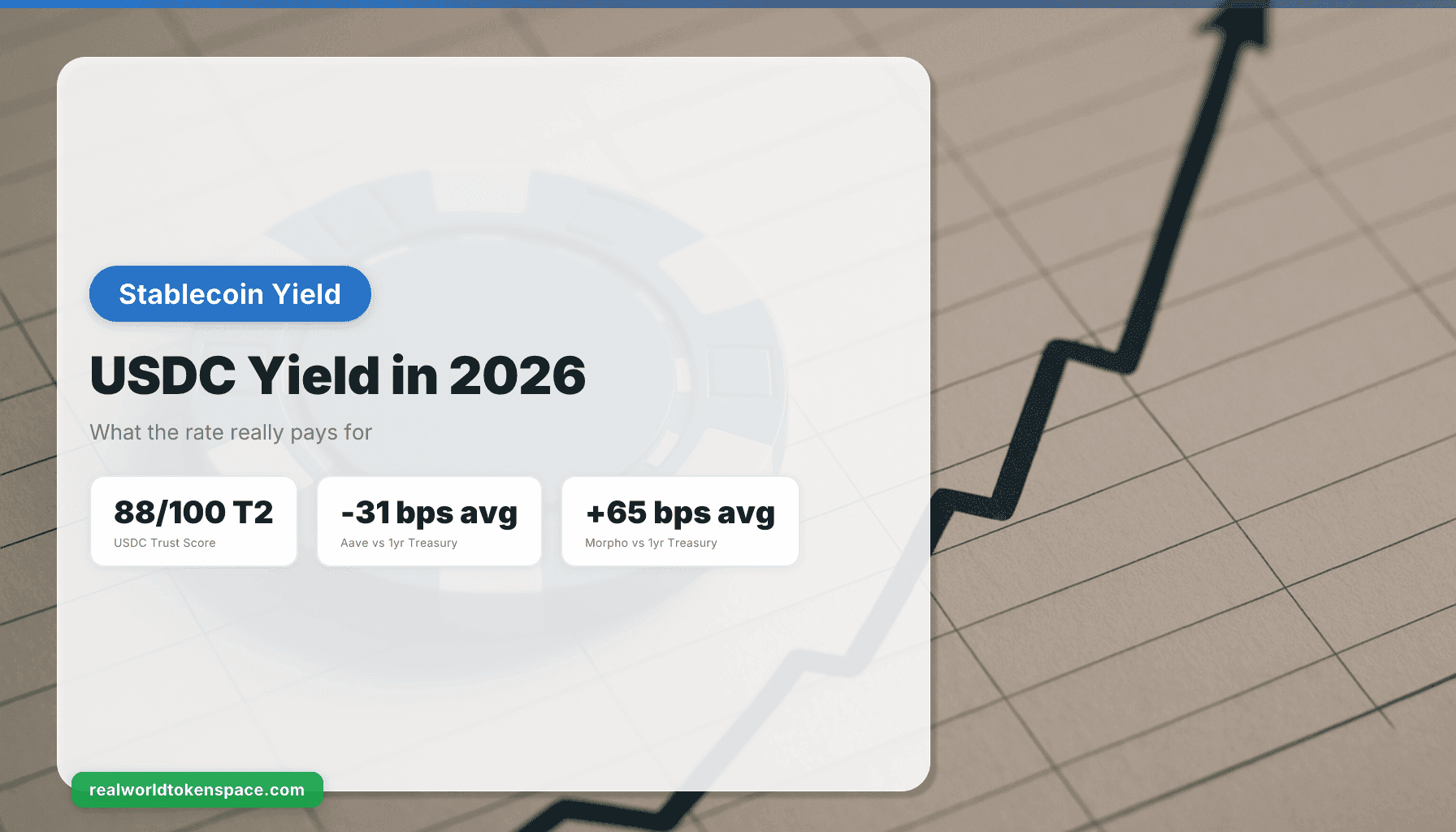
Verdict: On our scoring, USDC is among the safest stablecoin yield options available, Coinbase USDC Rewards rates T2 (88/100) and the USDC token itself rates T2 (88/100). The single most important caveat is that the balance is not FDIC or SIPC insured. We rate. You decide.
If you are searching for the best stablecoin yield safely in 2026, USDC is the default starting point for one reason: the score reflects reserve transparency, not a promotional rate. The reference for every number below is our Trust Score methodology.
Is USDC safe? The short answer
Coinbase USDC Rewards rates T2 (88/100), one of the strongest scores in our stablecoin coverage. The product is structurally simple. Eligible customers earn rewards for holding USDC in their Coinbase account, are automatically opted in, and there is no maximum holding limit. Rewards accrue daily based on your balance and the rate, are typically distributed on Fridays, and require holding at least $1 of USDC.
The yield is real but floats. The reward rate has recently been quoted around 4.35% APY, distributed and requiring a minimum balance of $1 USDC. Coinbase is explicit that this can move: it reserves the right to change or discontinue USDC Rewards at any time, and rates can vary by country, ongoing experimentation, and account type. Treat the headline number as a snapshot, not a contract.
How USDC's backing works
The reason USDC scores where it does is the reserve model. The token is collateralized 1:1 by US dollar reserves and short-dated US Treasuries, with regular third-party attestations. That transparency is the load-bearing part of the score, it is what separates a fully reserved stablecoin from one where the backing is harder to verify.
This is also why USDC out-scores Tether in our directory. The USDC token rates T2 (88/100) against USDT at T2 (64/100). The 25-point gap is not a price difference (both hold their peg in normal conditions) but a transparency and attestation difference. If reserve disclosure is your priority, USDC is the higher-rated holding.
The caveat that actually matters
The reward is not a bank product, and Coinbase says so plainly. USDC is a digital currency, not legal tender; Coinbase does not have the right to use USDC you hold, USDC balances are not deposit accounts, and your balance is not insured by the FDIC or SIPC.
That is the honest line between a stablecoin reward and a savings account. You are exposed to issuer risk (Circle's reserves performing as attested) and platform risk (Coinbase as custodian), without the federal backstop a bank deposit carries. The T2 score prices that in; it is why even the strongest stablecoin reward does not reach T1.
There is also a tax dimension worth flagging. US customers are generally required to report USDC Rewards earnings, and those receiving more than $600 in rewards receive a 1099-MISC from Coinbase. The reward is ordinary income, not a tax-free yield.
How it compares across exchanges
Coinbase is not the highest-rate venue, by design. Independent comparisons put Coinbase around 2% to 3.5% APY emphasizing compliance and institutional-grade custody, while Kraken provides roughly 4% to 6% APY depending on region and verification. The Coinbase trade-off is deliberate: Coinbase prioritizes regulatory compliance and institutional-grade security, accepting slightly lower yields as a trade-off.
If your decision rule is "best stablecoin yield safely," the higher score on Coinbase USDC Rewards reflects exactly that priority, safety-adjusted, not headline-rate-adjusted. Chasing an extra 100-150bps on a less-transparent venue is a different risk profile, and our scores make that visible. For a venue-by-venue read on the yield side, see our companion guide, Binance vs OKX vs Kraken USDT Earn Comparison.
Bottom line
USDC is, on our scoring, among the safest places to earn stablecoin yield, provided you understand it is a token reward with issuer and platform risk, not an insured deposit. For the full landscape of scored stablecoin products, our stablecoin yield hub tracks every option we rate.
RWTS isn't bullish or bearish on USDC, Circle, or Coinbase. We're the credit-rating agency for tokenized real assets. We rate. You decide.
Related on RWTS
Stay Ahead of the Yield Curve
Subscribe to The Yield Report for weekly yield intelligence.
Subscribe Now