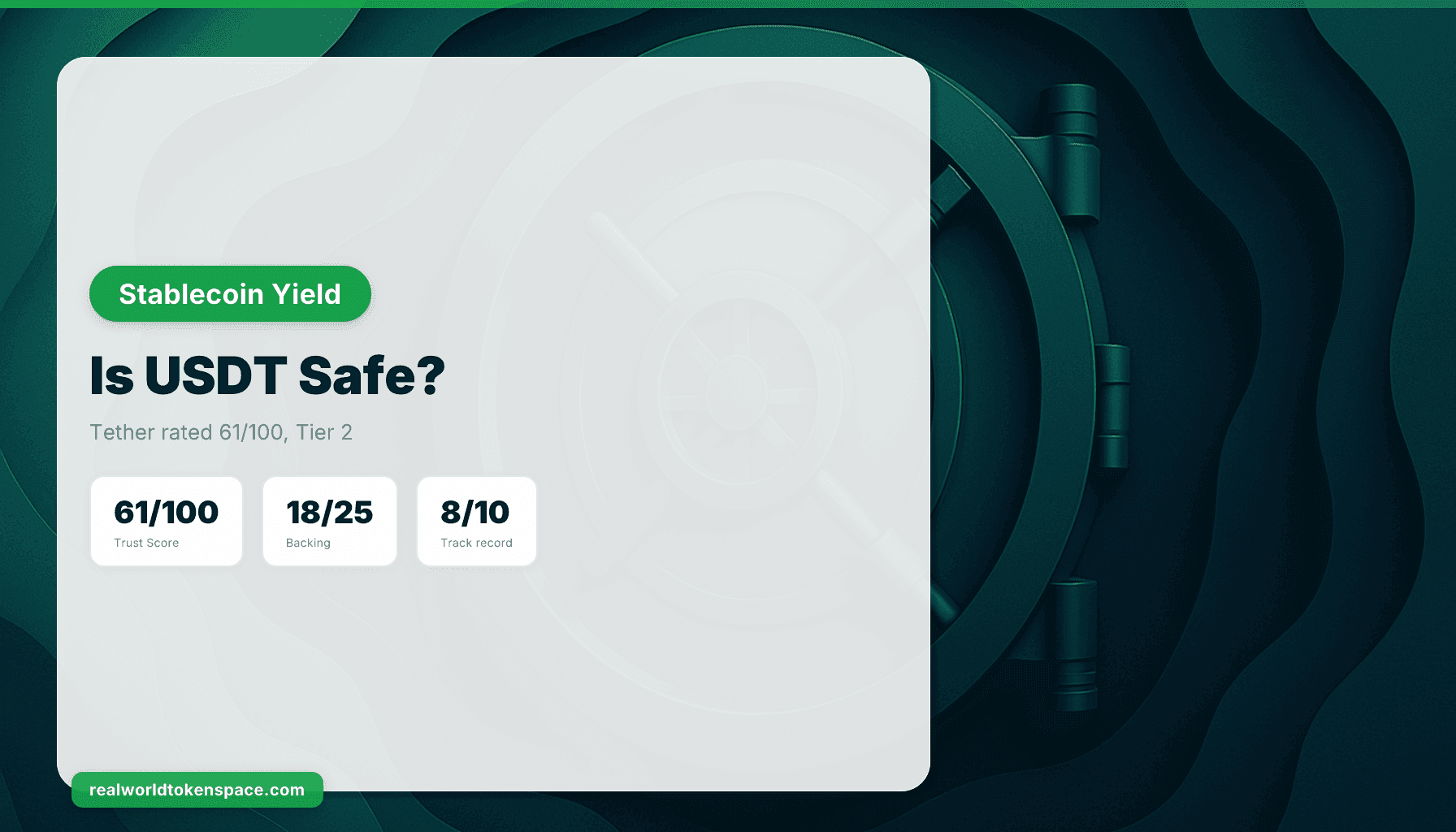
Is USDT safe? RWTS rates Tether 61/100 (Tier 2). We break down backing, verification, redemption, and reserve-attestation history across six dimensions.
Verdict: So, is USDT safe? RWTS rates Tether (USDT)61/100 (Tier 2): a broadly usable dollar token backed by a large, Treasury-heavy reserve with a long survival record, but held back by attestation-only verification rather than full audits. It is one of the deepest-liquidity assets in the stablecoin yield category, yet it does not top our transparency dimensions. Use it with eyes open on how the backing is proven. We rate. You decide.
The Trust Score, dimension by dimension
RWTS scores every dollar token across six weighted dimensions: backing, verification, redemption, audit, regulation, and track record. Here is exactly where USDT earns and loses points.
USDT's 61/100 is the sum of six weighted dimensions. Source: RWTS Trust Score methodology.
Dimension
USDT
Max
Asset backing quality
18
25
Reserve verification
11
20
Redeemability
10
15
Audit and security
8
15
Regulatory standing
6
15
Track record
8
10
Total
61
100 · Tier 2
The shape of the score is the story. USDT is strong where scale and history matter (backing at 18/25 and track record at 8/10), and softer where independent proof matters (verification at 11/25 and audit at 8/25). That gap is the single most important thing to understand before holding size in it.
Free guide
Reading this far? Get the Top 10 in your inbox.
One weekly email with the updated Trust Score leaderboard, the biggest moves, and a deeper dive on one asset. Independent ratings only — no sponsored content.
One email a week. Unsubscribe anytime. We never sell your email.
What USDT actually is
USDT is a fiat-referenced stablecoin issued by Tether, designed to hold a one-to-one value with the US dollar. It is the largest stablecoin by circulating supply and the most widely quoted trading pair across centralized and decentralized venues. Its ubiquity is a feature: deep order books, near-universal exchange support, and low slippage in and out of positions. That utility is a real part of why it survives stress events that thinner tokens do not.
How the backing works
Tether states that each USDT is backed by reserves at least equal to circulating supply. In recent reporting, those reserves are dominated by short-dated US Treasury bills and cash-equivalent instruments, with smaller allocations to other assets. High-quality, liquid collateral is why backing scores 18/25 rather than something lower. The mix is far more conservative than it was in Tether's earlier years, which is a meaningful improvement for holders.
The nuance: a strong asset mix and proving that mix are two different things. That distinction is where the next dimensions come in.
Attestation history and why verification lags
Tether publishes quarterly attestation reports prepared by an accounting firm. An attestation confirms reserve balances as of a specific date. It is not a full financial audit that examines internal controls and statements across a period. This is the core reason USDT lands at verification 11/25 and audit 8/25: the reserves may be real and sufficient, but the independent proof is lighter and less frequent than what our top-scoring tokens provide.
For an evergreen holder, the practical takeaway is that you are trusting periodic snapshots plus Tether's own real-time disclosures, not continuous third-party verification. That is not disqualifying, but it caps how high the Trust Score can go.
Redemption: who can actually redeem
Redemption scores 10/25. Direct redemption of USDT for dollars at par is available primarily to verified institutional accounts that meet Tether's onboarding requirements. Most retail holders never redeem directly; they exit through the secondary market on exchanges. Deep liquidity usually makes that painless, but it means the peg for ordinary users rests on market depth rather than a guaranteed personal redemption right. Understanding that path matters more than the headline "one-to-one" claim.
Is USDT safer than USDC?
It depends which dimension you weigh most. USDT's advantages are scale, liquidity, and a battle-tested track record (8/10). Where it trails is on the transparency dimensions, and that is precisely where audit-forward competitors position themselves. If your priority is the strongest independent verification and regulatory clarity, read our USDC breakdown and compare the two side by side. If your priority is the deepest liquidity across the most venues, USDT is hard to beat. Neither answer is universal; it maps to what you value.
The risks worth naming
Verification gap: attestations, not full audits, cap confidence in the backing.
Redemption asymmetry: direct par redemption is an institutional privilege, not a retail one.
Regulation: the regulation dimension scores 6/25, reflecting a more complex jurisdictional profile than fully domestic, licensed issuers.
Peg stress: like any stablecoin, USDT can trade slightly off peg during liquidity shocks. Its record of recovery supports the track-record score but does not guarantee future behavior.
For how yield-bearing dollar tokens fit into a wider allocation, see our best stablecoin yield guide. For methodology on how every dimension is weighted, see our full scoring methodology.
Final verdict on USDT
USDT at 61/100 (Tier 2) is a solid, high-utility dollar token: conservative Treasury-heavy backing, unmatched liquidity, and a survival record that few peers can claim. The ceiling on its score is verification quality, not the reserves themselves. Treat attestation-only proof and institutional-first redemption as known trade-offs, size accordingly, and you are working with a clear-eyed view of the largest stablecoin in the market.
Get the always-updated leaderboard delivered to your inbox. Independent ratings across gold, treasuries, stablecoin yield, and DeFi vaults — methodology + data, no hype.
One email a week. Unsubscribe anytime. We never sell your email.
Frequently asked questions
Is USDT safe?
RWTS rates USDT 61/100 (Tier 2). That is a mid-upper score: strong scale, liquidity, and a long track record, held back by weaker independent audit coverage relative to reserve size. It is broadly usable but not our top-scoring dollar token on verification quality.
Is Tether fully backed?
Tether publishes quarterly attestations showing reserves that meet or exceed circulating USDT, weighted heavily toward US Treasury bills. Attestations are not the same as a full financial audit, which is the main reason USDT scores 8/25 on the audit dimension rather than higher.
What is the difference between attestation and an audit for USDT?
An attestation is a point-in-time report where an accounting firm confirms reserve figures on a specific date. A full audit examines controls and financial statements over a period. USDT relies on attestations, so verification (11/25) and audit (8/25) score lower than backing itself (18/25).
Is USDT safer than USDC?
They score differently on different dimensions. Compare both live at their directory pages: USDT sits at 61/100 (Tier 2) on scale and track record, while USDC's rating is driven more by audit transparency. Read our USDC breakdown for the direct comparison.
Can USDT lose its peg?
Any stablecoin can trade off peg during stress. USDT has recovered from past dips, which supports its 8/10 track-record score. Redemption (10/25) reflects that direct redemption is available primarily to verified institutional accounts, not every retail holder.
Tags
#stablecoin#USDT#Tether#reserves#trust score
Disclaimer: This article is for informational purposes only and does not constitute financial advice. Always do your own research before making investment decisions.
Stay Ahead of the Yield Curve
Subscribe to The Yield Report for weekly yield intelligence.