Is sUSDe Safe? Ethena's Synthetic Dollar, Rated 61/100
Is sUSDe safe? RWTS rates Ethena's synthetic dollar 61/100 (Tier 4). The full six-dimension Trust Score breakdown, how the yield works, and the real risks.
Verdict: sUSDe, the staked synthetic dollar from Ethena, scores 61 out of 100 on the RWTS Trust Score, which puts it in Tier 4, the lowest band among the major yield-bearing dollars we cover. That does not mean broken. sUSDe is large, transparent, and its peg has survived a live nine-figure liquidation event. It means the backing is a market position rather than a hard claim, so it deserves more scrutiny than a Treasury-backed product. RWTS is not bullish or bearish on Ethena. We are the independent rating layer for tokenized real-world assets. We rate. You decide.
The Trust Score, dimension by dimension
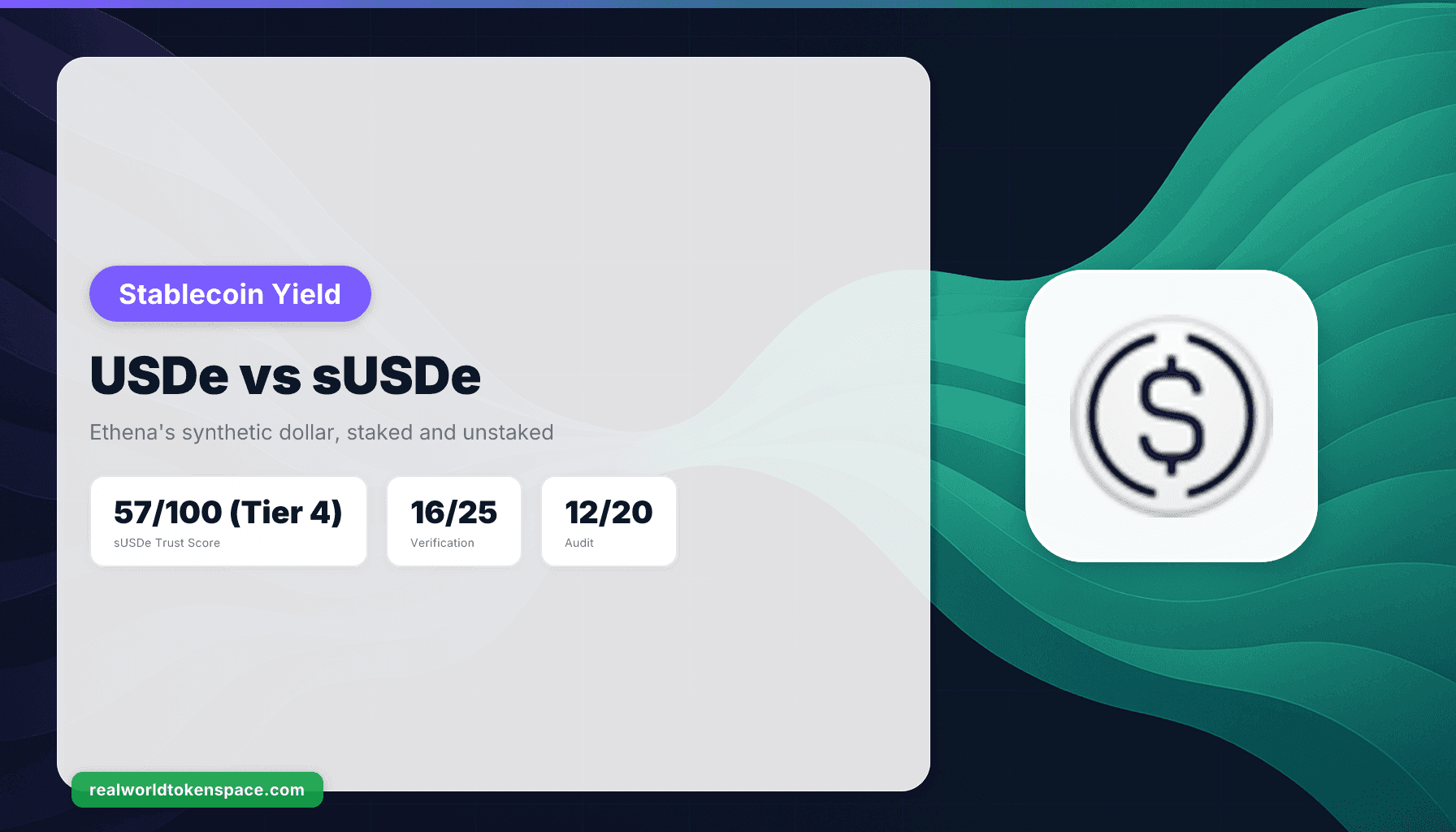
Our methodology scores every asset across six weighted dimensions that sum to 100. Here is exactly where sUSDe's 57 comes from, and why.
sUSDe's 61/100 is the sum of six weighted dimensions. Source: RWTS Trust Score methodology.
Dimension
sUSDe
Max
Asset backing quality
6
25
Reserve verification
16
20
Redeemability
9
15
Audit and security
12
15
Regulatory standing
7
15
Track record
7
10
Total
61
100 · Tier 4
The single number that defines sUSDe is the 6 out of 25 on backing. Every other dimension scores respectably. Reserve verification (16 of 20) is strong: Ethena publishes a live transparency dashboard and third-party attestations of collateral and hedges. Audit and security (12 of 15) reflects mature contracts and multiple audits, offset by the operational surface area the strategy adds. The product is well-run and well-disclosed. What the framework will not do is pretend a funding-rate basis trade is the same as cash in a vault.
Free guide
Reading this far? Get the Top 10 in your inbox.
One weekly email with the updated Trust Score leaderboard, the biggest moves, and a deeper dive on one asset. Independent ratings only — no sponsored content.
One email a week. Unsubscribe anytime. We never sell your email.
What sUSDe actually is
sUSDe is the staked form of USDe, Ethena's synthetic dollar. Three tokens get confused, so to be precise: USDe is the synthetic dollar and pays no yield on its own; sUSDe is what you get when you stake USDe, and it accrues the yield; ENA is the separate governance token and is not a dollar at all. If you hold USDe and never stake, you earn nothing. The reward sits with sUSDe.
USDe's peg is not held by reserves. There is no Treasury-bill float behind it the way there is behind USDC, and no over-collateralized vault the way there is behind DAI or USDS. Instead Ethena runs a delta-neutral basis trade: long spot staked-ETH and BTC collateral, short an equal notional of perpetual futures. The hedge cancels price exposure, and the peg holds structurally through arbitrage. That is exactly why the backing dimension scores 6 out of 25.
Where the yield comes from, and where it goes
The yield has two components. First, the staked-ETH portion of collateral earns consensus and execution rewards, roughly low-single-digit on the LST share. Second, and usually larger, the short perpetual leg captures funding paid by leveraged longs on venues such as Binance, Bybit, OKX, and Deribit. When perp markets are in contango, the normal regime in a bull market, longs pay shorts and that flow is the visible part of sUSDe's APY.
The flip side is the risk. APY is highest when funding is highest, which lines up with bullish, crowded long positioning. It is lowest, and can briefly turn negative, when sentiment reverses and longs unwind. Across 2024 and 2025 realized APY ranged roughly from 4% to 30%, with most periods between 8% and 18%. Into 2026 it has compressed to the low-to-mid single digits as funding markets cooled; the on-chain supplied rate has recently sat near 3.7%. If funding stays in contango above zero the thesis holds. Below zero for an extended stretch, the protocol pays rather than receives, and the reserve fund becomes the load-bearing buffer.
Is Ethena (the protocol) safe?
The protocol is large, transparent, and battle-tested, but its safety rests on two cushions worth watching.
The first is the reserve fund, the buffer between negative funding and yield-zero. It has grown over time and has generally held around 1% of USDe supply. A sustained drop below roughly 0.7% would warrant attention. The leading indicator any allocator can watch without insider data is the 7-day moving average of perpetual funding on the major venues: when it turns negative for more than three consecutive days, the protocol starts paying funding rather than receiving it. The August 2024 inversion showed up in funding data days before sUSDe's APY visibly compressed.
The second is the peg itself, which has been tested live. USDe briefly dipped to about $0.97 during the roughly $19B liquidation event on October 11, 2025, then recovered within hours. A three-cent dip that mean-reverts intraday cuts both ways: the structure absorbed a genuine tail event, but it did move. Treat the peg as resilient, not fixed.
sUSDe versus the alternatives
Our stablecoin yield hub maps the full risk ladder. Two comparisons frame the decision:
sUSDS, Sky's savings dollar, scores higher at 72/100 (Tier 3). Its yield comes from a governance-set savings rate and treasury allocations, a more conservative engine than funding-rate capture.
USDY, Ondo's yield-bearing dollar, scores 81/100 (Tier 2) and is backed by short-duration Treasuries. It pays less in a bull market but carries none of the basis-trade machinery.
The pattern matches our deeper head-to-head, sUSDe vs sUSDS: higher headline APY at the bottom of the tier table, conservative-but-lower yield further up.
So, is sUSDe safe?
There is no single yes or no. sUSDe is a transparent, large, battle-tested synthetic dollar from Ethena whose peg has survived a nine-figure liquidation cascade. It is also a basis trade dressed as a dollar, with yield that breathes with market sentiment, real exchange counterparty exposure, and a Trust Score of 57/100 (Tier 4) that reflects all of it. If funding stays positive and the reserve ratio holds above roughly 0.7%, the thesis is intact. If funding inverts for weeks, the variables that matter are the reserve buffer and the collateral rotation. Size it as a yield position with risk, not as a savings account.
Get the always-updated leaderboard delivered to your inbox. Independent ratings across gold, treasuries, stablecoin yield, and DeFi vaults — methodology + data, no hype.
One email a week. Unsubscribe anytime. We never sell your email.
Frequently asked questions
Is sUSDe safe?
sUSDe from Ethena carries an RWTS Trust Score of 61/100 (Tier 4), the lowest band among the major yield-bearing dollars we rate. The score is dragged down by backing quality (6 out of 25): the peg is held by a delta-neutral market position rather than cash or Treasuries. The peg survived the October 2025 liquidation cascade, but yield depends on perpetual funding rates and the product carries exchange, custody, and basis-trade risk. It is not a bank deposit.
Is Ethena safe?
Ethena, the protocol behind USDe and sUSDe, is large, transparent, and audited, and its synthetic dollar has held its peg through live stress including the October 2025 event. The structural risk is the model itself: returns come from a funding-rate basis trade run across centralized exchanges, so the protocol carries counterparty and market-regime risk that a Treasury-backed issuer does not. RWTS rates the sUSDe token 61/100 (Tier 4) to reflect that.
What is the difference between USDe and sUSDe?
USDe is Ethena's synthetic dollar and pays no yield on its own. sUSDe is the staked version: stake USDe and you receive sUSDe, which accrues the protocol's funding-rate and staking yield. If you hold USDe without staking, you earn nothing. ENA is the separate Ethena governance token and is not a dollar.
How does sUSDe generate yield?
Ethena runs a delta-neutral basis trade: it holds spot crypto collateral such as staked ETH and BTC and shorts an equal notional of perpetual futures. Yield comes from the funding payments leveraged longs pay shorts, plus staking rewards on the spot leg. When perp markets are in contango, sUSDe earns; when funding inverts, yield falls toward zero.
Is sUSDe better than USDC?
They are different instruments. USDC is a fiat-reserve stablecoin backed by cash and short Treasuries and pays no native yield; sUSDe is a yield-bearing synthetic dollar from Ethena with no fiat reserves. sUSDe can pay materially more, but RWTS scores it 61/100 (Tier 4) against USDC's far higher backing quality. Choose USDC for capital safety, sUSDe only if you are paid enough to accept basis-trade risk.
How does sUSDe compare to sUSDS for yield?
sUSDS (Trust Score 71, Tier 3) draws yield from Sky's savings rate and treasury allocations, a more conservative source than Ethena's funding-rate trade. sUSDe can pay more in bull markets but carries higher structural risk and a lower Trust Score.
Tags
#sUSDe#Ethena#USDe#stablecoin yield#delta-neutral
Disclaimer: This article is for informational purposes only and does not constitute financial advice. Always do your own research before making investment decisions.
Stay Ahead of the Yield Curve
Subscribe to The Yield Report for weekly yield intelligence.