USDe vs sUSDe: The Difference in Ethena's Synthetic Dollar Stack
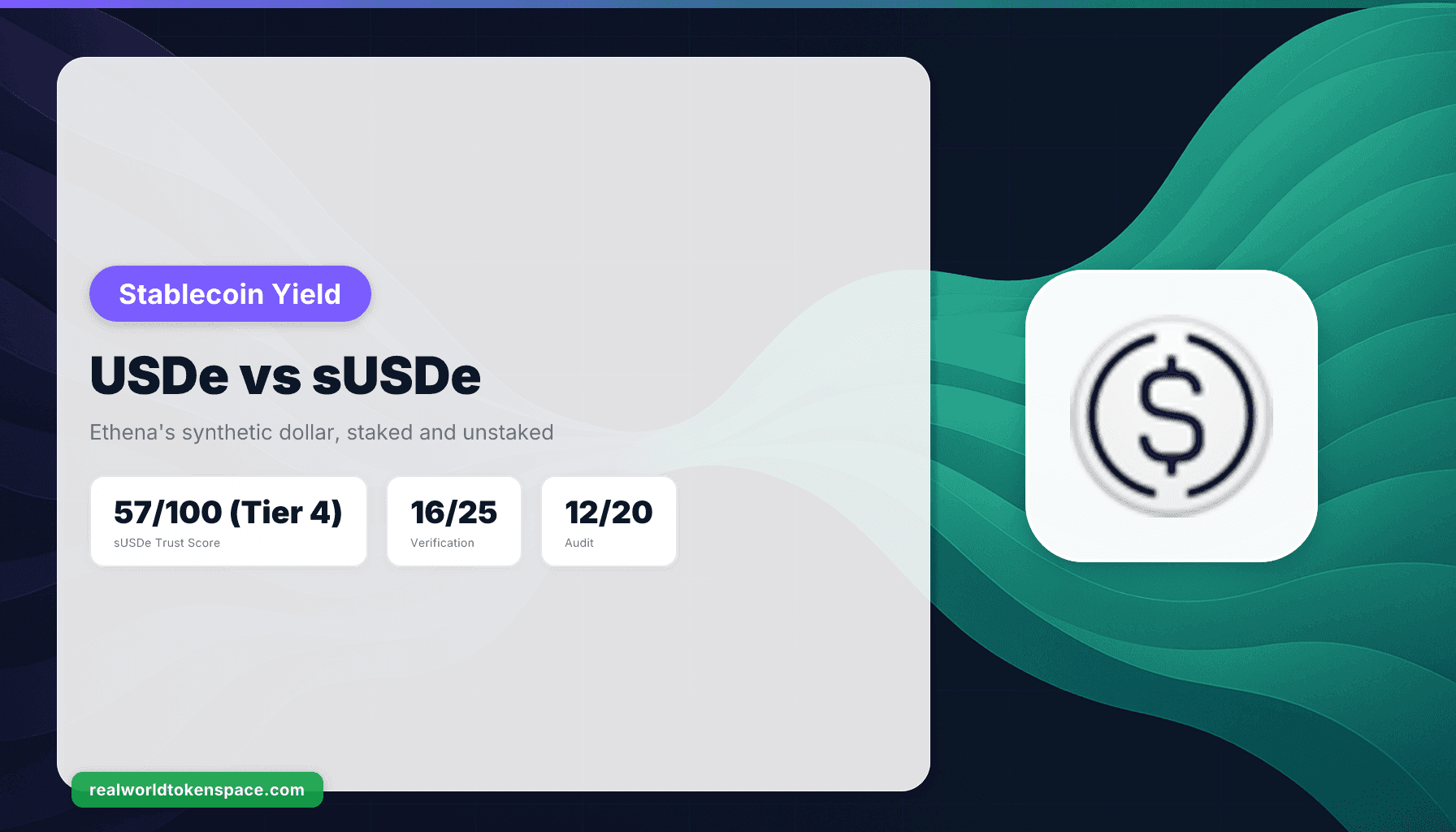
USDe vs sUSDe explained: USDe is Ethena's synthetic dollar with no yield, sUSDe is the staked version that earns. RWTS rates sUSDe 61/100 (Tier 4). We rate. You decide.
Verdict: USDe vs sUSDe is the same dollar in two states, and only one of them pays you. USDe is Ethena's synthetic dollar and earns nothing on its own. sUSDe is the staked version that accrues yield, and RWTS rates sUSDe at 61/100 (Tier 4). If you want the yield and can accept the mechanism risk, sUSDe is the token you actually want to hold. If you only need a transactional dollar, USDe is fine and simpler. We rate. You decide.
The confusion is understandable. Both tokens track roughly one dollar, both come from the same protocol, and the tickers differ by a single letter. But the difference is not cosmetic. It changes whether your balance grows, what risks you take on, and where the token fits in your portfolio. This guide sits inside our stablecoin yield hub and answers the split cleanly.
The Trust Score, dimension by dimension
RWTS scores the staked token, sUSDe, because that is the yield-bearing instrument most people evaluate. The chart and table below show exactly where the 61/100 (Tier 4) comes from across our six dimensions.
Free guide
Reading this far? Get the Top 10 in your inbox.
One weekly email with the updated Trust Score leaderboard, the biggest moves, and a deeper dive on one asset. Independent ratings only — no sponsored content.
One email a week. Unsubscribe anytime. We never sell your email.
sUSDe's 61/100 is the sum of six weighted dimensions. Source: RWTS Trust Score methodology.
Dimension
sUSDe
Max
Asset backing quality
6
25
Reserve verification
16
20
Redeemability
9
15
Audit and security
12
15
Regulatory standing
7
15
Track record
7
10
Total
61
100 · Tier 4
The pattern is telling. Verification (16/25) and audit (12/20) carry the score, because Ethena publishes reserve and position attestations and the contracts have been reviewed. Backing (6) is where the design loses the most points: sUSDe is not backed by cash and Treasuries in a bank. It is backed by a delta-neutral position (spot crypto held long, offset by short perpetual futures) plus staked assets. That is a live, market-dependent structure, and our methodology treats it as riskier than fiat-reserved backing. Read the full weighting logic on our methodology page.
What USDe actually is
USDe is a synthetic dollar. Rather than holding dollars in a bank, Ethena creates USDe by taking a hedged crypto position that is designed to be worth about one dollar regardless of which way the market moves. When you hold plain USDe, you hold that dollar exposure and nothing else. There is no interest, no rebasing, no accrual. Your balance stays the same number of tokens and each token stays near a dollar.
USDe exists so the protocol has a base unit that can move freely: used in payments, held as collateral, or paired in liquidity pools. It is deliberately yield-free so it behaves like a clean settlement dollar.
What sUSDe actually is
sUSDe is staked USDe. You deposit USDe into Ethena's staking contract and receive sUSDe in return. From that moment, the value of your sUSDe grows relative to USDe. The yield comes from two sources: the funding payments earned on the short perpetual futures side of the hedge, and the staking rewards on the underlying assets.
The important mechanical detail: sUSDe does not increase in token count. Instead its redemption rate rises. One sUSDe redeems for a growing amount of USDe over time. This is the ERC-4626 vault pattern, the same accrual style used by many yield tokens. When you unstake, you convert sUSDe back to USDe, often after a cooldown window before the funds are withdrawable.
USDe vs sUSDe: which should I hold?
This is the question most people are really asking, so here is the direct answer.
Hold sUSDe if:
You want the yield and intend to hold for more than a few days.
You accept that returns depend on derivatives funding rates, which can compress or turn negative.
You are comfortable with a Tier 4 mechanism-risk profile.
Hold USDe if:
You need an unstaked, freely transferable dollar for spending or as collateral where staking friction is a problem.
You want to avoid the unstaking cooldown when exiting quickly.
You do not want yield exposure at all and prefer the simplest dollar unit.
For most yield seekers, sUSDe is the token that matters, because raw USDe simply does not compensate you for the risk you are already carrying by using a synthetic dollar. If you are going to take Ethena's counterparty and funding risk, you should at least be paid for it, which means staking into sUSDe.
Where the yield comes from, and why it can fall
sUSDe yield is not a fixed rate. It floats with the perpetual futures funding market. When traders are net long and pay to hold that position, Ethena's short side collects funding and sUSDe yield rises. When the market flips and funding goes negative, the short side pays out, and yield can drop sharply or briefly turn negative before protocol reserves absorb it.
This is the core reason sUSDe scores 61/100 (Tier 4) rather than higher. The mechanism is transparent and well attested, but it is market-dependent in a way that fiat-reserved stablecoins are not. For a deeper look at the safety profile specifically, see our companion analysis: Is sUSDe Safe? Ethena's Synthetic Dollar, Rated 61/100.
The short version: sUSDe typically offers a higher headline yield because it carries higher mechanism risk. Treasury-backed alternatives offer lower, steadier yield with simpler backing. That trade-off is exactly what the Trust Score is designed to make visible.
Closing verdict
USDe vs sUSDe comes down to one line: USDe is the dollar, sUSDe is the dollar that pays. They share the same underlying synthetic-dollar exposure and the same 61/100 (Tier 4) mechanism risk that RWTS assigns to the staked token. If you are holding for yield, sUSDe is the correct choice. If you only need a clean transactional dollar and want to skip the unstaking cooldown, USDe does the job. Neither is a fiat-reserved stablecoin, so size your position with that in mind.
Get the always-updated leaderboard delivered to your inbox. Independent ratings across gold, treasuries, stablecoin yield, and DeFi vaults — methodology + data, no hype.
One email a week. Unsubscribe anytime. We never sell your email.
Frequently asked questions
What is the difference between USDe and sUSDe?
sUSDe carries an RWTS Trust Score of 61/100 (Tier 4). USDe is Ethena's synthetic dollar and pays no yield by itself. sUSDe is the staked version of USDe: you deposit USDe, receive sUSDe, and it accrues yield from Ethena's funding-rate and staking strategies. Same underlying dollar exposure, but only sUSDe earns.
Does USDe earn yield?
No. Holding raw USDe earns nothing. To earn, you stake USDe to receive sUSDe. The yield accrues to sUSDe holders through an increasing exchange rate back to USDe.
Is sUSDe the same as staked USDe?
Yes. sUSDe is the ERC-4626 staked receipt token for USDe. One sUSDe redeems for a growing amount of USDe over time as yield accrues.
Can I lose money holding sUSDe?
Yes. sUSDe carries market and mechanism risk. Ethena's yield comes from derivatives funding rates, which can turn negative, and the delta-neutral hedge depends on exchange and custody counterparties. RWTS rates the design 61/100 (Tier 4), reflecting real but manageable risk.
Should I hold USDe or sUSDe?
Hold sUSDe if you want the yield and can accept the mechanism risk. Hold USDe only if you need the unstaked token for spending, collateral, or short-term liquidity where staking friction matters.
How do I convert USDe to sUSDe?
You stake USDe in Ethena's staking contract and receive sUSDe. To exit you unstake sUSDe back to USDe, which may involve a cooldown period before the USDe is withdrawable.
Disclaimer: This article is for informational purposes only and does not constitute financial advice. Always do your own research before making investment decisions.
Stay Ahead of the Yield Curve
Subscribe to The Yield Report for weekly yield intelligence.