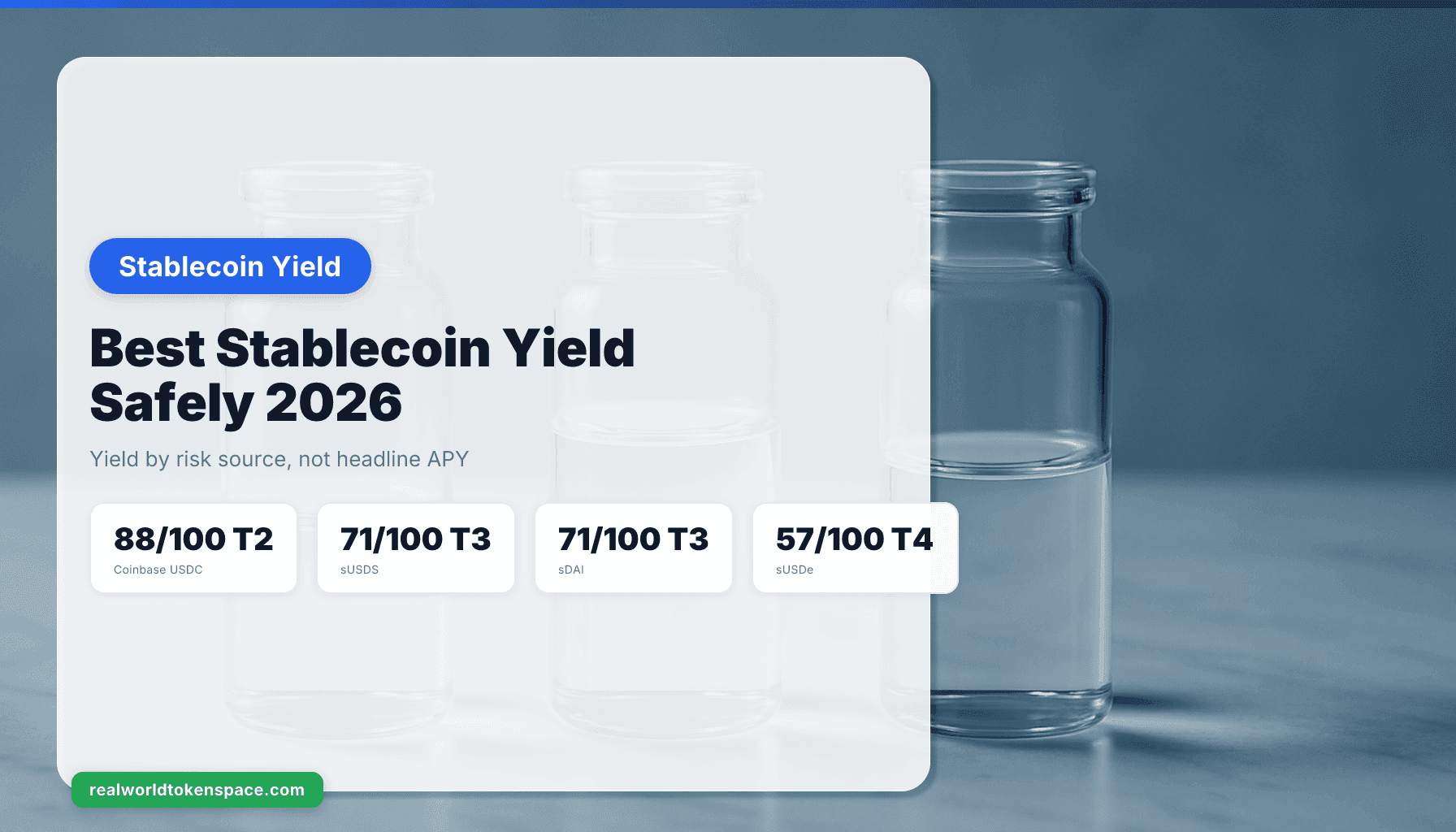
Verdict: the best stablecoin yield in 2026 is not the biggest number on the screen. It is the highest yield per unit of risk you can actually describe. By RWTS Trust Score, the conservative core is the Treasury-backed wrapper USDY at T2 (81/100) and the governance-set savings wrapper USDS at T3 (72/100). The high-yield outlier, sUSDe, rates T4 (61/100), not because it is a scam, but because its yield rests on a risk factor that can invert. We rate. You decide. Not financial advice.
What is the best stablecoin yield safely in 2026?
Start with where the yield comes from, because that determines the risk. USDC by itself pays nothing. Circle does not pass through the T-bill interest its reserves earn; that revenue stays at Circle. To earn stablecoin yield you have to lend, supply to a vault, swap for a yield-bearing wrapper, or hold on a custodian that rebates a piece of its own treasury yield. The reason is regulatory. US stablecoin rules bar licensed issuers from paying yield directly to holders of a payment stablecoin, so the yield did not vanish. It moved one layer out, into wrapper tokens and savings modules built on top of the base coin. That is why you earn on the wrapped versions, not USDC or USDS themselves.
That gives three distinct risk profiles, and the wrappers split cleanly along them. Treasury wrappers like USDY pass through short-dated government yield minus a fee, the lowest-volatility option, at the cost of KYC and trust in a centralised issuer. Savings wrappers like USDS pay a governance-set rate funded by the protocol's collateral, smoother, but adjustable by vote. Basis-trade wrappers like sUSDe pay whatever perpetual funding yields, historically higher but volatile, and capable of briefly turning negative.
Free guide
Reading this far? Get the Top 10 in your inbox.
One weekly email with the updated Trust Score leaderboard, the biggest moves, and a deeper dive on one asset. Independent ratings only — no sponsored content.
One email a week. Unsubscribe anytime. We never sell your email.
sUSDe dimension by dimension
sUSDe's 61/100 is the sum of six weighted dimensions. Source: RWTS Trust Score methodology.
Dimension
sUSDe
Max
Asset backing quality
6
25
Reserve verification
16
20
Redeemability
9
15
Audit and security
12
15
Regulatory standing
7
15
Track record
7
10
Total
61
100 · Tier 4
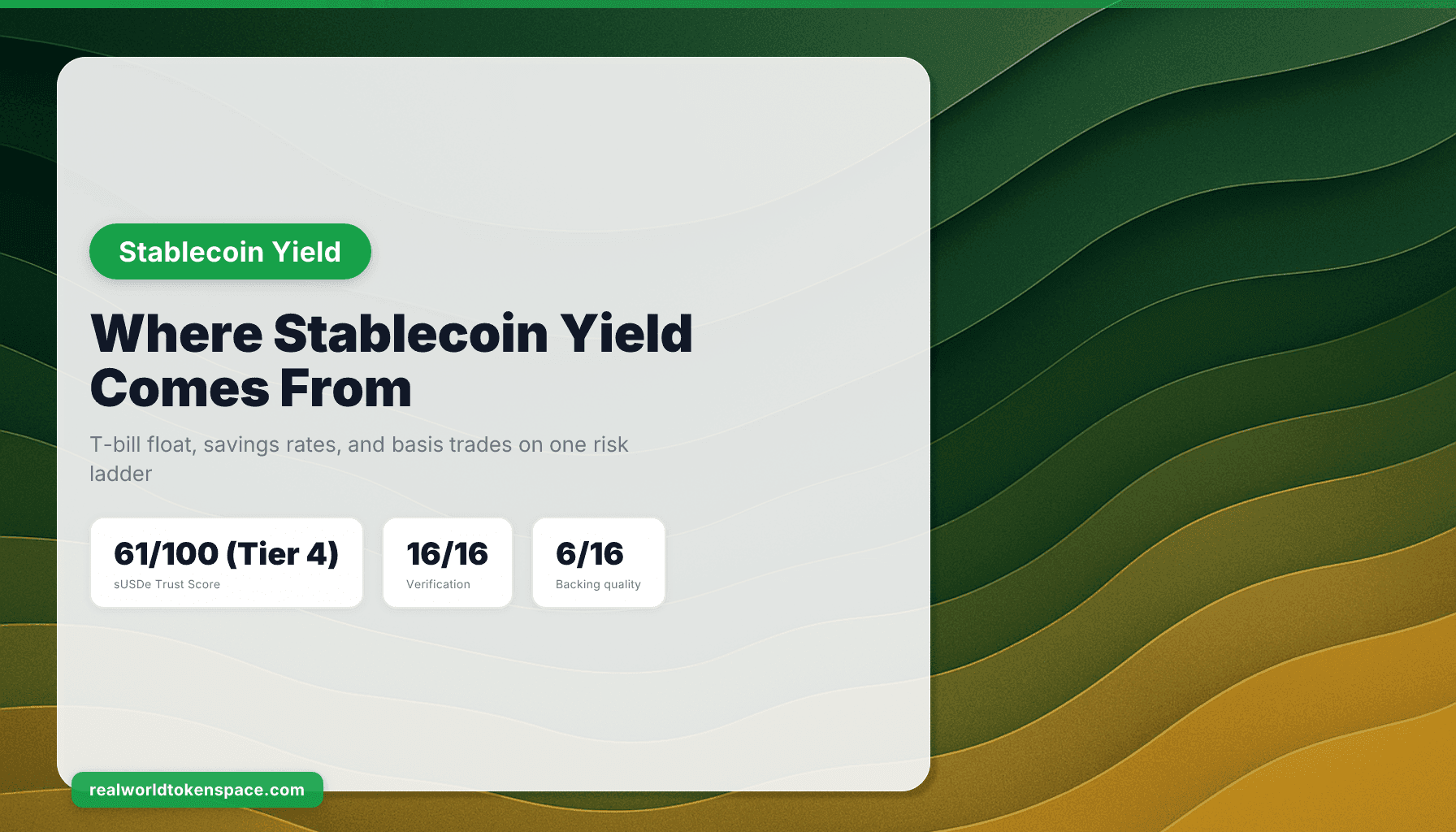
The chart above breaks sUSDe's T4 (61/100) into its six RWTS dimensions, and the shape tells the whole story. Backing scores just 6, the lowest in this comparison, because the collateral behind sUSDe is a delta-neutral basis trade rather than cash T-bills. Verification lands at a strong 16, redemption at 9, audit at 12, regulatory at 7, and track record at 7. The verification strength is real, but it cannot compensate for a yield source that depends on perpetual funding staying positive.
Compare that to USDS at T3 (72/100), whose backing dimension scores 14 thanks to a diversified collateral pool spanning tokenised US Treasuries and protocol-owned liquidity. And USDY reaches T2 (81/100) on the back of a 22 backing score, the highest here, because its reserves are auditable short-dated Treasuries. The full scoring rubric is documented at the RWTS methodology page.
The Trust Score read, from safest to spiciest
USDY, T2 (81/100). A tokenised note backed by short-dated US Treasuries and bank deposits. The yield source is the most transparent in the set: government interest passed through minus a fee. The residual risks are issuer counterparty exposure and the KYC gating required to mint and redeem. Its backing dimension score of 22 is the strongest reason it sits at the top of this list.
USDS, T3 (72/100). Sky's savings wrapper. The rate is conservative by design and set by governance vote. Backing is diversified across tokenised US Treasuries, crypto vaults, and protocol-owned liquidity, allocated by independent managers who compete to deploy reserves. The residual risks are the standard DeFi ones: smart-contract exposure across the vaults, governance concentration, and real-world-asset counterparty risk. See our full sUSDe vs sUSDS comparison for the mechanism.
sUSDe, T4 (61/100). The high-yield option, and the one demanding the most discipline. sUSDe is funding-rate dependent: in a sustained bear market with negative perp funding, sUSDe yield can fall below zero before Ethena's insurance fund absorbs the gap. The right mental model is explicit: treat sUSDe as a structured product, not a stablecoin. It pays a premium yield specifically because perpetual funding is a real risk factor that can turn negative for weeks at a time during flat or bearish markets.
How to build the book
Position sizing is where "safely" is actually won or lost. Most allocators cap sUSDe at 10 to 25 percent of their stablecoin book and hold passive wrappers or blue-chip lending for the rest. Farmers who went all-in on basis-trade stablecoins in previous cycles learned the hard way that "stable" is a description of the peg target, not the yield. The general principle holds across the whole stack: always compare the yield to the risk. A 2 percent premium over T-bills should come with a clear explanation of what additional risk you are taking.
A defensible 2026 framework: a base layer in a T2 product such as USDY or a blue-chip lending market, a middle layer in T3 savings wrappers like USDS for governance-smoothed yield, and only a small, capped satellite in a T4 basis-trade product like sUSDe if you want the funding-rate premium and understand it can go negative. For the broader landscape and where each product anchors, see our stablecoin yield hub.
The fork is simple. If funding rates stay positive, sUSDe outpaces the wrappers and the satellite earns its keep. If funding compresses or inverts, a real possibility in a flat or bearish tape, the T3 wrappers and the T2 Treasury note carry the book while the satellite drags. The humility variables are the Fed's rate path, perpetual funding regimes, and your own tolerance for a yield that can pause.
RWTS is neither bullish nor bearish on any stablecoin or yield product. We are the independent rating layer for tokenized real-world assets. We rate. You decide. Not financial advice.
Get the always-updated leaderboard delivered to your inbox. Independent ratings across gold, treasuries, stablecoin yield, and DeFi vaults — methodology + data, no hype.
One email a week. Unsubscribe anytime. We never sell your email.
Frequently asked questions
What is the best stablecoin yield safely in 2026?
Verdict: the best stablecoin yield in 2026 is the highest return per unit of risk you can actually describe, not the biggest headline APY. By RWTS Trust Score, the Treasury-backed wrapper USDY rates T2 (81/100), the governance-set savings wrapper USDS rates T3 (72/100), and the high-yield outlier sUSDe rates T4 (61/100) because its yield depends on perpetual funding rates that can turn negative.
Is sUSDe safe compared to USDS?
sUSDe rates T4 (61/100) and USDS rates T3 (72/100) on the RWTS scale. USDS pays a governance-set savings rate funded by Sky's collateral pool, while sUSDe pays whatever perpetual funding yields, which is historically higher but can briefly turn negative. Treat sUSDe as a structured product, not a passive dollar.
Why does USDC itself pay no yield?
US stablecoin rules bar licensed issuers from paying yield directly to holders of a payment stablecoin. The yield moved one layer out, into wrapper tokens and savings modules built on top of the base coin, or into custodian rewards paid from corporate revenue.
What is the safest source of stablecoin yield?
Treasury wrappers that pass through short-dated government yield carry the lowest volatility. USDY rates T2 (81/100), the highest among the yield products here, because its yield source is auditable T-bill interest rather than market-dependent funding.
How should I size a high-yield stablecoin position?
Most allocators cap basis-trade products like sUSDe at 10 to 25 percent of their stablecoin book and hold passive wrappers or blue-chip lending for the rest. Diversifying across issuers and yield sources limits the damage from any single failure.
Tags
#USDC#sUSDe#sUSDS#USDY#Stablecoin Yield
Disclaimer: This article is for informational purposes only and does not constitute financial advice. Always do your own research before making investment decisions.
Stay Ahead of the Yield Curve
Subscribe to The Yield Report for weekly yield intelligence.