Is USDS Safe? Sky's DAI Successor Trust Score Breakdown
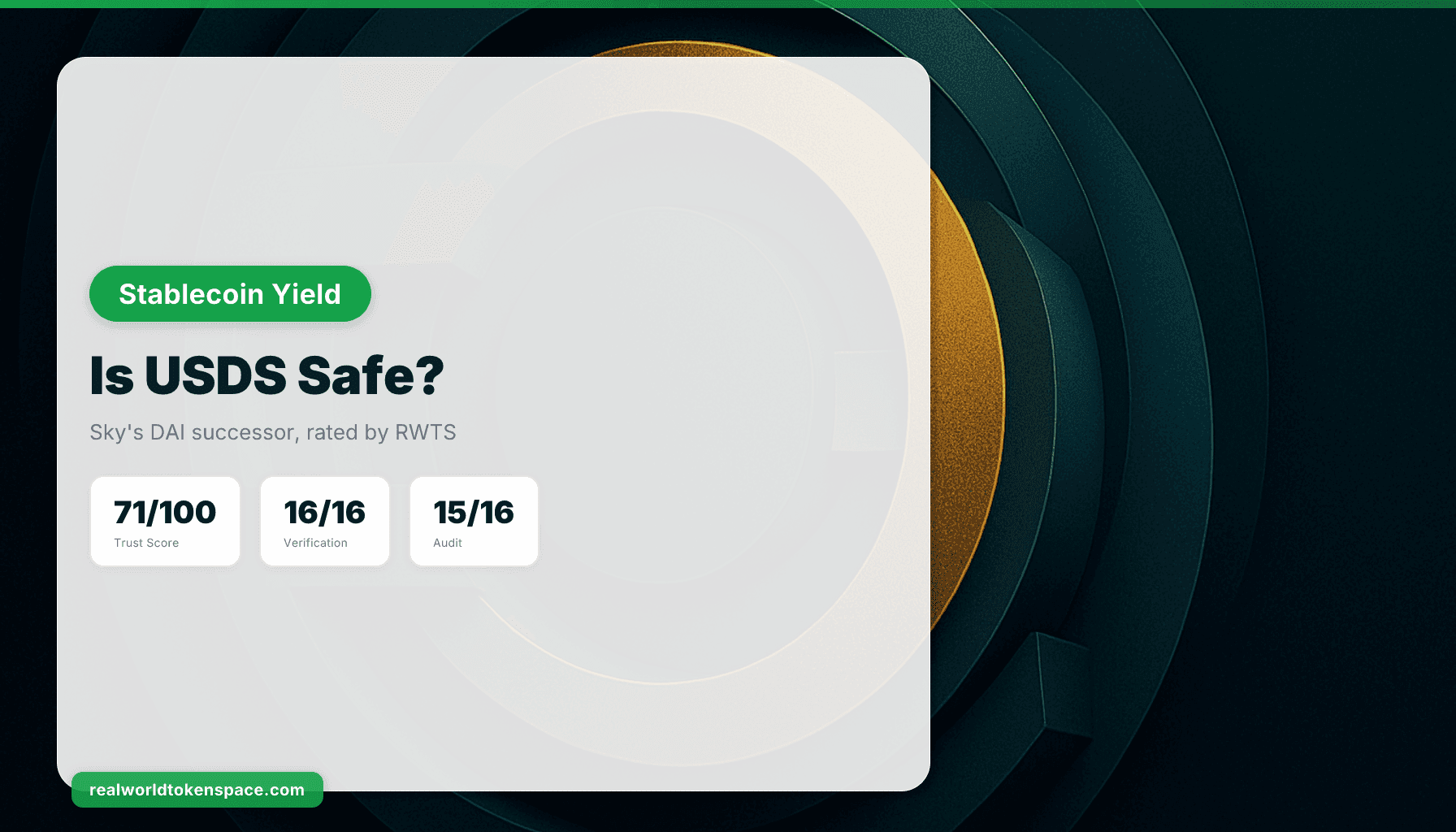
Is USDS safe? RWTS rates Sky's DAI successor USDS 71/100 (Tier 3). We break down over-collateralized backing, the DAI migration, and the savings rate yield.
Verdict: Is USDS safe? RWTS rates USDS 71/100 (Tier 3), a solid mid-upper score for an over-collateralized, on-chain stablecoin. USDS is Sky's successor to DAI, and it earns strong marks for verification and audit coverage while still carrying smart-contract, governance, and depeg risk. Its yield-bearing sibling sDAI matches it at 71/100 (Tier 3). If you searched "is USDS safe" after asking the same about DAI, treat this as a same-family upgrade with the same collateral logic, not a brand-new experiment. We rate. You decide.
The Trust Score, dimension by dimension
USDS's 71/100 is the sum of six weighted dimensions. Source: RWTS Trust Score methodology.
Dimension
USDS
Max
Asset backing quality
14
25
Reserve verification
16
20
Redeemability
12
15
Audit and security
15
15
Regulatory standing
7
15
Track record
7
10
Total
71
100 · Tier 3
USDS scores 71/100 (Tier 3). The strongest dimensions are verification (16/16) and audit (15/16), reflecting fully on-chain, publicly inspectable collateral and repeated third-party smart-contract review. Backing (14/16) is strong but not perfect because collateral includes volatile crypto assets alongside real-world reserves. Redemption (12/16) reflects that USDS is not directly redeemable for fiat at a bank window; you exit through swaps and vaults. Regulatory clarity (7) and track record (7) are the ceilings on the score, which is typical for a decentralized, governance-run stablecoin rather than a fiat-issuer product.
What is USDS and how does it relate to DAI
USDS is the rebranded, upgraded stablecoin issued by Sky, the protocol that was formerly MakerDAO. DAI is not gone: it still exists and still functions. What changed is that Sky introduced USDS as the forward-facing dollar token, with a one-to-one upgrade path from DAI and access to new features like the Sky Savings Rate and token rewards.
Free guide
Reading this far? Get the Top 10 in your inbox.
One weekly email with the updated Trust Score leaderboard, the biggest moves, and a deeper dive on one asset. Independent ratings only — no sponsored content.
One email a week. Unsubscribe anytime. We never sell your email.
Because so many people who used and trusted DAI now research USDS, the "is DAI safe" question and the "is USDS safe" question increasingly point at the same underlying machine: the same over-collateralized vault system, the same surplus buffer, the same on-chain transparency. The RWTS score reflects that continuity.
How USDS stays pegged: over-collateralization
USDS is minted against collateral worth more than the USDS issued. Borrowers lock crypto assets or exposure to real-world assets (including short-dated US Treasury strategies routed through vaults) and mint USDS against them at a conservative loan-to-value ratio. If collateral value falls, positions are liquidated to keep the system solvent. A protocol surplus buffer absorbs bad debt.
This is a different peg model from fiat-reserve coins. There is no single custodian holding one dollar per token. Instead the peg is defended by economics, liquidations, and arbitrage. That design is why verification scores so high: you can inspect the collateral on-chain at any moment. It is also why regulatory clarity scores lower: there is no bank charter or issuer balance sheet to point to.
The savings rate: how USDS and sDAI pay yield
Holders can deposit USDS into the Sky Savings Rate to earn a variable yield set by Sky governance. sDAI is a yield-bearing wrapper representing a claim on the same savings mechanism, which is why sDAI carries the identical 71/100 (Tier 3) score.
The yield is not fixed. It is a governance parameter that moves with the protocol's revenue and with broader rate conditions. When benchmark rates move, savings-rate yields on tokens like these tend to follow, a dynamic we cover in the Stablecoin Yield vs Fed Rate Hikes risk guide. Compare the yield mechanics directly with other savers on the Stablecoin Yield hub.
Is USDS or USDC safer?
They are not directly rankable by a single number because they carry different risk types. USDS (71/100, Tier 3) is decentralized and over-collateralized: its risks are smart-contract failure, collateral volatility, and governance concentration. USDC is a fiat-reserve stablecoin whose risks center on the issuer, banking partners, and reserve custody. Read the full USDC breakdown and weigh which failure modes you are more comfortable with. There is no universally "safer" ticker; there is only the risk you understand.
The real risks to weigh
Smart-contract risk: USDS lives entirely in code. A critical bug or exploit could impair the peg despite high audit coverage.
Governance concentration: Sky governance sets collateral rules, savings rates, and parameters. Concentrated voting power is a real dependency.
Collateral quality: over-collateralization protects against normal moves, but severe, fast drawdowns in crypto collateral can stress the buffer.
Depeg risk: like any stablecoin, USDS can trade below one dollar during stress before arbitrage restores it.
Regulatory ambiguity: the decentralized model scores lower on regulatory clarity, which is a live consideration.
For how these dimensions are weighted and capped, see the RWTS methodology.
Closing verdict
Is USDS safe? By the RWTS score it is a Tier 3 asset at 71/100: transparent, over-collateralized, and audited, with governance and regulatory ceilings rather than backing weakness holding the score down. It is the natural landing spot for DAI holders, and its yield-bearing form sDAI matches it exactly. Understand the collateral model and the governance dependency, then size your position to the risk you accept.
Get the always-updated leaderboard delivered to your inbox. Independent ratings across gold, treasuries, stablecoin yield, and DeFi vaults — methodology + data, no hype.
One email a week. Unsubscribe anytime. We never sell your email.
Frequently asked questions
Is USDS safe?
RWTS rates USDS 71/100 (Tier 3), a solid mid-upper score that reflects strong on-chain verification and audit coverage backed by over-collateralized reserves. It is not risk-free: smart-contract exposure, governance concentration under Sky, and depeg risk remain. We rate. You decide.
What is the difference between USDS and DAI?
USDS is the rebranded successor to DAI issued under the Sky protocol (formerly MakerDAO). It shares the same over-collateralized model and is upgradeable one-to-one from DAI. DAI continues to exist, but new savings-rate and token-reward features route through USDS.
Does USDS pay yield?
Yes. Holders can deposit USDS into the Sky Savings Rate to earn a variable yield, and sDAI represents a yield-bearing wrapper of the same savings mechanism. sDAI carries the same RWTS score of 71/100 (Tier 3).
What backs USDS?
USDS is over-collateralized. It is minted against a mix of crypto collateral and real-world assets such as short-dated US Treasuries held through vaults, with a surplus buffer designed to keep collateral value above the value of USDS in circulation.
Can I convert DAI to USDS?
Yes. Sky offers a one-to-one upgrade contract that converts DAI to USDS and back. There is no fee for the swap itself, though on-chain gas applies. Existing DAI is not forcibly migrated.
Is USDS or USDC safer?
They score in different ranges and carry different risk types. USDS (71/100, Tier 3) is over-collateralized and decentralized-governed, while USDC is a fiat-reserve stablecoin. Compare both on their RWTS dimension breakdowns rather than the ticker alone.
Tags
#stablecoin#usds#sdai#sky#makerdao#dai#yield
Disclaimer: This article is for informational purposes only and does not constitute financial advice. Always do your own research before making investment decisions.
Stay Ahead of the Yield Curve
Subscribe to The Yield Report for weekly yield intelligence.