Exchange ETH staking is the single easiest yield button in crypto: toggle a switch, earn a few percent. That convenience is real, and so is the trade-off underneath it. The question "is exchange ETH staking safe?" comes down to one word the marketing rarely uses out loud: counterparty. RWTS isn't bullish or bearish on any platform. We rate. You decide.
The three routes, and what each one actually pays
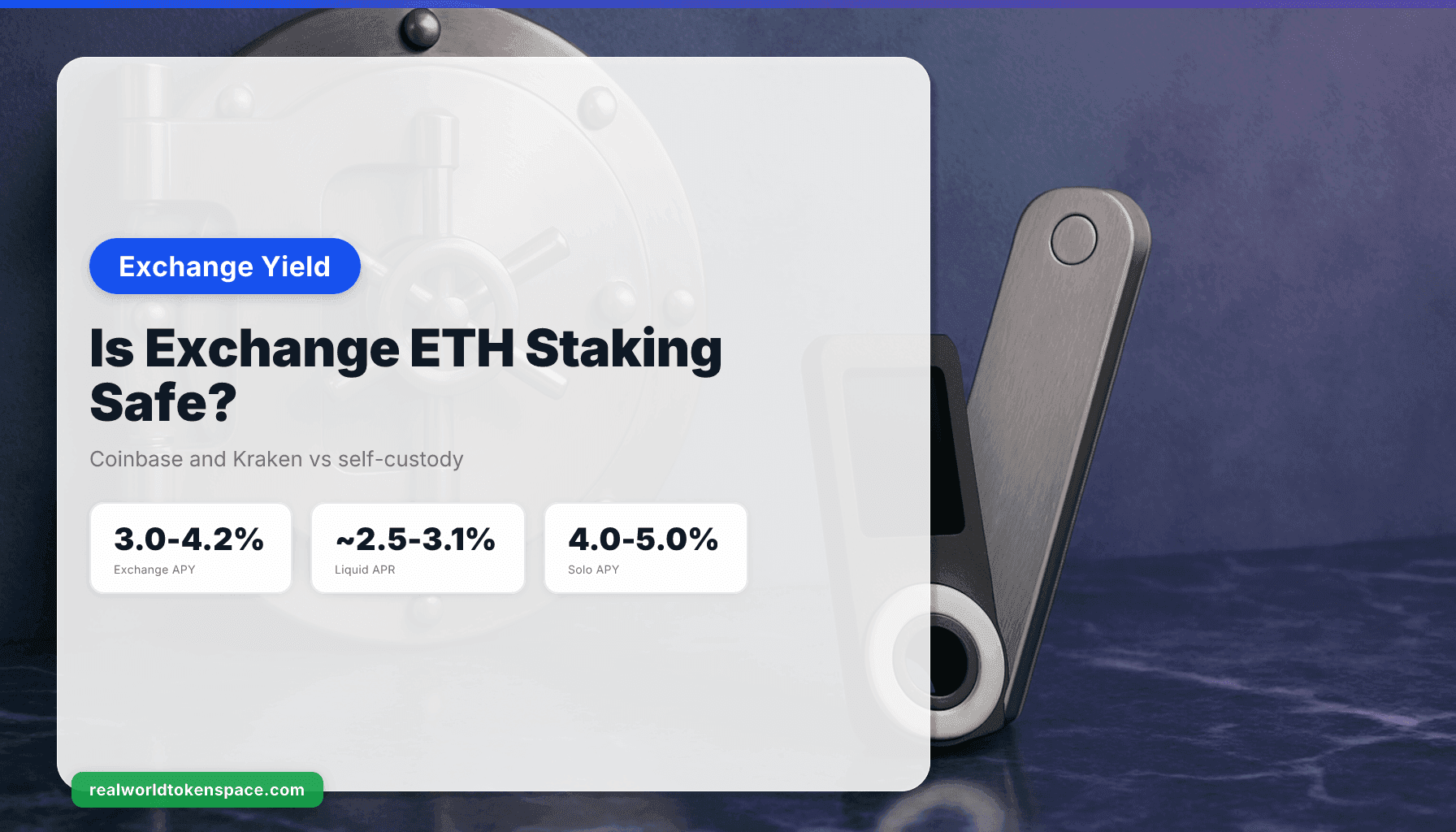
There are three practical ways to earn ETH yield, and they sit on a clean spectrum of convenience versus control. Solo staking offers 4.0% to 5.0% but requires 32 ETH and 24/7 hardware; liquid staking protocols pay 3.2% to 3.9% via a tradeable token like stETH with smart contract risk; and exchange-based staking pays 3.0% to 4.2%, where major exchanges handle all the technical work, making staking easy and accessible but with fees and insurance levels to check. On paper the exchange route looks competitive. The headline rate is not the whole story.
The convenience comes bundled with three costs the APY figure hides. The convenience comes with tradeoffs: lower yields because exchanges take larger cuts, counterparty risk because your ETH sits on the exchange, and potential regulatory issues. Each deserves a clear-eyed look.
Counterparty risk: the cost that does not show up in the APY
When you stake on an exchange, your ETH is on the exchange's books. You hold a claim, not the keys. That is the defining distinction from holding stETH or rETH in your own wallet, where the asset remains in self-custody and stays usable across the broader market.
Regulatory history reinforces the point. Kraken's staking program was shut down for US customers in 2023 before reopening under new terms. Programs can be paused, restructured, or geofenced by policy rather than by markets, a risk that self-custody simply does not carry. Staking services have faced regulatory scrutiny, and rules could change, affecting yields or access.
Some platforms now wrap an insurance layer around the validator-level risk. Major exchanges now offer "slashing insurance" so you do not bear that risk. That addresses one specific failure mode (a validator penalty) but it does not address the larger one, which is the solvency and policy of the custodian itself.
Lockups and exit risk
The other hidden cost is liquidity timing. Withdrawing staked ETH is now possible thanks to recent upgrades, but there may still be a delay of a few days or longer as the network processes exits. In calm markets the queue is short; in stressed markets it lengthens precisely when you most want out. Liquid staking tokens offer an alternative exit (selling on the open market) but, as noted across the category, that secondary price may trade below fair value during stress. There is no free liquidity; there is only where you choose to bear the friction.
It also helps to understand what you are actually exposed to. Slashing is Ethereum's strongest validator penalty: it removes the validator from active duty and burns part of its stake, though Pectra reduced the initial slashing penalty from 1 ETH to 0.0078125 ETH per 32 ETH validator. Post-Pectra, idiosyncratic slashing is a smaller tail risk than it once was, which is exactly why custodian solvency, not slashing, should sit at the top of your worry list.
Exchange staking vs liquid staking: the Trust Score lens
On the RWTS framework, the liquid staking tokens an exchange would otherwise hold on your behalf, stETH, wstETH, and rETH, sit in Tier 2 with multi-year records. The relevant comparison is governance and control. Liquid staking is attractive if you want both yield and liquidity, because your staked ETH becomes a token you can use in lending, trading, or DeFi applications. Exchange staking gives up that composability in exchange for a one-click experience and a single, regulated-ish counterparty.
For the beginner with a small balance, the exchange route is defensible. Exchange staking is best for beginners who prioritize simplicity over yield: major exchanges offer one-click staking, you keep your ETH on the exchange and toggle staking on, and withdrawals may take days or weeks depending on the platform. The cost is that you have re-introduced the exact intermediary that self-custody and DeFi were designed to remove.
We weigh custody model, withdrawal mechanics, fee drag, insurance scope, and counterparty solvency in our Trust Score methodology. For platform-by-platform yield detail, see our companion piece, Kraken vs Coinbase Staking Yield Comparison, and for the broader landscape start at the exchange yield hub.
The honest verdict
There is no universally "safe" choice, only a trade-off priced in convenience, counterparty exposure, and composability. If you value a single regulated counterparty and never plan to move the asset, exchange staking is rational. If you value self-custody and want your staked ETH to stay productive across DeFi, a Tier 2 liquid staking token fits better. And remember the risk staking never removes: if ETH price drops 50%, your staked position is down 50% regardless of yield earned, staking does not protect against market downturns.
If the exchange you choose maintains transparent proof-of-reserves and a short exit queue, the convenience case holds. If reserves go opaque or withdrawals stall during stress, the fork is whether your claim is honored on your timeline, the one thing self-custody never makes you wonder about. RWTS rates the structure. You decide which counterparty, if any, earns your keys.
Stay Ahead of the Yield Curve
Subscribe to The Yield Report for weekly yield intelligence.
Subscribe Now