Verdict: BUIDL remains the highest-rated tokenized treasury fund we cover at T2 (84/100), and BlackRock's latest disclosures confirm it is now the structural anchor of a far larger digital-asset franchise, not a side experiment. We rate. You decide.
In its FY2026 proxy materials, BlackRock disclosed nearly $150 billion in AUM connected to digital assets, described its tokenized treasury fund as the largest tokenized fund in the world, and said it manages $65 billion of stablecoin reserves. That language matters: the firm is no longer framing tokenization as a pilot. It is naming it as a line of business it intends to lead.
What actually changed
The headline number is the framing, not a fresh launch. BlackRock's USD Institutional Digital Liquidity Fund (BUIDL) has become one of the most consequential products in crypto's institutional adoption story, holding roughly $2.4 billion in AUM by Q2 2026, the largest tokenized US Treasury fund. The fund's growth is the proof point behind the firm-wide digital-asset figure.
Mechanism matters here. BUIDL's expansion is not driven by retail yield-chasing. BUIDL led the tokenized treasury category by a clear margin through early 2025, then ceded share as Ondo's USDY and other competitors gained ground, and as Circle launched a competing tokenized money market fund. BlackRock's answer was positioning, not a rate war. Rather than competing on yield optimization, where DeFi-native products can be more aggressive, BlackRock emphasized institutional credibility, regulatory positioning, and integration breadth.
That strategy is visible in the plumbing. Earlier this year, the BUIDL fund, the largest on-chain Treasuries vehicle, added oracle provider Chronicle as a new verification layer. Verification infrastructure (not a higher coupon) is where BlackRock is spending its credibility.
Is BlackRock BUIDL safe?
For RWTS, "safe" is a scored question, not a marketing one. The reference for every score below is our methodology.
| Fund |
RWTS Trust Score |
Tier |
| BUIDL |
84/100 |
T2 |
| USYC |
81/100 |
T2 |
| USDY |
81/100 |
T2 |
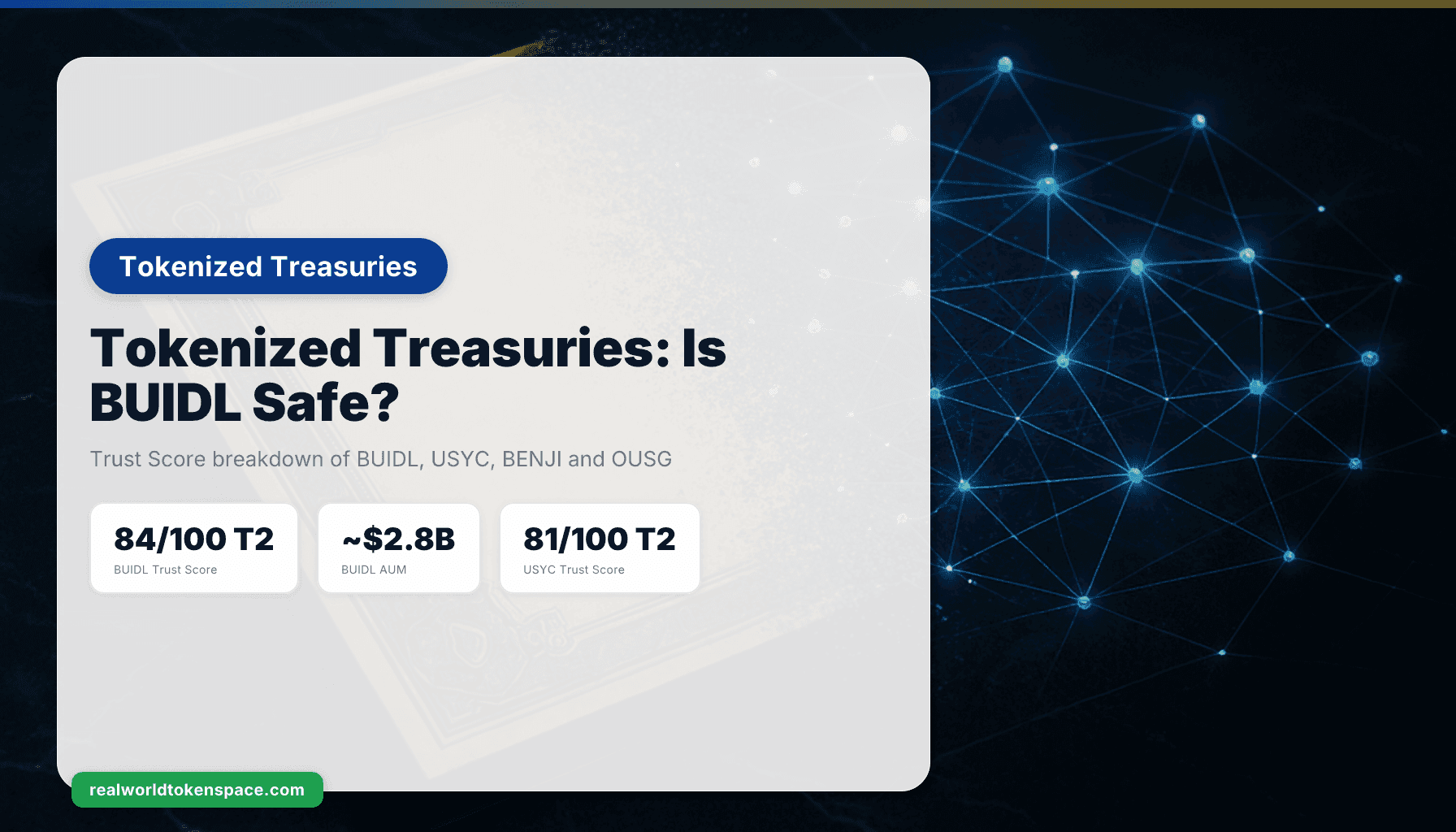
BUIDL rates T2 (84/100), the strongest score in our tokenized treasury coverage. The backing is conservative: BUIDL holds about Treasuries, overnight repos, and cash under management. Yield is a function of short-rate policy, not credit risk, BUIDL is a regulated investment product offering Treasury-bill yields, recently around 4.5-5.0% APY, with on-chain accessibility.
The constraint is access, not asset quality. BUIDL carries a high minimum and accreditation requirements, which keeps it an institutional product. Allocators who want a lower entry point route to alternatives like USYC at T2 (81/100) or USDY at T2 (81/100), the latter built for non-US retail access. None of these are interchangeable, and the score gaps reflect real differences in transparency, redemption mechanics, and operational maturity.
The macro frame
The yield case for tokenized treasuries strengthened, not weakened, this month. The dollar climbed to a one-year high after the Federal Reserve left rates unchanged but signaled a more hawkish outlook, with nine of the Fed's 19 policymakers now expecting at least one rate hike later this year. If the front end of the curve stays elevated, T-bill-backed products keep paying 4.5%-plus and the relative appeal of tokenized cash management holds. If the Fed reverses and cuts, those yields compress, the open variable here is the Fed's dot-plot at the next meeting.
The demand mix is what makes BUIDL structural rather than speculative. Stablecoin issuers represent a significant share of inflows as they seek yield on reserves, DeFi protocols use tokenized Treasuries as collateral, and corporate treasuries are increasingly allocating capital as part of cash management. That is three distinct buyer bases, not one fickle one.
What we'd watch next
If BUIDL holds its category lead while BlackRock layers on verification infrastructure, the T2 score has room to firm. If a competitor closes the transparency gap (Circle's USYC is the obvious candidate) the spread between these funds narrows and the comparison gets more interesting. For a fuller side-by-side on the lower-cost end of the category, see our companion analysis, OUSG vs USDY: Tokenized Treasury Comparison.
For the full category picture, our tokenized treasuries hub tracks every fund we score. RWTS isn't bullish or bearish on BlackRock, Circle, or Ondo. We're the credit-rating agency for tokenized real assets. We rate. You decide.
Related on RWTS
Stay Ahead of the Yield Curve
Subscribe to The Yield Report for weekly yield intelligence.
Subscribe Now