LBTC vs SolvBTC: which is safer?
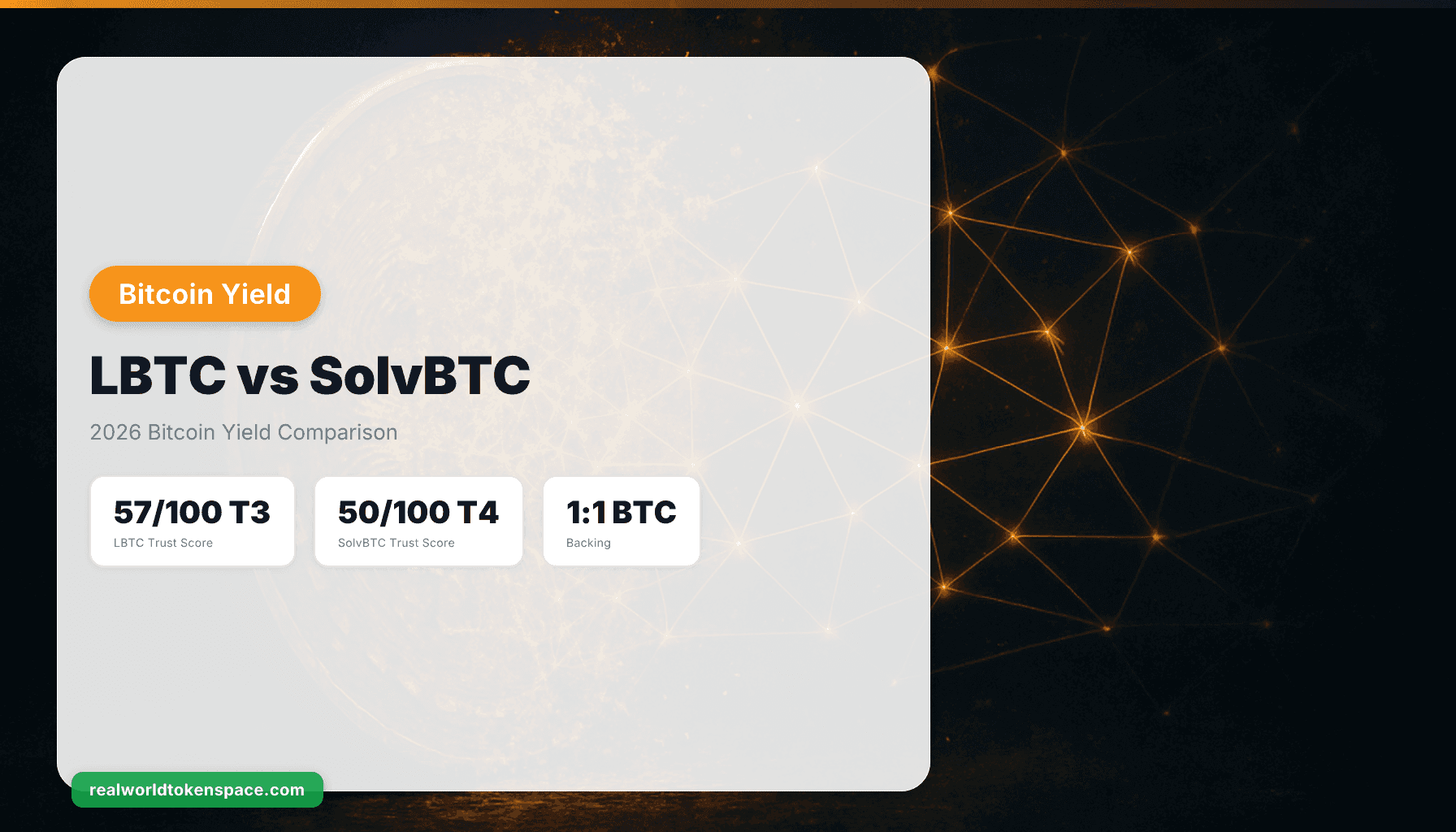
The verdict: on the RWTS Trust Score, LBTC scores T3 (59/100) and SolvBTC scores T4 (49/100). LBTC rates higher because it is a single, legible staking mechanism. SolvBTC is an aggregator, broader reach, but more moving parts to underwrite. Neither is investment-grade by our standards; both sit in the speculative tiers where the yield comes with real structural risk. We rate. You decide.
This comparison matters because Bitcoin yield is the fastest-growing and least standardized corner of the tokenized real-asset world. Two products can both call themselves "Bitcoin yield" and carry entirely different risk. The labels are similar; the plumbing is not.
What each token actually is
LBTC is Lombard's liquid staked Bitcoin. The mechanism is direct: BTC is staked through the Babylon protocol to provide economic security to proof-of-stake networks, and the holder receives a transferable token that accrues staking rewards. The directional claim has a clear "why", yield flows from validation rewards, not from a lending desk or a basis trade. That legibility is the core of its T3 (57/100) rating.
SolvBTC takes a different path. It is an aggregator that pools BTC and routes it across multiple underlying yield strategies. Aggregation is genuinely useful (it abstracts complexity and broadens reach) but every strategy added is another counterparty, another smart-contract surface, and another assumption the holder is implicitly underwriting. That is why SolvBTC sits at T4 (49/100): the product is harder to fully reason about from the outside.
Where the yield comes from, and the risk
The single most important question for any Bitcoin yield product is: where does the return originate, and what breaks it?
For LBTC, the dominant source is Babylon staking. The principal risk is slashing or a fault in the staking and bridging layer, plus the standard liquid-staking peg risk if redemption queues back up under stress. The risk set is bounded and nameable.
For SolvBTC, yield is a blend, which means the risk is a blend. If one underlying strategy impairs, the token absorbs it. Higher headline yield is not free, across our coverage, the extra basis points on aggregator products almost always price in extra strategy or counterparty risk. The mechanism naming gets murkier the deeper you go, and murk is precisely what the Trust Score penalizes.
The decision
If you want Bitcoin yield with the cleanest, most auditable mechanism of the two, LBTC at T3 (59/100) is the higher-rated choice. If you specifically want diversified strategy exposure in a single token and accept the added opacity, SolvBTC at T4 (49/100) does that, but read the rating as the warning it is.
A note on framing: both products are wrapped Bitcoin yield instruments, and neither approaches the structural soundness of a top-rated allocated holding. For perspective on how Bitcoin yield mechanics actually function, see our primer How Bitcoin Yield Works: Wrapping, Restaking, Lending, and browse the full rated set on our Bitcoin yield hub.
The humility variable here is depeg behavior under stress. If LBTC and SolvBTC both hold their peg through a sharp BTC drawdown and redemptions clear cleanly, both theses survive. If redemption queues lengthen, the lower-rated product is the one more likely to trade at a discount, that is what the tier gap is telling you in advance.
RWTS isn't bullish or bearish on Bitcoin or any yield token. We're the credit-rating agency for tokenized real assets. We rate. You decide.
Related on RWTS
Stay Ahead of the Yield Curve
Subscribe to The Yield Report for weekly yield intelligence.
Subscribe Now